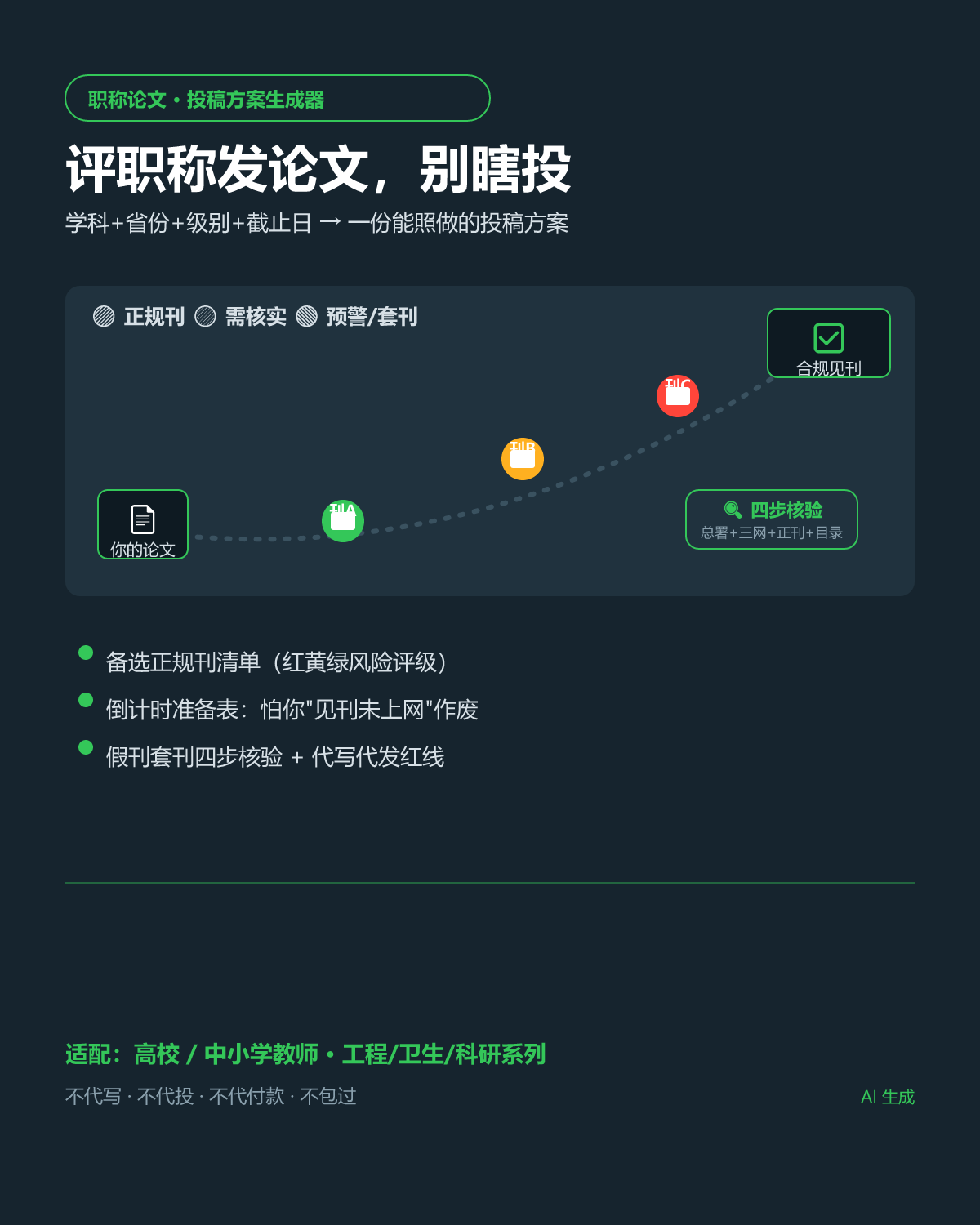
Title Paper Submission Planner
Journal selection, verification, and timeline
Title Paper Submission Planner
Journal selection, verification, and timeline
Showcase
Description
Enter your academic field, province, title series and level, paper word count, budget, and title evaluation deadline to generate an actionable professional title paper submission plan. It includes a curated list of legitimate journals with red/yellow/green risk ratings, a submission decision comparison table, a countdown preparation table, and a plagiarism check and budget breakdown. It also features a built-in four-step verification guide for fake or duplicated journals and compliance warnings against writing agencies and proxy submissions. Suitable for university and K-12 faculty members, as well as researchers, engineers, healthcare workers, and agricultural professionals planning journal submissions for career advancement.
Recommended by
Dancang
Why we love this skill
Turns professional title paper submissions from guesswork into a verifiable, scheduled, and trackable execution plan, helping users systematically avoid publishing traps.
Best for
Ideal for university and K-12 teachers, as well as professionals in research, engineering, healthcare, and agriculture applying for professional titles.
How to use this Skill
Provide your input
Provide your discipline, province, professional series and level, word count, budget, submission deadline, and institutional evaluation guidelines if available.
Run the Skill
The system matches your criteria to identify target journals, compare timelines, and highlight legitimacy verification, schedule buffers, and compliance risks.
Review your result
Receive a professional title paper submission plan, including journal lists, risk ratings, decision comparison, countdown schedule, plagiarism budget, and verification checklist.
Related Skills
View all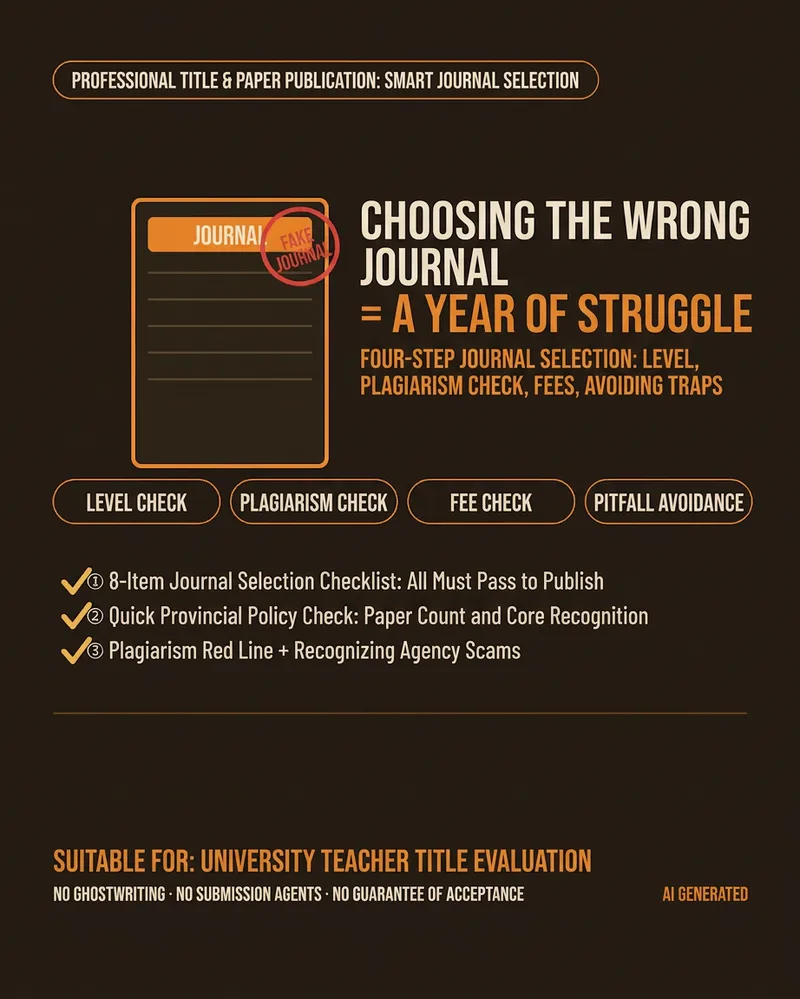 Research
Teacher Promotion Journal Screener
A journal selection and risk-screening assistant designed for primary, secondary, vocational, and university teachers publishing promotion papers. Triggered when a user provides a journal name or intermediary recommendation and asks questions about policy recognition, fake or duplicate journals, electronic journals, similarity thresholds, page fees, guaranteed publication claims by intermediaries, core journal requirements, SCD recognition, or database queries (CNKI, Wanfang, VIP). Uses the Four-Gate Selection Method (Verification, Inquiry, Targeting, Boundary) to output a journal selection checklist, provincial policy quick-reference card, and similarity/pitfall card. Does not ghostwrite or submit on your behalf. 1. Struggling to distinguish between real, fake, duplicate, or electronic journals for your promotion? Worried about intermediary scams, unrecognised publications, or failing similarity checks? This assistant uses the "Four-Gate Selection Method" to screen your journal options item by item. 2. Input your "province + school level + target level + journal name" to receive three core deliverables: ① Journal Selection Checklist (8 items to check off); ② Province Policy Quick-Reference Card (number of papers required, core requirements, recognition of SCD/electronic journals); ③ Similarity Red Line & Pitfall Card (similarity threshold, AIGC red lines, intermediary scam recognition tips). 3. No ghostwriting, no proxy submission, no guarantee of passing. Focuses strictly on identification and quality control. Policies are subject to official provincial/institutional documents of the reporting year, and outputs are marked "AI-assisted generation, please verify".
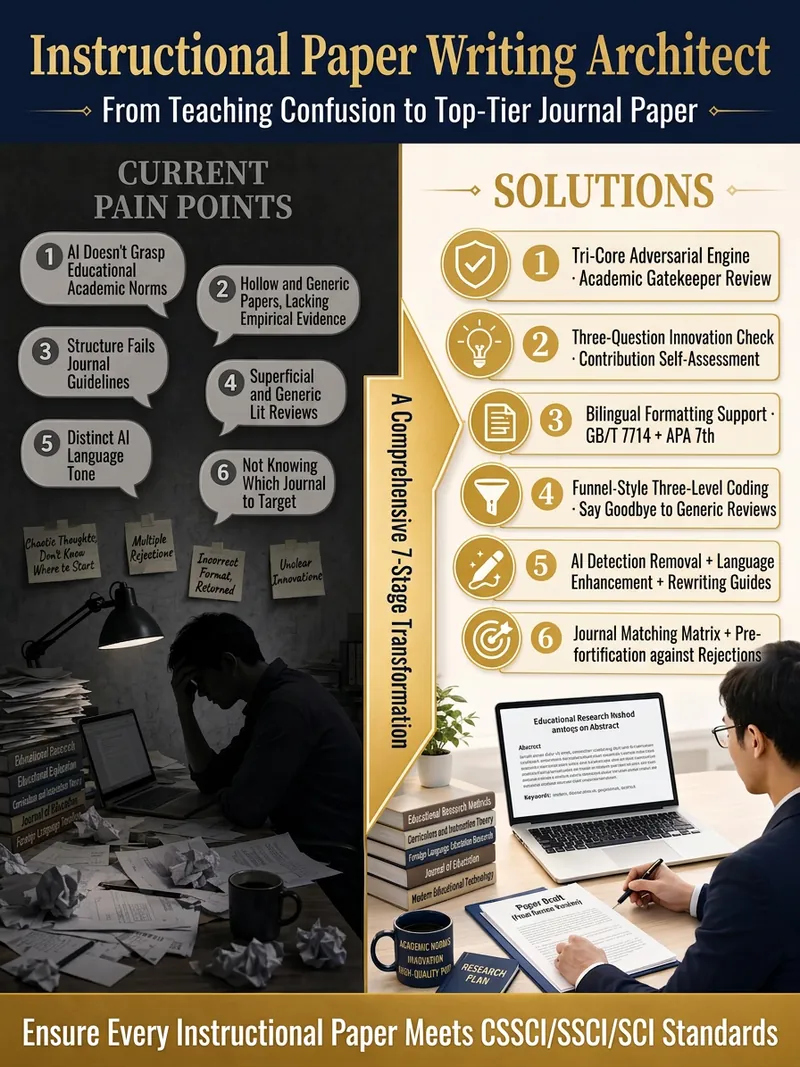
Teaching Paper Architect
From teaching research accumulation to CSSCI/SSCI/SCI — making every teaching paper stand up to peer review. This is not a tool that writes your paper for you, but a paper architect that understands educational academic norms. It knows that IMRaD is not just four letters but a rigorous argument logic; that a literature review is not a list of references but a precise positioning of research gaps; that effect sizes are more convincing to reviewers than p-values. Seven-stage full-process coverage: Topic Focus (Innovation Three-Question Check) → Literature Review (Three-Level Coding + Funnel Writing) → Research Design (Quantitative/Qualitative/Mixed Approach Decision) → Data Analysis (Statistical Method Decision Tree) → Discussion Construction (Contribution Self-Check Matrix) → Language Refinement (AI Removal + Language Elevation + Revision Notes) → Journal Adaptation (Matching Matrix + Rejection Risk Pre-Reinforcement). Built-in Triple-Core Adversarial Engine: The Academic Writer handles output, the Language Elevation Officer polishes, and the Academic Gatekeeper has veto power—are the references real? Is the data reliable? Is the argument grounded in evidence? Does the contribution match the target journal level? Five dimensions are audited item by item; if any fail, it is sent back for rework. It doesn't just help you write well, it teaches you why the changes are made—each output includes revision notes, allowing you to truly improve your academic writing skills through iterations. Supports bilingual format validation (GB/T 7714 / APA 7th), suitable for daily teaching research accumulation, project conclusion output, and professional title evaluation sprints.
 Research
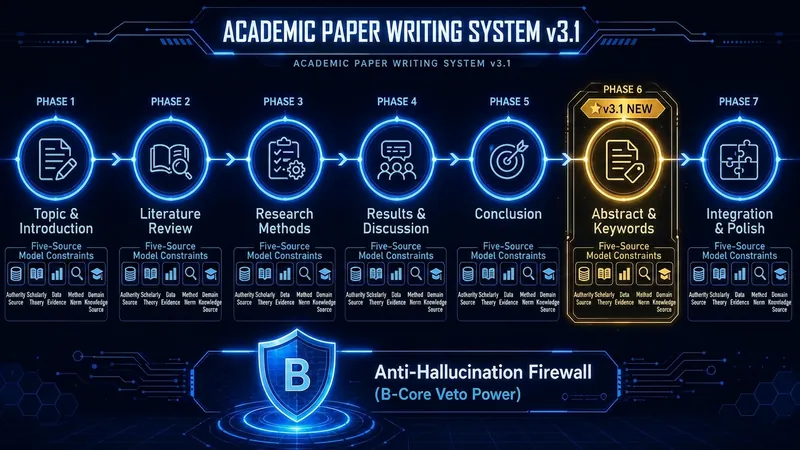
Academic Paper Writing v4.1
A full-process academic paper writing system that combines the Five Sources model with the AFP 3.1 three-layer architecture. Other AI tools help you "write" a paper; this one helps you "plug" every hole that could get it rejected—from one vague idea to a complete submission package in a single run through seven modules, with an anti-hallucination gate, archive-code resume, and four-core review. [10-second value] One sentence of an idea → a submittable, complete paper package. Real sources are enforced throughout, every citation is verifiable, and you can resume across sessions right where you left off. [Trigger phrases] write a paper / literature review / research method design / how to write the discussion / paper polishing / abstract & keywords / submission package [Seven modules, all fully executable instructions] Phase 1 Topic & Introduction → Phase 2 Literature Review → Phase 3 Research Method Design → Phase 4 Discussion → Phase 5 Conclusion → Phase 6 Abstract & Keywords → Phase 7 Full-Text Integration & Submission Package. Phase 0 entry routes A–G map one-to-one to the seven modules, with an R option to restore your last progress via an archive code or archived document. [v4.1 upgrades] 1. Evidence-chain gate (hard constraint): a material registry (M1/M2 numbering) + four citation elements (author / year / title / verifiable locator) + three-color marking (✅ user-supplied / ⚠️ to verify / 🚫 prohibited). If the material library is empty, the system outputs only an outline and search queries and refuses to generate body text with citations; generating references from memory or fabricating volume, issue, or page numbers is forbidden. 2. Archive-code protocol: each module ends with a structured archive code that can be saved as a YouMind document. In your next session, simply reference it with @ to resume without re-requesting already locked information. 3. Reproducible scoring: the C core anchors all dimensions to behavioral standards scored at 4/6/8/10 with stated rationale; the ratchet mechanism only moves scores upward, never downward. 4. Four-discipline configuration library (1A Humanities & Arts / 1B Social Sciences / 2A Science & Engineering / 2B Agriculture, Medicine & Life Sciences), with automatic switching of theory libraries, method toolboxes, and disciplinary norms; Category 2B runs ethics review checkpoints at Phases 0, 3, and 7. 5. Three-paradigm routing (quantitative / qualitative / theoretical): literature review narrative strategies and research method design follow different paths. 6. Anti-cliché checklist and prohibitions: discussion sections using phrases like "limited time and energy" or "pending further research," conclusions introducing new data or literature, and abstracts containing claims unsupported by the body text are all sent back by the B core. 7. Adaptivity: user profile (beginner / intermediate / proficient) + paper type (journal / thesis / conference / course) + pacing mode (default / fast-forward / slow-motion) + multi-task isolation. 8. Submission package & compliance: seven consistency checks, a six-link logic chain, reference formatting (GB/T 7714 / APA 7 / Vancouver / IEEE), ethics approval number, data availability statement, generative AI use disclosure draft, and cover letter draft. [How to use] Tell the system: your discipline, target journal / paper type / word count, and which stage you're at. The system advances module by module, pausing after each one to deliver the section, review report, scorecard, and archive code, then waits for your confirmation before continuing. [Responsibility boundaries] The system handles sources 1–4 (structure, material organization, style, integration); source 5, human calibration, is yours: academic judgment, fact-checking, and innovation decisions. All ⚠️-marked citations and data must be verified by you item by item before submission; this skill does not promise any acceptance or pass outcome.
Information
- Version
- v3
- Last updated
- Runtime credits
- Usage-based
- Models
- Auto
- Use cases
- Research & analysisCareer development
- What you get
- ReportPlanData