Teacher Promotion Journal Screener
Check journals and submission risks for teachers
Teacher Promotion Journal Screener
Check journals and submission risks for teachers
Showcase
Description
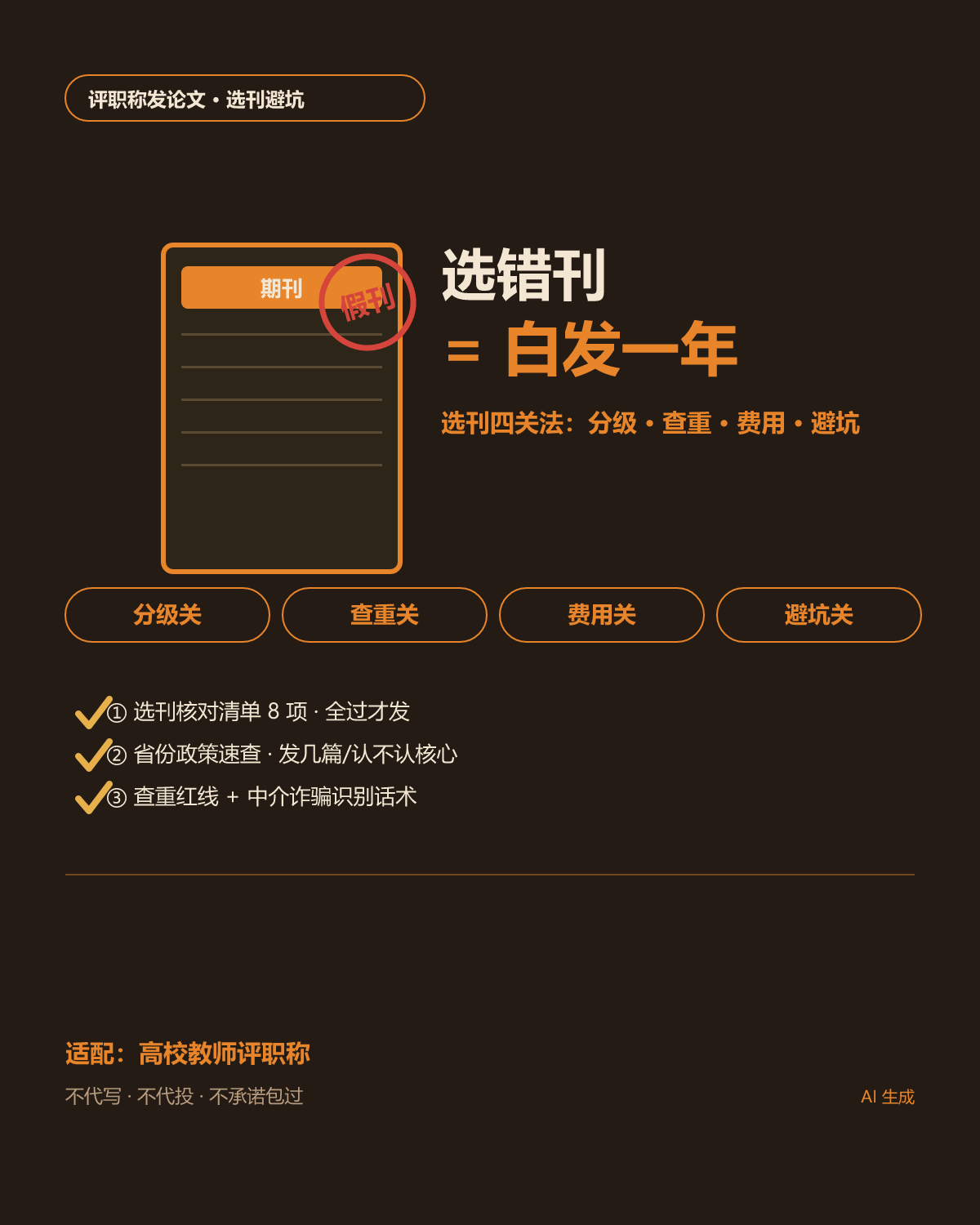
A journal selection and risk-screening assistant designed for primary, secondary, vocational, and university teachers publishing promotion papers. Triggered when a user provides a journal name or intermediary recommendation and asks questions about policy recognition, fake or duplicate journals, electronic journals, similarity thresholds, page fees, guaranteed publication claims by intermediaries, core journal requirements, SCD recognition, or database queries (CNKI, Wanfang, VIP). Uses the Four-Gate Selection Method (Verification, Inquiry, Targeting, Boundary) to output a journal selection checklist, provincial policy quick-reference card, and similarity/pitfall card. Does not ghostwrite or submit on your behalf. 1. Struggling to distinguish between real, fake, duplicate, or electronic journals for your promotion? Worried about intermediary scams, unrecognised publications, or failing similarity checks? This assistant uses the "Four-Gate Selection Method" to screen your journal options item by item. 2. Input your "province + school level + target level + journal name" to receive three core deliverables: ① Journal Selection Checklist (8 items to check off); ② Province Policy Quick-Reference Card (number of papers required, core requirements, recognition of SCD/electronic journals); ③ Similarity Red Line & Pitfall Card (similarity threshold, AIGC red lines, intermediary scam recognition tips). 3. No ghostwriting, no proxy submission, no guarantee of passing. Focuses strictly on identification and quality control. Policies are subject to official provincial/institutional documents of the reporting year, and outputs are marked "AI-assisted generation, please verify".
Recommended by
Dancang
Why we love this skill
Using a four-step selection framework, this Skill turns journal selection from guesswork into a verifiable checklist. It cross-references provincial and institutional policies to identify duplicate or fake journals, scam tactics, and plagiarism risks, making it ideal for pre-submission risk management.
Best for
Ideal for teachers who need to verify journal compliance, institutional recognition, and submission risks for promotion papers.
How to use this Skill
Provide your input
Enter your province, school level, target title, journal name, known ISSN/CN, indexing claims, pricing, and submission channel, plus your institution's recognition scope and similarity requirements.
Run the Skill
Checks journal authenticity, registration and indexing, institutional policy matching, similarity, and submission risks, highlighting items that need further confirmation.
Review your result
Generates a journal selection checklist, province and institution policy quick-reference card, and similarity, AIGC, and intermediary risk warnings.
Related Skills
View all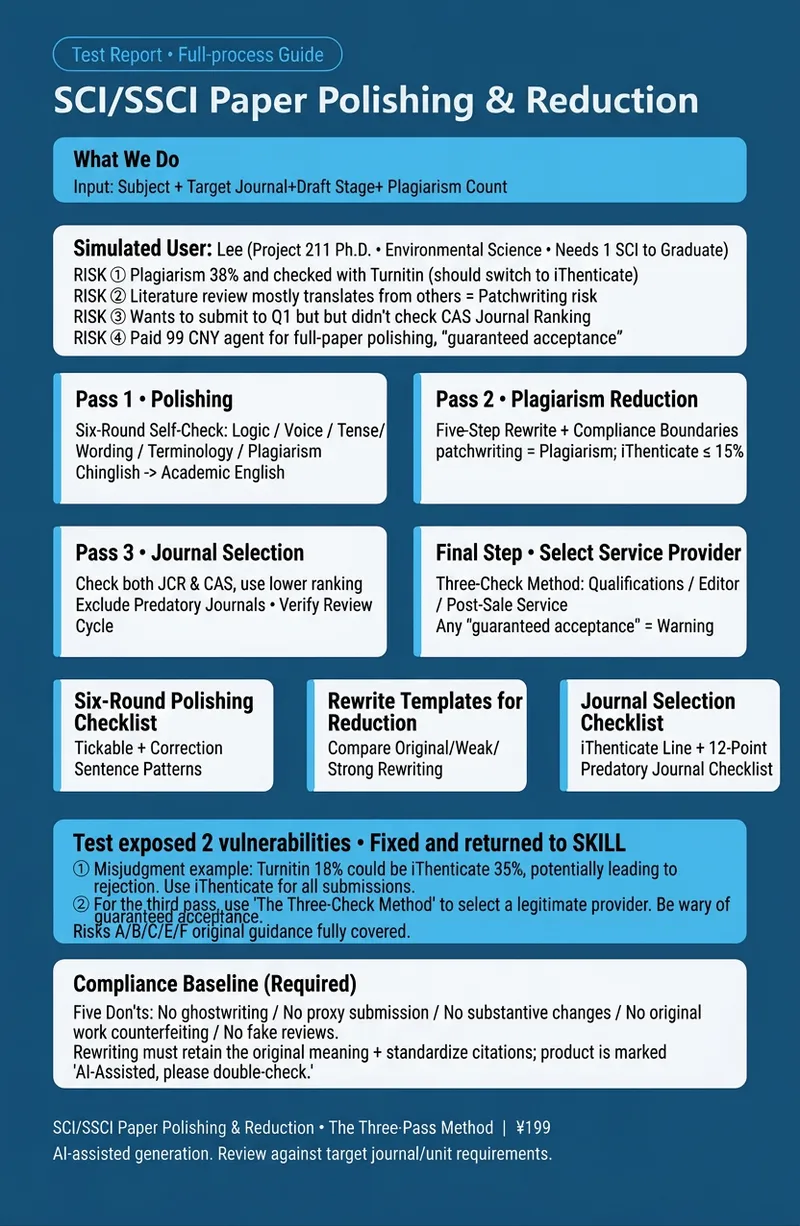 Write
SCI Paper Polishing
An assistant for graduate students and university faculty to polish English SCI/SSCI papers, paraphrase to reduce similarity, and vet target journals. Triggered when users submit English drafts or ask about fixing Chnglish, handling high similarity scores, writing paraphrases to avoid plagiarism, avoiding predatory journals, choosing editing services, or overcoming language-based rejections. It uses the "Three-Stage Polishing and Similarity Reduction Method" to generate a checklist, compliant rewriting templates, and a journal verification card. Does not write or submit papers, nor alter substantive content. 1. Finished your SCI/SSCI manuscript but struggling with severe Chnglish, high similarity scores, or fear of predatory journals? This assistant uses the "Three-Stage Method" (six-round polishing / five-step similarity reduction / journal pitfalls avoidance) to help you prepare your draft for submission and select the right journal. 2. Input your "discipline + target journal + draft stage + similarity percentage" to get three core deliverables: (1) Six-round polishing self-check checklist (with common errors and corrected sentence patterns); (2) Paraphrasing templates (original sentence / light rewrite / heavy rewrite comparison); (3) Journal verification card (iThenticate safety thresholds, 12-point predatory journal check, and JCR/CAS dual-index lookup). 3. Strictly optimizes language expression only—does not write or submit papers, nor alter substantive content (data/conclusions). Strictly adheres to academic integrity principles. All outputs are marked with "AI-assisted generation, please review against target journal or institution requirements."
Teaching Paper Architect
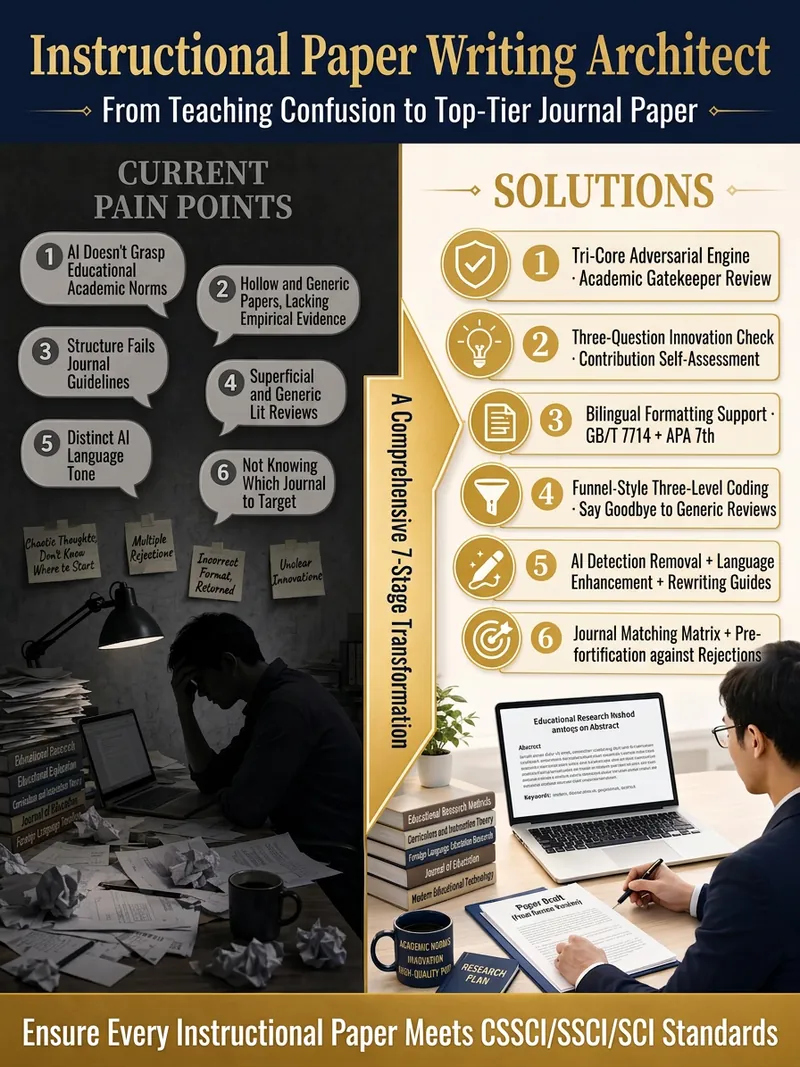
From teaching research accumulation to CSSCI/SSCI/SCI — making every teaching paper stand up to peer review. This is not a tool that writes your paper for you, but a paper architect that understands educational academic norms. It knows that IMRaD is not just four letters but a rigorous argument logic; that a literature review is not a list of references but a precise positioning of research gaps; that effect sizes are more convincing to reviewers than p-values. Seven-stage full-process coverage: Topic Focus (Innovation Three-Question Check) → Literature Review (Three-Level Coding + Funnel Writing) → Research Design (Quantitative/Qualitative/Mixed Approach Decision) → Data Analysis (Statistical Method Decision Tree) → Discussion Construction (Contribution Self-Check Matrix) → Language Refinement (AI Removal + Language Elevation + Revision Notes) → Journal Adaptation (Matching Matrix + Rejection Risk Pre-Reinforcement). Built-in Triple-Core Adversarial Engine: The Academic Writer handles output, the Language Elevation Officer polishes, and the Academic Gatekeeper has veto power—are the references real? Is the data reliable? Is the argument grounded in evidence? Does the contribution match the target journal level? Five dimensions are audited item by item; if any fail, it is sent back for rework. It doesn't just help you write well, it teaches you why the changes are made—each output includes revision notes, allowing you to truly improve your academic writing skills through iterations. Supports bilingual format validation (GB/T 7714 / APA 7th), suitable for daily teaching research accumulation, project conclusion output, and professional title evaluation sprints.
Journal Fit Advisor
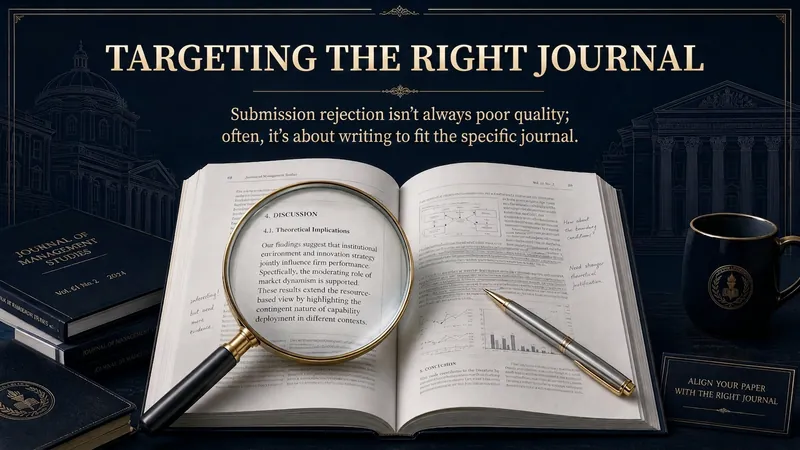
Rejected? It's not necessarily bad writing—it's not writing like this journal. 「Journal Fit Advisor」doesn't boast about the journal's ranking. It does one thing: break down real samples from your target journal, show you exactly what it prefers, and help you revise your paper paragraph by paragraph to fit better. 🎯 How it helps Submit a target journal → Extracts real preferences across six dimensions: topic, structure, theory, methodology, language, argumentation → Diagnoses where your paper falls short → Provides actionable rewrites (2-3 versions each for title, abstract, introduction, conclusion). ✨ Why trust it • Each preference is labeled with evidence level: official statement (A), sample inference (B), cautious guess (C). If it's a guess, it says so. • Cross-checked for uniqueness: every feature asks 'Do other similar journals do this too?' Only retains true differentiators. • No fabrication: no fake impact factors, no fake acceptance rates, no promises of acceptance. Lowers confidence if material is insufficient. • Plus a 'Journal Style Prompt Card' – copy and paste into any LLM to instantly write in that journal's style. 💬 How to use it ·“Analyze the topics and writing style of Journal XX over the last three years” ·“I want to submit to Journal XX – run a submission fit diagnosis for me” ·“Rewrite my abstract to sound more like Journal XX” ·“How long are titles in Journal XX typically?” (quick answer for short questions) 👥 Who it's for: graduate students, early-career researchers, authors wanting to self-check before submission. ⚠️ Boundaries: It provides observable style analysis, not the editor's true thoughts, nor a guarantee of acceptance. Cross-journal topic selection, pure title polishing, and chapter ghostwriting will be redirected to more appropriate tools.
Information
- Version
- v3
- Last updated
- Runtime credits
- Usage-based
- Models
- Auto
- Use cases
- Research & analysisCareer development
- What you get
- ReportDocument