
Multi-Agent Event Predictor
Multi-Agent Event Predictor
Showcase
Description
Multi-Agent Event Predictor - By simulating social media interactions of target market users, it proactively identifies cultural, religious, and political taboo scenarios that may be triggered by product feature launches, and generates targeted testing suggestions.
Related Skills
View all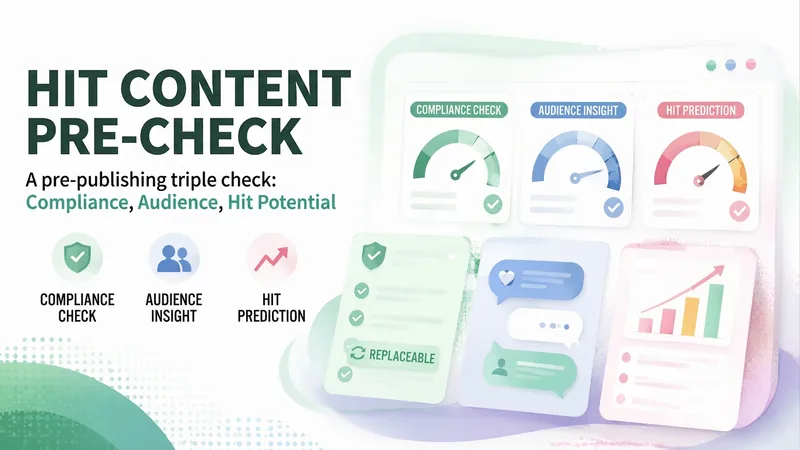 Write
Social Content Precheck
Before publishing on WeChat Channels, WeChat Official Accounts, Douyin, Xiaohongshu, Kuaishou, Bilibili, Zhihu, Weibo, or other platforms, get a precheck covering compliance risks, audience response, and reach potential. Whether it is a short-video script, image-and-text post, WeChat Official Account article, Moments copy, livestream script, or direct-message script, the precheck starts with the original text, identifies the platform, category, target audience, and publishing goal, then flags risks such as performance promises, absolute claims, restricted areas in regulated industries, and inducements to move users off-platform. The precheck uses traceable, up-to-date rules to flag high-, medium-, and low-risk wording line by line, explain the basis for each judgment, and provide ready-to-use replacement copy that preserves the original tone and rhythm. It also highlights differences in review standards across platforms. For the target audience, it simulates reactions in the first three seconds or at the start of reading, generates authentic-sounding comments showing support, skepticism, and backlash, and identifies the sentence most likely to attract criticism. For reach evaluation, the Skill provides explainable scores based on the hook, emotion, information gain, identity, quotability, likelihood of being read or watched to completion, and path to action. It gives platform fit, probability ranges, and the highest-priority changes. The final delivery includes an in-chat overview and a full report, helping you quickly decide whether to publish as is, publish after revisions, or rewrite—and provides a clean version of the copy for retesting.

Cosmic Insight
Automatically searches multiple platforms for news in finance, tech, or business topics, filters preliminary and core clues, and uncovers related events within 10 years to output a structured topic analysis report. Step 1: Multi-Source Information Collection - Search news from the past 30 days covering WeChat official accounts, Wall Street CN, 36Kr (high weight), Huxiu, Xueqiu, TMTpost (standard weight) - Record title, time, platform, summary, original links - Initially filter duplicates, ads, and low-credibility content Step 2: Information Deduplication and Aggregation - Aggregate the same event by core object, core fact, and time window (within 7 days) - Count how many independent sources mention it - Remove low-value events, output a candidate event list Step 3: Event Analysis and Clue Classification Preliminary clues (any one): abnormal events, high discussion (more than 3 sources), unusual changes, major industry milestones, negative news about large companies Core clues (2 or more): dramatic conflict, room for meaning exploration, more than 3 entities, timeliness (within 14 days) - At least 5 core clues, total 10-25 clues - Each clue includes: event title, summary, deep analysis of writing value, criteria met Step 4: Deep Association Mining - Expand search scope to 10 years - Extract key entities, search: historical nodes of the subject, industry policy evolution, competitor dynamics over the same period, upstream and downstream industry chain changes - Include any association, note association type and year Step 5: Structured Output Output includes: 1. Core clues block; 2. Preliminary clues block; 3. Research suggestions Each clue includes: event overview, criteria met, deep writing value analysis, related events (10-year history), reference links Tools: Web search, long document generation Reference resources: None fixed; user can attach at input.
 Research
Niche AI Product Radar
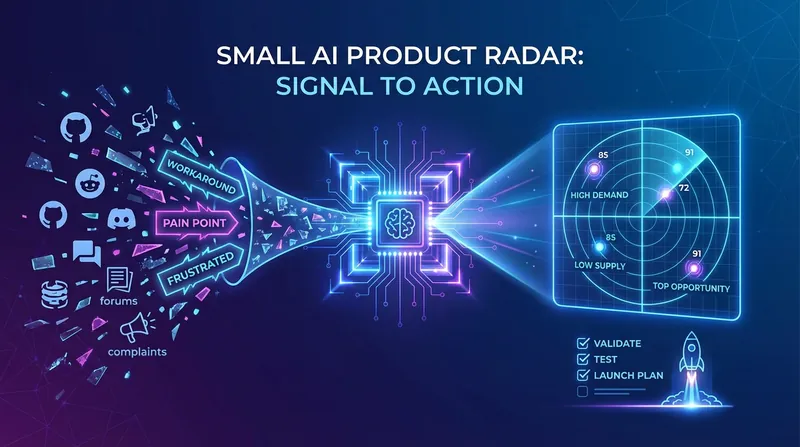
A systematic engine for discovering niche AI product opportunities, v3.1. It combines the mathematical rigor of v2.0 with the execution methodology of App Gold Mining: a five-level anchor scale and logarithmic demand-intensity scoring, category-weighted supply scarcity, signal time-decay functions, competitive response and platform-risk game analysis, and a Bayesian prior-to-posterior validation framework. v3.1 adds the SonarPing supply-side detection layer, incorporating its daily scans of new AI products, elimination of wrapper and lookalike products, hands-on testing, and time-series snapshot data. It filters out ineffective competitors from nominal supply, calculates the effective supply rate, new-product entry speed, and deactivation speed, and upgrades the static half-life into a dynamic opportunity window driven by real supply flows. It integrates data from 130+ Chinese Twitter creators, Chinese-language communities, and payment behavior as high-quality demand signals, helping indie developers identify low-competition, high-pain-density opportunities in AaaS and B2C subscription products, and produces actionable radar reports and promotion-channel matrices.
Information
- Version
- v3
- Last updated
- Runtime credits
- Usage-based
- Models
- Auto