
Bar Exam Subjective Mastery
Frameworks, scoring checklists, and time plans
Bar Exam Subjective Mastery
Frameworks, scoring checklists, and time plans
Showcase
Description
A response framework generator for the legal professional qualification subjective exam. Triggered when you provide the subject, case excerpt, and remaining preparation time, or ask about structuring answers, writing conclusions, criminal law perspective displays, civil law request bases, administrative law legality review, statute citation formats, time management, scoring points, or elective selection. It uses the Three-Pass Method (Structure Pass, Scoring Pass, Time Pass) to produce subject response framework templates, scoring point checklists, and timed training plans. It does not leak exam questions, guarantee a passing grade through predictions, or provide official past exam answers. 1. Passed the objective exam but stuck on the subjective exam due to poor structuring, missed scoring points, time management, or elective indecision? This assistant uses the Three-Pass Method to break down the answer logic for the 240-minute exam and scoring thresholds into reusable frameworks. 2. Input your progress, most challenging subject, remaining time, and computer-based open-book awareness to receive three core deliverables: ① subject response framework templates (7-subject skeleton, conclusion-first format, essay four-step structure); ② scoring point checklists (conclusions, rule of law thought terms, perspective displays, full statute names, 11 types of score-deduction pitfalls); ③ timed training plans (three-stage method, time allocation table, circuit-breaker strategy, one-page statute localization). 3. Provides response frameworks, scoring logic, and training methods only; **does not leak exam questions, guarantee passing through predictions, or provide official past exam answers** (as the Ministry of Justice does not release them). Any claim that you can bring paper statutes into the exam room contradicts official rules—the exam is computer-based with built-in searchable electronic statutes. Outputs include the note: "Generated by AI; please refer to official materials and the year's actual exam questions."
Recommended by
Dancang
Why we love this skill
Tackles bar exam subjective test challenges using the Three-Gate Method (Structure, Scoring, Time). It generates actionable plans tailored to each subject and remaining time, covering everything from conclusion-first frameworks to scoring keywords, pitfalls, and timed training.
Best for
Suitable for candidates preparing for the legal profession qualification subjective exam who need to improve answer structure, point coverage, or timed writing.
How to use this Skill
Provide your input
Provide your study stage, focus subjects or weak areas, remaining time, and whether you are familiar with computer-based electronic statute search; you can also include case excerpts.
Run the Skill
Based on your information, it generates the response structure for the corresponding subjects, outlines common scoring points and deduction risks, and arranges timed training and time allocation.
Review your result
Receive reusable response frameworks, scoring checklists, and phased training plans to assist with your subjective exam preparation.
Related Skills
View all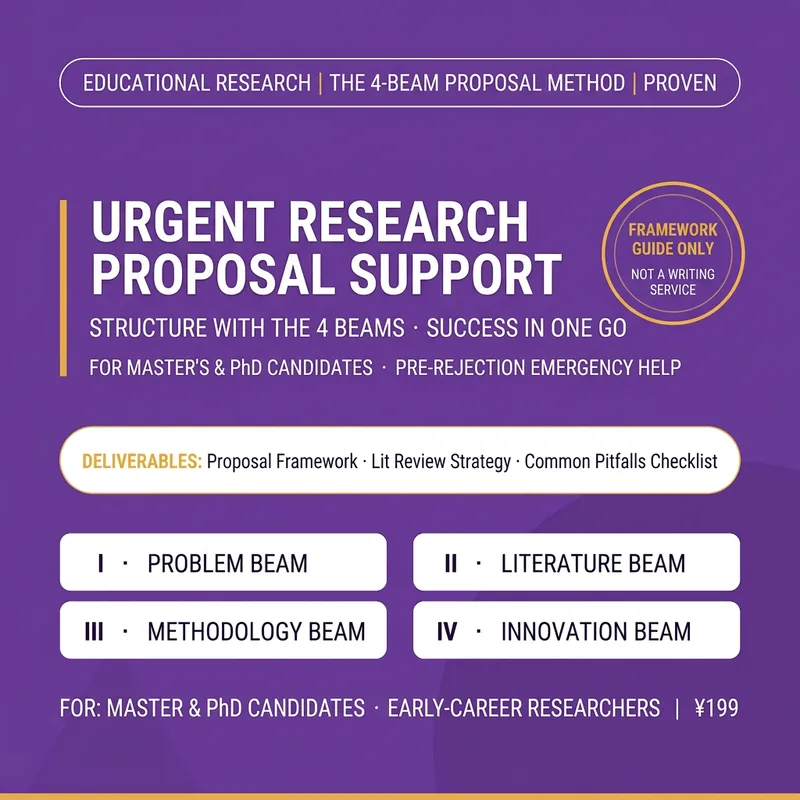
Education Proposal Four-Pillar Framework
An emergency proposal assistance skill for education graduate students and young researchers, using the vertical Four-Pillar Proposal Method. Triggers when users ask how to write an education thesis proposal, how to design education research, what to do if a proposal is rejected, how to structure a literature review, how to formulate research questions, or how to handle advisor misalignment. Uses the Four-Pillar Method (Problem Pillar / Literature Pillar / Methodology Pillar / Innovation Pillar) to generate a proposal skeleton, a literature search strategy table, and a rejection risk checklist. Version 1.0.0. * **One-Sentence Positioning** Your personal proposal skeleton generator: turns loose directions, piled-up literature, mismatched methods, and empty innovation points into four solid pillars—problem, literature, methodology, and innovation—plus advisor alignment checks, making your proposal robust rather than a word count exercise. **How to Use - The Four-Pillar Method** 1. Problem Pillar: Three cuts to narrow the direction (lock the target / set the perspective / draw boundaries), with main and sub-questions ready to use. 2. Literature Pillar: Avoid piling up; build a map by context, school of thought, debate, or gap to pinpoint your research gap. 3. Methodology Pillar: Match quantitative, qualitative, or mixed methods by disciplinary paradigm, including red flags like IRB prerequisites. 4. Innovation Pillar: Choose one from theory, perspective, method, or target, grounding it in how it differs from existing work. 5. Closing: Advisor alignment check to connect your lens back to your advisor's framework, preventing rejections due to drifting off course. **What You Receive** A proposal skeleton (four pillars filled out cell by cell), a literature search strategy table (databases + keywords + tracing), and a rejection risk checklist (top 8 reasons + avoidance tips), ready to be expanded into a full proposal. **Compliance Disclaimer** This skill does not ghostwrite complete proposals or papers; it only generates frameworks and checklists. It does not fabricate literature or data, clearly labels AI generation, requires original literature verification, does not guarantee approval, prioritizes offline confirmation for ethics reviews and advisor conflicts, and defers to institutional formats and advisor opinions.
 Write
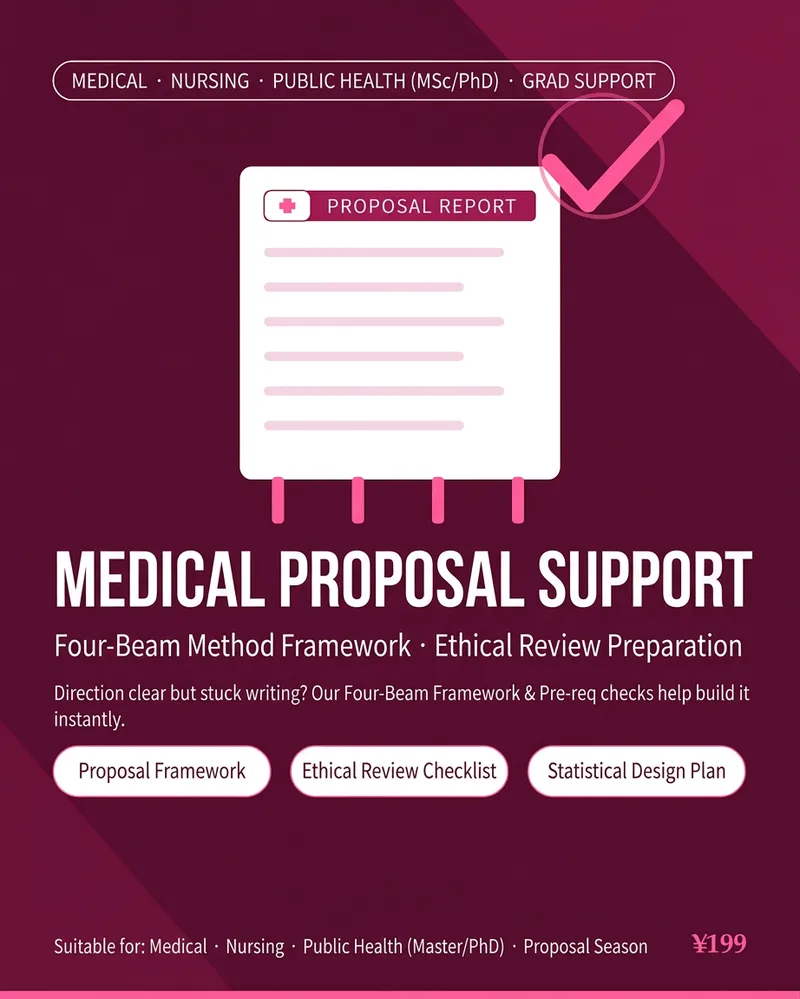
Medical Proposal Rescue
Designed for master's, doctoral, and resident physicians in medicine, nursing, and public health facing urgent proposal deadlines. Triggered when users ask how to write a medical proposal, recover from a rejected clinical topic, structure a literature review, calculate sample sizes, pass ethics reviews, handle clinical registration, or resolve mentor alignment issues. It uses the Four-Pillars Method (Problem, Literature, Methodology, Innovation) along with medical-specific additions (IRB ethics, clinical registration, accessibility, and statistical design) to generate a proposal skeleton, ethics and registration checklist, and statistical design table. Version 1.0.0. - **Pain Points**: Struggling to write a proposal despite having a direction, or facing rejection over ethics, registration, or sample size. - **Method**: The Four-Pillars Method combined with dual prerequisites (IRB ethics and ChiCTR clinical registration) to build a solid proposal skeleton. - **Deliverables**: A three-part package including a proposal skeleton, an ethics and registration checklist, and a statistical design key points table.
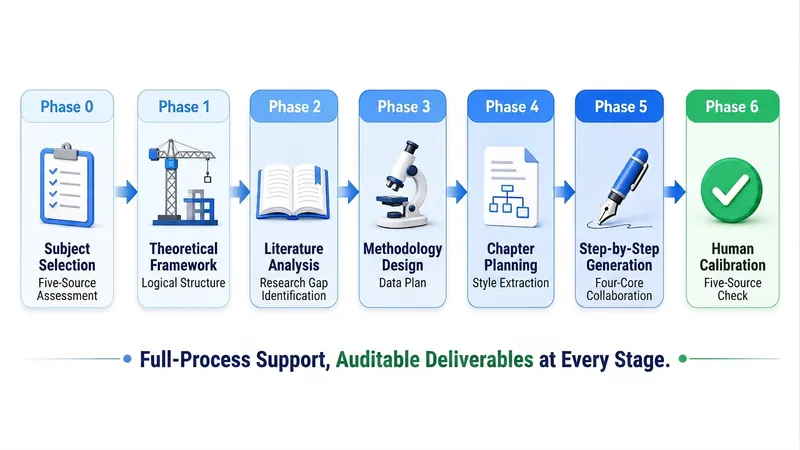
Proposal Readiness Checker
Before you spend dozens of hours writing your thesis, take ten minutes to run a structured checkup. This skill does only one thing: It diagnoses, not writes. It tells you whether your topic can hold up, whether your materials are sufficient, what's missing, where to fill the gaps, and in what order. Then it gives you an actionable missing-material checklist and search queries. It will not write your introduction, literature review, methods, or discussion. Four steps: 1. Discipline diagnosis: Classify your work into 1A Humanities/Arts, 1B Social Sciences, 2A Science/Engineering, or 2B Agriculture/Medicine/Life Sciences, and load the corresponding regulatory red lines; 2B triggers a mandatory ethics review block. 2. Topic checkup: Examine the topic from three dimensions—momentum, shape, and wording—to judge whether the research unit can be operationalized, whether the research question can be answered, and whether the topic has been done to death. 3. Material checkup: Register your existing literature into an M1/M2… material library, verify each entry against the four elements (author/year/title/verifiable locator), and compute the true coverage rate. 4. Gap list and search queries: Specify how many papers of what type are missing and which piece of evidence is lacking, and provide search queries ready to paste into databases (including Boolean keyword combinations, time ranges, and screening criteria). When to use it (trigger phrases): "Help me check my proposal" "Can this topic work?" "Do I have enough literature?" "My proposal was sent back" "I want to confirm before starting to write" — for graduate students who have just set a direction but haven't started writing; for those whose proposal was rejected but don't know why; for those with a pile of literature but unsure if it's enough to begin; for those wanting to confirm whether the topic is worth the investment before committing fully. Deliverables: A Proposal Checkup Report document + a Five-Source Readiness Scorecard (each level has behavioral criteria, not vague scoring) + a prioritized list of missing materials + search queries + an archive code. The archive code is compatible with the Academic Paper Full-Process Writing System v4.0; after the checkup, paste it there to continue writing without re-stating your discipline, topic, or journal. What this skill explicitly does not do: It does not write the main text, generate reference lists, or fabricate authors, years, volumes, issues, pages, or DOIs. Any literature found via online search is flagged with ⚠️ "needs verification" and must be verified by you before use. This skill does not promise any acceptance or passing outcome.
Information
- Version
- v3
- Last updated
- Runtime credits
- Usage-based
- Models
- Auto
- Use cases
- Learning & education
- What you get
- DocumentPlan