GPT Image 2
View full prompt & copy
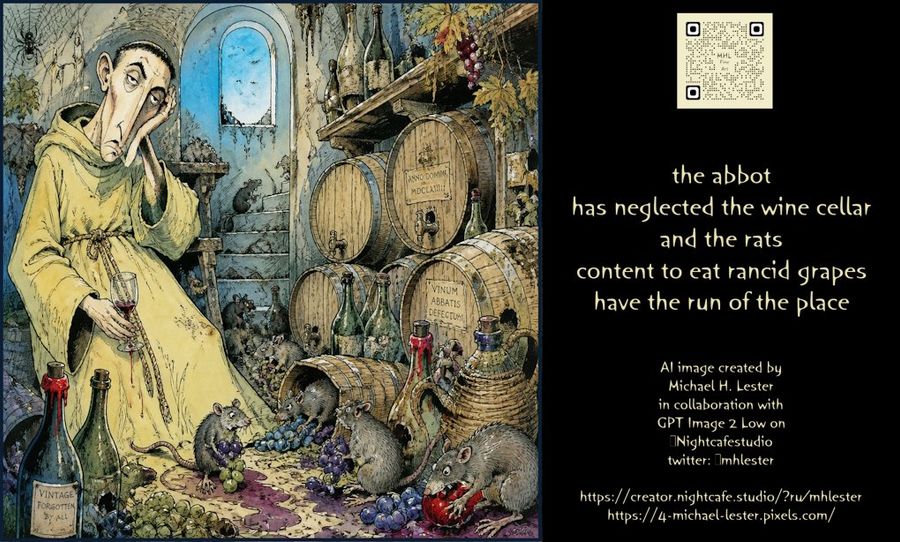
the abbot has neglected the wine cellar and the rats content to eat rancid grapes have the run of the place
Generate image
Explore free Sketch / Line Art image prompts from YouMind's AI prompt library, grouped under styles. Every prompt is curated from real creative workflows and ready to copy, adapt, and reuse.
the abbot has neglected the wine cellar and the rats content to eat rancid grapes have the run of the place
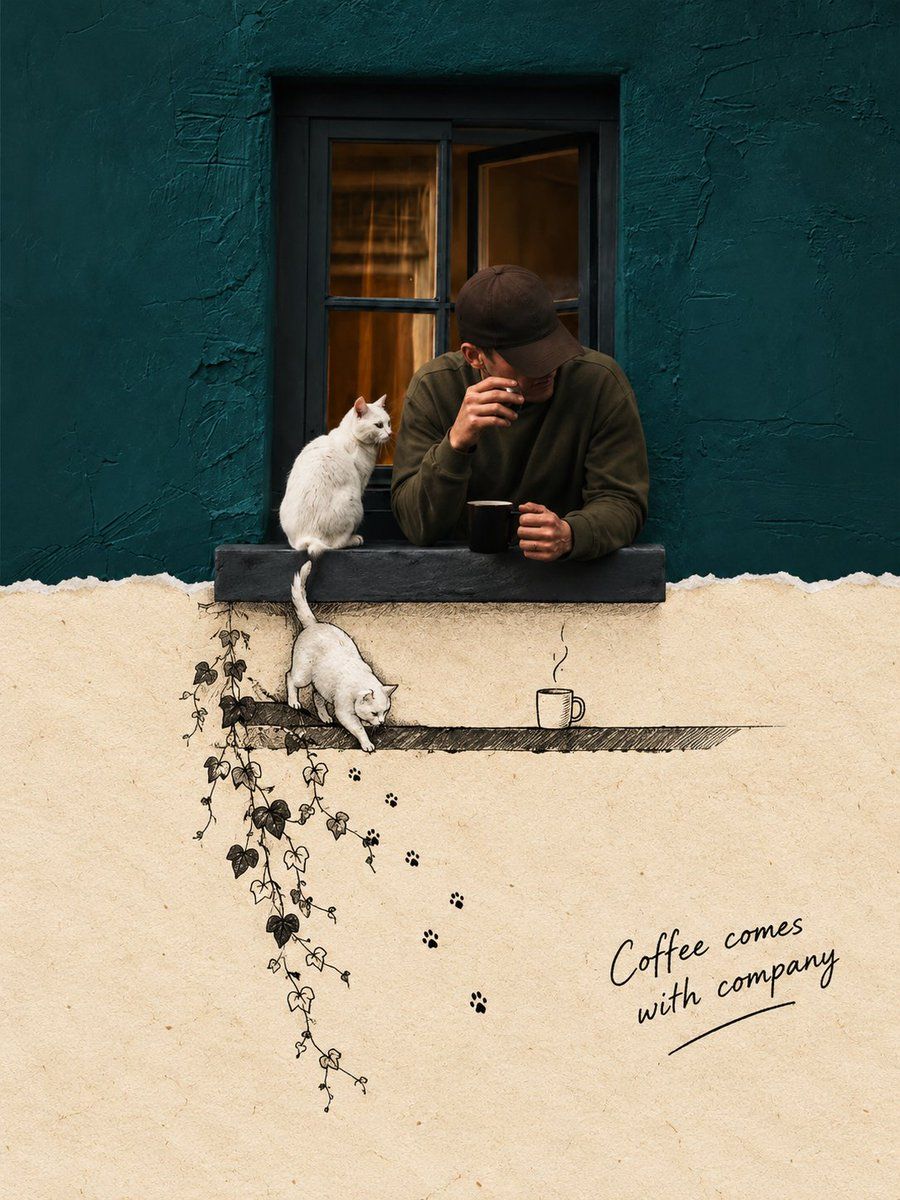
Vertical 3:4 canvas split into two strictly equal horizontal halves: top 50% and bottom 50%. The upper half stays photographic; the lower half becomes the continued Second World. Together they must read as one scene. the UPPER HALF Keep the photo faithful. Preserve the subject, pose, spatial relationships, color atmosphere, and natural light. Do not redesign, repaint, replace, or restage it. Only necessary proportional cropping is allowed. CONTINUITY (highest priority) Identify one source structure that naturally reaches the center split: a road, shoreline, water, reflection, branch, beam of light, piece of architecture, or body movement. This structure must cross the boundary and continue into the lower half. The Second World begins from the photograph itself, so the same scene passes through the seam and simply changes its physical rules. TRANSITION EDGE The center may use an irregular torn-paper edge, but the tear must follow the source structure, never act as decoration. Source elements may touch, follow, break through, or extend beyond edge. Never force the same tear shape onto every image. The Second World LOWER HALF Ivory paper with subtle fibers and abundant negative space. Continue the chosen structure downward from the exact point where it meets the split, then reinterpret it with restrained photo fragments, cut-paper forms, and minimal black hand-drawn lines. The lower world must stay visibly attached Never isolate it as a separate portal, window, stage, platform, or floating vignette unless it clearly comes from the photo. SECOND WORLD LOGIC Ask: if this structure became touchable, usable, enterable, or changeable, what would it naturally become? Create one image-specific interaction. For example, water may stay attached while being pulled, a road may continue as a drawn path, or light may become something held. Do not repeat actions mechanically. FIGURES Add 0-3 tiny black line figures only when useful. They must physically interact with the continued structure. If the photo already contains strong human action, add none. Never use figures as decoration. World CAPTION One short handwritten English caption (2-6 words) based on the action. Natural, light, slightly witty. Spell it correctly. No inspirational quotes and no fixed "Same..., different..." phrasing. STYLE Real photography above, warm paper below, minimal black line doodles, subtle handmade collage texture, independent-magazine mood. Bright, airy, restrained. It should feel as if the Second was already hidden inside the photo and simply continued downward. NEGATIVE No detached lower-half illustration, no generic torn-paper template, no isolated portal, no unrelated vignette, no broken continuity, no dense illustration, no random decoration, no crowd, altered photo colors, no redesign of the upper image, no glossy 3D, no scrapbook clutter, no gibberish text, no watermark, no logo, no UI.
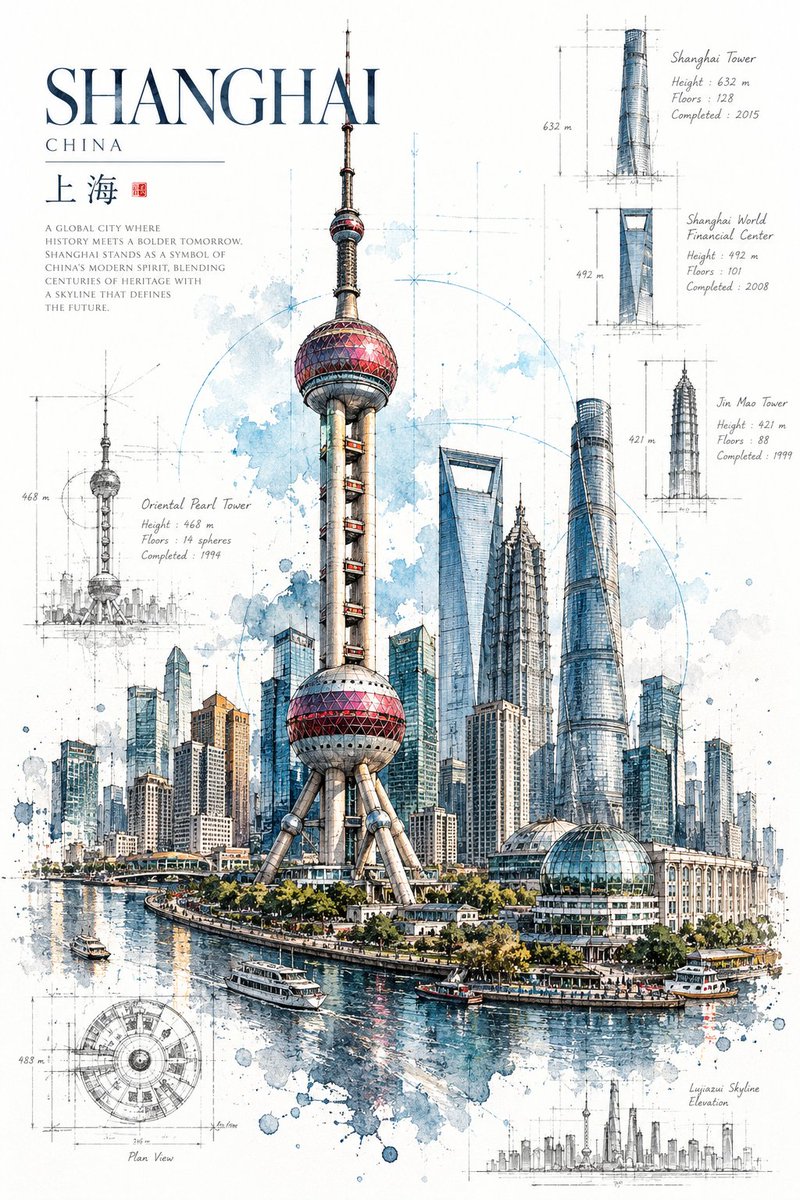
Create a premium 2:3 vertical architectural art poster of [BUILDING / LANDMARK], combining precise architectural sketching with expressive ink and watercolor. COMPOSITION: Feature one architecturally accurate building in a dynamic three-quarter perspective, occupying 60–70% of the composition. Preserve its recognizable silhouette, proportions, structural details, and authentic architectural character. ART STYLE: Intricate hand-drawn ink lines, graphite sketching, delicate crosshatching, translucent watercolor washes, organic imperfections, and expressive ink splashes concentrated around the building’s base. TECHNICAL DETAILS: Integrate fine cyan and muted-teal construction lines, perspective guides, measurement arrows, geometric diagrams, and a few subtle handwritten annotations that relate to the building’s actual structure. COLOR & BACKGROUND: Pure white background, charcoal and graphite linework, pale cyan drafting marks, muted blue-gray watercolor, and restrained indigo accents. Keep the composition airy with generous negative space. TYPOGRAPHY: Add a small, elegant museum-archive label containing the building name, location, architectural style, and a short, factual 2–3-line English curatorial note. Keep typography refined and secondary. FINAL AESTHETIC: A collectible museum-quality architectural study blending technical precision, expressive handmade artistry, and sophisticated editorial design. AVOID: Photorealism, 3D rendering, vector-perfect outlines, inaccurate architecture, unrelated buildings, clutter, colored backgrounds, excessive annotations, logos, and watermarks. FORMAT: Full-bleed 2:3 portrait, high resolution, exceptionally detailed, authentic ink-and-watercolor craftsmanship. Generate for new york
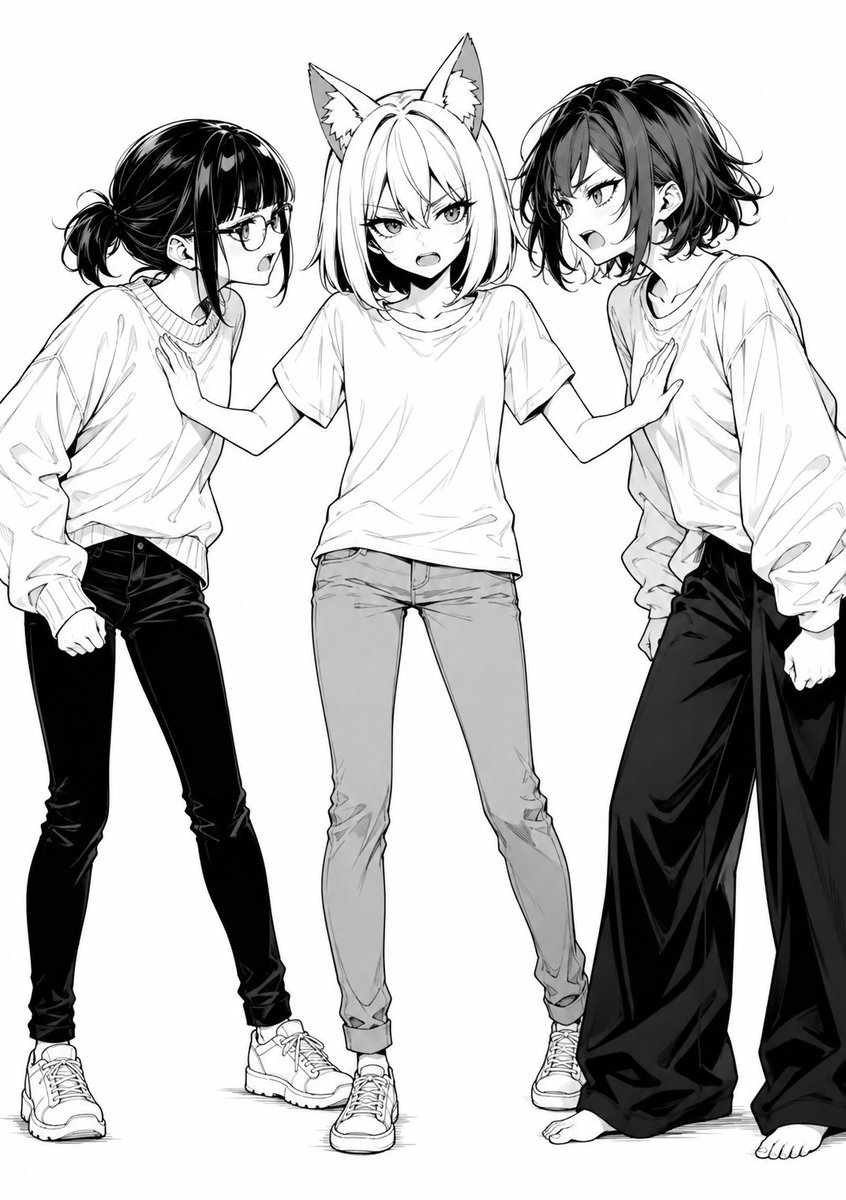
A black and white manga-style illustration of three young women standing in a row against a plain white background. The central figure has light hair, animal ears (kemonomimi), and an angry expression with furrowed brows; she wears a loose t-shirt and jeans, extending both arms to push the other two girls away. The girl on the left has dark hair tied back, glasses, and a surprised open-mouthed expression, wearing a sweater and tight pants while being pushed by her shoulder. The girl on the right has messy dark hair, an annoyed shouting expression, and wears an oversized long-sleeve shirt with baggy trousers, also being pushed away. The art style features clean line work, screentone shading, and dynamic character poses typical of shonen or seinen manga.
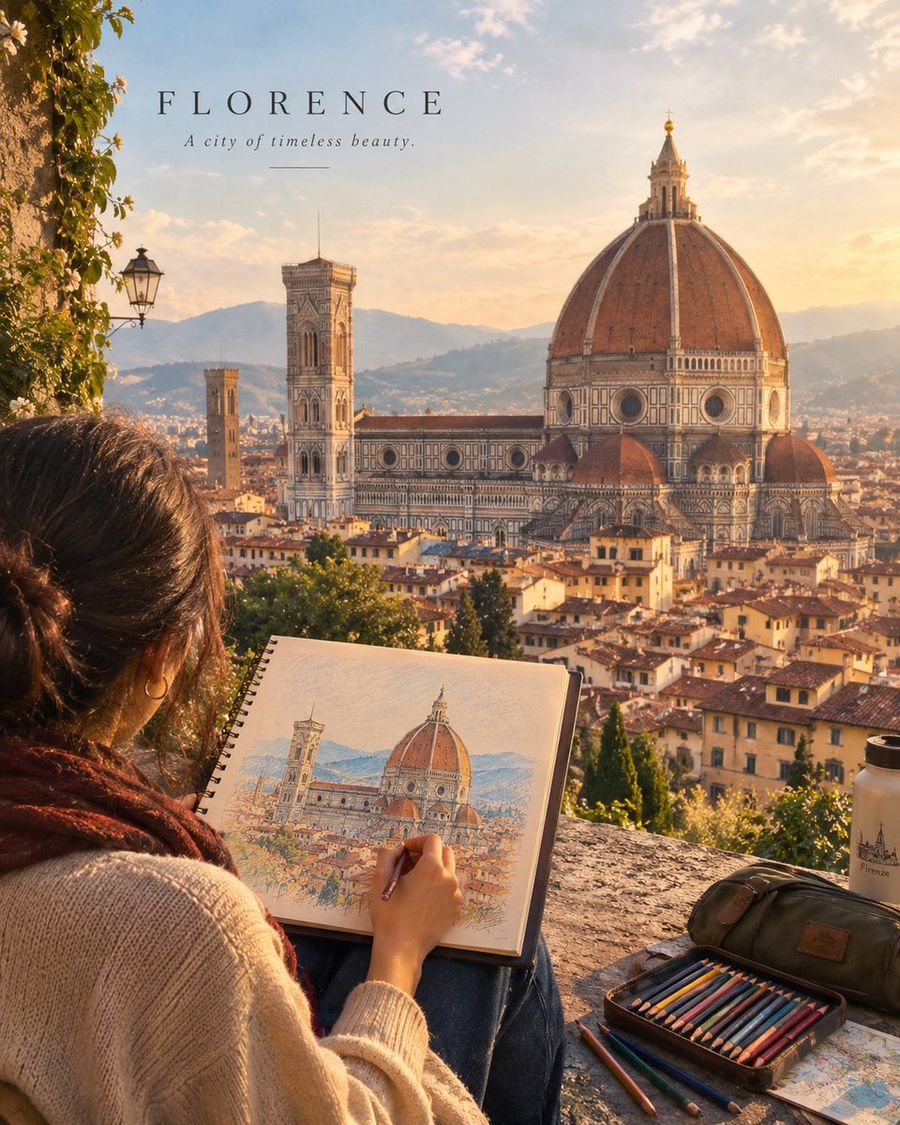
Create a beautiful, cinematic travel photograph of a person sitting comfortably on a small wooden stool in front of a world-famous landmark, creating a detailed hand-drawn artwork of the landmark on a large sketchbook. The person is seen from behind or at a slight side angle, holding a pencil or colored pencil and carefully sketching the landmark while looking up at the real architecture for reference. An open sketchbook, scattered colored pencils, a few wax crayons, and a small art bag rest beside them. The landmark is the main attraction: Show the actual landmark prominently in the background, with authentic architecture, accurate proportions, original colors, and recognizable details. The artwork on the person’s sketchbook should closely resemble the real landmark, creating a beautiful visual connection between the artist’s drawing and reality. Art style: Realistic travel photography blended with a delicate colored-pencil and wax-crayon aesthetic. Visible pencil strokes, textured paper, soft hand-drawn shading, and subtle artistic imperfections. Atmosphere: Warm golden-hour sunlight, gentle shadows, a peaceful breeze, and a dreamy yet believable travel atmosphere. Include small environmental details that reflect the landmark’s real location and culture. Composition: Vertical 4:5 format, premium travel magazine cover, the seated artist in the foreground, the sketchbook clearly visible, and the magnificent landmark rising in the background. Color palette: Warm beige, muted pastels, earthy tones, and naturally vibrant colors inspired by the destination. The final image should feel artistic, emotional, peaceful, and visually captivating, like a beautiful memory captured while travelling. Avoid distorted landmarks, fictional architecture, exaggerated fantasy elements, extra fingers, messy compositions, and artificial-looking textures. Keep the person, drawing materials, and landmark natural and realistic.
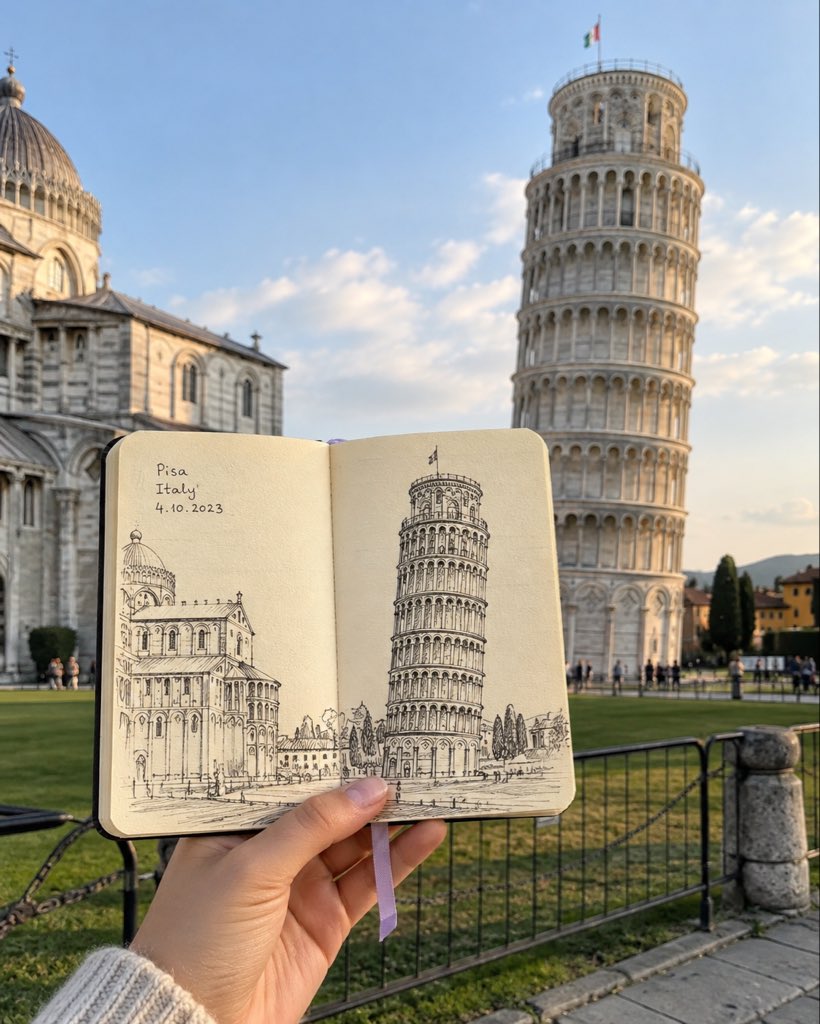
Create a stunning, photorealistic travel photograph of a person standing at the exact real-world location of [LANDMARK], holding an open pocket-sized sketchbook in the foreground. The sketchbook contains a beautiful, hand-drawn black-ink architectural sketch of that exact landmark, with fine pen strokes, intricate details, natural imperfections, and handwritten travel-journal notes. The magic is in the composition: The real landmark stands directly behind the sketchbook, perfectly aligned with its hand-drawn version, creating a beautiful visual connection between the real world and the artist’s drawing. The sketch should look like someone visited the place, sat nearby, and carefully drew the architecture by hand. Capture the person’s hand naturally holding the sketchbook, with the landmark clearly visible in the background. Use shallow depth of field, soft natural daylight, realistic shadows, subtle film grain, and an authentic travel-photography aesthetic. The sketchbook should have slightly textured cream-colored pages, a simple binding, and a delicate ribbon bookmark. The drawing must remain monochrome, using only black ink and fine pencil lines. Important details: Keep the actual landmark architecturally accurate and instantly recognizable. Match the sketch to the real building’s exact structure, proportions, windows, towers, and distinctive features. Make the background location feel authentic, including its surrounding streets and buildings. Keep the hand and sketchbook sharp, with the real landmark slightly softened but still recognizable. Natural human hand anatomy, realistic perspective, professional travel photography. No cartoon effects, no 3D render, no artificial-looking architecture, no excessive filters. Overall mood: Artistic, nostalgic, authentic, and travel-journal inspired — like a beautiful moment captured during a real trip. Aspect ratio: 4:5, vertical composition.
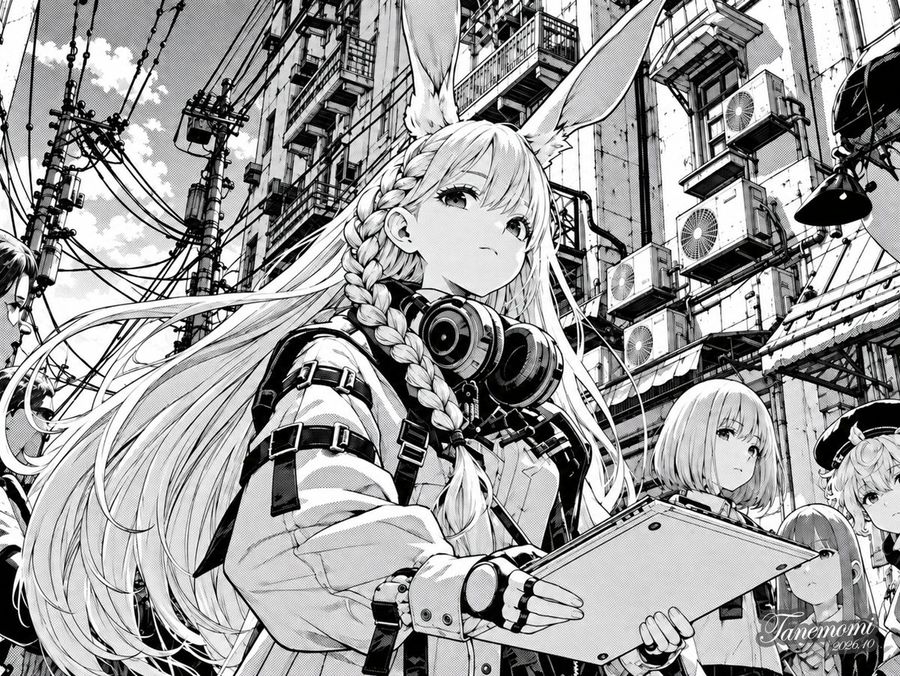
A high-resolution black and white manga illustration of a young woman with long, light-colored hair styled in two thick braids. She has large, fluffy rabbit ears protruding from the top of her head. She is wearing a detailed tactical jacket with multiple straps and buckles, and a pair of headphones rests around her neck. She holds a clipboard or tablet in her hands, looking forward with a calm expression. The background is a dense urban alleyway featuring tall buildings, numerous air conditioning units mounted on walls, and a complex web of overhead power lines and utility poles. The entire image uses traditional screentone patterns for shading and texture.
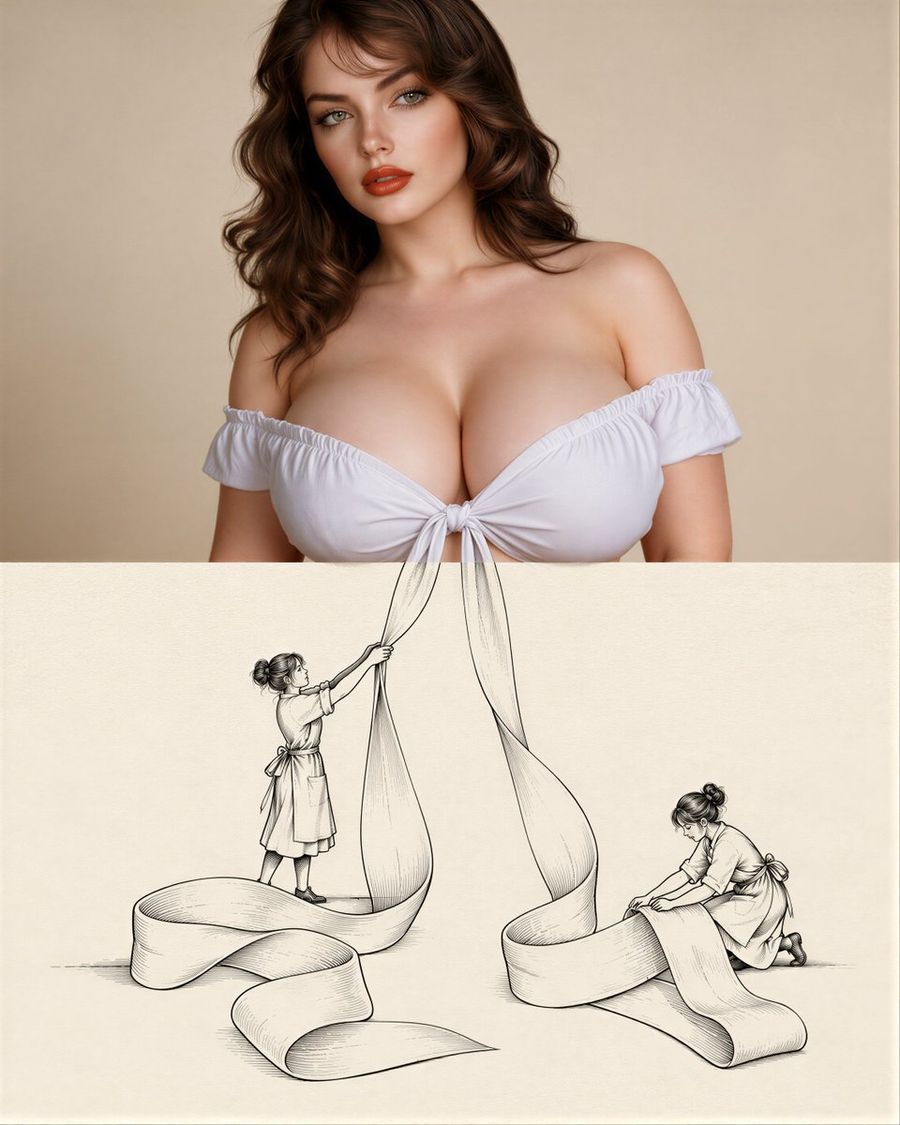
Use the uploaded photograph as the strict visual reference. Create a sophisticated vertical 4:5 conceptual editorial artwork. CORE CONCEPT: An ordinary photograph reveals a hidden second reality. COMPOSITION: Exactly two horizontal sections. TOP 50%: Preserve the uploaded photograph as faithfully as possible. Maintain: subject identity composition lighting perspective recognizable objects photographic realism BOTTOM 50%: A minimalist illustrated world on warm ivory paper. TRANSFORMATION: Identify ONE visually important element in the original photograph. Examples: road river shadow staircase tree branch fabric fold cloud architectural edge Allow that element to physically cross the boundary between the two sections. As it crosses, transform its meaning. Example: A winding road becomes a long ribbon that two tiny hand-drawn workers are carefully measuring and folding. The transformation must feel clever, natural and visually understandable. ILLUSTRATION: Minimal black ink line art. Zero to three tiny illustrated figures. Subtle paper texture. Large areas of negative space. The illustrated figures interact physically with the transformed object. PHOTOGRAPHY: Upper half remains genuinely photographic. No painterly filter on the photograph. STORYTELLING: The lower half reveals a surprising new interpretation of the upper half. No unrelated decorations. No random miniature workers. No generic inspirational quotes. No clutter. No watermark.
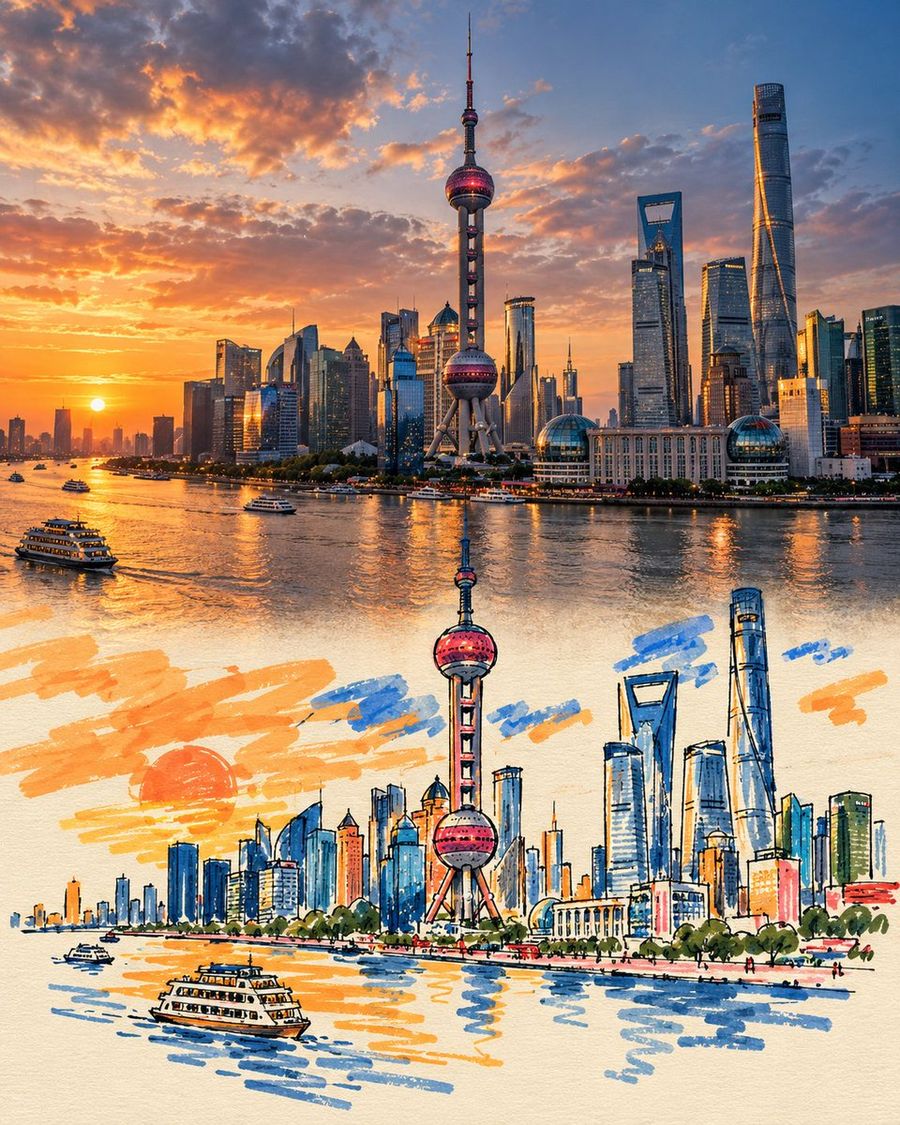
Create a premium FULL-FRAME 4:5 vertical Photo × Graffiti Art travel poster for COUNTRY / CITY / LOCATION / SUBJECT. TEXT-TO-IMAGE ONLY — generate everything creatively from the written subject alone. No reference image required. CORE CONCEPT: A cinematic realistic scene in the upper 50%, seamlessly transforming into minimalist, playful hand-drawn graffiti art on warm ivory paper in the lower 50%. One recognizable element naturally extends across the center, maintaining its original shape, perspective, colors, and direction. ART STYLE: Use chunky marker strokes and opaque paint pens, awkward rounded outlines, oversized simple shapes, tiny facial features where appropriate, and slightly wobbly hand-drawn lines. Preserve the subject’s identity while simplifying it into charming, naïve artwork. COLOR & COMPOSITION: Choose one dominant vivid color inspired by the scene, plus 1–2 accent colors. Keep secondary details mostly paper-white with sparse colored outlines. Use broad, imperfect paint strokes, subtle ink irregularities, and tiny handwritten English commentary. Remove unnecessary background details from the illustrated section and leave at least 70% of its area as clean negative space. FINAL AESTHETIC: Authentic photography × minimalist naïve graffiti × continuous visual transformation × contemporary travel editorial. Airy, playful, artistic, and collectible. AVOID: Visible seams, rigid dividing lines, gradients, shadows in the illustration, detailed background recreation, smooth vector curves, excessive lettering, borders, logos, watermarks, and interface elements. FORMAT: Full-bleed 4:5 vertical artwork. Exact 50/50 composition, with a natural, seamless transition and no external margins.
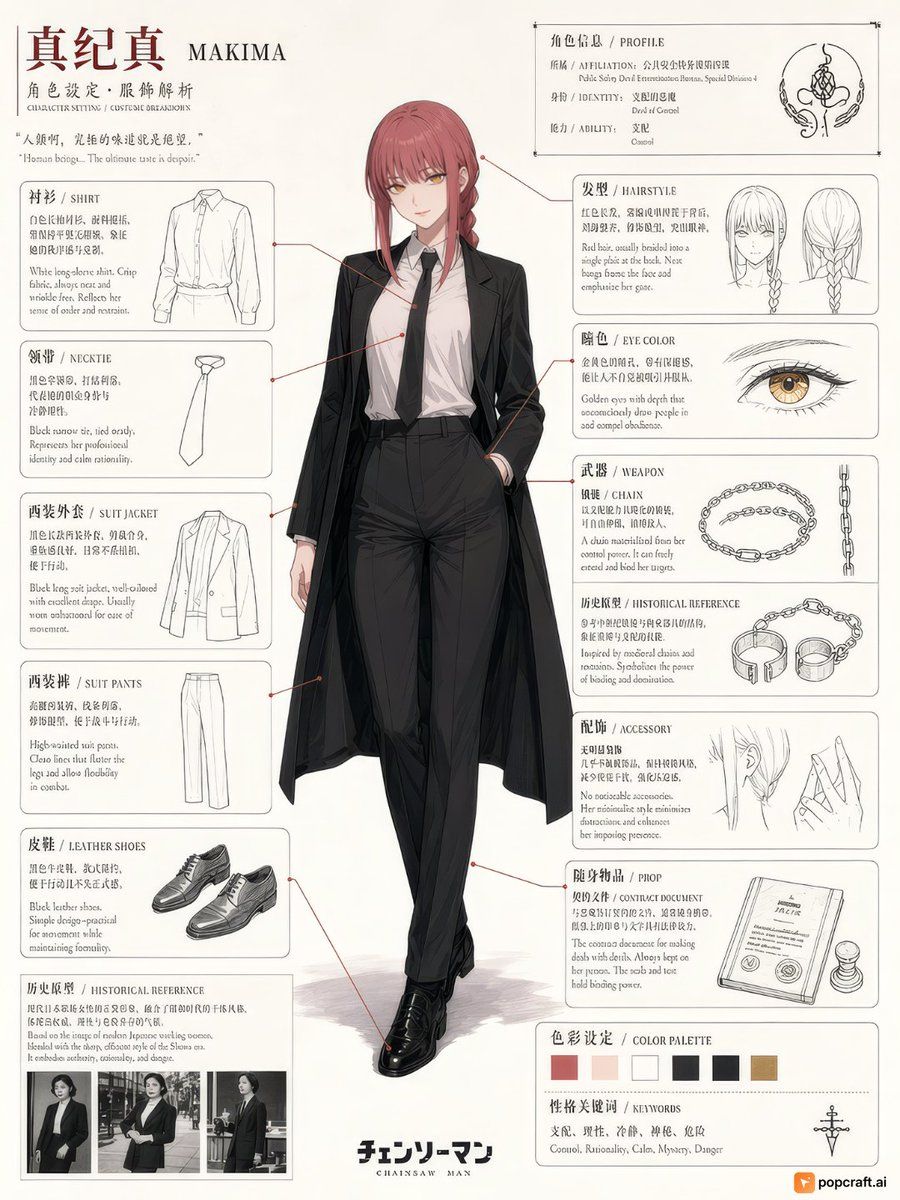
Goal: Create a detailed anime character design sheet for Makima from Chainsaw Man. Canvas: Vertical layout, clean white background with black text and line art. Layout: Central full-body illustration of the character. Surrounding panels detail specific costume elements, physical traits, and profile information. Subject details: Makima stands in the center wearing a long-sleeved white button-down shirt tucked into high-waisted black trousers, a black necktie, and a long black coat draped over her shoulders like a cape. She has red hair braided at the back with bangs framing her face, golden eyes with distinct rings, and black leather shoes. Her expression is calm and composed. Sections: - Top Left: Title "Makima" (真纪真) and subtitle "Character Setting / Costume Breakdown". - Top Right: Profile box listing Affiliation (Public Safety Devil Extermination Bureau), Identity (Divine of Control), and Ability (Control). - Left Column (Costume Breakdown): Panels for Shirt, Necktie, Suit Jacket, Suit Pants, Leather Shoes, and Historical Reference (showing photos of women in suits). - Right Column (Physical & Props): Panels for Hairstyle (front/side/back views), Eye Color (close-up of golden eye), Weapon/Chain (illustration of chains), Historical Reference (chains/handcuffs), Accessory (earring/hand gesture), Prop (contract document and stamp), Color Palette (swatches of red, beige, black, gold), and Keywords (Control, Rationality, Calm, Mystery, Danger). Visual style: High-quality anime illustration mixed with technical fashion sketching. Clean lines, precise shading on clothing folds, and elegant typography. Text content: Include bilingual labels (English/Japanese) for each section header as seen in the reference image.
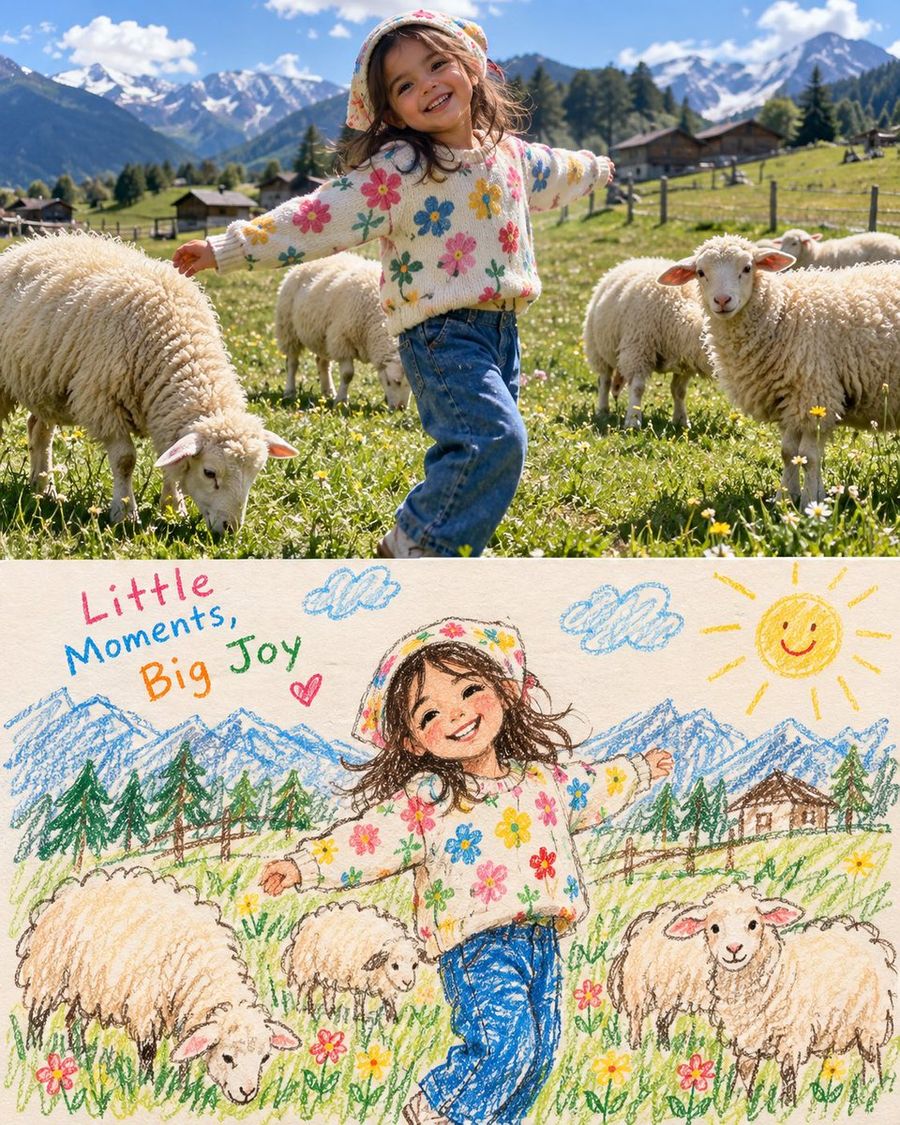
Create a charming, heartwarming two-panel vertical collage inspired by nostalgic childhood photography and handmade children’s crayon drawings. TOP PANEL — PHOTOREALISTIC PHOTO: Capture a candid, ultra-realistic photograph of a happy young child enjoying a simple outdoor adventure in a beautiful countryside meadow. The child wears colorful, playful everyday clothing and a cute hat or headscarf, with a natural, spontaneous pose interacting with fluffy sheep grazing nearby. Alternatively, capture the child joyfully jumping in the air against a vivid blue sky. Use bright natural sunlight, authentic skin texture, realistic fabric details, soft shadows, natural colors, and an unposed documentary photography aesthetic. The scene should feel like a genuine childhood memory captured by a professional family photographer. BOTTOM PANEL — MATCHING CRAYON DRAWING: Directly beneath the photograph, create a handmade children’s illustration of the exact same child, outfit, pose, and main subjects from the photograph. Use visible wax crayon strokes, colored-pencil scribbles, uneven hand-drawn outlines, imperfect proportions, and a warm ivory paper texture. Add small flowers, grass, clouds, a smiling sun, and playful decorative doodles. Include a few short handwritten words in colorful childlike lettering, such as “Little Moments, Big Joy” or “Jump for a Brighter Day.” COMPOSITION: Stack both panels vertically with a clean horizontal division. The top photograph occupies approximately 60% of the image; the illustrated panel occupies the remaining 40%. Keep the child’s appearance, clothing colors, pose, and surroundings recognizable across both panels. Soft nostalgic colors, cheerful storytelling, wholesome family-album aesthetic, authentic handmade charm, high-quality photorealism in the upper panel, richly textured crayon artwork in the lower panel, portrait 4:5 composition. IMPORTANT: The two panels must depict the same moment and subject. The upper half must look like a real photograph, while the lower half must look genuinely hand-drawn by a child. Do not blend the illustration into the photograph. Avoid 3D cartoon rendering, digital vector art, overly polished illustrations, artificial skin, and excessive decorative elements.
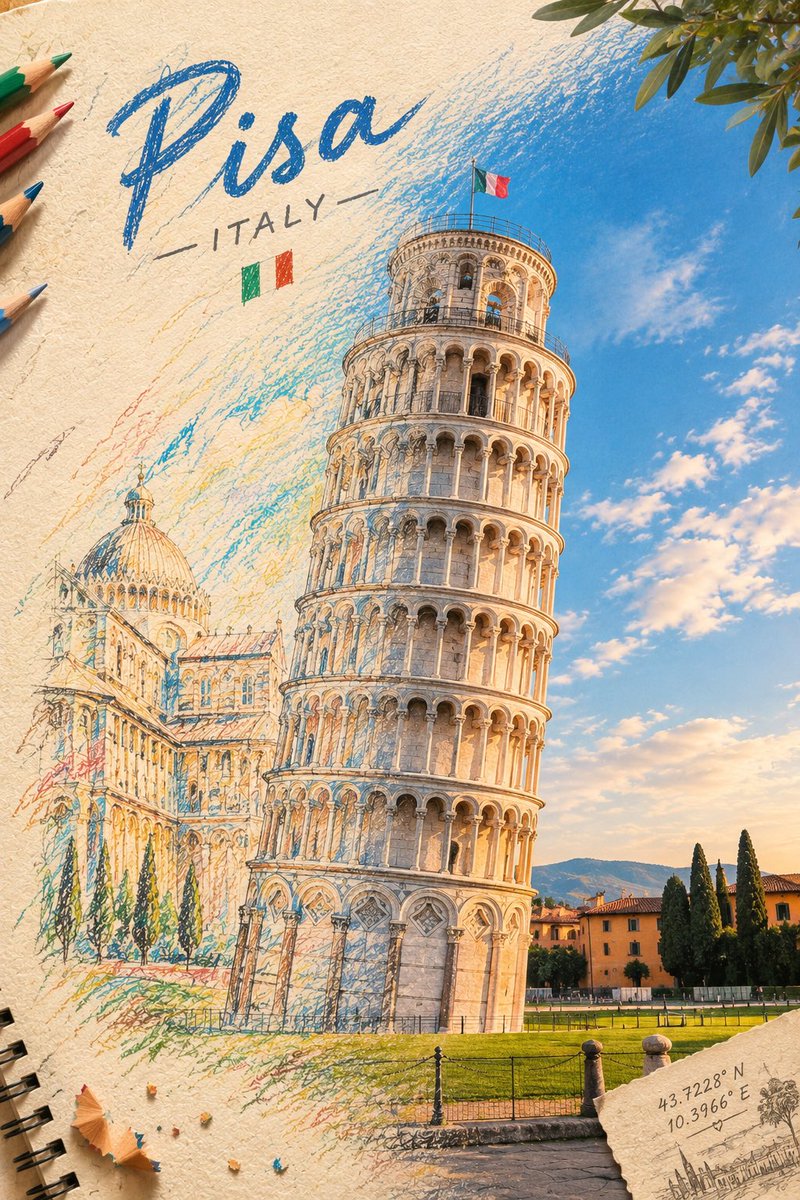
Create a breathtaking artistic composition of [REAL LANDMARK] in [CITY, COUNTRY], where a hand-drawn colored-pencil illustration seamlessly transforms into a beautifully detailed, realistic scene. On one side, the landmark appears as an intricate drawing on textured ivory sketchbook paper, featuring visible pencil strokes, wax-crayon shading, delicate crosshatching, and imperfect hand-drawn lines. Moving across the composition, the colored strokes gradually evolve into the real landmark, surrounded by its authentic streets, architecture, and recognizable local environment. Tiny pencil marks transform into real trees, sketchy rooftops become actual buildings, and loose strokes of color turn into the natural sky. The transition must feel fluid and artistic, as if the entire city is being brought to life by an invisible artist. Preserve the landmark’s exact real-world architecture, proportions, and recognizable details. Use a sophisticated palette of warm terracotta, muted turquoise, golden yellow, deep cobalt blue, and natural earthy tones. Add subtle paper grain, expressive colored-pencil textures, wax-crayon details, imperfect outlines, and beautiful natural lighting. Keep the composition clean, visually striking, and professionally art-directed, with the landmark as the unmistakable focal point. Place the real name of the city in elegant, hand-lettered typography at the top, integrated naturally into the artwork. Style: Contemporary editorial illustration meets realistic colored-pencil and wax-crayon artwork, tactile textures, artistic transformation, premium art-book aesthetic, intricate details, visually captivating composition. Avoid: Generic fantasy architecture, distorted landmarks, excessive visual clutter, plastic-looking 3D effects, and artificial-looking buildings.
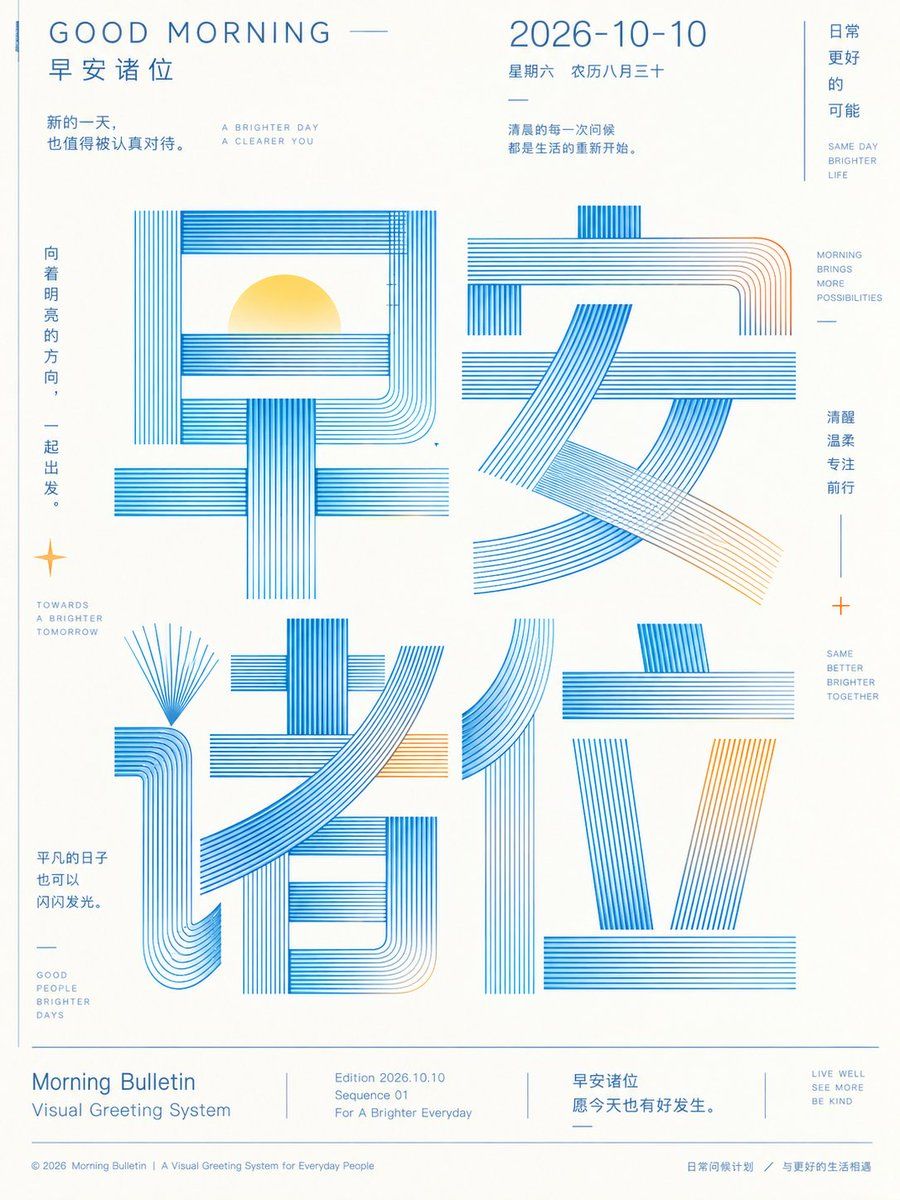
Goal: Create a vertical poster design featuring large, stylized Chinese typography for the greeting "早安诸位" (Good Morning Everyone) in a modern line-art style. Canvas: Vertical aspect ratio with a clean off-white background. The color palette is primarily cool blue (#4A90E2) with accents of warm yellow/orange (#F5A623). Layout: - Top Header: Left side has "GOOD MORNING — 早安诸位" in blue sans-serif. Right side displays the date "2026-10-10" and lunar calendar info "星期六 农历八月三十". - Central Visual: Four massive Chinese characters arranged in a 2x2 grid. These characters are constructed entirely from parallel horizontal and vertical lines (stripes), creating a wireframe or barcode effect. - Top-left character (早): Contains a solid yellow circle representing the sun rising behind the stripes. - Top-right character (安): Features curved striped strokes that transition from blue to orange at the ends. - Bottom-left character (诸): Includes a small fan-like burst of radiating lines on its left radical. - Bottom-right character (位): Has one vertical stroke block colored in orange stripes instead of blue. - Side Margins: Small vertical text blocks flank the main graphic. Left margin reads "向着明亮的方向,一起出发。" and "平凡的日子也可以闪闪发光。" Right margin lists keywords like "清醒", "温柔", "专注", "前行". - Footer: A horizontal divider separates the bottom section containing "Morning Bulletin Visual Greeting System", edition details, and copyright text. Visual Style: Minimalist, typographic, geometric, flat design, high contrast between the thin blue lines and the white space.
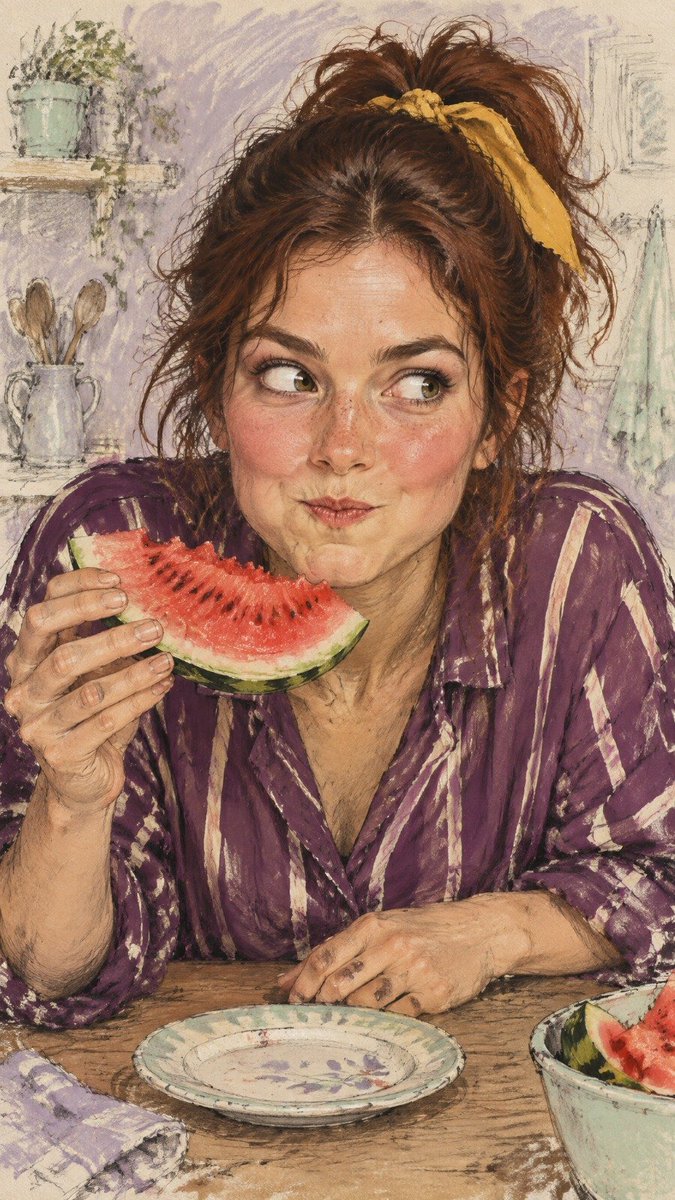
Create an original vertical 9:16 semi-realistic hand-drawn editorial illustration of a quirky young adult woman caught in a funny, spontaneous moment while eating a slice of watermelon. She has realistic human facial anatomy, naturally flushed cheeks, detailed expressive hazel eyes, a few freckles, and messy dark auburn hair loosely tied in a high ponytail with a mustard-yellow ribbon. She wears a vivid plum-purple blouse with loose cream-colored stripes. Her body leans forward over a kitchen table, her head tilted slightly to one side, eyes glancing sideways with a comically suspicious expression, cheeks slightly puffed, and lips pressed together as she tries not to laugh. One hand holds a juicy watermelon slice close to her mouth while the other rests casually on the table beside a small ceramic plate. The image must look like a traditional artist's expressive sketchbook illustration, with loose charcoal and graphite strokes, rough ink outlines, visible construction marks, scratchy cross-hatching, textured watercolor washes and opaque gouache brushwork. Realistic skin shading and believable human hands, painterly facial details, imperfect sketch lines extending beyond the figure, lively spontaneous brush marks. Background: a loosely sketched muted dusty-lavender kitchen wall with pale mint and warm ivory brush strokes, faint illegible handwritten-style artistic scribbles, and unfinished pencil marks. Use a fresh, vibrant color palette of plum purple, watermelon red, mustard yellow, dusty lavender, pale mint, and warm peach skin tones. Medium close-up composition, face large and sharply readable, natural human proportions, expressive eyes and mouth, visible paper texture, sophisticated hand-illustrated magazine art aesthetic. Keep the character visually dominant and the background loose and sketchy. IMPORTANT STYLE: semi-realistic human illustration, NOT cartoon, NOT anime, NOT 3D, NOT glossy digital art, NOT a photograph. Preserve the raw, loose, textured, imperfect hand-drawn quality of traditional editorial sketch art. Original character, original pose, original outfit, original composition.
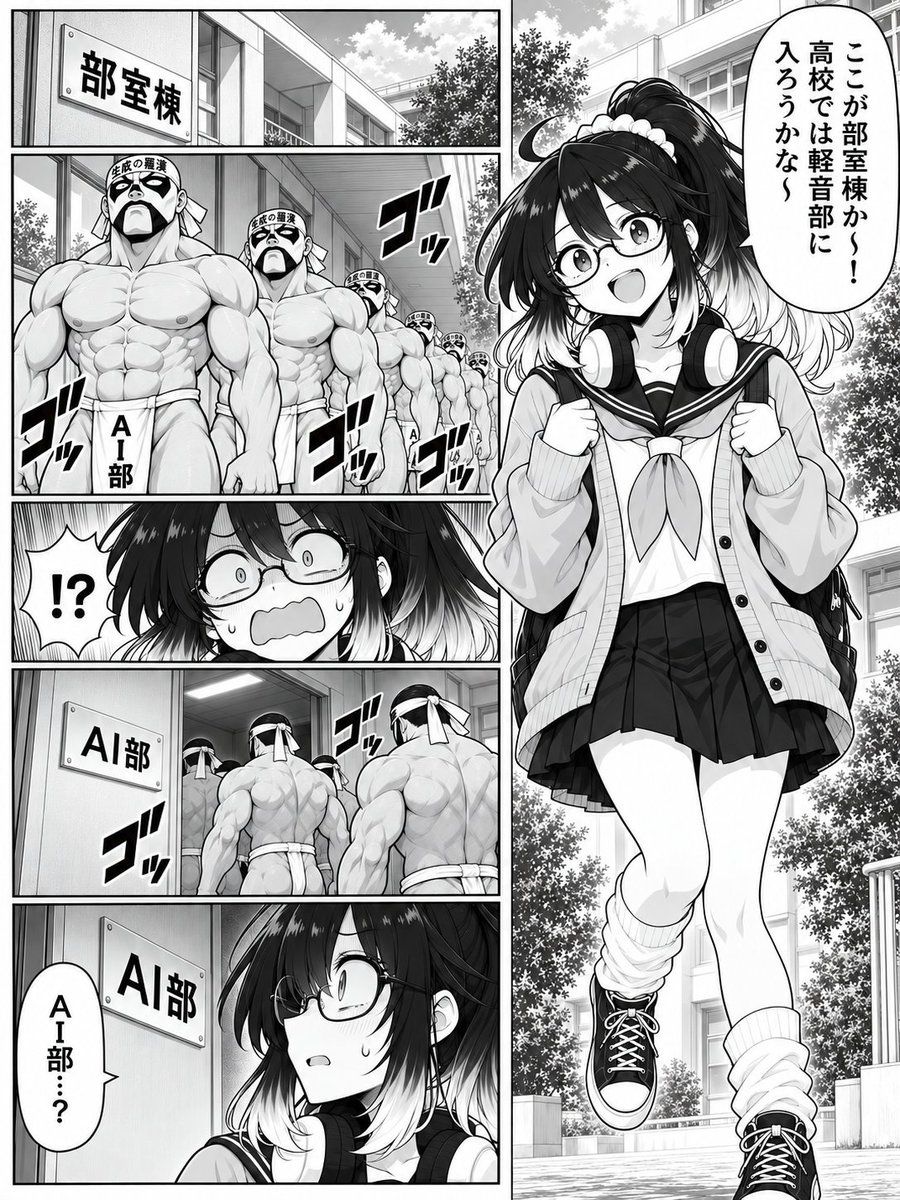
A black-and-white manga page in a vertical layout. The right side features a full-body illustration of a cheerful schoolgirl with dark hair, glasses, and headphones around her neck, wearing a sailor uniform with a cardigan and leg warmers. She is smiling brightly and holding the straps of her backpack. A speech bubble above her reads: "ここが部室棟か〜!高校では軽音部に入ろうかな〜" (Is this the club building? I think I'll join the light music club in high school). The left side consists of four stacked panels showing a comedic contrast. Panel 1 shows a sign reading "部室棟" (Club Building) on a school exterior. Panel 2 depicts a row of muscular men wearing only white loincloths and headbands that say "生徒の羅漢" (Student Arhats), flexing their bodies with sound effects like "ゴッ" (Go). Their loincloths have text reading "AI部" (AI Club). Panel 3 is a close-up of the girl's face looking shocked and terrified with wide eyes and sweat drops, accompanied by an "!?" symbol. Panel 4 shows the men walking into a room labeled "AI部" from behind, while the girl looks at the sign with a confused expression, saying "AI部…?" (AI Club...?).
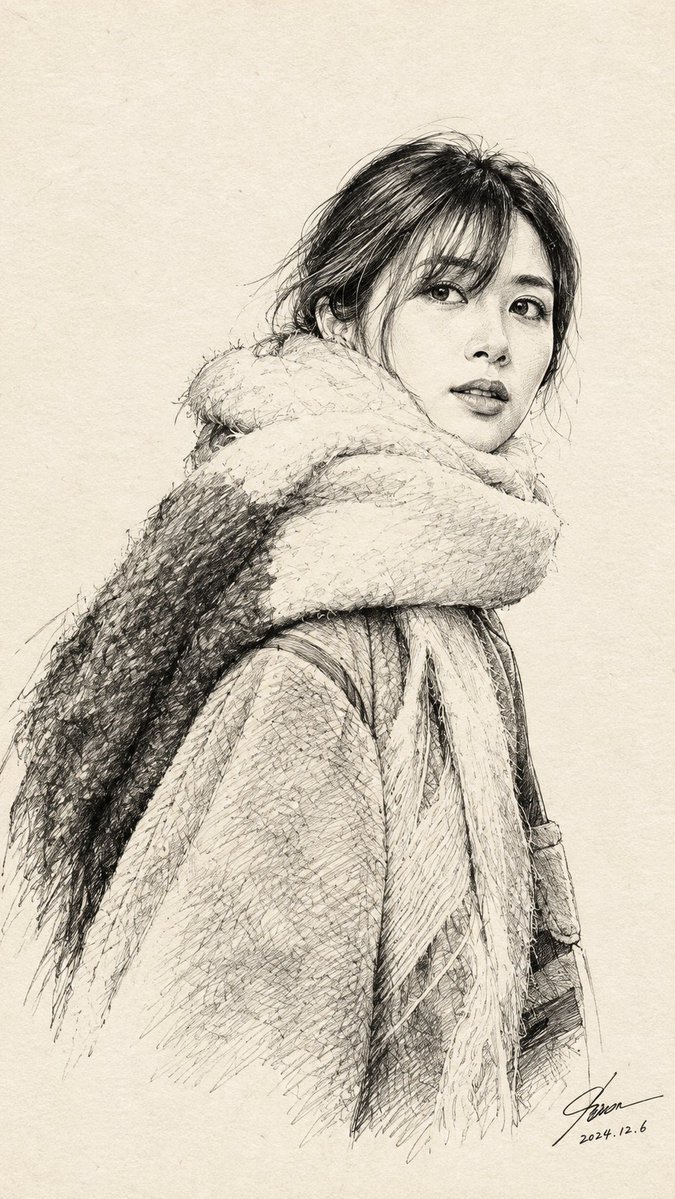
Using the person in the reference image as a prototype, retain facial features, expression, clothing, and body posture, remove the original background, and recreate it as a masterpiece-level black and white pen figure manuscript. Adopt exquisite traditional pen drawing techniques, using lively and smooth ink lines, dense cross-hatching, natural broken strokes, and bold blank spaces to shape the three-dimensional sense and artistic tension of the character. Fine depiction of the face, orderly density of clothing lines, retaining traces of drafting and casual unfinished strokes locally to present the texture of authentic artist handiwork. Warm ivory vintage sketch paper with clearly visible paper fibers and delicate ink marks, rich layers of black, white, and gray. Minimalist art book layout with large areas of whitespace, accented with handwritten signatures and creation dates in the corners. Overall elegant, free, and valuable for art collection, rejecting digital tracing and AI filter effects, 9:16 vertical high-definition composition.
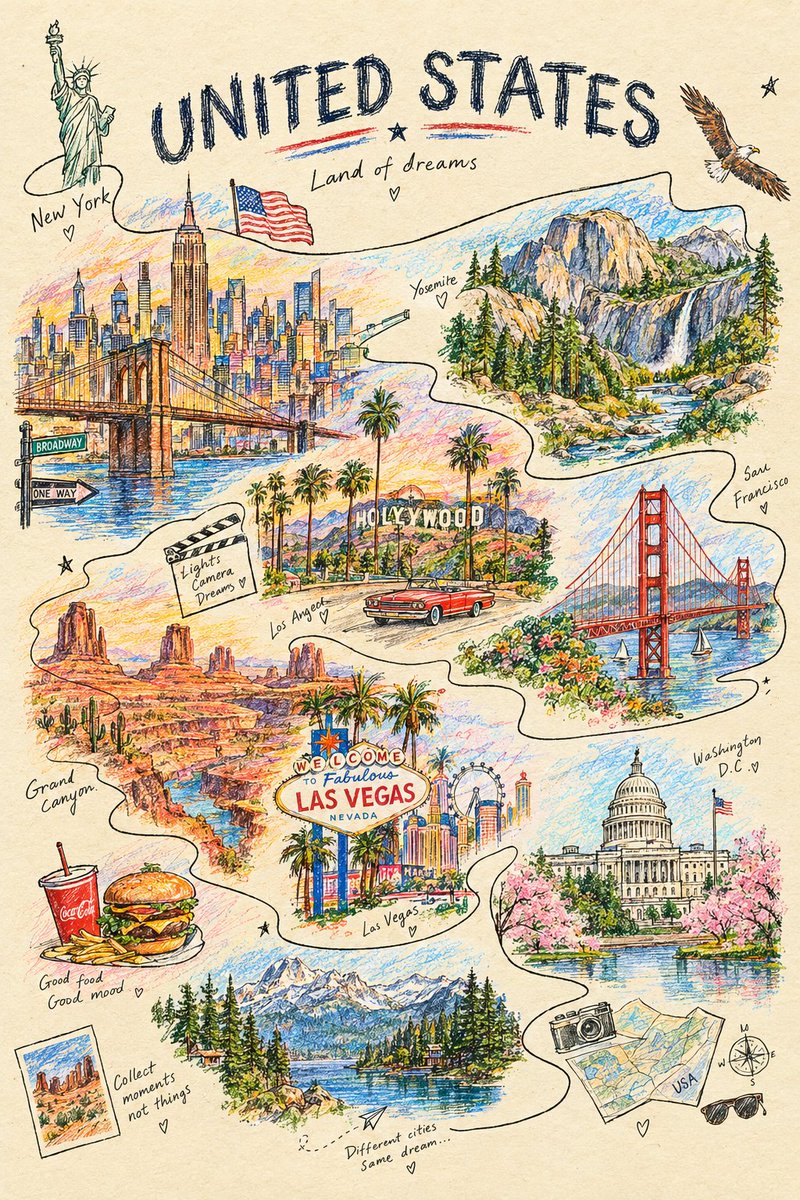
Create a visually stunning minimalist colored-pencil and wax-crayon artwork of [CITY], where the entire city is constructed from one single continuous hand-drawn line. The line begins as a tiny cultural symbol, travels through famous architecture, streets, vehicles, trees, mountains, and everyday life, gradually forming an intricate panoramic cityscape. Add unexpected pops of bright wax-crayon color between the graphite lines, visible paper texture, imperfect handmade strokes, subtle smudges, playful scale changes, and tiny hidden details that reward zooming in. Clean ivory background, sophisticated editorial poster composition, artistic but recognizable, highly detailed, contemporary viral design aesthetic. Add "[CITY]" in bold refined typography at the top.
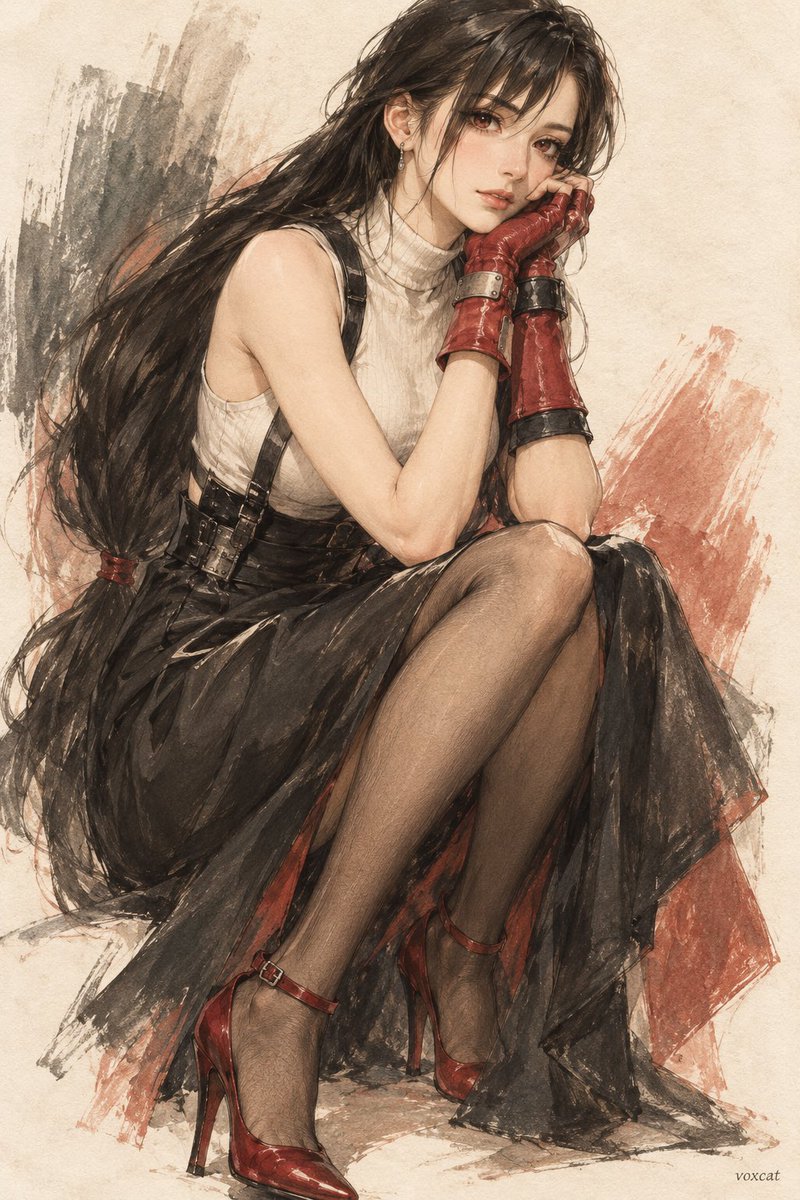
[Character], clearly adult version, retain most core identity recognition: hairstyle outline, hair color, eye main color, facial features, character main color, iconic accessories and temperament. whimsical fashion illustration x elongated figure drawing x ink sketch x watercolor wash x colored pencil x 1940s–1950s studio fashion portrait. Represent [Character] as hand-drawn figure illustration with strong retro fashion feel. Overall styling references elegant poses in late medieval to 50s fashion photography, presented in hand-drawn fashion sketch manner. Figure proportions slightly elongated, neck/limbs/body contours slender, posture restrained, elegant, slightly dramatic. Character uses compact and flattering retro studio pose, could be crouching squat, hands supporting face, knees together, shoulders slightly tilted, or other classic fashion portrait sitting/half-squatting poses. Face is visual center, expression quiet, sensitive, slightly melancholic or playful. Retain obvious hand-drawing process traces: black or dark grey draft lines, contour lines, structure lines clearly visible; locally retain sketch-style flying lines. Coloring combines watercolor washes, colored pencil overlays and paper whitespace, color blocks can slightly cross contour edges, forming relaxed natural hand-drawn loss-of-control feel. Color suggestion uses high-recognition clashing color logic, e.g., purple/orange/milk-white/dark-grey clashes, or rewrite new high-contrast hand-drawn palette based on character main color. Background is light grey/beige/cream white or soft solid paper color, with delicate paper texture. Overall atmosphere like character illustration page in retro fashion magazine: elegant, slender, exaggerated, emotional, slightly neurotic. Vertical image, tiny voxcat in bottom right corner.
the abbot has neglected the wine cellar and the rats content to eat rancid grapes have the run of the place
Create a premium 2:3 vertical architectural art poster of [BUILDING / LANDMARK], combining precise architectural sketching with expressive ink and watercolor. COMPOSITION: Feature one architecturally accurate building in a dynamic three-quarter perspective, occupying 60–70% of the composition. Preserve its recognizable silhouette, proportions, structural details, and authentic architectural character. ART STYLE: Intricate hand-drawn ink lines, graphite sketching, delicate crosshatching, translucent watercolor washes, organic imperfections, and expressive ink splashes concentrated around the building’s base. TECHNICAL DETAILS: Integrate fine cyan and muted-teal construction lines, perspective guides, measurement arrows, geometric diagrams, and a few subtle handwritten annotations that relate to the building’s actual structure. COLOR & BACKGROUND: Pure white background, charcoal and graphite linework, pale cyan drafting marks, muted blue-gray watercolor, and restrained indigo accents. Keep the composition airy with generous negative space. TYPOGRAPHY: Add a small, elegant museum-archive label containing the building name, location, architectural style, and a short, factual 2–3-line English curatorial note. Keep typography refined and secondary. FINAL AESTHETIC: A collectible museum-quality architectural study blending technical precision, expressive handmade artistry, and sophisticated editorial design. AVOID: Photorealism, 3D rendering, vector-perfect outlines, inaccurate architecture, unrelated buildings, clutter, colored backgrounds, excessive annotations, logos, and watermarks. FORMAT: Full-bleed 2:3 portrait, high resolution, exceptionally detailed, authentic ink-and-watercolor craftsmanship. Generate for new york
Create a beautiful, cinematic travel photograph of a person sitting comfortably on a small wooden stool in front of a world-famous landmark, creating a detailed hand-drawn artwork of the landmark on a large sketchbook. The person is seen from behind or at a slight side angle, holding a pencil or colored pencil and carefully sketching the landmark while looking up at the real architecture for reference. An open sketchbook, scattered colored pencils, a few wax crayons, and a small art bag rest beside them. The landmark is the main attraction: Show the actual landmark prominently in the background, with authentic architecture, accurate proportions, original colors, and recognizable details. The artwork on the person’s sketchbook should closely resemble the real landmark, creating a beautiful visual connection between the artist’s drawing and reality. Art style: Realistic travel photography blended with a delicate colored-pencil and wax-crayon aesthetic. Visible pencil strokes, textured paper, soft hand-drawn shading, and subtle artistic imperfections. Atmosphere: Warm golden-hour sunlight, gentle shadows, a peaceful breeze, and a dreamy yet believable travel atmosphere. Include small environmental details that reflect the landmark’s real location and culture. Composition: Vertical 4:5 format, premium travel magazine cover, the seated artist in the foreground, the sketchbook clearly visible, and the magnificent landmark rising in the background. Color palette: Warm beige, muted pastels, earthy tones, and naturally vibrant colors inspired by the destination. The final image should feel artistic, emotional, peaceful, and visually captivating, like a beautiful memory captured while travelling. Avoid distorted landmarks, fictional architecture, exaggerated fantasy elements, extra fingers, messy compositions, and artificial-looking textures. Keep the person, drawing materials, and landmark natural and realistic.
A high-resolution black and white manga illustration of a young woman with long, light-colored hair styled in two thick braids. She has large, fluffy rabbit ears protruding from the top of her head. She is wearing a detailed tactical jacket with multiple straps and buckles, and a pair of headphones rests around her neck. She holds a clipboard or tablet in her hands, looking forward with a calm expression. The background is a dense urban alleyway featuring tall buildings, numerous air conditioning units mounted on walls, and a complex web of overhead power lines and utility poles. The entire image uses traditional screentone patterns for shading and texture.
Create a premium FULL-FRAME 4:5 vertical Photo × Graffiti Art travel poster for COUNTRY / CITY / LOCATION / SUBJECT. TEXT-TO-IMAGE ONLY — generate everything creatively from the written subject alone. No reference image required. CORE CONCEPT: A cinematic realistic scene in the upper 50%, seamlessly transforming into minimalist, playful hand-drawn graffiti art on warm ivory paper in the lower 50%. One recognizable element naturally extends across the center, maintaining its original shape, perspective, colors, and direction. ART STYLE: Use chunky marker strokes and opaque paint pens, awkward rounded outlines, oversized simple shapes, tiny facial features where appropriate, and slightly wobbly hand-drawn lines. Preserve the subject’s identity while simplifying it into charming, naïve artwork. COLOR & COMPOSITION: Choose one dominant vivid color inspired by the scene, plus 1–2 accent colors. Keep secondary details mostly paper-white with sparse colored outlines. Use broad, imperfect paint strokes, subtle ink irregularities, and tiny handwritten English commentary. Remove unnecessary background details from the illustrated section and leave at least 70% of its area as clean negative space. FINAL AESTHETIC: Authentic photography × minimalist naïve graffiti × continuous visual transformation × contemporary travel editorial. Airy, playful, artistic, and collectible. AVOID: Visible seams, rigid dividing lines, gradients, shadows in the illustration, detailed background recreation, smooth vector curves, excessive lettering, borders, logos, watermarks, and interface elements. FORMAT: Full-bleed 4:5 vertical artwork. Exact 50/50 composition, with a natural, seamless transition and no external margins.
Create a charming, heartwarming two-panel vertical collage inspired by nostalgic childhood photography and handmade children’s crayon drawings. TOP PANEL — PHOTOREALISTIC PHOTO: Capture a candid, ultra-realistic photograph of a happy young child enjoying a simple outdoor adventure in a beautiful countryside meadow. The child wears colorful, playful everyday clothing and a cute hat or headscarf, with a natural, spontaneous pose interacting with fluffy sheep grazing nearby. Alternatively, capture the child joyfully jumping in the air against a vivid blue sky. Use bright natural sunlight, authentic skin texture, realistic fabric details, soft shadows, natural colors, and an unposed documentary photography aesthetic. The scene should feel like a genuine childhood memory captured by a professional family photographer. BOTTOM PANEL — MATCHING CRAYON DRAWING: Directly beneath the photograph, create a handmade children’s illustration of the exact same child, outfit, pose, and main subjects from the photograph. Use visible wax crayon strokes, colored-pencil scribbles, uneven hand-drawn outlines, imperfect proportions, and a warm ivory paper texture. Add small flowers, grass, clouds, a smiling sun, and playful decorative doodles. Include a few short handwritten words in colorful childlike lettering, such as “Little Moments, Big Joy” or “Jump for a Brighter Day.” COMPOSITION: Stack both panels vertically with a clean horizontal division. The top photograph occupies approximately 60% of the image; the illustrated panel occupies the remaining 40%. Keep the child’s appearance, clothing colors, pose, and surroundings recognizable across both panels. Soft nostalgic colors, cheerful storytelling, wholesome family-album aesthetic, authentic handmade charm, high-quality photorealism in the upper panel, richly textured crayon artwork in the lower panel, portrait 4:5 composition. IMPORTANT: The two panels must depict the same moment and subject. The upper half must look like a real photograph, while the lower half must look genuinely hand-drawn by a child. Do not blend the illustration into the photograph. Avoid 3D cartoon rendering, digital vector art, overly polished illustrations, artificial skin, and excessive decorative elements.
Goal: Create a vertical poster design featuring large, stylized Chinese typography for the greeting "早安诸位" (Good Morning Everyone) in a modern line-art style. Canvas: Vertical aspect ratio with a clean off-white background. The color palette is primarily cool blue (#4A90E2) with accents of warm yellow/orange (#F5A623). Layout: - Top Header: Left side has "GOOD MORNING — 早安诸位" in blue sans-serif. Right side displays the date "2026-10-10" and lunar calendar info "星期六 农历八月三十". - Central Visual: Four massive Chinese characters arranged in a 2x2 grid. These characters are constructed entirely from parallel horizontal and vertical lines (stripes), creating a wireframe or barcode effect. - Top-left character (早): Contains a solid yellow circle representing the sun rising behind the stripes. - Top-right character (安): Features curved striped strokes that transition from blue to orange at the ends. - Bottom-left character (诸): Includes a small fan-like burst of radiating lines on its left radical. - Bottom-right character (位): Has one vertical stroke block colored in orange stripes instead of blue. - Side Margins: Small vertical text blocks flank the main graphic. Left margin reads "向着明亮的方向,一起出发。" and "平凡的日子也可以闪闪发光。" Right margin lists keywords like "清醒", "温柔", "专注", "前行". - Footer: A horizontal divider separates the bottom section containing "Morning Bulletin Visual Greeting System", edition details, and copyright text. Visual Style: Minimalist, typographic, geometric, flat design, high contrast between the thin blue lines and the white space.
A black-and-white manga page in a vertical layout. The right side features a full-body illustration of a cheerful schoolgirl with dark hair, glasses, and headphones around her neck, wearing a sailor uniform with a cardigan and leg warmers. She is smiling brightly and holding the straps of her backpack. A speech bubble above her reads: "ここが部室棟か〜!高校では軽音部に入ろうかな〜" (Is this the club building? I think I'll join the light music club in high school). The left side consists of four stacked panels showing a comedic contrast. Panel 1 shows a sign reading "部室棟" (Club Building) on a school exterior. Panel 2 depicts a row of muscular men wearing only white loincloths and headbands that say "生徒の羅漢" (Student Arhats), flexing their bodies with sound effects like "ゴッ" (Go). Their loincloths have text reading "AI部" (AI Club). Panel 3 is a close-up of the girl's face looking shocked and terrified with wide eyes and sweat drops, accompanied by an "!?" symbol. Panel 4 shows the men walking into a room labeled "AI部" from behind, while the girl looks at the sign with a confused expression, saying "AI部…?" (AI Club...?).
Create a visually stunning minimalist colored-pencil and wax-crayon artwork of [CITY], where the entire city is constructed from one single continuous hand-drawn line. The line begins as a tiny cultural symbol, travels through famous architecture, streets, vehicles, trees, mountains, and everyday life, gradually forming an intricate panoramic cityscape. Add unexpected pops of bright wax-crayon color between the graphite lines, visible paper texture, imperfect handmade strokes, subtle smudges, playful scale changes, and tiny hidden details that reward zooming in. Clean ivory background, sophisticated editorial poster composition, artistic but recognizable, highly detailed, contemporary viral design aesthetic. Add "[CITY]" in bold refined typography at the top.
Vertical 3:4 canvas split into two strictly equal horizontal halves: top 50% and bottom 50%. The upper half stays photographic; the lower half becomes the continued Second World. Together they must read as one scene. the UPPER HALF Keep the photo faithful. Preserve the subject, pose, spatial relationships, color atmosphere, and natural light. Do not redesign, repaint, replace, or restage it. Only necessary proportional cropping is allowed. CONTINUITY (highest priority) Identify one source structure that naturally reaches the center split: a road, shoreline, water, reflection, branch, beam of light, piece of architecture, or body movement. This structure must cross the boundary and continue into the lower half. The Second World begins from the photograph itself, so the same scene passes through the seam and simply changes its physical rules. TRANSITION EDGE The center may use an irregular torn-paper edge, but the tear must follow the source structure, never act as decoration. Source elements may touch, follow, break through, or extend beyond edge. Never force the same tear shape onto every image. The Second World LOWER HALF Ivory paper with subtle fibers and abundant negative space. Continue the chosen structure downward from the exact point where it meets the split, then reinterpret it with restrained photo fragments, cut-paper forms, and minimal black hand-drawn lines. The lower world must stay visibly attached Never isolate it as a separate portal, window, stage, platform, or floating vignette unless it clearly comes from the photo. SECOND WORLD LOGIC Ask: if this structure became touchable, usable, enterable, or changeable, what would it naturally become? Create one image-specific interaction. For example, water may stay attached while being pulled, a road may continue as a drawn path, or light may become something held. Do not repeat actions mechanically. FIGURES Add 0-3 tiny black line figures only when useful. They must physically interact with the continued structure. If the photo already contains strong human action, add none. Never use figures as decoration. World CAPTION One short handwritten English caption (2-6 words) based on the action. Natural, light, slightly witty. Spell it correctly. No inspirational quotes and no fixed "Same..., different..." phrasing. STYLE Real photography above, warm paper below, minimal black line doodles, subtle handmade collage texture, independent-magazine mood. Bright, airy, restrained. It should feel as if the Second was already hidden inside the photo and simply continued downward. NEGATIVE No detached lower-half illustration, no generic torn-paper template, no isolated portal, no unrelated vignette, no broken continuity, no dense illustration, no random decoration, no crowd, altered photo colors, no redesign of the upper image, no glossy 3D, no scrapbook clutter, no gibberish text, no watermark, no logo, no UI.
A black and white manga-style illustration of three young women standing in a row against a plain white background. The central figure has light hair, animal ears (kemonomimi), and an angry expression with furrowed brows; she wears a loose t-shirt and jeans, extending both arms to push the other two girls away. The girl on the left has dark hair tied back, glasses, and a surprised open-mouthed expression, wearing a sweater and tight pants while being pushed by her shoulder. The girl on the right has messy dark hair, an annoyed shouting expression, and wears an oversized long-sleeve shirt with baggy trousers, also being pushed away. The art style features clean line work, screentone shading, and dynamic character poses typical of shonen or seinen manga.
Create a stunning, photorealistic travel photograph of a person standing at the exact real-world location of [LANDMARK], holding an open pocket-sized sketchbook in the foreground. The sketchbook contains a beautiful, hand-drawn black-ink architectural sketch of that exact landmark, with fine pen strokes, intricate details, natural imperfections, and handwritten travel-journal notes. The magic is in the composition: The real landmark stands directly behind the sketchbook, perfectly aligned with its hand-drawn version, creating a beautiful visual connection between the real world and the artist’s drawing. The sketch should look like someone visited the place, sat nearby, and carefully drew the architecture by hand. Capture the person’s hand naturally holding the sketchbook, with the landmark clearly visible in the background. Use shallow depth of field, soft natural daylight, realistic shadows, subtle film grain, and an authentic travel-photography aesthetic. The sketchbook should have slightly textured cream-colored pages, a simple binding, and a delicate ribbon bookmark. The drawing must remain monochrome, using only black ink and fine pencil lines. Important details: Keep the actual landmark architecturally accurate and instantly recognizable. Match the sketch to the real building’s exact structure, proportions, windows, towers, and distinctive features. Make the background location feel authentic, including its surrounding streets and buildings. Keep the hand and sketchbook sharp, with the real landmark slightly softened but still recognizable. Natural human hand anatomy, realistic perspective, professional travel photography. No cartoon effects, no 3D render, no artificial-looking architecture, no excessive filters. Overall mood: Artistic, nostalgic, authentic, and travel-journal inspired — like a beautiful moment captured during a real trip. Aspect ratio: 4:5, vertical composition.
Use the uploaded photograph as the strict visual reference. Create a sophisticated vertical 4:5 conceptual editorial artwork. CORE CONCEPT: An ordinary photograph reveals a hidden second reality. COMPOSITION: Exactly two horizontal sections. TOP 50%: Preserve the uploaded photograph as faithfully as possible. Maintain: subject identity composition lighting perspective recognizable objects photographic realism BOTTOM 50%: A minimalist illustrated world on warm ivory paper. TRANSFORMATION: Identify ONE visually important element in the original photograph. Examples: road river shadow staircase tree branch fabric fold cloud architectural edge Allow that element to physically cross the boundary between the two sections. As it crosses, transform its meaning. Example: A winding road becomes a long ribbon that two tiny hand-drawn workers are carefully measuring and folding. The transformation must feel clever, natural and visually understandable. ILLUSTRATION: Minimal black ink line art. Zero to three tiny illustrated figures. Subtle paper texture. Large areas of negative space. The illustrated figures interact physically with the transformed object. PHOTOGRAPHY: Upper half remains genuinely photographic. No painterly filter on the photograph. STORYTELLING: The lower half reveals a surprising new interpretation of the upper half. No unrelated decorations. No random miniature workers. No generic inspirational quotes. No clutter. No watermark.
Goal: Create a detailed anime character design sheet for Makima from Chainsaw Man. Canvas: Vertical layout, clean white background with black text and line art. Layout: Central full-body illustration of the character. Surrounding panels detail specific costume elements, physical traits, and profile information. Subject details: Makima stands in the center wearing a long-sleeved white button-down shirt tucked into high-waisted black trousers, a black necktie, and a long black coat draped over her shoulders like a cape. She has red hair braided at the back with bangs framing her face, golden eyes with distinct rings, and black leather shoes. Her expression is calm and composed. Sections: - Top Left: Title "Makima" (真纪真) and subtitle "Character Setting / Costume Breakdown". - Top Right: Profile box listing Affiliation (Public Safety Devil Extermination Bureau), Identity (Divine of Control), and Ability (Control). - Left Column (Costume Breakdown): Panels for Shirt, Necktie, Suit Jacket, Suit Pants, Leather Shoes, and Historical Reference (showing photos of women in suits). - Right Column (Physical & Props): Panels for Hairstyle (front/side/back views), Eye Color (close-up of golden eye), Weapon/Chain (illustration of chains), Historical Reference (chains/handcuffs), Accessory (earring/hand gesture), Prop (contract document and stamp), Color Palette (swatches of red, beige, black, gold), and Keywords (Control, Rationality, Calm, Mystery, Danger). Visual style: High-quality anime illustration mixed with technical fashion sketching. Clean lines, precise shading on clothing folds, and elegant typography. Text content: Include bilingual labels (English/Japanese) for each section header as seen in the reference image.
Create a breathtaking artistic composition of [REAL LANDMARK] in [CITY, COUNTRY], where a hand-drawn colored-pencil illustration seamlessly transforms into a beautifully detailed, realistic scene. On one side, the landmark appears as an intricate drawing on textured ivory sketchbook paper, featuring visible pencil strokes, wax-crayon shading, delicate crosshatching, and imperfect hand-drawn lines. Moving across the composition, the colored strokes gradually evolve into the real landmark, surrounded by its authentic streets, architecture, and recognizable local environment. Tiny pencil marks transform into real trees, sketchy rooftops become actual buildings, and loose strokes of color turn into the natural sky. The transition must feel fluid and artistic, as if the entire city is being brought to life by an invisible artist. Preserve the landmark’s exact real-world architecture, proportions, and recognizable details. Use a sophisticated palette of warm terracotta, muted turquoise, golden yellow, deep cobalt blue, and natural earthy tones. Add subtle paper grain, expressive colored-pencil textures, wax-crayon details, imperfect outlines, and beautiful natural lighting. Keep the composition clean, visually striking, and professionally art-directed, with the landmark as the unmistakable focal point. Place the real name of the city in elegant, hand-lettered typography at the top, integrated naturally into the artwork. Style: Contemporary editorial illustration meets realistic colored-pencil and wax-crayon artwork, tactile textures, artistic transformation, premium art-book aesthetic, intricate details, visually captivating composition. Avoid: Generic fantasy architecture, distorted landmarks, excessive visual clutter, plastic-looking 3D effects, and artificial-looking buildings.
Create an original vertical 9:16 semi-realistic hand-drawn editorial illustration of a quirky young adult woman caught in a funny, spontaneous moment while eating a slice of watermelon. She has realistic human facial anatomy, naturally flushed cheeks, detailed expressive hazel eyes, a few freckles, and messy dark auburn hair loosely tied in a high ponytail with a mustard-yellow ribbon. She wears a vivid plum-purple blouse with loose cream-colored stripes. Her body leans forward over a kitchen table, her head tilted slightly to one side, eyes glancing sideways with a comically suspicious expression, cheeks slightly puffed, and lips pressed together as she tries not to laugh. One hand holds a juicy watermelon slice close to her mouth while the other rests casually on the table beside a small ceramic plate. The image must look like a traditional artist's expressive sketchbook illustration, with loose charcoal and graphite strokes, rough ink outlines, visible construction marks, scratchy cross-hatching, textured watercolor washes and opaque gouache brushwork. Realistic skin shading and believable human hands, painterly facial details, imperfect sketch lines extending beyond the figure, lively spontaneous brush marks. Background: a loosely sketched muted dusty-lavender kitchen wall with pale mint and warm ivory brush strokes, faint illegible handwritten-style artistic scribbles, and unfinished pencil marks. Use a fresh, vibrant color palette of plum purple, watermelon red, mustard yellow, dusty lavender, pale mint, and warm peach skin tones. Medium close-up composition, face large and sharply readable, natural human proportions, expressive eyes and mouth, visible paper texture, sophisticated hand-illustrated magazine art aesthetic. Keep the character visually dominant and the background loose and sketchy. IMPORTANT STYLE: semi-realistic human illustration, NOT cartoon, NOT anime, NOT 3D, NOT glossy digital art, NOT a photograph. Preserve the raw, loose, textured, imperfect hand-drawn quality of traditional editorial sketch art. Original character, original pose, original outfit, original composition.
Using the person in the reference image as a prototype, retain facial features, expression, clothing, and body posture, remove the original background, and recreate it as a masterpiece-level black and white pen figure manuscript. Adopt exquisite traditional pen drawing techniques, using lively and smooth ink lines, dense cross-hatching, natural broken strokes, and bold blank spaces to shape the three-dimensional sense and artistic tension of the character. Fine depiction of the face, orderly density of clothing lines, retaining traces of drafting and casual unfinished strokes locally to present the texture of authentic artist handiwork. Warm ivory vintage sketch paper with clearly visible paper fibers and delicate ink marks, rich layers of black, white, and gray. Minimalist art book layout with large areas of whitespace, accented with handwritten signatures and creation dates in the corners. Overall elegant, free, and valuable for art collection, rejecting digital tracing and AI filter effects, 9:16 vertical high-definition composition.
[Character], clearly adult version, retain most core identity recognition: hairstyle outline, hair color, eye main color, facial features, character main color, iconic accessories and temperament. whimsical fashion illustration x elongated figure drawing x ink sketch x watercolor wash x colored pencil x 1940s–1950s studio fashion portrait. Represent [Character] as hand-drawn figure illustration with strong retro fashion feel. Overall styling references elegant poses in late medieval to 50s fashion photography, presented in hand-drawn fashion sketch manner. Figure proportions slightly elongated, neck/limbs/body contours slender, posture restrained, elegant, slightly dramatic. Character uses compact and flattering retro studio pose, could be crouching squat, hands supporting face, knees together, shoulders slightly tilted, or other classic fashion portrait sitting/half-squatting poses. Face is visual center, expression quiet, sensitive, slightly melancholic or playful. Retain obvious hand-drawing process traces: black or dark grey draft lines, contour lines, structure lines clearly visible; locally retain sketch-style flying lines. Coloring combines watercolor washes, colored pencil overlays and paper whitespace, color blocks can slightly cross contour edges, forming relaxed natural hand-drawn loss-of-control feel. Color suggestion uses high-recognition clashing color logic, e.g., purple/orange/milk-white/dark-grey clashes, or rewrite new high-contrast hand-drawn palette based on character main color. Background is light grey/beige/cream white or soft solid paper color, with delicate paper texture. Overall atmosphere like character illustration page in retro fashion magazine: elegant, slender, exaggerated, emotional, slightly neurotic. Vertical image, tiny voxcat in bottom right corner.
the abbot has neglected the wine cellar and the rats content to eat rancid grapes have the run of the place
A black and white manga-style illustration of three young women standing in a row against a plain white background. The central figure has light hair, animal ears (kemonomimi), and an angry expression with furrowed brows; she wears a loose t-shirt and jeans, extending both arms to push the other two girls away. The girl on the left has dark hair tied back, glasses, and a surprised open-mouthed expression, wearing a sweater and tight pants while being pushed by her shoulder. The girl on the right has messy dark hair, an annoyed shouting expression, and wears an oversized long-sleeve shirt with baggy trousers, also being pushed away. The art style features clean line work, screentone shading, and dynamic character poses typical of shonen or seinen manga.
A high-resolution black and white manga illustration of a young woman with long, light-colored hair styled in two thick braids. She has large, fluffy rabbit ears protruding from the top of her head. She is wearing a detailed tactical jacket with multiple straps and buckles, and a pair of headphones rests around her neck. She holds a clipboard or tablet in her hands, looking forward with a calm expression. The background is a dense urban alleyway featuring tall buildings, numerous air conditioning units mounted on walls, and a complex web of overhead power lines and utility poles. The entire image uses traditional screentone patterns for shading and texture.
Goal: Create a detailed anime character design sheet for Makima from Chainsaw Man. Canvas: Vertical layout, clean white background with black text and line art. Layout: Central full-body illustration of the character. Surrounding panels detail specific costume elements, physical traits, and profile information. Subject details: Makima stands in the center wearing a long-sleeved white button-down shirt tucked into high-waisted black trousers, a black necktie, and a long black coat draped over her shoulders like a cape. She has red hair braided at the back with bangs framing her face, golden eyes with distinct rings, and black leather shoes. Her expression is calm and composed. Sections: - Top Left: Title "Makima" (真纪真) and subtitle "Character Setting / Costume Breakdown". - Top Right: Profile box listing Affiliation (Public Safety Devil Extermination Bureau), Identity (Divine of Control), and Ability (Control). - Left Column (Costume Breakdown): Panels for Shirt, Necktie, Suit Jacket, Suit Pants, Leather Shoes, and Historical Reference (showing photos of women in suits). - Right Column (Physical & Props): Panels for Hairstyle (front/side/back views), Eye Color (close-up of golden eye), Weapon/Chain (illustration of chains), Historical Reference (chains/handcuffs), Accessory (earring/hand gesture), Prop (contract document and stamp), Color Palette (swatches of red, beige, black, gold), and Keywords (Control, Rationality, Calm, Mystery, Danger). Visual style: High-quality anime illustration mixed with technical fashion sketching. Clean lines, precise shading on clothing folds, and elegant typography. Text content: Include bilingual labels (English/Japanese) for each section header as seen in the reference image.
Goal: Create a vertical poster design featuring large, stylized Chinese typography for the greeting "早安诸位" (Good Morning Everyone) in a modern line-art style. Canvas: Vertical aspect ratio with a clean off-white background. The color palette is primarily cool blue (#4A90E2) with accents of warm yellow/orange (#F5A623). Layout: - Top Header: Left side has "GOOD MORNING — 早安诸位" in blue sans-serif. Right side displays the date "2026-10-10" and lunar calendar info "星期六 农历八月三十". - Central Visual: Four massive Chinese characters arranged in a 2x2 grid. These characters are constructed entirely from parallel horizontal and vertical lines (stripes), creating a wireframe or barcode effect. - Top-left character (早): Contains a solid yellow circle representing the sun rising behind the stripes. - Top-right character (安): Features curved striped strokes that transition from blue to orange at the ends. - Bottom-left character (诸): Includes a small fan-like burst of radiating lines on its left radical. - Bottom-right character (位): Has one vertical stroke block colored in orange stripes instead of blue. - Side Margins: Small vertical text blocks flank the main graphic. Left margin reads "向着明亮的方向,一起出发。" and "平凡的日子也可以闪闪发光。" Right margin lists keywords like "清醒", "温柔", "专注", "前行". - Footer: A horizontal divider separates the bottom section containing "Morning Bulletin Visual Greeting System", edition details, and copyright text. Visual Style: Minimalist, typographic, geometric, flat design, high contrast between the thin blue lines and the white space.
Using the person in the reference image as a prototype, retain facial features, expression, clothing, and body posture, remove the original background, and recreate it as a masterpiece-level black and white pen figure manuscript. Adopt exquisite traditional pen drawing techniques, using lively and smooth ink lines, dense cross-hatching, natural broken strokes, and bold blank spaces to shape the three-dimensional sense and artistic tension of the character. Fine depiction of the face, orderly density of clothing lines, retaining traces of drafting and casual unfinished strokes locally to present the texture of authentic artist handiwork. Warm ivory vintage sketch paper with clearly visible paper fibers and delicate ink marks, rich layers of black, white, and gray. Minimalist art book layout with large areas of whitespace, accented with handwritten signatures and creation dates in the corners. Overall elegant, free, and valuable for art collection, rejecting digital tracing and AI filter effects, 9:16 vertical high-definition composition.
Vertical 3:4 canvas split into two strictly equal horizontal halves: top 50% and bottom 50%. The upper half stays photographic; the lower half becomes the continued Second World. Together they must read as one scene. the UPPER HALF Keep the photo faithful. Preserve the subject, pose, spatial relationships, color atmosphere, and natural light. Do not redesign, repaint, replace, or restage it. Only necessary proportional cropping is allowed. CONTINUITY (highest priority) Identify one source structure that naturally reaches the center split: a road, shoreline, water, reflection, branch, beam of light, piece of architecture, or body movement. This structure must cross the boundary and continue into the lower half. The Second World begins from the photograph itself, so the same scene passes through the seam and simply changes its physical rules. TRANSITION EDGE The center may use an irregular torn-paper edge, but the tear must follow the source structure, never act as decoration. Source elements may touch, follow, break through, or extend beyond edge. Never force the same tear shape onto every image. The Second World LOWER HALF Ivory paper with subtle fibers and abundant negative space. Continue the chosen structure downward from the exact point where it meets the split, then reinterpret it with restrained photo fragments, cut-paper forms, and minimal black hand-drawn lines. The lower world must stay visibly attached Never isolate it as a separate portal, window, stage, platform, or floating vignette unless it clearly comes from the photo. SECOND WORLD LOGIC Ask: if this structure became touchable, usable, enterable, or changeable, what would it naturally become? Create one image-specific interaction. For example, water may stay attached while being pulled, a road may continue as a drawn path, or light may become something held. Do not repeat actions mechanically. FIGURES Add 0-3 tiny black line figures only when useful. They must physically interact with the continued structure. If the photo already contains strong human action, add none. Never use figures as decoration. World CAPTION One short handwritten English caption (2-6 words) based on the action. Natural, light, slightly witty. Spell it correctly. No inspirational quotes and no fixed "Same..., different..." phrasing. STYLE Real photography above, warm paper below, minimal black line doodles, subtle handmade collage texture, independent-magazine mood. Bright, airy, restrained. It should feel as if the Second was already hidden inside the photo and simply continued downward. NEGATIVE No detached lower-half illustration, no generic torn-paper template, no isolated portal, no unrelated vignette, no broken continuity, no dense illustration, no random decoration, no crowd, altered photo colors, no redesign of the upper image, no glossy 3D, no scrapbook clutter, no gibberish text, no watermark, no logo, no UI.
Create a beautiful, cinematic travel photograph of a person sitting comfortably on a small wooden stool in front of a world-famous landmark, creating a detailed hand-drawn artwork of the landmark on a large sketchbook. The person is seen from behind or at a slight side angle, holding a pencil or colored pencil and carefully sketching the landmark while looking up at the real architecture for reference. An open sketchbook, scattered colored pencils, a few wax crayons, and a small art bag rest beside them. The landmark is the main attraction: Show the actual landmark prominently in the background, with authentic architecture, accurate proportions, original colors, and recognizable details. The artwork on the person’s sketchbook should closely resemble the real landmark, creating a beautiful visual connection between the artist’s drawing and reality. Art style: Realistic travel photography blended with a delicate colored-pencil and wax-crayon aesthetic. Visible pencil strokes, textured paper, soft hand-drawn shading, and subtle artistic imperfections. Atmosphere: Warm golden-hour sunlight, gentle shadows, a peaceful breeze, and a dreamy yet believable travel atmosphere. Include small environmental details that reflect the landmark’s real location and culture. Composition: Vertical 4:5 format, premium travel magazine cover, the seated artist in the foreground, the sketchbook clearly visible, and the magnificent landmark rising in the background. Color palette: Warm beige, muted pastels, earthy tones, and naturally vibrant colors inspired by the destination. The final image should feel artistic, emotional, peaceful, and visually captivating, like a beautiful memory captured while travelling. Avoid distorted landmarks, fictional architecture, exaggerated fantasy elements, extra fingers, messy compositions, and artificial-looking textures. Keep the person, drawing materials, and landmark natural and realistic.
Use the uploaded photograph as the strict visual reference. Create a sophisticated vertical 4:5 conceptual editorial artwork. CORE CONCEPT: An ordinary photograph reveals a hidden second reality. COMPOSITION: Exactly two horizontal sections. TOP 50%: Preserve the uploaded photograph as faithfully as possible. Maintain: subject identity composition lighting perspective recognizable objects photographic realism BOTTOM 50%: A minimalist illustrated world on warm ivory paper. TRANSFORMATION: Identify ONE visually important element in the original photograph. Examples: road river shadow staircase tree branch fabric fold cloud architectural edge Allow that element to physically cross the boundary between the two sections. As it crosses, transform its meaning. Example: A winding road becomes a long ribbon that two tiny hand-drawn workers are carefully measuring and folding. The transformation must feel clever, natural and visually understandable. ILLUSTRATION: Minimal black ink line art. Zero to three tiny illustrated figures. Subtle paper texture. Large areas of negative space. The illustrated figures interact physically with the transformed object. PHOTOGRAPHY: Upper half remains genuinely photographic. No painterly filter on the photograph. STORYTELLING: The lower half reveals a surprising new interpretation of the upper half. No unrelated decorations. No random miniature workers. No generic inspirational quotes. No clutter. No watermark.
Create a charming, heartwarming two-panel vertical collage inspired by nostalgic childhood photography and handmade children’s crayon drawings. TOP PANEL — PHOTOREALISTIC PHOTO: Capture a candid, ultra-realistic photograph of a happy young child enjoying a simple outdoor adventure in a beautiful countryside meadow. The child wears colorful, playful everyday clothing and a cute hat or headscarf, with a natural, spontaneous pose interacting with fluffy sheep grazing nearby. Alternatively, capture the child joyfully jumping in the air against a vivid blue sky. Use bright natural sunlight, authentic skin texture, realistic fabric details, soft shadows, natural colors, and an unposed documentary photography aesthetic. The scene should feel like a genuine childhood memory captured by a professional family photographer. BOTTOM PANEL — MATCHING CRAYON DRAWING: Directly beneath the photograph, create a handmade children’s illustration of the exact same child, outfit, pose, and main subjects from the photograph. Use visible wax crayon strokes, colored-pencil scribbles, uneven hand-drawn outlines, imperfect proportions, and a warm ivory paper texture. Add small flowers, grass, clouds, a smiling sun, and playful decorative doodles. Include a few short handwritten words in colorful childlike lettering, such as “Little Moments, Big Joy” or “Jump for a Brighter Day.” COMPOSITION: Stack both panels vertically with a clean horizontal division. The top photograph occupies approximately 60% of the image; the illustrated panel occupies the remaining 40%. Keep the child’s appearance, clothing colors, pose, and surroundings recognizable across both panels. Soft nostalgic colors, cheerful storytelling, wholesome family-album aesthetic, authentic handmade charm, high-quality photorealism in the upper panel, richly textured crayon artwork in the lower panel, portrait 4:5 composition. IMPORTANT: The two panels must depict the same moment and subject. The upper half must look like a real photograph, while the lower half must look genuinely hand-drawn by a child. Do not blend the illustration into the photograph. Avoid 3D cartoon rendering, digital vector art, overly polished illustrations, artificial skin, and excessive decorative elements.
Create an original vertical 9:16 semi-realistic hand-drawn editorial illustration of a quirky young adult woman caught in a funny, spontaneous moment while eating a slice of watermelon. She has realistic human facial anatomy, naturally flushed cheeks, detailed expressive hazel eyes, a few freckles, and messy dark auburn hair loosely tied in a high ponytail with a mustard-yellow ribbon. She wears a vivid plum-purple blouse with loose cream-colored stripes. Her body leans forward over a kitchen table, her head tilted slightly to one side, eyes glancing sideways with a comically suspicious expression, cheeks slightly puffed, and lips pressed together as she tries not to laugh. One hand holds a juicy watermelon slice close to her mouth while the other rests casually on the table beside a small ceramic plate. The image must look like a traditional artist's expressive sketchbook illustration, with loose charcoal and graphite strokes, rough ink outlines, visible construction marks, scratchy cross-hatching, textured watercolor washes and opaque gouache brushwork. Realistic skin shading and believable human hands, painterly facial details, imperfect sketch lines extending beyond the figure, lively spontaneous brush marks. Background: a loosely sketched muted dusty-lavender kitchen wall with pale mint and warm ivory brush strokes, faint illegible handwritten-style artistic scribbles, and unfinished pencil marks. Use a fresh, vibrant color palette of plum purple, watermelon red, mustard yellow, dusty lavender, pale mint, and warm peach skin tones. Medium close-up composition, face large and sharply readable, natural human proportions, expressive eyes and mouth, visible paper texture, sophisticated hand-illustrated magazine art aesthetic. Keep the character visually dominant and the background loose and sketchy. IMPORTANT STYLE: semi-realistic human illustration, NOT cartoon, NOT anime, NOT 3D, NOT glossy digital art, NOT a photograph. Preserve the raw, loose, textured, imperfect hand-drawn quality of traditional editorial sketch art. Original character, original pose, original outfit, original composition.
[Character], clearly adult version, retain most core identity recognition: hairstyle outline, hair color, eye main color, facial features, character main color, iconic accessories and temperament. whimsical fashion illustration x elongated figure drawing x ink sketch x watercolor wash x colored pencil x 1940s–1950s studio fashion portrait. Represent [Character] as hand-drawn figure illustration with strong retro fashion feel. Overall styling references elegant poses in late medieval to 50s fashion photography, presented in hand-drawn fashion sketch manner. Figure proportions slightly elongated, neck/limbs/body contours slender, posture restrained, elegant, slightly dramatic. Character uses compact and flattering retro studio pose, could be crouching squat, hands supporting face, knees together, shoulders slightly tilted, or other classic fashion portrait sitting/half-squatting poses. Face is visual center, expression quiet, sensitive, slightly melancholic or playful. Retain obvious hand-drawing process traces: black or dark grey draft lines, contour lines, structure lines clearly visible; locally retain sketch-style flying lines. Coloring combines watercolor washes, colored pencil overlays and paper whitespace, color blocks can slightly cross contour edges, forming relaxed natural hand-drawn loss-of-control feel. Color suggestion uses high-recognition clashing color logic, e.g., purple/orange/milk-white/dark-grey clashes, or rewrite new high-contrast hand-drawn palette based on character main color. Background is light grey/beige/cream white or soft solid paper color, with delicate paper texture. Overall atmosphere like character illustration page in retro fashion magazine: elegant, slender, exaggerated, emotional, slightly neurotic. Vertical image, tiny voxcat in bottom right corner.
Create a premium 2:3 vertical architectural art poster of [BUILDING / LANDMARK], combining precise architectural sketching with expressive ink and watercolor. COMPOSITION: Feature one architecturally accurate building in a dynamic three-quarter perspective, occupying 60–70% of the composition. Preserve its recognizable silhouette, proportions, structural details, and authentic architectural character. ART STYLE: Intricate hand-drawn ink lines, graphite sketching, delicate crosshatching, translucent watercolor washes, organic imperfections, and expressive ink splashes concentrated around the building’s base. TECHNICAL DETAILS: Integrate fine cyan and muted-teal construction lines, perspective guides, measurement arrows, geometric diagrams, and a few subtle handwritten annotations that relate to the building’s actual structure. COLOR & BACKGROUND: Pure white background, charcoal and graphite linework, pale cyan drafting marks, muted blue-gray watercolor, and restrained indigo accents. Keep the composition airy with generous negative space. TYPOGRAPHY: Add a small, elegant museum-archive label containing the building name, location, architectural style, and a short, factual 2–3-line English curatorial note. Keep typography refined and secondary. FINAL AESTHETIC: A collectible museum-quality architectural study blending technical precision, expressive handmade artistry, and sophisticated editorial design. AVOID: Photorealism, 3D rendering, vector-perfect outlines, inaccurate architecture, unrelated buildings, clutter, colored backgrounds, excessive annotations, logos, and watermarks. FORMAT: Full-bleed 2:3 portrait, high resolution, exceptionally detailed, authentic ink-and-watercolor craftsmanship. Generate for new york
Create a stunning, photorealistic travel photograph of a person standing at the exact real-world location of [LANDMARK], holding an open pocket-sized sketchbook in the foreground. The sketchbook contains a beautiful, hand-drawn black-ink architectural sketch of that exact landmark, with fine pen strokes, intricate details, natural imperfections, and handwritten travel-journal notes. The magic is in the composition: The real landmark stands directly behind the sketchbook, perfectly aligned with its hand-drawn version, creating a beautiful visual connection between the real world and the artist’s drawing. The sketch should look like someone visited the place, sat nearby, and carefully drew the architecture by hand. Capture the person’s hand naturally holding the sketchbook, with the landmark clearly visible in the background. Use shallow depth of field, soft natural daylight, realistic shadows, subtle film grain, and an authentic travel-photography aesthetic. The sketchbook should have slightly textured cream-colored pages, a simple binding, and a delicate ribbon bookmark. The drawing must remain monochrome, using only black ink and fine pencil lines. Important details: Keep the actual landmark architecturally accurate and instantly recognizable. Match the sketch to the real building’s exact structure, proportions, windows, towers, and distinctive features. Make the background location feel authentic, including its surrounding streets and buildings. Keep the hand and sketchbook sharp, with the real landmark slightly softened but still recognizable. Natural human hand anatomy, realistic perspective, professional travel photography. No cartoon effects, no 3D render, no artificial-looking architecture, no excessive filters. Overall mood: Artistic, nostalgic, authentic, and travel-journal inspired — like a beautiful moment captured during a real trip. Aspect ratio: 4:5, vertical composition.
Create a premium FULL-FRAME 4:5 vertical Photo × Graffiti Art travel poster for COUNTRY / CITY / LOCATION / SUBJECT. TEXT-TO-IMAGE ONLY — generate everything creatively from the written subject alone. No reference image required. CORE CONCEPT: A cinematic realistic scene in the upper 50%, seamlessly transforming into minimalist, playful hand-drawn graffiti art on warm ivory paper in the lower 50%. One recognizable element naturally extends across the center, maintaining its original shape, perspective, colors, and direction. ART STYLE: Use chunky marker strokes and opaque paint pens, awkward rounded outlines, oversized simple shapes, tiny facial features where appropriate, and slightly wobbly hand-drawn lines. Preserve the subject’s identity while simplifying it into charming, naïve artwork. COLOR & COMPOSITION: Choose one dominant vivid color inspired by the scene, plus 1–2 accent colors. Keep secondary details mostly paper-white with sparse colored outlines. Use broad, imperfect paint strokes, subtle ink irregularities, and tiny handwritten English commentary. Remove unnecessary background details from the illustrated section and leave at least 70% of its area as clean negative space. FINAL AESTHETIC: Authentic photography × minimalist naïve graffiti × continuous visual transformation × contemporary travel editorial. Airy, playful, artistic, and collectible. AVOID: Visible seams, rigid dividing lines, gradients, shadows in the illustration, detailed background recreation, smooth vector curves, excessive lettering, borders, logos, watermarks, and interface elements. FORMAT: Full-bleed 4:5 vertical artwork. Exact 50/50 composition, with a natural, seamless transition and no external margins.
Create a breathtaking artistic composition of [REAL LANDMARK] in [CITY, COUNTRY], where a hand-drawn colored-pencil illustration seamlessly transforms into a beautifully detailed, realistic scene. On one side, the landmark appears as an intricate drawing on textured ivory sketchbook paper, featuring visible pencil strokes, wax-crayon shading, delicate crosshatching, and imperfect hand-drawn lines. Moving across the composition, the colored strokes gradually evolve into the real landmark, surrounded by its authentic streets, architecture, and recognizable local environment. Tiny pencil marks transform into real trees, sketchy rooftops become actual buildings, and loose strokes of color turn into the natural sky. The transition must feel fluid and artistic, as if the entire city is being brought to life by an invisible artist. Preserve the landmark’s exact real-world architecture, proportions, and recognizable details. Use a sophisticated palette of warm terracotta, muted turquoise, golden yellow, deep cobalt blue, and natural earthy tones. Add subtle paper grain, expressive colored-pencil textures, wax-crayon details, imperfect outlines, and beautiful natural lighting. Keep the composition clean, visually striking, and professionally art-directed, with the landmark as the unmistakable focal point. Place the real name of the city in elegant, hand-lettered typography at the top, integrated naturally into the artwork. Style: Contemporary editorial illustration meets realistic colored-pencil and wax-crayon artwork, tactile textures, artistic transformation, premium art-book aesthetic, intricate details, visually captivating composition. Avoid: Generic fantasy architecture, distorted landmarks, excessive visual clutter, plastic-looking 3D effects, and artificial-looking buildings.
A black-and-white manga page in a vertical layout. The right side features a full-body illustration of a cheerful schoolgirl with dark hair, glasses, and headphones around her neck, wearing a sailor uniform with a cardigan and leg warmers. She is smiling brightly and holding the straps of her backpack. A speech bubble above her reads: "ここが部室棟か〜!高校では軽音部に入ろうかな〜" (Is this the club building? I think I'll join the light music club in high school). The left side consists of four stacked panels showing a comedic contrast. Panel 1 shows a sign reading "部室棟" (Club Building) on a school exterior. Panel 2 depicts a row of muscular men wearing only white loincloths and headbands that say "生徒の羅漢" (Student Arhats), flexing their bodies with sound effects like "ゴッ" (Go). Their loincloths have text reading "AI部" (AI Club). Panel 3 is a close-up of the girl's face looking shocked and terrified with wide eyes and sweat drops, accompanied by an "!?" symbol. Panel 4 shows the men walking into a room labeled "AI部" from behind, while the girl looks at the sign with a confused expression, saying "AI部…?" (AI Club...?).
Create a visually stunning minimalist colored-pencil and wax-crayon artwork of [CITY], where the entire city is constructed from one single continuous hand-drawn line. The line begins as a tiny cultural symbol, travels through famous architecture, streets, vehicles, trees, mountains, and everyday life, gradually forming an intricate panoramic cityscape. Add unexpected pops of bright wax-crayon color between the graphite lines, visible paper texture, imperfect handmade strokes, subtle smudges, playful scale changes, and tiny hidden details that reward zooming in. Clean ivory background, sophisticated editorial poster composition, artistic but recognizable, highly detailed, contemporary viral design aesthetic. Add "[CITY]" in bold refined typography at the top.