YouMind
Sign in

Infographic / Edu Visual

Explore free Infographic / Edu Visual image prompts from YouMind's AI prompt library, grouped under use cases. Every prompt is curated from real creative workflows and ready to copy, adapt, and reuse.

Prompt to ImageImage to Prompt
GPT Image 2.5
Fashion App UI Proposal Slide
View full prompt & copy

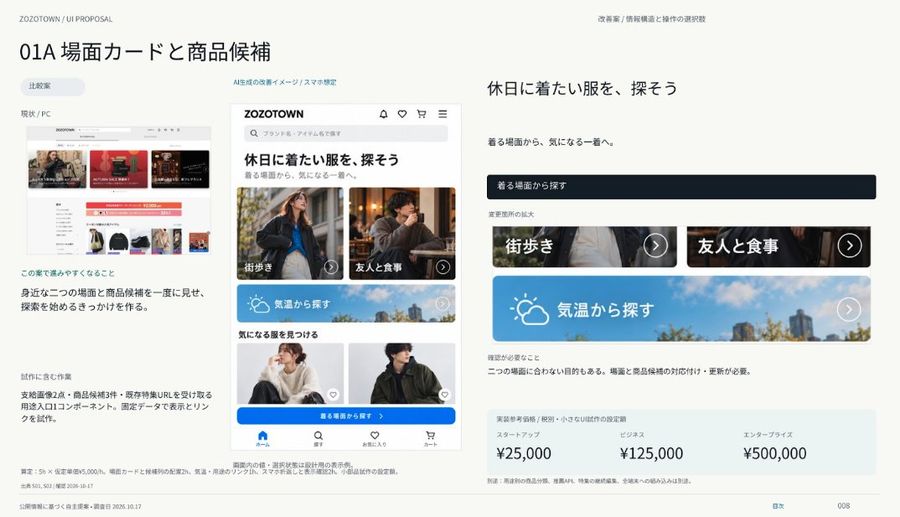
Goal: Design a professional UI/UX proposal slide for a fashion e-commerce mobile app, specifically focusing on 'Scene Cards and Product Recommendations'. Canvas: A clean, white-background presentation slide with a structured layout. Layout: - Top Header: Small text 'ZOZOTOWN / UI PROPOSAL' on the left, 'Improvement Plan / Information Structure and Operation Selection' on the right. - Main Title: Large bold text '01A Scene Cards and Product Recommendations'. - Left Column (Context): A small thumbnail of the current desktop site labeled 'Current / PC', followed by explanatory text about making it easier to choose in this scene. - Center Column (Mobile Mockup): A realistic smartphone interface mockup showing the proposed design. It features a search bar, a headline 'Find clothes you want to wear on your day off', and two large image cards labeled 'Walking around town' and 'Dining with friends'. Below that is a blue banner card labeled 'Search by temperature' with a weather icon, and further down are product images. - Right Column (Component Details): Detailed breakdowns of the UI elements shown in the phone. This includes enlarged views of the 'Walking around town' and 'Dining with friends' buttons, and the 'Search by temperature' banner. There is also a pricing table at the bottom right listing costs for Startup (¥25,000), Business (¥125,000), and Enterprise (¥500,000). Visual Style: Modern, minimalist corporate design. High-quality photography within the UI mockups showing young adults in casual fashion. Use of black text on white background, with specific brand colors like ZOZO's signature red/orange accents and soft blues for the weather feature. Text content: Preserve Japanese labels such as '休日に着たい服を、探そう' (Let's find clothes you want to wear on your day off) and '気温から探す' (Search by temperature). Include the pricing figures clearly.
Generate image
GPT Image 2.5
Papercraft Cube Model Template Generator
View full prompt & copy

Use the selected landmark as the only source of architectural reference. Create a realistic, printable papercraft cube model of Eiffel Tower, Paris, France, preserving its recognizable identity and unique architectural features: original silhouette, proportions, rooflines, towers, arches, windows, columns, decorative patterns, materials, and signature colors. Transform the landmark into a handmade paper craft 3D model using a low-poly geometric cube style, similar to a professional DIY papercraft kit. Show the complete unfolded cut-out template pieces laid flat on a clean white background, with clearly separated sections for the main structure, towers, roof, entrance, architectural extensions, decorative elements, and supporting base. The template must include: Main structure: A cube-shaped central building featuring the landmark’s authentic façade, recognizable architectural details, original colors, and realistic printed stone, brick, or surface textures. Roof and upper sections: Separate foldable pieces that accurately reproduce the landmark’s distinctive roof shape, domes, spires, ridges, or other defining features. Towers and extensions: Individual papercraft components for recognizable towers, minarets, bell towers, columns, arches, or side structures, depending on the landmark. Windows and entrances: Precisely positioned printed details that preserve the landmark’s original architectural identity. Decorative elements: Small foldable pieces for signature ornaments, railings, clock faces, carvings, or other historically recognizable features. Supporting base: A printable base with subtle ground textures and a small engraved-style label displaying the landmark’s name, city, and country. Printable template design: Every component must be unfolded and arranged flat, with visible solid cutting lines, dashed folding lines, numbered assembly sections, and properly sized glue tabs. All pieces should be logically connected or clearly separated, with realistic dimensions and enough white space to distinguish each component. The template must look like a genuine, usable papercraft kit rather than an assembled model photographed from above. Texture and realism: Print the landmark’s authentic architectural textures and colors directly onto the paper surfaces. Use realistic stonework, weathered brick, aged plaster, ceramic tiles, wood, or other materials appropriate to the actual building. Maintain the landmark’s recognizable proportions and historical character while adapting its structure into clean geometric paper components. Presentation: High-quality product photography, perfectly flat overhead view, pure white background, crisp paper edges, subtle natural shadows, fine printed textures, precise geometric folds, professional printable craft-sheet layout, and exceptional detail. Architectural accuracy is essential. Do not invent architectural features, alter the landmark’s silhouette, change its defining colors, or r

Generate image
GPT Image 2.5
Autumn Farm Seek-and-Find Illustration
View full prompt & copy

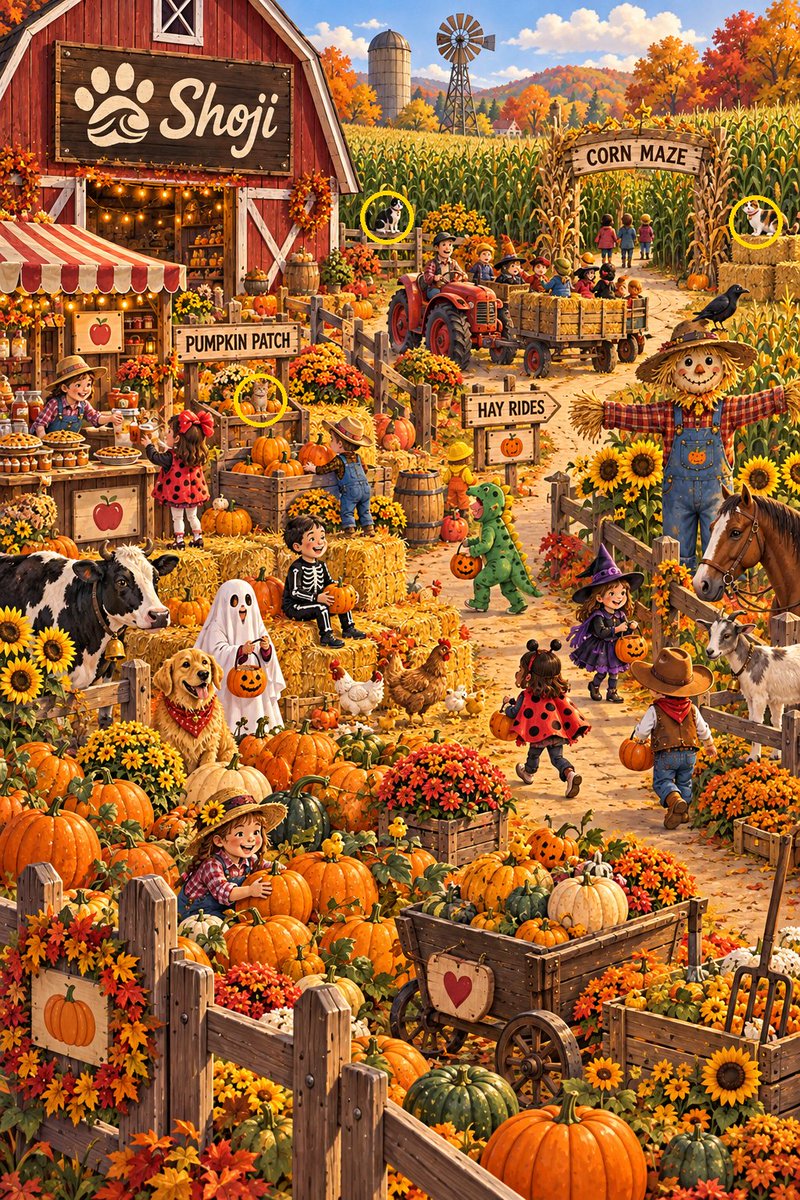
A highly detailed, vibrant, and busy 'Wimmelbilderbuch' (seek-and-find) style illustration of a bustling autumn farm scene. The image is packed with characters and objects in a warm, golden-hour lighting setting. **Top Left:** A large red barn with white trim. A wooden sign hangs on the front featuring a paw print logo and the text "Shoji" in cursive. Below the barn is a market stall with a red-and-white striped awning, displaying pies and jars. A woman in an apron stands behind the counter. A young girl in a red polka-dot dress reaches for a pie. **Center & Background:** A dirt path winds through the scene. In the distance, there are rolling hills with colorful fall foliage, a silo, and a windmill. To the right, a wooden archway reads "CORN MAZE" leading into tall corn stalks. A red tractor pulls a wagon full of children and hay bales down the center path. A wooden signpost points to "HAY RIDES". **Right Side:** A cheerful scarecrow wearing a plaid shirt and denim overalls stands amidst sunflowers. A brown horse's head peeks in from the far right edge. A black crow perches on a fence post nearby. **Foreground & Mid-ground Characters:** - **Left:** A black and white cow stands near a pile of pumpkins. A golden retriever dog sits next to it. A child dressed as a ghost holds a pumpkin bucket. Another child in a skeleton costume sits on a hay bale holding a pumpkin. - **Center:** A child in a green dinosaur costume walks carrying a pumpkin bucket. Two girls walk away from the viewer; one wears a purple witch outfit, the other a red ladybug costume. - **Bottom Left:** A child in a straw hat and plaid shirt hugs a large orange pumpkin inside a fenced area decorated with autumn leaves. - **Bottom Right:** A wooden cart filled with pumpkins and gourds sits on the grass. **Hidden Elements (Yellow Circles):** There are three distinct yellow circles highlighting specific cats hidden in the scene: 1. Top center: A tuxedo cat sitting on a hay bale near the tractor. 2. Middle left: An orange tabby cat sitting on a crate near the "Pumpkin Patch" sign. 3. Top right: A calico cat peeking out from the corn maze entrance. **Style:** Digital art, hyper-realistic textures but cartoonish proportions, bright saturated colors (oranges, yellows, reds), high detail.

Generate image
GPT Image 2
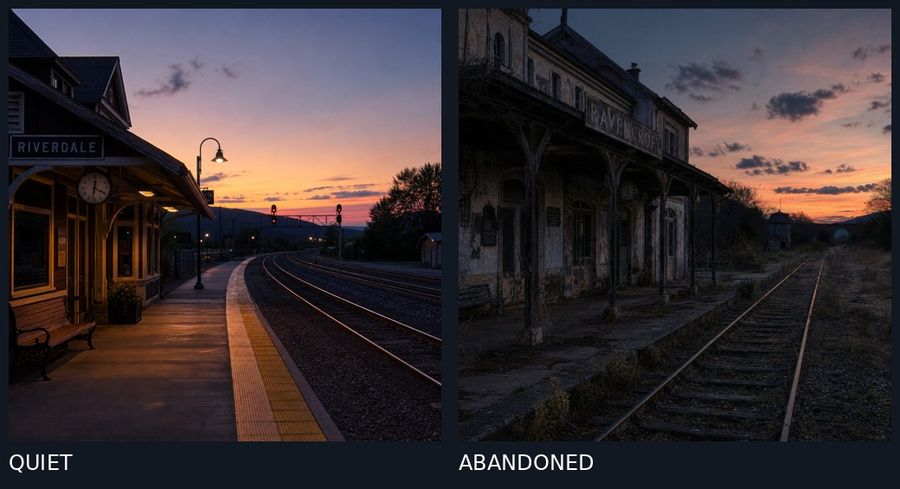
Quiet vs Abandoned Train Station Comparison
View full prompt & copy

A split-screen comparison of two train station scenes at dusk, separated by a thin vertical line. Left panel: A quiet, well-maintained train station named "RIVERDALE" with warm yellow lighting under the platform canopy, a wooden bench, a round clock on the wall, clean concrete platform with yellow tactile paving edge, curved railway tracks leading into the distance, signal lights glowing red, and a vibrant sunset sky with orange and purple hues over distant hills. Right panel: An abandoned, dilapidated train station named "RAVENSBROOK" with peeling paint, broken windows, overgrown weeds and grass between cracked concrete platforms, rusted railway tracks, weathered wooden support beams, dark and eerie atmosphere, similar sunset sky but more muted and cloudy. Bottom labels: "QUIET" in white text on dark background beneath left image, "ABANDONED" in white text on dark background beneath right image.

Generate image
GPT Image 2.5
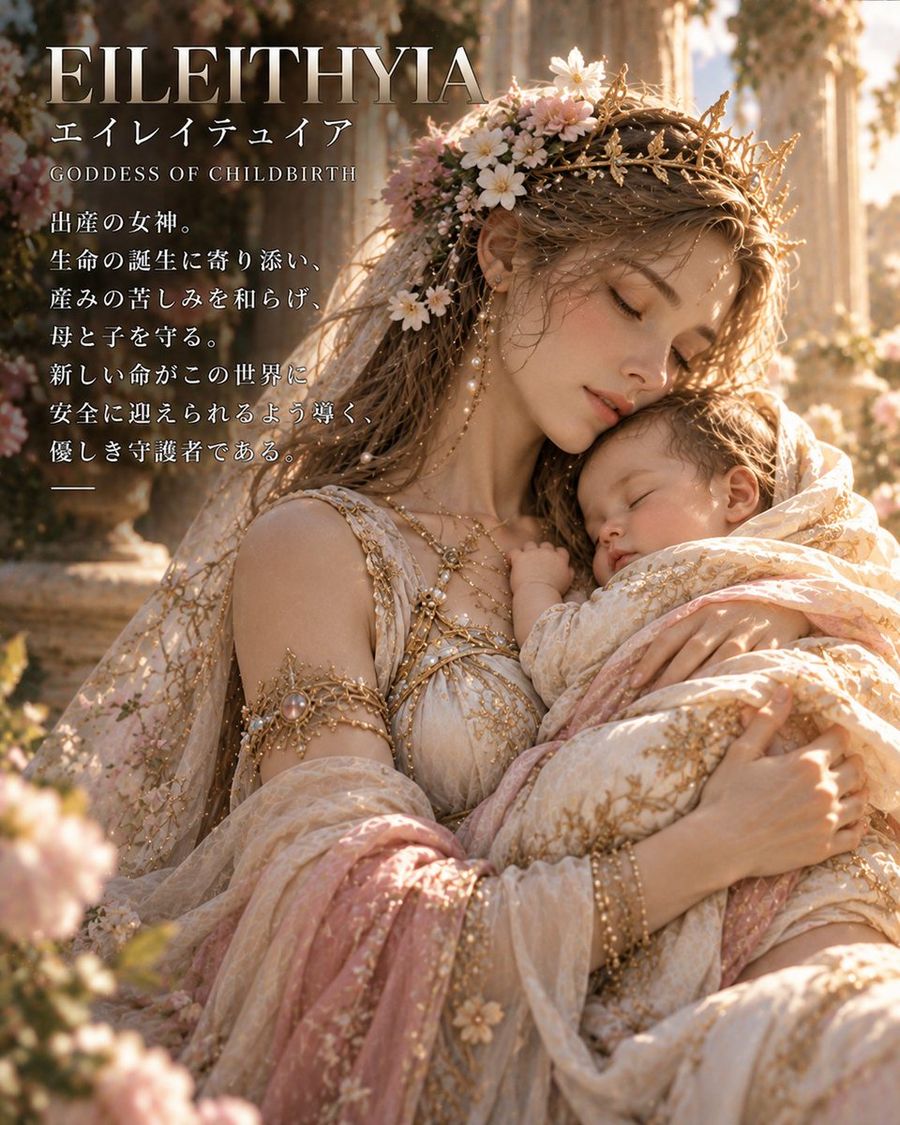
Portrait of Eileithyia Goddess
View full prompt & copy

A hyper-realistic, cinematic portrait of EILEITHYIA, the ancient Greek goddess of childbirth. She is a beautiful young woman with long, wavy brown hair adorned with a delicate floral crown of white and pink blossoms intertwined with gold filigree. Her eyes are closed in a serene expression as she tenderly cradles a sleeping infant wrapped in soft, cream-colored swaddling cloth. She wears an ethereal gown of sheer fabric featuring intricate gold embroidery and beaded jewelry that drapes elegantly over her shoulders. The background consists of blurred classical marble columns and lush greenery bathed in warm, golden-hour sunlight. Overlay text on the left side includes the large serif title "EILEITHYIA", followed by Japanese characters "エイレイテュイア", the subtitle "GODDESS OF CHILDBIRTH", and a vertical block of Japanese descriptive text explaining her role as a protector of mother and child.

Generate image
GPT Image 2.5
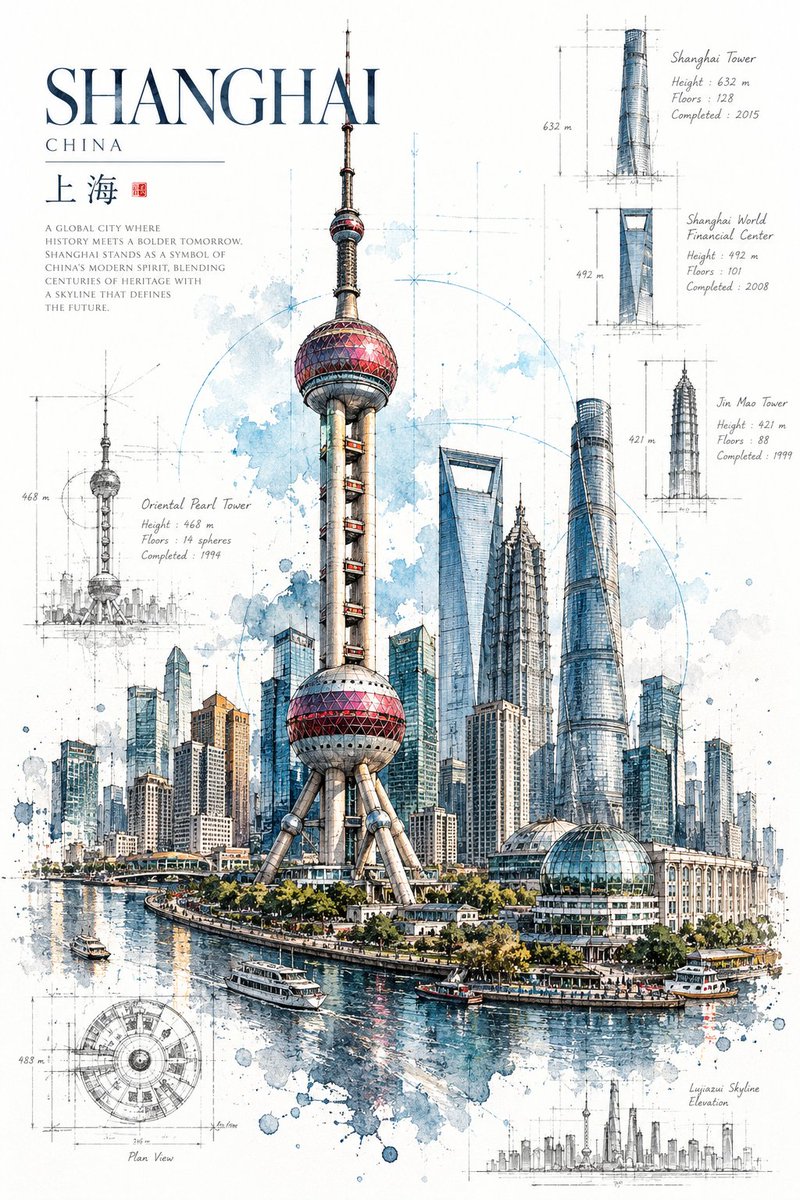
Architectural Art Poster Prompt
View full prompt & copy

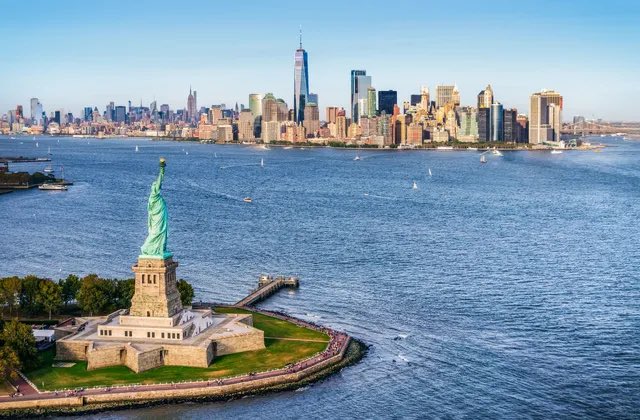
Create a premium 2:3 vertical architectural art poster of [BUILDING / LANDMARK], combining precise architectural sketching with expressive ink and watercolor. COMPOSITION: Feature one architecturally accurate building in a dynamic three-quarter perspective, occupying 60–70% of the composition. Preserve its recognizable silhouette, proportions, structural details, and authentic architectural character. ART STYLE: Intricate hand-drawn ink lines, graphite sketching, delicate crosshatching, translucent watercolor washes, organic imperfections, and expressive ink splashes concentrated around the building’s base. TECHNICAL DETAILS: Integrate fine cyan and muted-teal construction lines, perspective guides, measurement arrows, geometric diagrams, and a few subtle handwritten annotations that relate to the building’s actual structure. COLOR & BACKGROUND: Pure white background, charcoal and graphite linework, pale cyan drafting marks, muted blue-gray watercolor, and restrained indigo accents. Keep the composition airy with generous negative space. TYPOGRAPHY: Add a small, elegant museum-archive label containing the building name, location, architectural style, and a short, factual 2–3-line English curatorial note. Keep typography refined and secondary. FINAL AESTHETIC: A collectible museum-quality architectural study blending technical precision, expressive handmade artistry, and sophisticated editorial design. AVOID: Photorealism, 3D rendering, vector-perfect outlines, inaccurate architecture, unrelated buildings, clutter, colored backgrounds, excessive annotations, logos, and watermarks. FORMAT: Full-bleed 2:3 portrait, high resolution, exceptionally detailed, authentic ink-and-watercolor craftsmanship. Generate for new york

Generate image
GPT Image 2.5
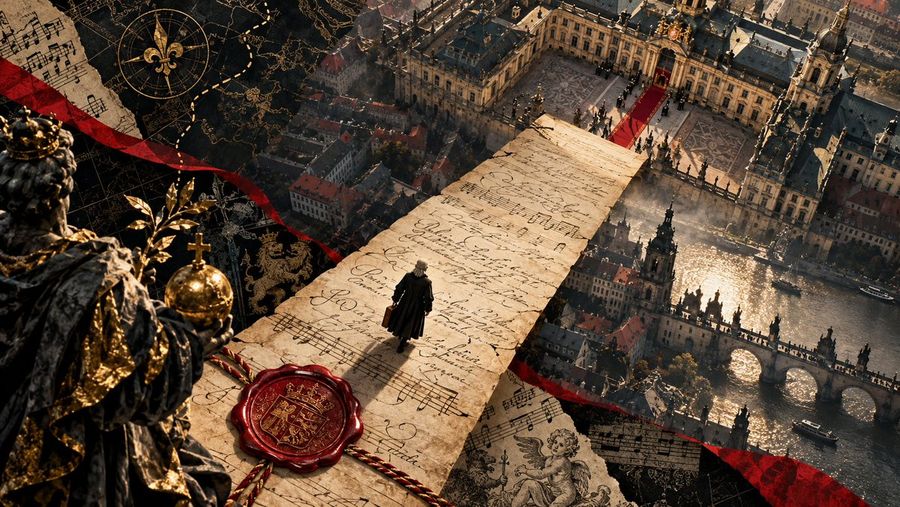
Bach's Musical Petition to Dresden
View full prompt & copy

Goal: Create a cinematic, high-resolution digital illustration depicting the historical moment of Johann Sebastian Bach submitting his musical petition to the court in Dresden. Canvas: Wide aspect ratio (16:9), photorealistic 3D render style with dramatic lighting and rich textures. Layout & Composition: - **Foreground Left:** A close-up, slightly out-of-focus statue or bust of a crowned monarch (King Augustus III) wearing heavy velvet robes with gold embroidery and holding a golden orb. This frames the scene on the left. - **Center Axis:** A massive, long scroll of aged parchment stretches diagonally from the bottom center toward the top right, acting as a bridge or path over the city below. The parchment is covered in handwritten cursive script and musical notation (staves and notes). - **Midground Center:** A tiny figure of Bach, dressed in black 18th-century attire with a white wig, stands on the parchment scroll, looking down at the document he has written. He holds a small leather satchel. - **Background Right:** An aerial view of the historic city of Dresden. Key landmarks include the Zwinger Palace with its ornate baroque architecture and red carpet entrance, the Hofkirche (Court Church) spires, and the Augustus Bridge spanning the Elbe River. The river reflects the sunlight. - **Overlay Elements:** Scattered around the edges are torn fragments of sheet music, a golden compass rose symbol, a red wax seal with a coat of arms attached to the main scroll, and flowing red ribbons that weave through the composition. Visual Style: - **Lighting:** Golden hour sunlight hitting the city and the parchment, creating strong contrasts and shadows. Warm tones dominate. - **Texture:** Highly detailed paper grain on the scroll, stone texture on the buildings, fabric texture on the king's robe. - **Atmosphere:** Majestic, historical, and artistic. It visualizes the concept of "music as a plea for status." Text Content: - The handwriting on the scroll should be illegible but stylistically accurate to 18th-century German Kurrent script. - Musical staves should look authentic. Constraints: - Do not make the text readable English; it must look like a historical manuscript. - Ensure the scale difference between the giant scroll/king and the tiny composer is exaggerated for dramatic effect.

Generate image
GPT Image 2
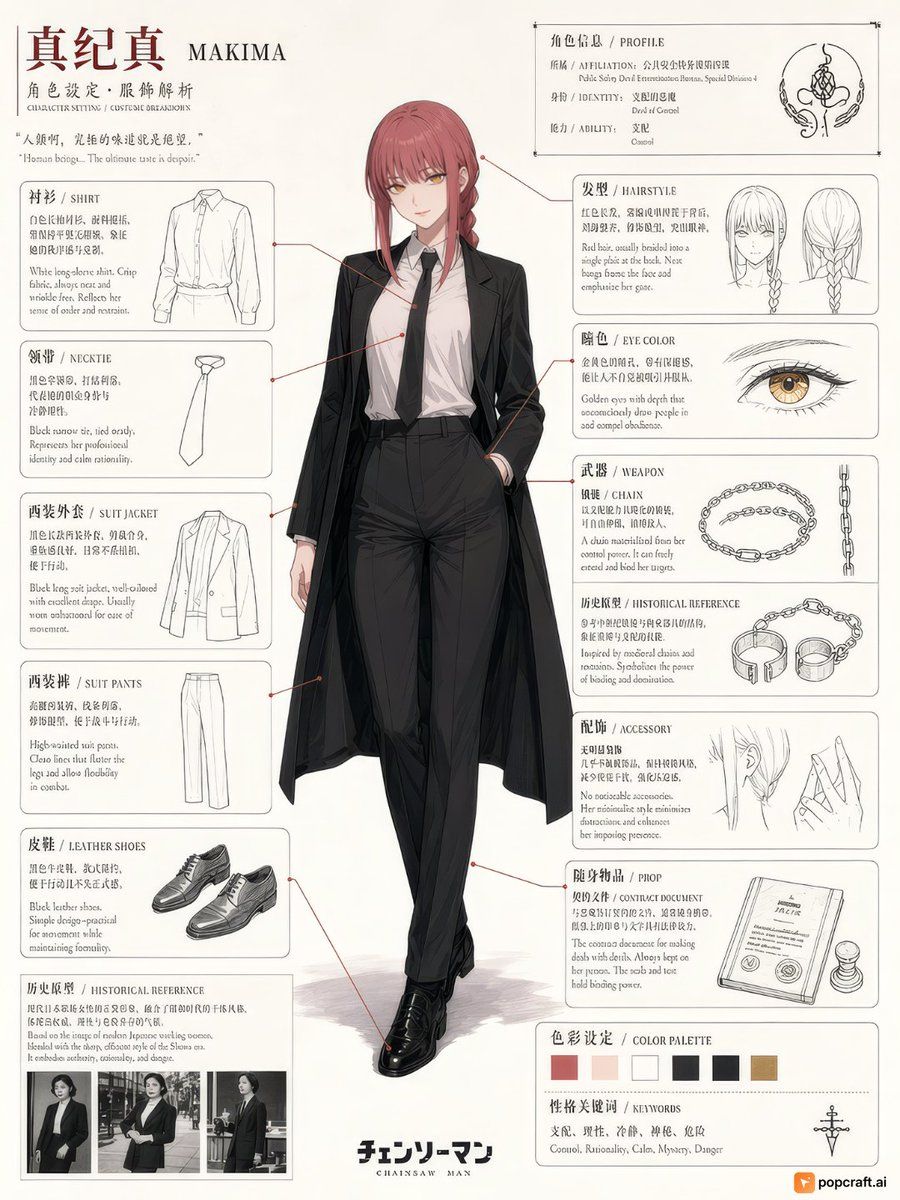
Chainsaw Man Makima Character Design Sheet
View full prompt & copy

Goal: Create a detailed anime character design sheet for Makima from Chainsaw Man. Canvas: Vertical layout, clean white background with black text and line art. Layout: Central full-body illustration of the character. Surrounding panels detail specific costume elements, physical traits, and profile information. Subject details: Makima stands in the center wearing a long-sleeved white button-down shirt tucked into high-waisted black trousers, a black necktie, and a long black coat draped over her shoulders like a cape. She has red hair braided at the back with bangs framing her face, golden eyes with distinct rings, and black leather shoes. Her expression is calm and composed. Sections: - Top Left: Title "Makima" (真纪真) and subtitle "Character Setting / Costume Breakdown". - Top Right: Profile box listing Affiliation (Public Safety Devil Extermination Bureau), Identity (Divine of Control), and Ability (Control). - Left Column (Costume Breakdown): Panels for Shirt, Necktie, Suit Jacket, Suit Pants, Leather Shoes, and Historical Reference (showing photos of women in suits). - Right Column (Physical & Props): Panels for Hairstyle (front/side/back views), Eye Color (close-up of golden eye), Weapon/Chain (illustration of chains), Historical Reference (chains/handcuffs), Accessory (earring/hand gesture), Prop (contract document and stamp), Color Palette (swatches of red, beige, black, gold), and Keywords (Control, Rationality, Calm, Mystery, Danger). Visual style: High-quality anime illustration mixed with technical fashion sketching. Clean lines, precise shading on clothing folds, and elegant typography. Text content: Include bilingual labels (English/Japanese) for each section header as seen in the reference image.

Generate image
GPT Image 2.5
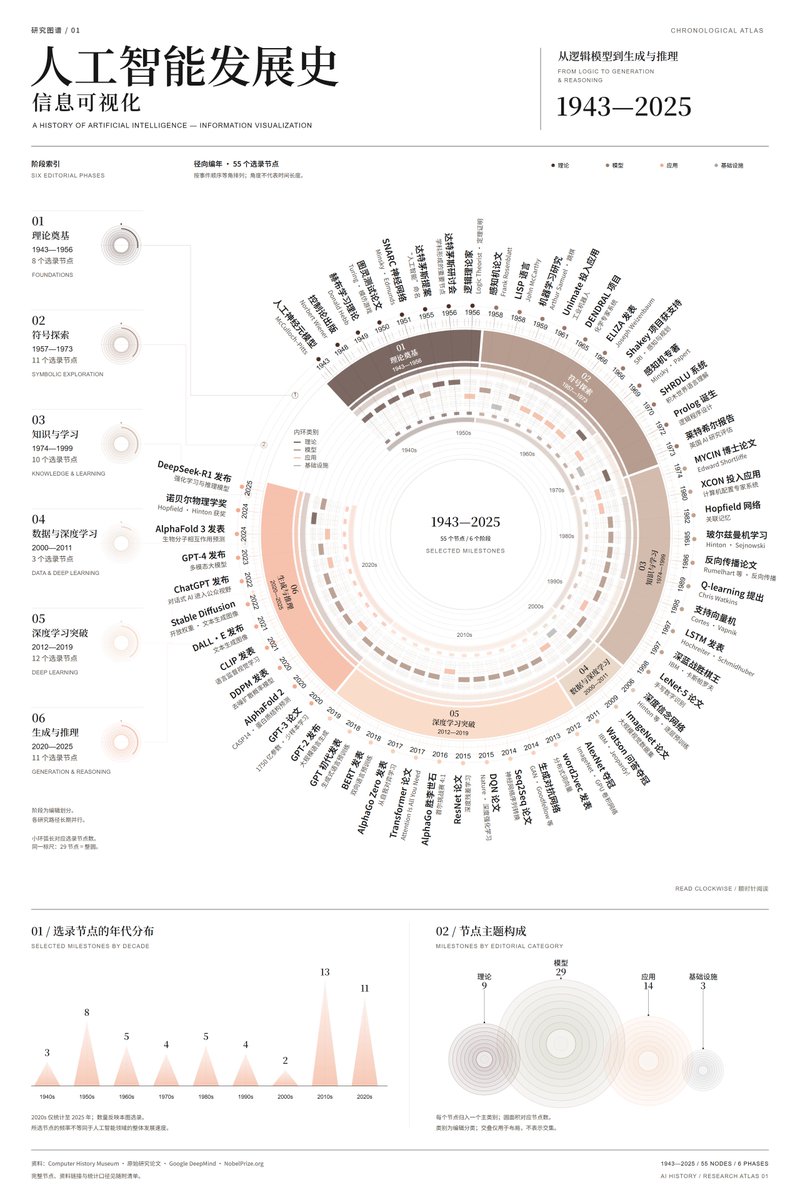
AI History Chronological Atlas Infographic
View full prompt & copy

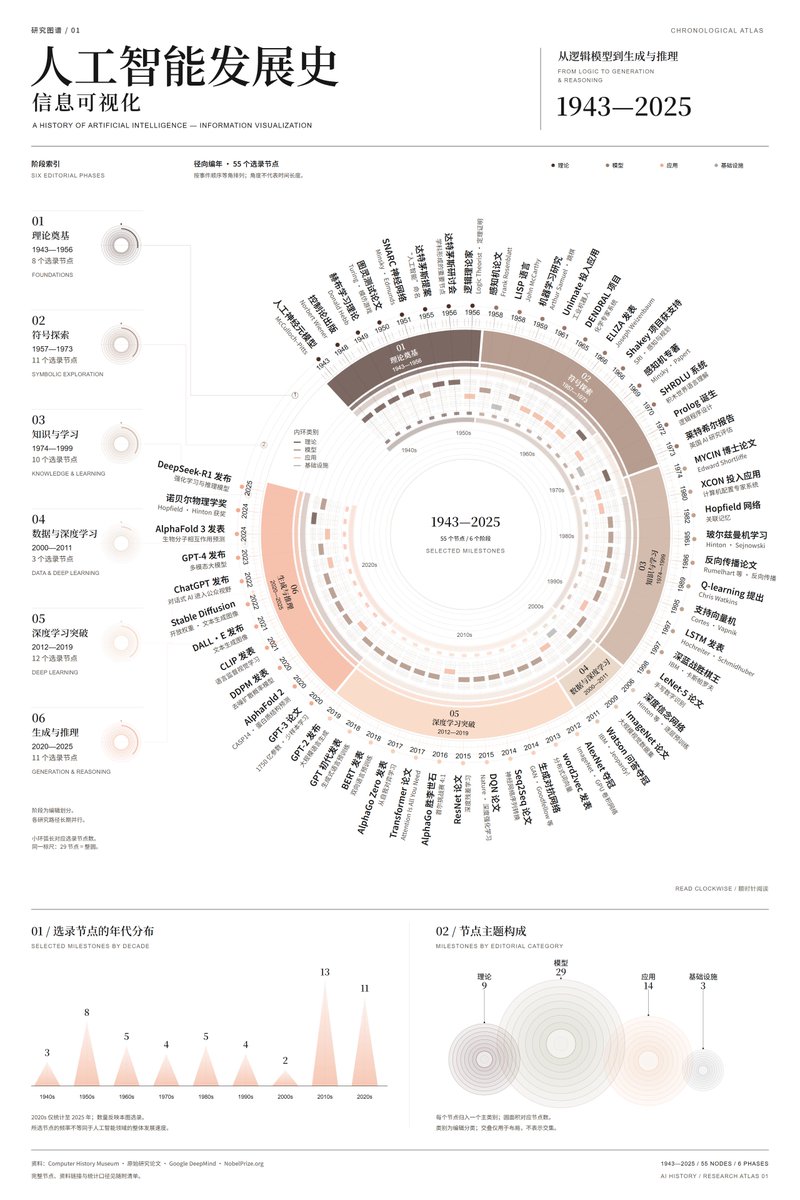
Goal: Create a sophisticated, high-density chronological atlas infographic visualizing the history of Artificial Intelligence from 1943 to 2025. Canvas: Vertical layout with a clean, academic aesthetic. Background is off-white/light gray. Primary colors are muted earth tones (terracotta, beige, dark brown) and black text. Layout: The design is divided into three main sections: a header, a central radial visualization, and a footer with statistical breakdowns. Header Section: - Top Left: Large Chinese title "人工智能发展史" (History of AI), subtitle "信息可视化" (Information Visualization). English subtext: "A HISTORY OF ARTIFICIAL INTELLIGENCE — INFORMATION VISUALIZATION". - Top Right: A boxed section titled "从逻辑模型到生成与推理" (From Logic Generation & Reasoning) with the date range "1943—2025" in large serif font. - Legend: Small dots indicating categories like Theory, Model, Application, Infrastructure. Central Radial Visualization (The Core): - Structure: A complex concentric circular chart (radial timeline). - Center: Text "1943—2025" and "55 SELECTED MILESTONES". - Rings: Multiple concentric rings representing decades (1940s to 2020s moving outward/inward depending on specific layer logic, but generally chronological flow). - Segments: The circle is divided into 6 colored arcs corresponding to historical phases. Labels for these phases appear on the left side as a vertical list: 1. 理论奠基 (Foundations) 1943-1956 2. 符号探索 (Symbolic Exploration) 1957-1973 3. 知识与学习 (Knowledge & Learning) 1974-1999 4. 数据与深度学习 (Data & Deep Learning) 2000-2011 5. 深度学习突破 (Deep Learning Breakthrough) 2012-2019 6. 生成与推理 (Generation & Reasoning) 2020-2025 - Data Points: Numerous small labels radiating outwards or placed along the rings, citing specific milestones. Examples visible include: "McCulloch-Pitts", "Turing Machine", "Perceptron", "ELIZA", "Expert Systems", "Backpropagation", "AlexNet", "AlphaGo", "Transformer", "GPT-3", "ChatGPT", "Sora". Footer Section: - Bottom Left: Bar chart titled "01 / 选录节点的年代分布" (Selected Milestones by Decade). Shows counts per decade (e.g., 8 in 1950s, 13 in 2010s). - Bottom Right: Bubble/Donut chart titled "02 / 节点主题构成" (Milestones by Editorial Category). Four circles sized by count: Theory (9), Model (29), Application (14), Infrastructure (3). Visual Style: Swiss International Design style. High contrast typography. Use thin lines for connectors. Clean sans-serif fonts for data, serif for titles. Professional, editorial look.

Generate image
GPT Image 2
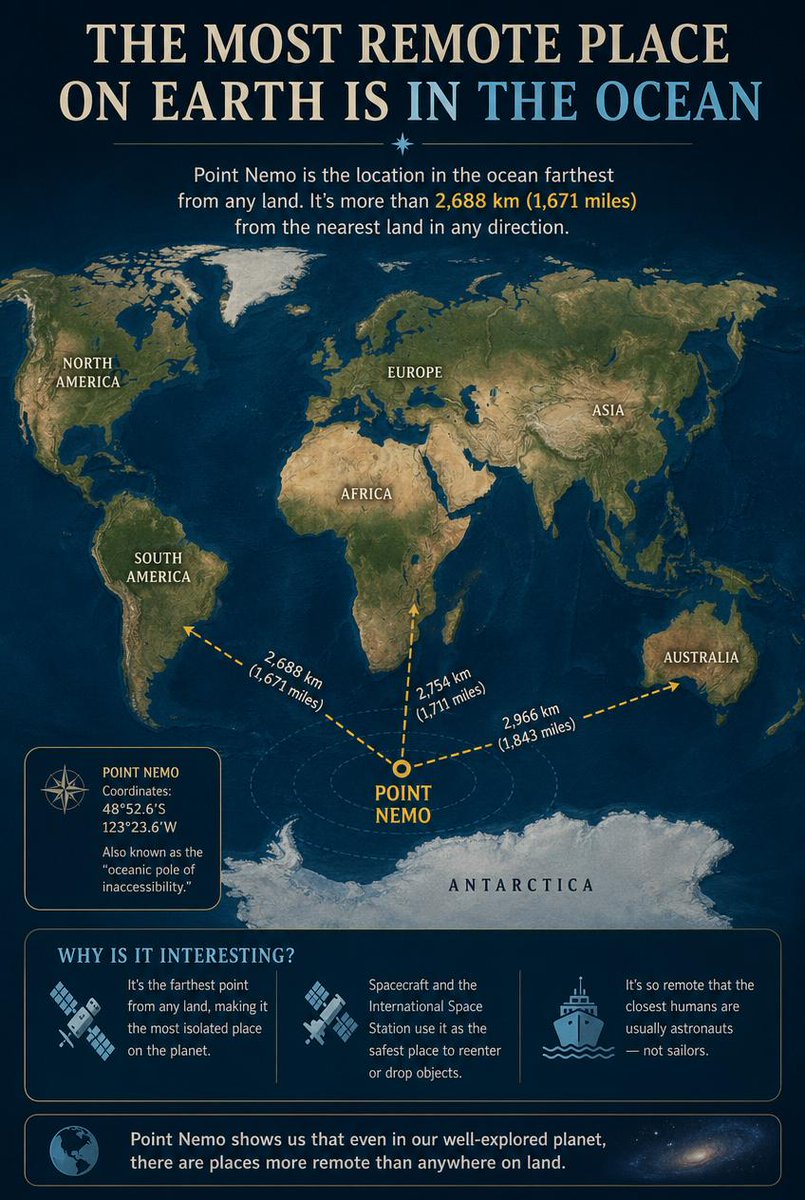
Point Nemo Infographic
View full prompt & copy

Goal: Create an educational infographic explaining Point Nemo, the most remote place on Earth located in the ocean. Canvas: Vertical portrait layout with a deep navy blue background and a subtle starry night sky texture at the top. The style is clean, modern, and informative, using gold and white text for high contrast. Layout: 1. **Header:** Large serif title "THE MOST REMOTE PLACE ON EARTH IS IN THE OCEAN" (with "IN THE OCEAN" highlighted in light blue). Below it, a small introductory paragraph defining Point Nemo as the location farthest from land, mentioning the distance of 2,688 km (1,671 miles). 2. **Central Map:** A stylized world map centered on the South Pacific Ocean. Continents are rendered in muted earth tones (greens, browns) against dark blue oceans. Labels include NORTH AMERICA, SOUTH AMERICA, EUROPE, ASIA, AFRICA, AUSTRALIA, and ANTARCTICA. 3. **Data Visualization:** A bright yellow dot marks "POINT NEMO" in the ocean south of Easter Island. Three dashed yellow arrows radiate from this point to the nearest landmasses, labeled with distances: "2,688 km (1,671 miles)" to Antarctica, "2,754 km (1,711 miles)" to South America, and "2,966 km (1,843 miles)" to Australia. 4. **Info Box (Left):** A rectangular box with a compass icon containing the coordinates "48°52.6'S 123°23.6'W" and the nickname "oceanic pole of inaccessibility." 5. **Bottom Section:** A section titled "WHY IS IT INTERESTING?" with three columns featuring icons and text: - Icon: Satellite dish. Text: "It's the farthest point from any land, making it the most isolated place on the planet." - Icon: Space station/satellite. Text: "Spacecraft and the International Space Station use it as the safest place to reenter or drop objects." - Icon: Ship. Text: "It's so remote that the closest humans are usually astronauts — not sailors." 6. **Footer:** A concluding statement next to a globe icon: "Point Nemo shows us that even in our well-explored planet, there are places more remote than anywhere on land." Visual Style: Professional infographic design. Use clear sans-serif fonts for body text and serif fonts for headings. Ensure the map projection clearly highlights the isolation of the central point.

Generate image
GPT Image 2
Thermal Imaging Photo of Person
View full prompt & copy

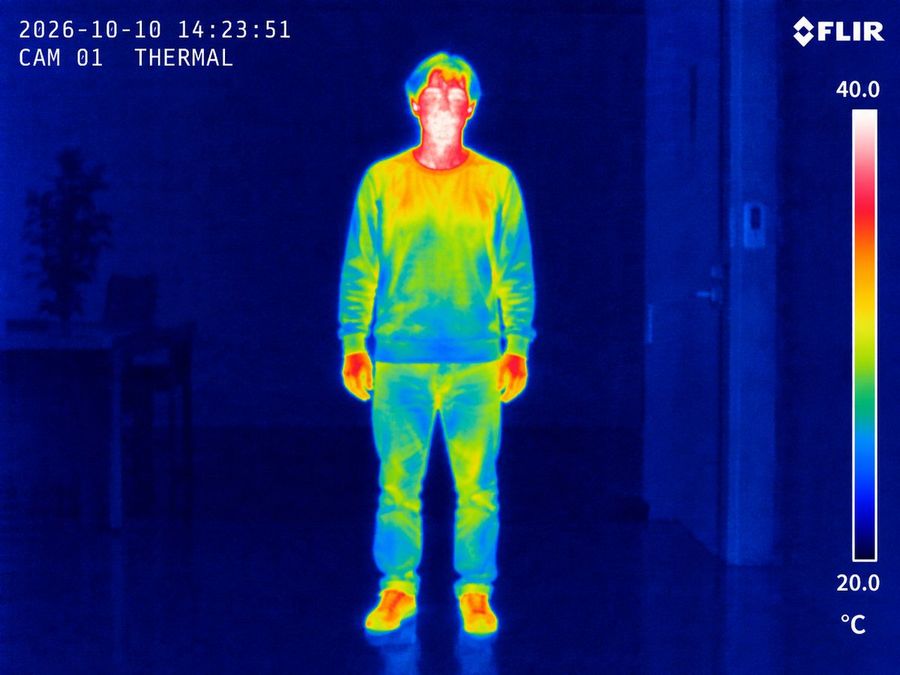
A realistic thermal imaging photograph of a person standing in an indoor environment, captured with a FLIR camera. The subject is wearing a long-sleeved shirt and pants, rendered in the classic rainbow color palette where hot areas (face, hands, feet) appear white/yellow/red and cooler areas (clothing, background) appear blue/purple. In the top left corner, there is digital overlay text reading '2026-10-10 14:23:51' and 'CAM 01 THERMAL'. In the top right corner, the white 'FLIR' logo is visible. On the far right edge, a vertical temperature scale bar ranges from 20.0°C at the bottom to 40.0°C at the top. The background shows a dimly lit room with a plant on the left and a door frame on the right.

Generate image
GPT Image 2.5
Character Reference Sheet: Rainbow Mika
View full prompt & copy

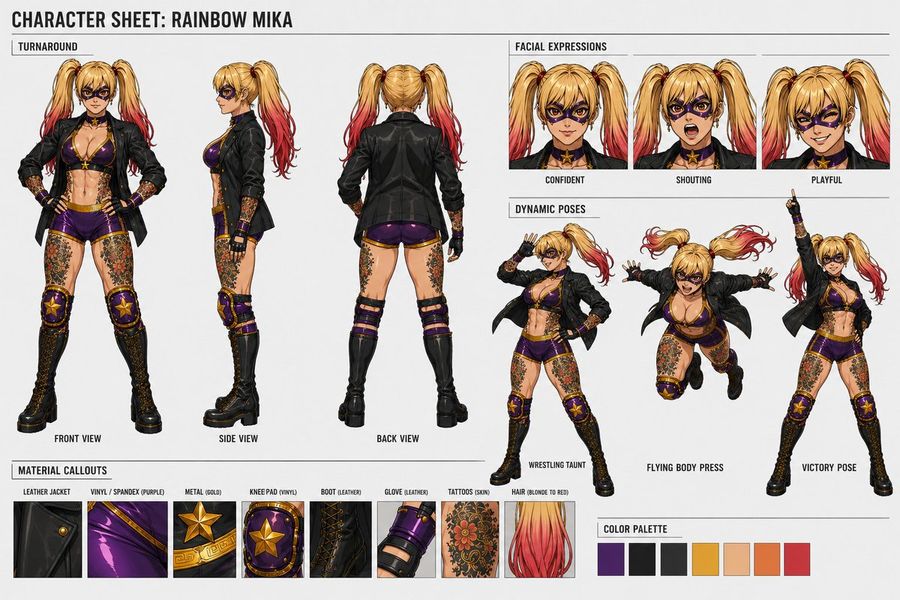
Goal: Create a professional character reference sheet for a female wrestler-inspired superhero named Rainbow Mika. Canvas: Horizontal 16:9 layout with a clean, light gray background and bold black section headers. Layout: Organized into four distinct sections: Turnaround (left), Facial Expressions (top right), Dynamic Poses (middle right), and Material Callouts/Color Palette (bottom). Subject details: The character has blonde hair in twin-tails with red tips, wearing a purple eye mask, a cropped black leather jacket, a purple vinyl bra top with gold star accents, matching purple shorts, knee pads with gold stars, and tall black lace-up boots. She features extensive floral tattoos on her arms and legs. Sections: - Turnaround: Three full-body views labeled "FRONT VIEW," "SIDE VIEW," and "BACK VIEW." - Facial Expressions: Three headshots labeled "CONFIDENT," "SHOUTING," and "PLAYFUL." - Dynamic Poses: Three action poses labeled "WRESTLING TAUNT," "FLYING BODY PRESS," and "VICTORY POSE." - Material Callouts: Eight square close-ups showing textures for Leather Jacket, Vinyl/Spandex (Purple), Metal (Gold), Knee Pad (Vinyl), Boot (Leather), Glove (Leather), Tattoos (Skin), and Hair (Blonde to Red). - Color Palette: A row of six solid color swatches at the bottom right. Visual style: High-quality digital illustration, comic book art style, sharp lines, vibrant colors, and realistic shading.

Generate image
GPT Image 2.5
AI Development History Infographic
View full prompt & copy

Create a high-density, professional infographic titled "A History of Artificial Intelligence — Information Visualization" (人工智能发展史). The design should be a chronological radial atlas covering the years 1943–2025. Layout and Structure: - Top Header: Large title text in Chinese and English. Subtitle: "From Logic to Generation & Reasoning 1943—2025". - Left Sidebar: A vertical list of six editorial phases (01 Foundations, 02 Symbolic Exploration, 03 Knowledge & Learning, 04 Data & Deep Learning, 05 Deep Learning Breakthroughs, 06 Generation & Reasoning), each with a small circular icon and year range. - Central Visual: A complex concentric ring chart (radial timeline) representing decades from the 1940s to the 2020s. - Radial Labels: Numerous AI milestones arranged along the rings, connected by lines to their specific years. Examples include: McCulloch-Pitts Neuron, Turing Test, Perceptron, Expert Systems, Backpropagation, AlexNet, GANs, Transformers, AlphaGo, BERT, GPT series, Stable Diffusion, ChatGPT, Sora, and Llama. - Color Coding: Use a palette of muted earth tones (terracotta, beige, dark brown, grey) to differentiate between categories like Theory, Models, Applications, and Infrastructure. - Bottom Section: Two data visualization panels. Left panel shows a bar chart of milestone distribution by decade. Right panel uses nested circles to show the composition of nodes by category (Theory, Model, Application, Infrastructure). Style: Minimalist, academic, clean typography, high information density but legible. White background.

Generate image
GPT Image 2.5
Three-Panel Character Style Comparison
View full prompt & copy

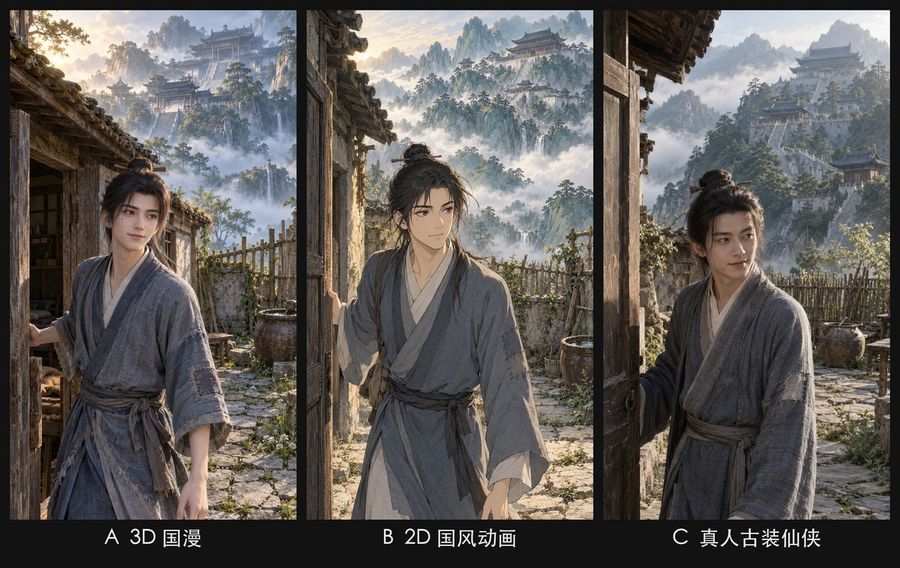
Create a high-resolution, three-panel horizontal image showcasing the same young male character in three distinct visual styles. The panels should be separated by thin black vertical lines. **Panel A (Left): 3D Chinese Animation Style.** Rendered with realistic lighting and textures typical of modern 3D animation films. The character is a handsome young man with long dark hair tied in a topknot, wearing a tattered grey robe with a white under-layer and a sash. He stands near a wooden door frame, looking slightly to his left with a calm expression. Background: A misty mountain landscape with traditional Chinese architecture and waterfalls. **Panel B (Center): 2D Chinese Anime Style.** Rendered as a clean, flat-shaded illustration with distinct outlines. The character has the same pose, clothing, and hairstyle as Panel A but drawn in an anime aesthetic. The background is a painted version of the same misty mountain scene. **Panel C (Right): Live-Action Ancient Costume Xianxia Style.** Photorealistic style resembling a still from a high-budget Chinese fantasy drama. The character looks like a real actor with natural skin texture, wearing the same costume. The lighting is cinematic and soft. The background is a photorealistic rendering of the misty mountains and village. **Text Overlay:** At the bottom of each panel, include white text labels on a black bar: - Under Panel A: "A 3D 国漫" - Under Panel B: "B 2D 国风动画" - Under Panel C: "C 真人古装仙侠"

Generate image
GPT Image 2.5
Editorial Food-Art Poster Prompt
View full prompt & copy

Create a premium 3:4 vertical editorial food-art poster for [COUNTRY / CITY / LOCAL DISH / FOOD SUBJECT]. TEXT-TO-IMAGE ONLY. Generate the entire composition from the written dish or food subject alone. Do not request, upload, use, or depend on any reference image or existing photograph. Automatically identify the dish’s authentic appearance, ingredients, textures, and cultural identity. CORE CONCEPT: Create one elegant travel-food editorial poster combining realistic food photography in the upper section with a handmade ingredient-observation sketchbook in the lower section. Feature ONE recognizable plate or bowl containing a single dish, with at least three visually distinct ingredients. UPPER SECTION — REALISTIC FOOD PHOTOGRAPHY: Occupy approximately 48% of the canvas height. Create a beautifully composed, authentic photographic view of the specified local dish, preserving believable ingredient textures, natural lighting, realistic proportions, and culturally accurate presentation. Use subtle food-magazine color grading and extremely light film grain. Keep the entire plate or bowl visible. SECTION DIVIDER: Separate both sections with a straight, clean horizontal boundary. A very thin warm-ivory paper strip is optional. No gradients, blending, or elements crossing the divider. LOWER SECTION — INGREDIENT OBSERVATION SHEET: Use warm ivory drawing paper with visible fibers, fine grain, faint smudges, and subtle handmade irregularities. Create a sparse, asymmetrical food-field-note composition rather than repeating the full photographic dish. Place ONE small, simplified but recognizable illustration of the complete dish near the center. Keep it secondary and compact, occupying approximately one-third of the lower section’s width. Around it, illustrate 3–6 individually selected ingredients inferred from the dish. Use small watercolor specimens, cut-surface studies, herb sketches, grain clusters, sauce swatches, or distinctive ingredient shapes. Arrange them at varied sizes and angles with generous breathing room. DRAWING STYLE: Matte gouache, delicate black-ink outlines, slightly hesitant hand-drawn strokes, dry-brush gaps, uneven pigment coverage, soft watercolor edges, visible paper texture, and restrained natural colors. Keep ingredients recognizable without excessive detail. Add a few fine arrows and small handwritten numbers connecting specimens to the miniature dish. TYPOGRAPHY: Use minimal, understated editorial annotations only when helpful. Short ingredient names or tiny handwritten notes are acceptable. Keep all text small and secondary; avoid unnecessary titles or decorative lettering. COLOR PALETTE: Derive the colors naturally from the dish, balanced by warm cream, muted earth tones, and subtle ink details. FINAL AESTHETIC: Authentic local food photography × handmade ingredient studies × refined travel-food editorial × collectible culinary field notebook. AVOID: Multiple dishes, duplicate plates, mixed

Generate image
GPT Image 2.5
Kintsugi Tea Bowl Exhibition Poster
View full prompt & copy

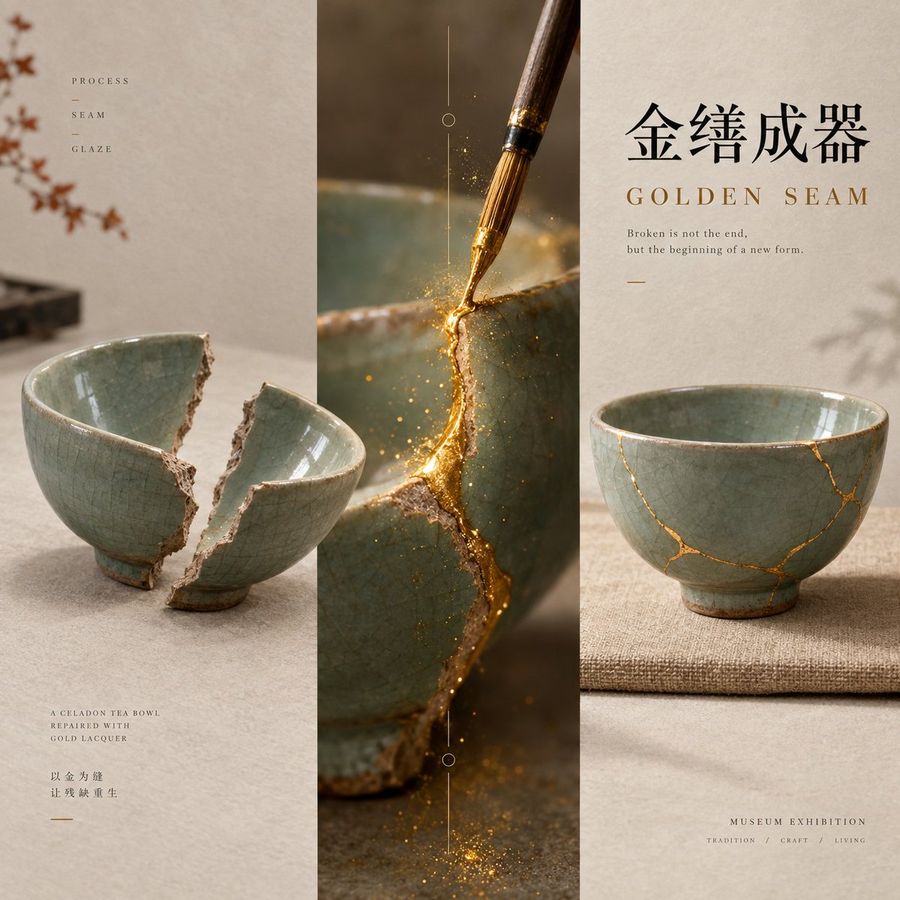
Theme: Kintsugi tea bowl repair Chinese title: Gold Repair Becomes Vessel English title: GOLDEN SEAM Initial state / material: A cracked celadon tea bowl split into two pieces, cool gray-green glaze, visible raw clay fracture edges Transformation process: Fine gold lacquer seams being brushed along the cracks, tiny gold dust catching light Completed state: The same celadon bowl fully restored with luminous gold kintsugi lines, upright on a linen mat Central change axis: The gold lacquer repair seam itself — wet gold meeting clay fracture Correspondence: Crack / seam Main colors: celadon green, warm gold, ivory paper, soft charcoal Accent colors: muted rust Research node: PROCESS · SEAM · GLAZE Aspect ratio: 9:16 Generate a mature cultural exhibition poster with strong material expression and a craft-transformation central-axis composition. The core is not two unrelated objects side by side — the material change itself becomes the composition. Left side shows the INITIAL cracked celadon tea bowl pieces. Right side shows the COMPLETED gold-repaired bowl. Center is the critical craft moment where gold lacquer fills the fracture. Viewers must understand without reading: original material → craft happening → finished state. Left and right must truly belong together: the same bowl form, matching fracture edges that could rejoin, identical celadon glaze language. The central axis is not a plain color band — it is where transformation occurs (gold lacquer meeting clay). Add 2–3 extremely restrained correspondence lines or process marks, never a process PPT. Materials must read real: celadon glaze, raw clay, gold lacquer, linen, paper — clear stable surface logic. Do not replace material detail with noise or heavy aging. Typography relates to the craft logic and may cross materials, sit near the central seam, or lightly intersect the subject. Avoid fixed four-character vertical stacks or one giant central character every time. Include one small research node totaling about 6% of the frame (PROCESS / SEAM / GLAZE). First glance: material contrast. Second: the central repair happening. Third: why left and right are one craft process. Museum Exhibition Poster × Contemporary Editorial Graphic Design × East Asian Cultural Visual. High clarity, clean structure, concentrated information. Avoid: unrelated left/right content, broken process logic, plastic materials, random cracks, excessive flame, complex tool diagrams, too many technical parameters, mechanical three-column layout, PPT info boxes, heavy aging, low-finish AI poster look.

Generate image
GPT Image 2
Tsing Hua Arts Festival Poster Design
View full prompt & copy

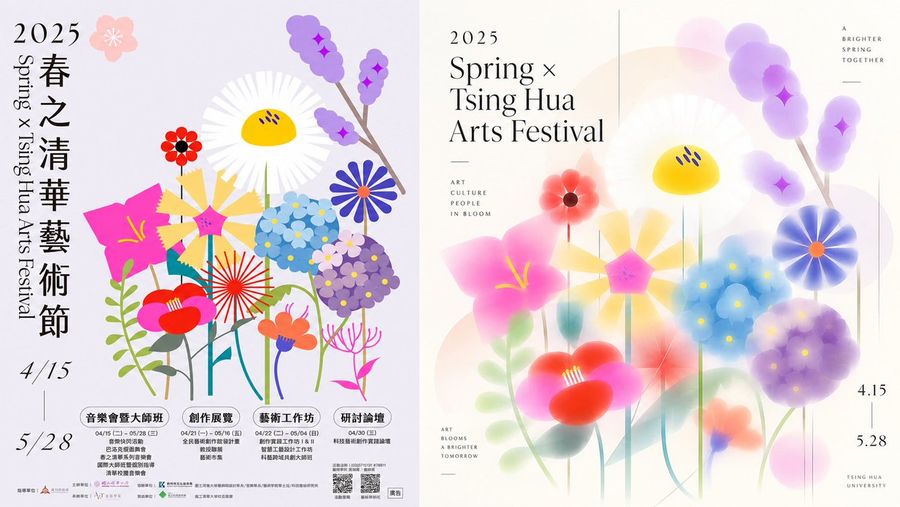
Create a split-screen graphic design poster for the '2025 Spring x Tsing Hua Arts Festival'. The left side features a clean white background with vibrant, flat vector-style illustrations of flowers including a large daisy, pink lilies, blue hydrangeas, and purple lilacs. Vertical Chinese text on the far left reads '2025 春之清華藝術節' alongside English text 'Spring x Tsing Hua Arts Festival'. The bottom left contains four distinct event categories: '音樂會暨大師班', '創作展覽', '藝術工作坊', and '研討論壇', each with specific dates (4/15-5/28) and small QR codes. The right side displays a soft-focus, dreamy version of the same floral arrangement against a warm, hazy cream background. Large serif typography at the top reads '2025 Spring x Tsing Hua Arts Festival', accompanied by smaller text 'ART CULTURE PEOPLE IN BLOOM'. The bottom right shows the dates '4.15 — 5.28' and the logo 'TSING HUA UNIVERSITY'.

Generate image
Loading more prompts

FAQ

Where do YouMind prompts come from?
YouMind curates high-signal AI prompt examples from creator communities and public creative workflows. The library focuses on prompts that are useful to inspect, reuse, and adapt.
How are image prompt categories organized?
Image prompts are grouped into use cases, styles, and subjects. Use cases describe the job to be done, styles describe the visual treatment, and subjects describe what the image is mainly about.
How are prompts assigned to categories?
YouMind uses AI to analyze each image prompt, its title, metadata, and generated result when available, then assigns the closest categories. Editors can refine categories as the taxonomy evolves.
What is YouMind?
YouMind is an AI workspace for turning research, ideas, and creative references into usable outputs. The prompt library is one public part of that workflow, built to help creators learn from strong examples faster.