
Viral AI Character Deconstructor
Deconstruct viral AI characters → your clone-proof IP plan.
Viral AI Character Deconstructor
Deconstruct viral AI characters → your clone-proof IP plan.
Showcase
Description
See someone racking up views with an AI virtual character (fixed persona + borrowed viral moves) and want in — but stuck on three things: what actually made it blow up? Will copying it get me shadowbanned or hit with IP claims? How do I build my own character that's instantly recognizable and impossible to clone? This skill breaks any viral AI-persona account down to the studs: account layer, character layer, content layer, and spread-mechanism layer — plus frame-by-frame video analysis to extract a replicable shot template. From there it gives you 3 original character directions (with anti-clone checks), a channel-packaging plan, your first 10 content briefs, and a review playbook. What you get is a ready-to-execute "research report + design spec + handoff prompts" — not a clone. Every claim is tagged by evidence level; any revenue or follower numbers are marked [claimed], never fabricated, and no earnings are promised.
Best for
Creators and strategists developing an original AI-character channel inspired by viral formats without copying existing IP.
How to use this Skill
Provide your input
Provide material about a viral AI-character account, such as screenshots or video, plus your niche, audience, and goals.
Run the Skill
The Skill analyzes the account’s positioning, character, content, and distribution patterns, then separates transferable ideas from imitation and rights risks.
Review your result
Receive an evidence-labeled research report, original character directions, channel packaging guidance, initial content briefs, and a review plan.
Related Skills
View all Image
ImageAI Influencer Character Studio
Don't just generate a face. Build a character people can recognize. AI Influencer Character Studio turns an idea or style reference into an original adult AI influencer with a defined look, personality, lifestyle, and reusable reference package. Choose photorealistic, anime, 3D, comic, or illustrated styles. DEFINE THE IDENTITY Build a Character Bible: your character's facial features, hair, eyes, body proportions, distinctive marks, and signature accessories, plus reusable identity and negative prompts. BUILD THE REFERENCE SET Approve your master portrait first, then create a 10-part set covering facial angles, profile, hair, full-body views, expressions, and a lifestyle scene. Images are checked against the approved identity, with visible inconsistencies flagged for review and targeted repair. GIVE YOUR CHARACTER A LIFE Develop a niche, personality, voice, backstory, wardrobe direction, daily life, target audience, and content pillars. Create a character with a world, not just a look. CONTINUE WITHOUT STARTING OVER Receive a portable HANDOFF.md containing your character profile, image inventory, prompt log, decisions, and next-session roadmap. Bring it back to resume later or carry the documented identity into another tool. Start with a clear vision, an inspiration image, or no idea at all. Guided questions and suggested defaults help you shape the character step by step. Works in your language, with English image prompts and explanations in your language. If image generation is unavailable, you receive a copy-ready prompt package instead. For original adult characters only, not real-person replicas. Video production and social media management are not included.
 Video
VideoUGC Product Video Studio
Turn a product photo into a complete UGC video workflow: a lifelike AI creator, a connected sequence of scenes, natural dialogue, and prompts tailored to your chosen video model. Built for product owners, marketers, and creators who want to show their product through a believable everyday story. You guide the creative decisions: • Design your character step by step. Approve the look, refine specific features, or request a different person. • Build a sequence of portrait shots, product details, demonstrations, location changes, and a product-only closing shot. • Explore image variations and approve the final scene set before the script is finalized. • Review the scenario and spoken text, then adjust the hook, tone, pacing, or closing line. Realism goes beyond skin texture. Prompts account for natural facial detail, smartphone framing, lighting, and character consistency. Images are checked for awkward grips, floating caps, nozzle direction, and other physical contradictions. Complex actions can be simplified or split into separate shots before animation. Choose your platform, video model, spoken language, and audio method: • Speech generated directly inside the video. • Separate speech text or audio for lip sync. • Off-screen narration. Prompts adapt to the selected model, with language and audio support checked for that route. After approval, generate the video in YouMind, prepare a prompt package for another platform, or stop with the production report. Receive complete image and video prompts, the approved script, reference mappings, timing, and quality-check notes. Your character. Your scenes. Your approval at every key stage.
 Write
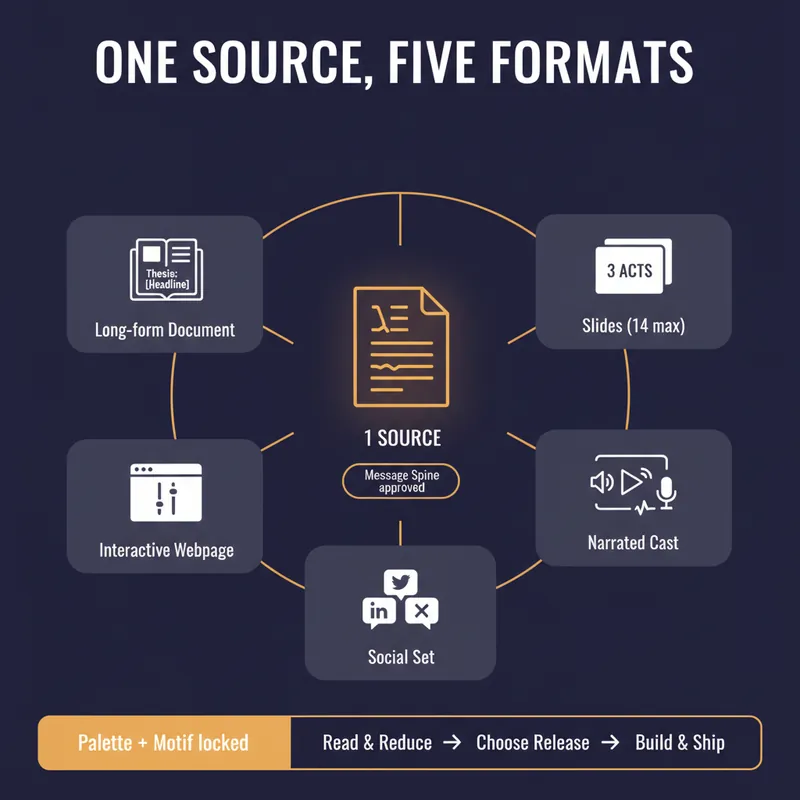
WriteOne Source, Five Formats
YouMind can produce a document, a slide deck, a narrated video, an interactive webpage and a set of social posts. Most people use one of them, because doing all five by hand means writing the same argument five times and watching it drift a little further each time. This skill stops the drift by refusing to start until you have a spine. Before anything is generated it writes a Message Spine: one thesis under 25 words, three load-bearing points, the single strongest piece of evidence, the one image a reader should still have tomorrow, the change you want in them, and who this is explicitly not for. You approve it. Every format is then built from the spine, never from the previous format, so nothing compounds an earlier compromise. Then it tells you which formats are actually worth making. A short reflective essay makes bad slides. A dense data teardown makes bad audio. It will recommend two formats and explain why the other three would weaken the work, which is the opposite of what a content-multiplier is supposed to say. Each format gets built to its own rules, one at a time, with your confirmation. Slides get one idea per slide and speaker notes that carry the argument. The cast script is written for the ear, with numbers rounded and given a comparison and a deliberate pause before the strongest evidence. The webpage gets exactly one interactive move the flat text could not do. The social set opens each post on a different point so it does not read as three copies of itself, and every post gives away something real instead of begging for a click. One palette, one type treatment, one recurring motif, decided in writing before the first image is generated. You finish with a ship sheet: what goes where, in what order, how many days apart, with what call to action, and the one signal to watch. Plus a consistency check that quotes the thesis sentence from every format and confirms they still agree. It estimates credits before it spends them and never renders a full cast or image set without an explicit yes.
Information
- Version
- v3
- Last updated
- Runtime credits
- Usage-based
- Models
- Auto
- Use cases
- Research & analysisMarketing & growthBusiness & strategy
- What you get
- ReportBriefPlan
