Michael Colligon
 Write
WritePre-Publish Integrity Audit
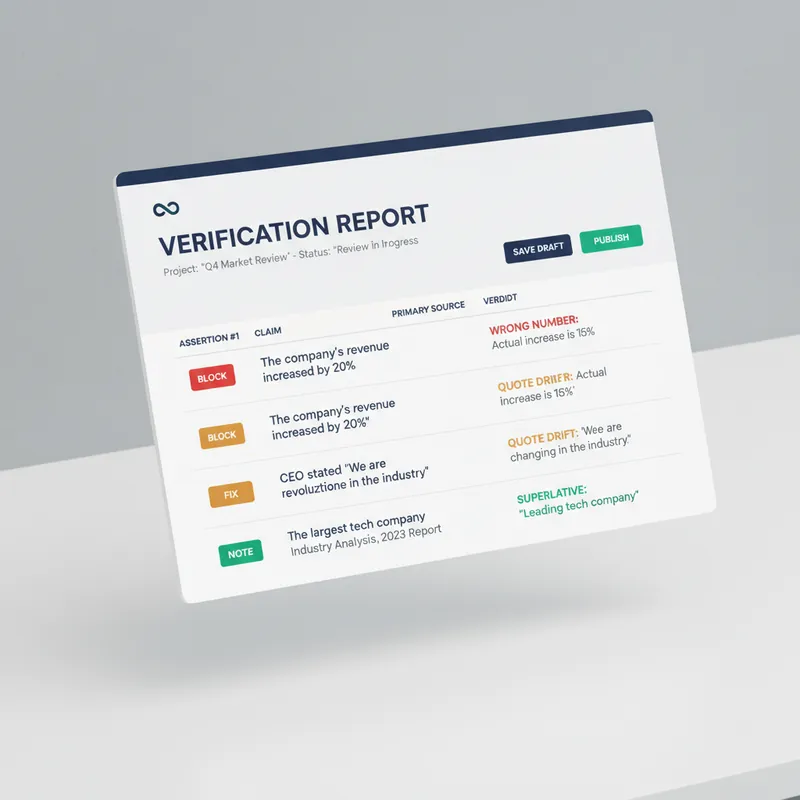
Every generator in the marketplace makes first drafts. Almost nothing checks them before they go out with your name on top. This is the desk between your draft and the public. It does not improve your prose. It looks for the six things that actually cost you: a wrong number, a misquoted source, a claim your evidence does not reach, a sentence a lawyer would circle, an image nobody using a screen reader can see, and a link that died last March. Six passes. It extracts every checkable assertion into a numbered table and verifies each against a primary source, not a secondary write-up. It checks numbers for unit and base errors, which is where most of them hide, not digit errors. It finds the original wording of every quote and reports the drift. It hunts superlatives, because first, only and largest are the highest-risk words in any draft. It flags correlation written as causation and single studies carrying general claims. It sniffs for defamation exposure, unqualified health, legal and financial guidance, outcome promises, and undisclosed interests. Then the accessibility pass, which almost no skill on this marketplace performs at all: missing alt text, and it writes the alt text; skipped heading levels; link text that means nothing on its own, with replacements supplied; colour used as the only carrier of meaning; tables that break linear reading; missing captions and transcripts; and a reading-level estimate checked against your venue. Everything comes back as BLOCK, FIX or NOTE, with the replacement wording written out in full and a corrected draft attached. It will not tell you to consider rephrasing. It hands you the sentence. It also tells you what it could not verify, and why. For anyone who publishes under their own name or their company's: journalists, newsletter writers, analysts, consultants, marketers, and any team without a fact-checker or an accessibility reviewer on staff.
Recall Engine: Study Kit from Sources
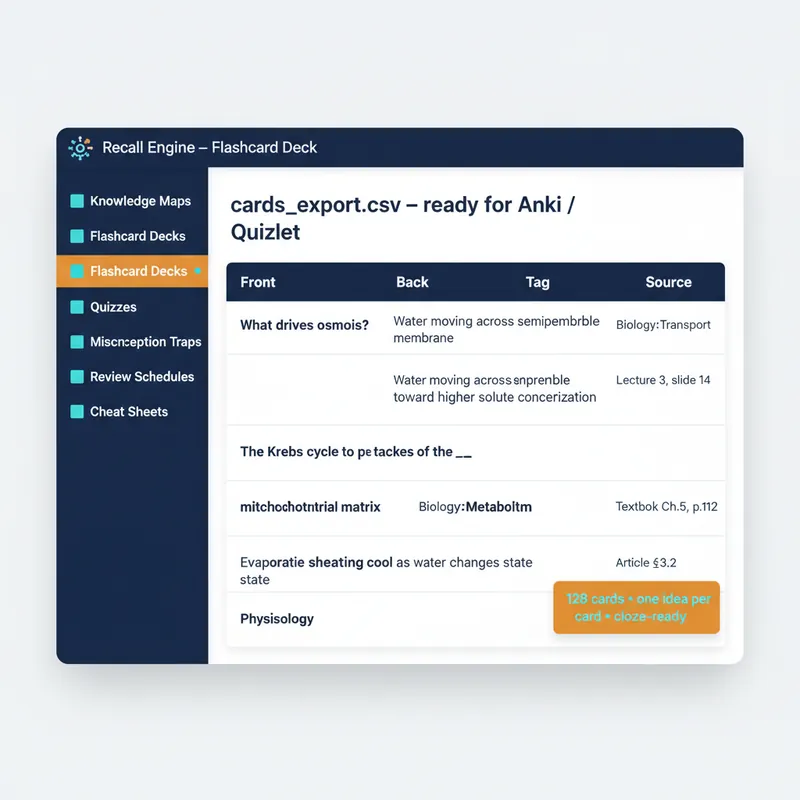
You read it. You highlighted it. A week later it is gone. YouMind is very good at helping you collect and create. Recall Engine handles the part in between: actually keeping what you read. Point it at a board, an article, a PDF, a lecture or a podcast transcript and it builds a complete study system out of that specific material — not a generic summary. What you get: • A testable knowledge map that separates the 8-15 things you must know from the detail and the context, each tied to its source • A ready-to-import flashcard deck as CSV — paste straight into Anki, Quizlet or a spreadsheet — written to real card-design rules: one idea per card, cloze for definitions, question form for causes, nothing with a four-item answer • A three-tier quiz that moves from recall to application to transfer, each question with its answer, its source, and the wrong answer you were most likely to pick • Five misconception traps drawn from the actual material, in the form "most people think X, actually Y, and here is why the confusion happens" • A dated review schedule on expanding intervals that fits your real deadline and your real minutes per day • A one-page cheat sheet, plus the three questions your source never answers It calibrates first: exam, interview, teaching it, or long-term fluency all produce different decks. It refuses to invent a fact to make a neat card — where a source is ambiguous, the card asks about the ambiguity. Contested claims are tagged, with the counter-view on the back. Built for students, researchers, people preparing for interviews or certifications, and anyone whose reading list is longer than their memory.
 Research
Signal Room: Interview Synthesis
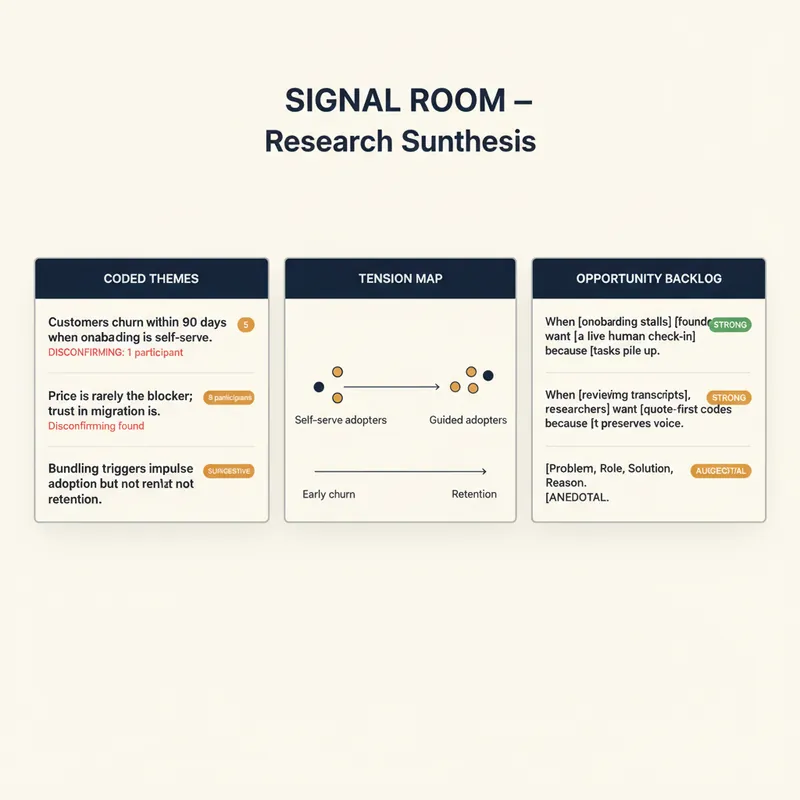
YouMind already transcribes your calls, interviews and podcasts. Signal Room is what happens next. Drop in one transcript or twenty and get back a research synthesis an actual analyst would sign: coded themes, verbatim evidence with timestamps, the places people disagree, and a ranked answer to the decision you are trying to make. The method is real qualitative practice, not summarisation: • Open coding that works quote-first — no quote, no code — with codes named in the participant's own words rather than analyst jargon • Every code tagged Behaviour, Belief or Wish, because "I would definitely pay for that" is not the same class of evidence as "I paid for that last month" • Themes stated as falsifiable sentences, with strength counted in participants rather than quotes, and disconfirming evidence hunted for on purpose • A tension map showing where your participants genuinely split and what predicts which side they fall on • An opportunity backlog written as "when [situation], [who] wants [outcome] because [reason]", each rated Strong, Suggestive or Anecdotal • A direct answer to your decision question, with a stated confidence level and what would change it • The three questions this round could not answer, and who to interview next Guardrails that matter: it never invents or polishes a quote, it refuses to report percentages on fewer than twelve participants, it pseudonymises participants by default, and it will tell you to your face when n=1 means you have a hypothesis rather than a finding. For product managers, UX and market researchers, journalists, consultants, founders doing customer discovery, and anyone sitting on hours of recordings and no findings.
 Webpage
Explorable Explainer Page Builder
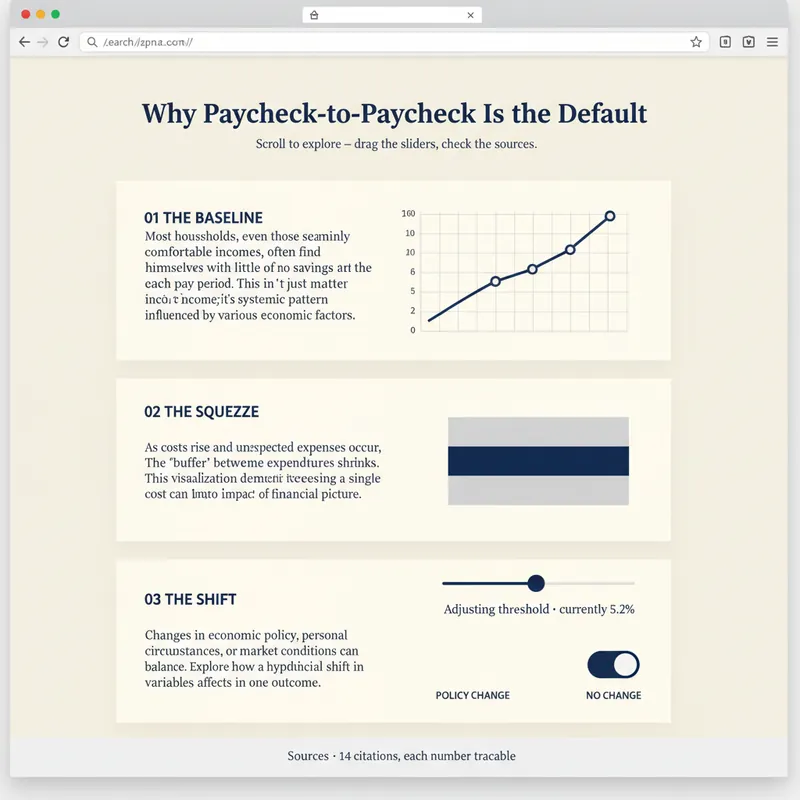
A report explains. A page lets people find out for themselves. YouMind can already build webpages. Explorable Explainer decides what to build — it turns a piece of research, a dataset or a topic into a single interactive page in the tradition of newsroom graphics and explorable explanations: scroll-driven narrative, real charts, controls you can move, sources you can check. It plans before it codes. You approve a build plan first: the one question the page answers, the reveal — the moment the reader should feel "oh" — a five to eight section scroll spine, two to four interactions each justified by what the reader learns from moving it, and a data contract listing every number and where it came from. Then it builds one self-contained HTML file with no build step. Semantic markup. All numbers in a single editable DATA constant at the top. Scroll reveals that do not break on a phone. Every control a real, keyboard-operable form element with live text describing its current value. Accessibility is built in rather than bolted on: 4.5:1 contrast, visible focus rings, alt text everywhere, no meaning carried by colour alone, reduced-motion respected, responsive from 360px. Before handing over, it runs a five-point self-review and reports the results honestly: does the reveal actually land, does the page still read with JavaScript off, is the tab order sane, is every number traceable, is anything animating that a reader would want to stop. Two rules it will not break: it never invents data to make a chart look good, and it tells you when your numbers contradict your draft. For researchers, analysts, journalists, educators, indie founders and consultants who want their work to be explored rather than skimmed.
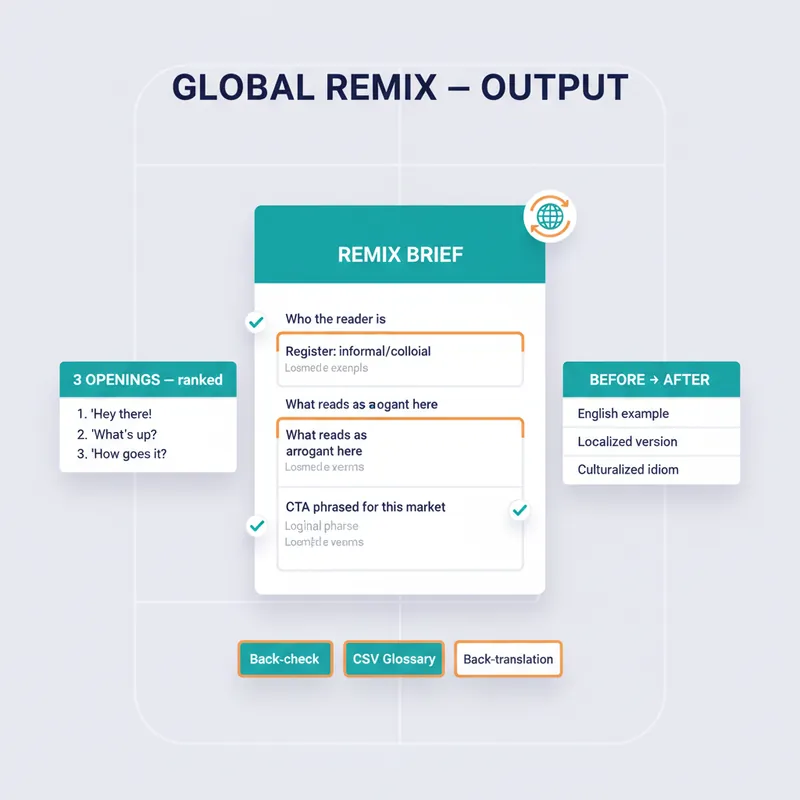
Global Remix: Market Transcreation
Most "multilingual" output is a translation wearing a hat. The argument is still shaped for the market it was born in, the examples still come from there, and the reader can feel it in the first line. Global Remix rebuilds a finished piece for another market instead of converting its words. It starts by taking your source apart: the argument spine stripped of style, the load-bearing elements that must survive unchanged (figures, product names, legal wording, quotes), the culture-bound elements that will not travel (idioms, sports references, humour, units, dates, name order, example companies, assumed knowledge), and your voice fingerprint. Then, for each target market, it writes a brief you can argue with — who the reader is, what in your piece will read there as arrogant or naive or obvious, how formal the register should be, what the channel rewards, what gets truncated in the feed, and which claims carry local risk. Then it transcreates: three market-native openings ranked with reasons, the full adapted piece restructured for that market's rhetorical habits, a before-and-after table of every swapped reference so you can veto each one, channel-sized title and cover copy, and a call to action phrased the way that market actually responds to. Finally it back-checks. Key claims are back-translated beside your original, and every drift in meaning is flagged as deliberate localisation or an accident to fix — plus a mechanical pass on currency, units, dates, name order, unintended second meanings and loaded phrases. You also get a reusable CSV glossary of do-not-translate and always-translate-this-way terms, so your next piece stays consistent. For creators and companies publishing across borders, and for anyone whose work reads slightly foreign in every market but one.

Ship Check: Pre-Publish Audit
Everything you make in YouMind eventually leaves the building — as a document, a deck, a page, a cast or a post. Ship Check is the gate before it does. It is a single, unsentimental pass across the seven things that actually cause regret after publishing. Claim integrity: every factual, numerical, causal and comparative statement is quoted back to you and classified as sourced, unsourced, unsupportable, or opinion stated as fact — including the arithmetic, where it checks whether the parts sum to the total, whether a percentage has a stated base, and whether a comparison is missing its baseline. Attribution: quotes verbatim and correctly credited, images accounted for, data sourced, and every citation it cannot resolve flagged rather than assumed. Accessibility, which almost nothing else in the gallery covers: heading order, missing alt text (it writes it for you), link text that means something out of context, contrast, meaning carried by colour alone, missing captions and transcripts, table headers, focus order, and motion that ignores reduced-motion preferences. Readability: sentence and paragraph density, undefined jargon, reading level against your actual audience — plus full rewrites of the three worst passages. Structure, channel fit and risk: whether the opening earns the second paragraph, what gets truncated in the feed, and where you have wandered into defamation, unqualified medical or financial advice, privacy exposure, indefensible superlatives, or a disclosure you are required to make. You get a verdict, a scored table, and an issue list sorted Critical to Minor — each with the exact replacement text rather than a suggestion — plus a ten-minute version if that is all you have. It only reports what it can point at, it will not soften a Critical finding to be nice, and it will never tell you something is legally safe.
 Write
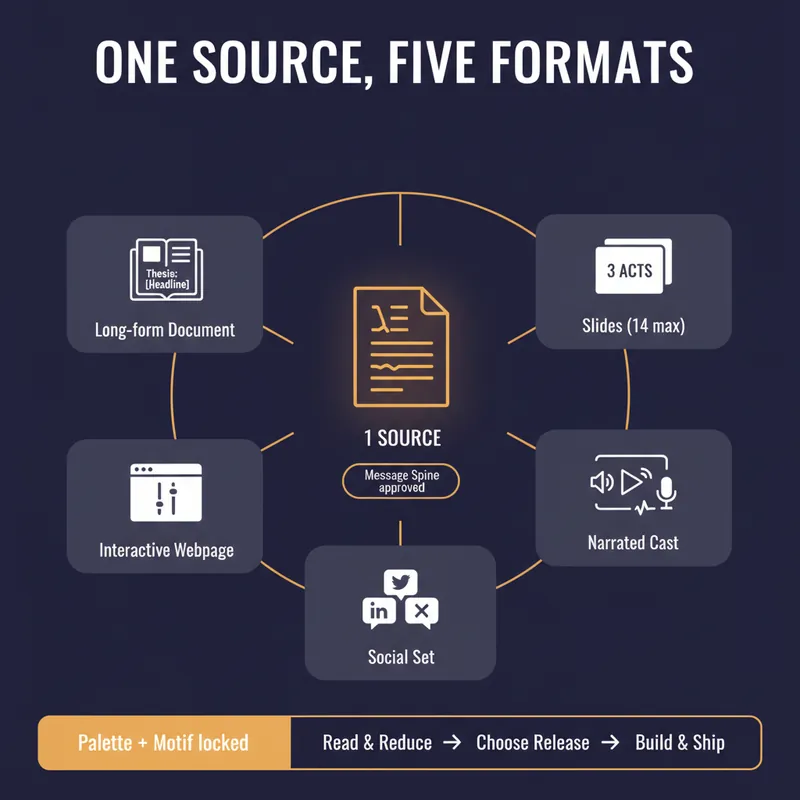
WriteOne Source, Five Formats
YouMind can produce a document, a slide deck, a narrated video, an interactive webpage and a set of social posts. Most people use one of them, because doing all five by hand means writing the same argument five times and watching it drift a little further each time. This skill stops the drift by refusing to start until you have a spine. Before anything is generated it writes a Message Spine: one thesis under 25 words, three load-bearing points, the single strongest piece of evidence, the one image a reader should still have tomorrow, the change you want in them, and who this is explicitly not for. You approve it. Every format is then built from the spine, never from the previous format, so nothing compounds an earlier compromise. Then it tells you which formats are actually worth making. A short reflective essay makes bad slides. A dense data teardown makes bad audio. It will recommend two formats and explain why the other three would weaken the work, which is the opposite of what a content-multiplier is supposed to say. Each format gets built to its own rules, one at a time, with your confirmation. Slides get one idea per slide and speaker notes that carry the argument. The cast script is written for the ear, with numbers rounded and given a comparison and a deliberate pause before the strongest evidence. The webpage gets exactly one interactive move the flat text could not do. The social set opens each post on a different point so it does not read as three copies of itself, and every post gives away something real instead of begging for a click. One palette, one type treatment, one recurring motif, decided in writing before the first image is generated. You finish with a ship sheet: what goes where, in what order, how many days apart, with what call to action, and the one signal to watch. Plus a consistency check that quotes the thesis sentence from every format and confirms they still agree. It estimates credits before it spends them and never renders a full cast or image set without an explicit yes.
 Write
WriteEvergreen Refresh Radar
Everything in this marketplace helps you publish something new. Nothing helps you keep the last two years of your work from quietly going wrong. Published content rots. The statistic you quoted has moved. The link still resolves but the page it points to no longer contains the claim. The tool you recommended killed its free tier. The word "recently" is doing damage every single day it sits there. Your readers do not email you about any of this. They just trust you slightly less. Evergreen Refresh Radar audits what you already put out. Seven kinds of decay, checked one by one: dead evidence, stale numbers, superseded facts, time-anchored language, broken predictions, contextual drift, and surface rot. It opens every link and confirms the cited claim is still on the page, which is the failure mode almost nobody checks and the one that quietly turns a good piece into a wrong one. Then it ranks. Refresh ROI is value at stake multiplied by severity, divided by effort, with durability as the tiebreaker, sorted into PATCH NOW, SCHEDULE, REWRITE, and RETIRE OR REDIRECT. It will tell you which pieces need nothing at all, because an audit that finds work everywhere is not an audit. And it writes the patch. Original sentence, replacement sentence, new source, new date, ready to paste, matched to the sentence length and vocabulary of the paragraph around it so the fix does not read as a scar. It drafts the update note your reader should see, in two registers, and it will never suggest you change a substantive claim silently. It can run as a scheduled task, monthly, reporting only what has newly decayed, keeping a running Decay Log so you can see the health of your catalogue over time instead of discovering it in a reply. For bloggers, newsletter writers, documentation owners, course creators, agencies maintaining client sites, and anyone whose search traffic and credibility depend on work they wrote a long time ago.