
Interview-to-Insights V3
Evidence-led analysis from interview data
Interview-to-Insights V3
Evidence-led analysis from interview data
Showcase
Description
Turn interview, user research, or focus-group transcripts into an evidence-based research synthesis where every conclusion is traceable to a supporting quote. From one transcript to twenty, get coded themes, a tension map, an opportunity backlog, and direct answers to your decision questions—no more hours of recordings with zero findings. For businesses and product teams: save days of analyst time spent organizing and coding. Every claim is anchored to participants’ exact words and timestamps, making it auditable and traceable while reducing the risk of AI-fabricated insights. Opportunities are presented as “when [situation], [who] wants [outcome] because [reason]”, ready to connect with product roadmaps and market decisions. For researchers and academics: follow rigorous qualitative research practice rather than simple summarization—quote-first open coding, Behaviour/Belief/Wish evidence categories, falsifiable themes, and deliberate searches for disconfirming evidence. The method is rigorous enough for a research paper. Sample discipline is strict: percentages are not reported with fewer than 12 participants, n=1 is identified as a hypothesis rather than a finding, and conclusion strength is based on participant counts. Ideal for product managers, UX and market researchers, journalists, consultants, founders, and anyone with hours of recordings but no research findings yet. English: Turn interview, user research, or focus-group transcripts into an evidence-led research synthesis where every conclusion is traceable to a verbatim quote. Feed it one transcript or twenty, and get coded themes, a tension map, an opportunity backlog, and a direct answer to your decision question—no more hours of recordings with zero findings. For businesses & product teams: skip days of manual coding; every claim is anchored to participant quotes with timestamps, auditable and traceable, eliminating the risk of AI-fabricated insights; opportunities are framed as "when [situation], [who] wants [outcome] because [reason]", ready to feed product roadmaps and market decisions. For researchers & academics: real qualitative practice, not summarisation—quote-first open coding, Behaviour/Belief/Wish evidence tagging, falsifiable themes, deliberate disconfirming-evidence hunting, rigorous enough for a methods section; strict sample discipline: no percentages under 12 participants, n=1 flagged as hypothesis rather than finding, theme strength counted in participants. For product managers, UX & market researchers, journalists, consultants, founders doing customer discovery—and anyone sitting on hours of recordings with no findings.
Recommended by
Shuting@YouMind
Why we love this skill
Quote- and timestamp-grounded analysis with disconfirming-evidence checks, clear Behavior/Belief/Wish distinctions, and disciplined limits on conclusion strength.
Best for
Research, product, and strategy teams turning interview or user research materials into auditable insights.
How to use this Skill
Provide your input
Provide one or more interview, user research, or focus-group transcripts and describe the decision question you want answered. You may include participant backgrounds, IDs, and timestamps.
Run the Skill
The system organizes evidence from the transcripts, identifies themes, surfaces disagreements and opportunities, and flags anything the material cannot support.
Review your result
Receive a traceable research synthesis with themes, supporting and disconfirming evidence, a tension map, opportunity items, and a direct answer to the decision question.
Related Skills
View all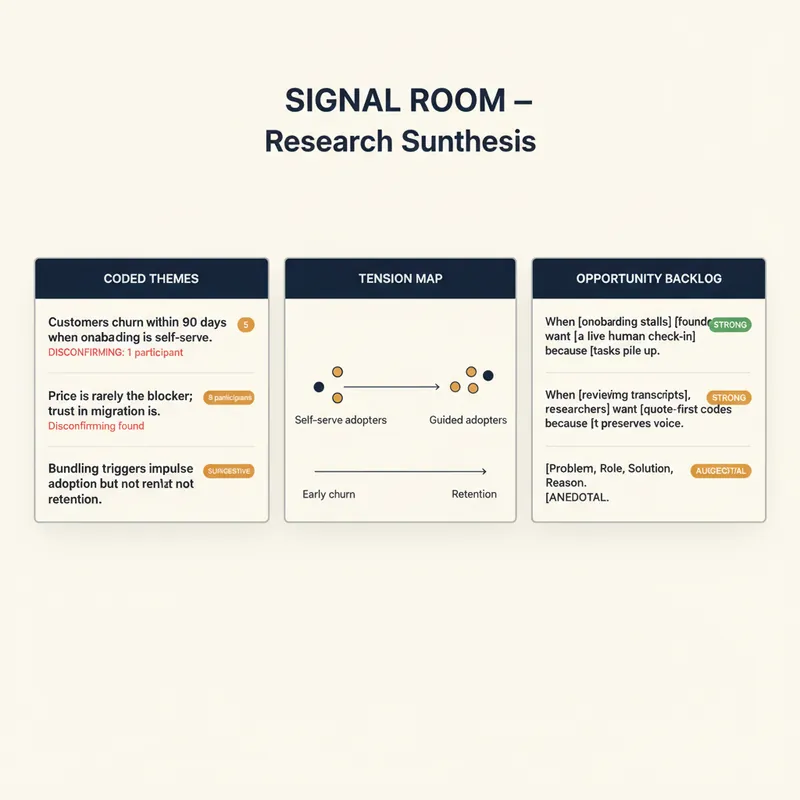 Research
Signal Room: Interview Synthesis
YouMind already transcribes your calls, interviews and podcasts. Signal Room is what happens next. Drop in one transcript or twenty and get back a research synthesis an actual analyst would sign: coded themes, verbatim evidence with timestamps, the places people disagree, and a ranked answer to the decision you are trying to make. The method is real qualitative practice, not summarisation: • Open coding that works quote-first — no quote, no code — with codes named in the participant's own words rather than analyst jargon • Every code tagged Behaviour, Belief or Wish, because "I would definitely pay for that" is not the same class of evidence as "I paid for that last month" • Themes stated as falsifiable sentences, with strength counted in participants rather than quotes, and disconfirming evidence hunted for on purpose • A tension map showing where your participants genuinely split and what predicts which side they fall on • An opportunity backlog written as "when [situation], [who] wants [outcome] because [reason]", each rated Strong, Suggestive or Anecdotal • A direct answer to your decision question, with a stated confidence level and what would change it • The three questions this round could not answer, and who to interview next Guardrails that matter: it never invents or polishes a quote, it refuses to report percentages on fewer than twelve participants, it pseudonymises participants by default, and it will tell you to your face when n=1 means you have a hypothesis rather than a finding. For product managers, UX and market researchers, journalists, consultants, founders doing customer discovery, and anyone sitting on hours of recordings and no findings.
 Research
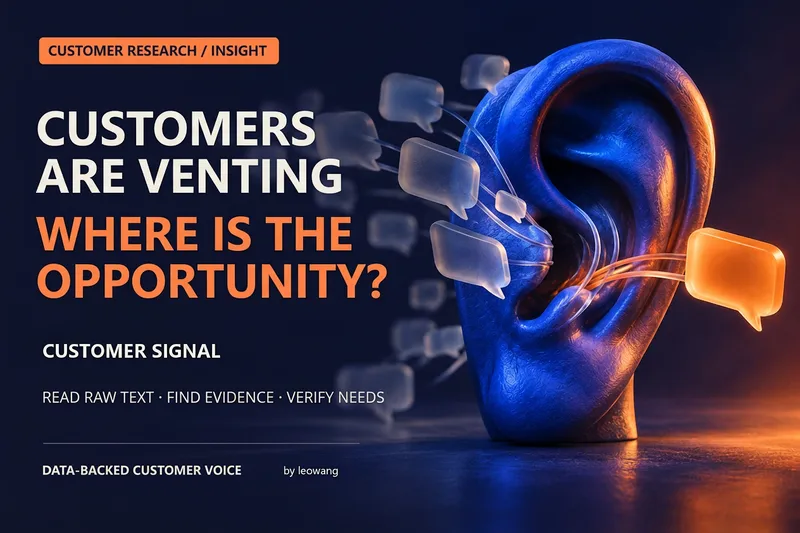
Customer Signals
There’s plenty of feedback—but what’s actually worth solving? Customer Signals organizes customer interviews, surveys, reviews, support tickets, and churn feedback. It extracts exact quotes, pain points, trigger events, and alternative approaches. It merges duplicate materials, preserves counterexamples, and separates research findings from opportunities that still need validation. It supports research synthesis, a VOC quote library, JTBD, provisional user personas, competitor review comparisons, and research gap plans. It can also design public community research, customer interviews, and PMF surveys. Online collection depends on the host’s available tools; without internet access, it provides search and sampling plans. For product managers, indie developers, operators, and small teams. Complaints do not equal willingness to pay, so the research marks evidence boundaries and identifies the next steps for validation. Published by: leowang. Adapted from customer-research v2.0.4 under the MIT License, with the required copyright notice retained.
 Research
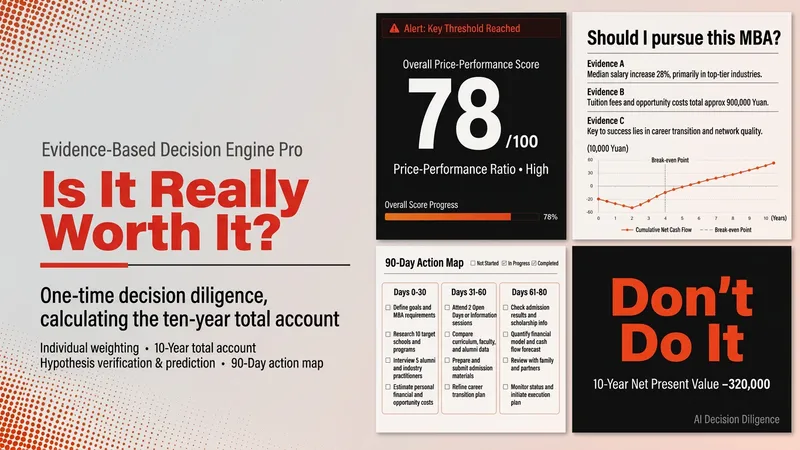
Is It Worth It? Decision Pro
One decision due diligence, delivered as a four-part package. “Is It Worth It?” doesn’t give you a simple “do it” or “don’t do it.” Instead, it treats a life decision like an investment due diligence process: first, it measures your personal priorities (the answer can differ for someone earning 5,000 a month versus 50,000), then checks four red lines—legal, health, financial, and relationship risks. It searches academic papers and official data, models the costs, benefits, and evidence levels, calculates a 10-year total, and runs sensitivity analysis. Finally, it stress-tests the decision with a pre-mortem, base rates, and a bias checklist, then designs a “minimum viable experiment” to buy information at low cost. You’ll receive: ① An interactive decision dashboard (web): a four-dimension radar, value-for-money gauge, 10-year cash flow, draggable sensitivity sliders to see when the conclusion flips, an evidence pyramid, risk matrix, 90-day action map, saveable review ledger, and 3:4 share cards. ② A decision due diligence report (document): conclusion, calculations, evidence chain, risks, and actions—ready to archive or print. ③ A 90-day action map: what to validate in week 1, where the stop-loss line is, what conditions trigger an exit, and when to review. ④ A decision review ledger: record predictions and outcomes to improve your judgment calibration. Suitable for: graduate school vs. work, whether to change jobs, whether to buy a home, whether to start a business, whether to pursue a PhD, whether to end a relationship, whether to accept an offer, whether to have surgery, and whether to move to another city. The method is rigorous: every piece of evidence is labeled A/B/C with its original source; figures are recorded together with confidence intervals; if something can’t be found, it says so plainly; and all rating formulas are公开 so you can recalculate them yourself. The methodology pays tribute to the open-source project “The High Value-for-Money Life Guide” (github.com/eternity4719/HowToLiveBetter), with four upgrades: personalized weighting, a 10-year total, falsification stress tests, and “buying information.”
Information
- Version
- v5
- Last updated
- Runtime credits
- Usage-based
- Models
- Auto
- Use cases
- Research & analysisBusiness & strategy
- What you get
- Report