
Is It Worth It? Decision Pro
One review: dashboard, report & 90-day plan
Is It Worth It? Decision Pro
One review: dashboard, report & 90-day plan
Showcase
Description
One decision due diligence, delivered as a four-part package. “Is It Worth It?” doesn’t give you a simple “do it” or “don’t do it.” Instead, it treats a life decision like an investment due diligence process: first, it measures your personal priorities (the answer can differ for someone earning 5,000 a month versus 50,000), then checks four red lines—legal, health, financial, and relationship risks. It searches academic papers and official data, models the costs, benefits, and evidence levels, calculates a 10-year total, and runs sensitivity analysis. Finally, it stress-tests the decision with a pre-mortem, base rates, and a bias checklist, then designs a “minimum viable experiment” to buy information at low cost. You’ll receive: ① An interactive decision dashboard (web): a four-dimension radar, value-for-money gauge, 10-year cash flow, draggable sensitivity sliders to see when the conclusion flips, an evidence pyramid, risk matrix, 90-day action map, saveable review ledger, and 3:4 share cards. ② A decision due diligence report (document): conclusion, calculations, evidence chain, risks, and actions—ready to archive or print. ③ A 90-day action map: what to validate in week 1, where the stop-loss line is, what conditions trigger an exit, and when to review. ④ A decision review ledger: record predictions and outcomes to improve your judgment calibration. Suitable for: graduate school vs. work, whether to change jobs, whether to buy a home, whether to start a business, whether to pursue a PhD, whether to end a relationship, whether to accept an offer, whether to have surgery, and whether to move to another city. The method is rigorous: every piece of evidence is labeled A/B/C with its original source; figures are recorded together with confidence intervals; if something can’t be found, it says so plainly; and all rating formulas are公开 so you can recalculate them yourself. The methodology pays tribute to the open-source project “The High Value-for-Money Life Guide” (github.com/eternity4719/HowToLiveBetter), with four upgrades: personalized weighting, a 10-year total, falsification stress tests, and “buying information.”
Recommended by
Dancang
Why we love this skill
Turns “Is it worth it?” uncertainty into an auditable, calculable, and falsifiable personal decision system—with evidence grading, 10-year accounting, sensitivity analysis, experiments, and a 90-day action map.
Related Skills
View all
High-Value Decision Advisor
When you are grappling with 'whether to do something', 'whether to choose a certain option', 'whether it's worth investing resources', or want to review 'why that decision turned out the way it did', this Skill acts like a warm project evaluation advisor, helping you break down vague thoughts into assessable evidence. It is suitable for: - Career choices: whether to change jobs, switch careers, join a startup, pursue graduate studies; - Education and growth investments: whether to enroll children in classes, buy courses, commit to a long-term learning plan; - Project and opportunity evaluation: whether to start a project, take on a partnership, invest resources; - Relationships and life choices: whether to confess feelings, move, change living arrangements; - Historical decision review: review a resignation, postgraduate exam, investment, partnership, or relationship choice. It automatically adjusts the depth of reasoning based on the decision magnitude: - Lightweight decisions: quickly clarify key variables and give brief advice; - Medium-weight decisions: structured analysis around necessity, feasibility, risk, timing, and alternatives; - Heavyweight decisions: full project-style reasoning, outputting risk warnings, directional recommendation, and action paths; - Review-type questions: helps you reconstruct the judgment chain at that time, identify prediction biases and transferable lessons. You can start like this: - 'Should I sign my child up for a 20,000 per year English class?' - 'Should I leave my stable job for a startup?' - 'I want to review my decision last year to resign and study for graduate exams.' - 'I'm not sure whether to confess my feelings, can you help me analyze it?' - 'Is this opportunity worth my time and money?' In the end you will get: - A clear directional recommendation: recommend to proceed / recommend to hold off / recommend to gather more information before deciding; - The confidence level and key uncertainties for each recommendation; - The risks you most easily overlook; - The next minimal validation step. Note: It will not pretend to be certain with insufficient information and make decisions for you; it will help you see the decision basis, risk boundaries, and what to verify next.
Should I Do It? Analysis
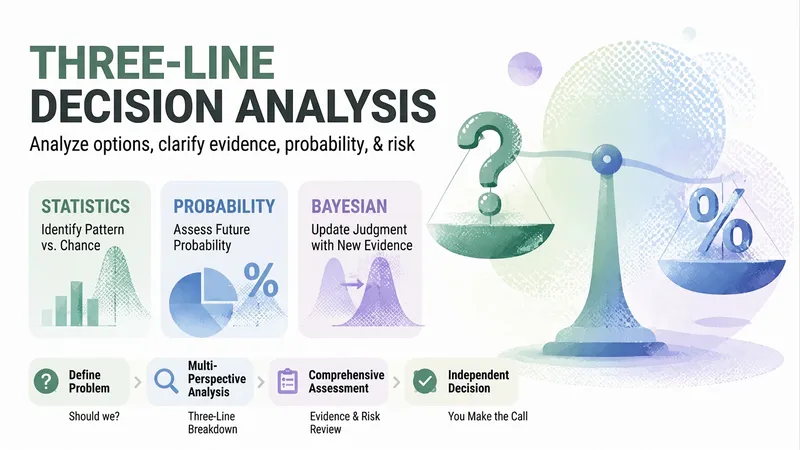
Turn the vague uncertainty of “Should I do X?” into a clearly bounded decision analysis that can be checked and updated over time. Whether you’re considering leaving your job to start a business, investing in a project, buying an asset, or making a career or life choice, you can provide text, tables, documents, or screenshots to organize your options, time horizon, major costs, how much risk you’re willing to accept, and how much confidence you need before acting. The analysis examines the question through statistics, probability theory, and Bayesian reasoning: checking whether samples are reliable and whether an observed pattern is more likely a real trend or a coincidence; breaking down possible future scenarios and comparing probabilities, expected returns, and tail risks; then combining prior beliefs with new evidence to determine which information is truly discriminating and how your judgment should be updated. User-provided facts, public information, and analytical assumptions are clearly separated. When reliable data is lacking, uncertainty is not concealed behind false precision. You’ll receive a replayable decision framework that includes new information worth verifying, actionable next steps, triggers for reassessment, and key evidence still needed. It won’t make the decision for you or present assumptions as facts. Instead, it helps you see the evidence, probabilities, costs, and risks clearly, leaving the decision in your hands.
 Research
Multi-Agent: A-Share Pick & IC
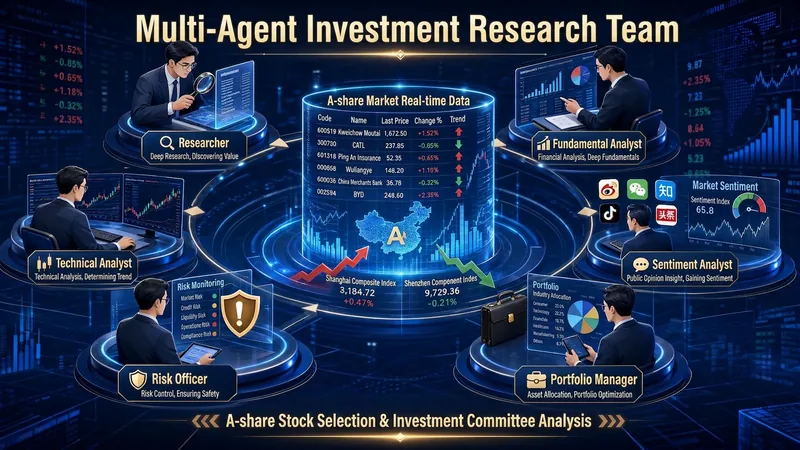
It's not an AI assistant, but a virtual investment research team. Common AI stock-picking tools suffer from three problems: fabricating financial figures and target prices, giving vague "bullish/bearish" remarks, and offering "buy" recommendations without clear reasoning. The Multi-Agent Investment Research Team tackles these with a three-pronged approach: 6 parallel roles, cross-validation, and mandatory source attribution. It convenes researchers, fundamental analysts, technical analysts, sentiment analysts, risk officers, and investment managers to work in parallel, deliberating like a real investment committee. What you get is not fuzzy opinions, but a professional research document with facts, signals, disagreements, risks, and every number traceable to its source. Two modes covering "researching a single stock" and "screening a batch of stocks" Mode A: Single-Stock Committee Deep Analysis — Just provide a stock (e.g., "Analyze BYD 002594"), and the skill automatically convenes a full investment committee: the researcher aggregates market data, financial reports, research reports, and industry chain positioning, presenting only objective facts; the fundamental analyst issues a financial health scorecard, key changes in the three financial statements, and PEG valuation; the technical analyst evaluates trends, moving averages, MACD, support and resistance levels, and provides a five-point buy signal hit table; the sentiment analyst scans institutional divergence, retail investor sentiment, and potential misinterpretations; the risk officer digs up counter-evidence, systematically refuting optimistic conclusions from other roles; finally, the investment manager, without adding new data, integrates everything to produce committee minutes and a one-page summary. Mode B: Multi-Condition Stock Screening — From a specified universe (e.g., CSI 300, a sector/theme basket, or your own stock pool), apply a three-layer funnel: L1 financial hard screen (three consecutive quarters of growth, ample cash flow, PEG<1 or huge increase in contract liabilities), L2 technical timing (base breakout, moving average golden cross, volume breakout, strong pullback on low volume, MACD crossing above zero line), L3 information validation (research report ratings and industry chain logic, eliminating "pure technical without fundamental basis" picks). After obtaining a candidate list, the top N stocks can automatically proceed to Mode A for deep analysis. What you will get Mode A delivers a fixed "five-piece set": ① Full analysis report integrating all six roles; ② Data source and evidence table, with each key conclusion mapped to "data → source → date"; ③ Meeting-style committee minutes (agenda → each role's view → disagreements → consensus → variables to track); ④ Risk list sorted by high/medium/low severity; ⑤ One-page investment manager summary condensing core logic, key variables, verification points, and confidence level. Mode B delivers: Candidate stock list table (ticker | name | triggered conditions | key data | source | trigger date) plus screening criteria and methodology description, optionally with the full five-piece set for top candidates. All outputs are saved as files with ticker and date in the filename for easy reuse and archiving.
Information
- Version
- v9
- Last updated
- Runtime credits
- Usage-based
- Models
- Auto