
Comment Demand Miner
Turn viral comments into ranked content ideas
Comment Demand Miner
Turn viral comments into ranked content ideas
Showcase
Description
You come across a viral post, scroll through its comments for ages, and still have no idea what to make next. 【Comment Demand Miner】sorts scattered comments into six categories (help-seeking, opposing, personal-experience, follow-up-question, complaint, and unrelated), first cleaning them up and telling you how many were removed and why. It then ranks a list of content ideas by demand strength. Each idea includes the idea itself, why there is demand for it (which comment type points to it and roughly how many comments do so), three opening lines plus a structure outline, and potential pitfalls. It also provides a reverse list of topics that commenters ask about frequently but that you should not make content about, including medical diagnoses, investment promises, and legal judgments. Finally, it tells you which types of content are most likely to contain genuine demand in their comments: how-to content tends to produce more help-seeking comments, opinion content more opposing comments, and story-based content more personal-experience comments. Hard rules: no downloading, scraping, or bypassing login walls. If comments cannot be read, it will say so honestly and show you how to copy them. It will not republish commenters' exact words as content, extract any personal information about commenters, or include privacy-related information. It will not organize flame wars or cyberbullying, and it will not predict which idea will go viral.
Related Skills
View all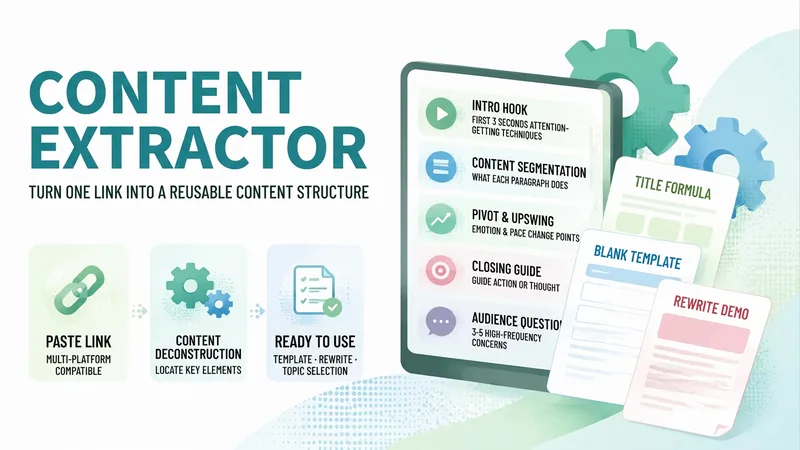
Short-Form Content Extractor
You come across a particularly well-made piece of content and want to learn its structure, but don’t know where to start. **Content Extraction Sheet** breaks down a link from Douyin, Xiaohongshu, WeChat Official Accounts, Bilibili, Weibo, or Zhihu into a practical structure you can use right away: what technique the first three-second hook uses, how many sections the content has and what each one does, where the transitions and emotional build-ups appear, and what the ending calls viewers to do. It then gives you three highly practical resources: an abstracted headline formula, with three examples adapted to your field; a blank structure template with fill-in fields; and a rewritten example based on a topic you choose. It also finds 3–5 questions viewers genuinely care about in public comments, which can become topics for your next piece of content. The honest boundary comes first: when the link content is accessible, it will clearly say “based on the original.” When it isn’t, it will say so plainly and give you a three-step method for obtaining the material—never inventing content from a link alone. Strict rules: no downloading videos, removing watermarks, bypassing login or paywalls, reposting original content, rewriting to disguise plagiarism, or extracting other people’s personal information.
 Write
Write1 Post->3-7 Unexpected Topics
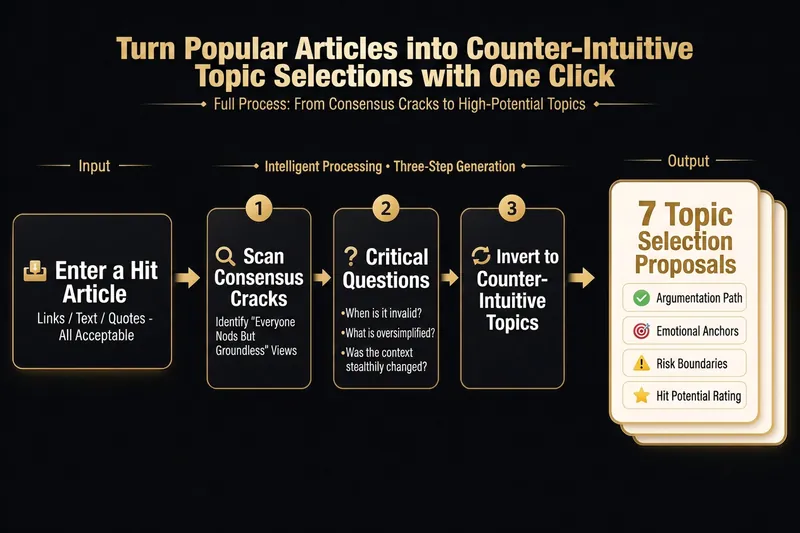
😤 Do you feel this too— You scroll through viral articles for an hour, save seven or eight, and feel like you've "learned." But when you sit down to come up with topics—your mind goes blank. Hundreds of articles in your bookmarks, and not one of them turns into your own content. You're not lacking material; you're lacking a method to "extract your own topics from others' viral posts." 🔍 Where's the problem— Inside every 100,000+ viral article, there are a few viewpoints that "most people nod along with, but actually don't hold up." Most people scroll past them. A few people pick these views out, think in reverse—and a new topic is born. The gap is in this one "deconstruction" action. 🛠️ How it helps you— 📥 Drop in a viral article link 🔬 Automatically scans the full text, picks out common consensus that "sounds right, but the conditions for truth are quietly stripped away" ❓ Dives into three key questions for each: ① Under what circumstances is it false? ② What does it oversimplify? ③ Which context did it sneak in from? 🔄 Reverses into 3–7 counterintuitive topic ideas 📊 Each comes with a complete output: ✅ Logical path — why this topic holds up ✅ Emotional hook audience — who it's for, what hits them ✅ Risk boundary — where you might go wrong ✅ 5‑dimensional viral score — how hard this topic can hit It doesn't give you a bunch of directions to think about; it gives you topics you can start writing on right away. ✍️ 🚀 Give it a try— Search for "1 Post->3-7 Unexpected Topics" in YouMind. Open it and drop a link to a viral article you've seen recently, and it will walk you through deconstructing it into topics. 🗂️ Supports deep dives on single articles + batch filtering 📎 Opinion pieces, experience sharing, tutorials, lists—works with any article type
Xiaohongshu Comment Manager
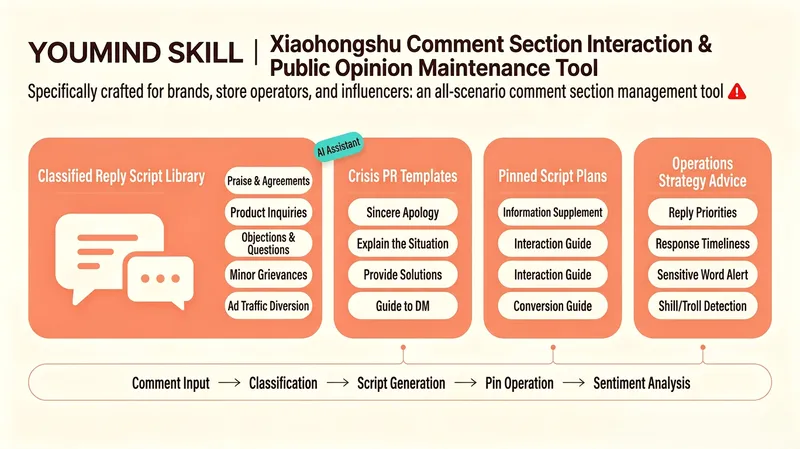
A full-scenario comment management tool for brands, Xiaohongshu shop operators, and creators. This Skill is more than simply "helping you reply to comments." It is a complete comment operations system with the following core capabilities: 💬 Categorized reply script library: Generates 5+ differentiated replies for each comment type (positive feedback/agreement, product inquiries, skeptical or argumentative comments, mild complaints, and promotional spam). Every reply matches the brand voice while remaining professional, appropriate, and personable. Switch between friendly and enthusiastic, professional and objective, humorous and disarming, and other styles. 🚨 Crisis PR templates: Provides complete response workflows for negative comments and potential public-opinion issues—step one: offer a sincere apology (without deflecting or arguing); step two: explain the situation (state the facts objectively); step three: offer a solution (return/exchange, compensation, or follow-up); step four: guide the user to direct messages (moving a public dispute into private communication). Each template is reviewed for public-opinion safety to help avoid a second misstep where further explanations make the situation worse. 📌 Pinned comment plans: Generates three types of pinned comments for different goals—information supplements (product specifications, usage instructions, or purchase links), engagement prompts (polls, questions, or requests for submissions to spark discussion), and conversion prompts (limited-time offers, exclusive benefits, or direct-message redemption). These help turn the comment section from a "passive reply area" into an "active conversion area." 📊 Operations strategy recommendations: Provides an overall comment management strategy, including reply priority (negative comments > inquiries > positive feedback), suggested response times (within 2 hours for negative comments, 4 hours for inquiries, and 24 hours for positive feedback), a sensitive-word alert list, and recommendations for identifying and handling fake engagement. Whether you run a brand shop receiving hundreds of comments a day, manage a personal brand that needs reputation support, or are a small or midsize creator looking to increase comment engagement, this Skill can help you build a professional, efficient comment management system—turning the comment section into an asset for your brand reputation rather than a liability.
Information
- Version
- v3
- Last updated
- Runtime credits
- Usage-based
- Models
- Auto
- Use cases
- Writing & contentResearch & analysisMarketing & growth
- What you get
- ReportBriefPlan
