
Short-Form Content Extractor
Turn a social post into a usable structure
Short-Form Content Extractor
Turn a social post into a usable structure
Showcase
Description
You come across a particularly well-made piece of content and want to learn its structure, but don’t know where to start. **Content Extraction Sheet** breaks down a link from Douyin, Xiaohongshu, WeChat Official Accounts, Bilibili, Weibo, or Zhihu into a practical structure you can use right away: what technique the first three-second hook uses, how many sections the content has and what each one does, where the transitions and emotional build-ups appear, and what the ending calls viewers to do. It then gives you three highly practical resources: an abstracted headline formula, with three examples adapted to your field; a blank structure template with fill-in fields; and a rewritten example based on a topic you choose. It also finds 3–5 questions viewers genuinely care about in public comments, which can become topics for your next piece of content. The honest boundary comes first: when the link content is accessible, it will clearly say “based on the original.” When it isn’t, it will say so plainly and give you a three-step method for obtaining the material—never inventing content from a link alone. Strict rules: no downloading videos, removing watermarks, bypassing login or paywalls, reposting original content, rewriting to disguise plagiarism, or extracting other people’s personal information.
Related Skills
View all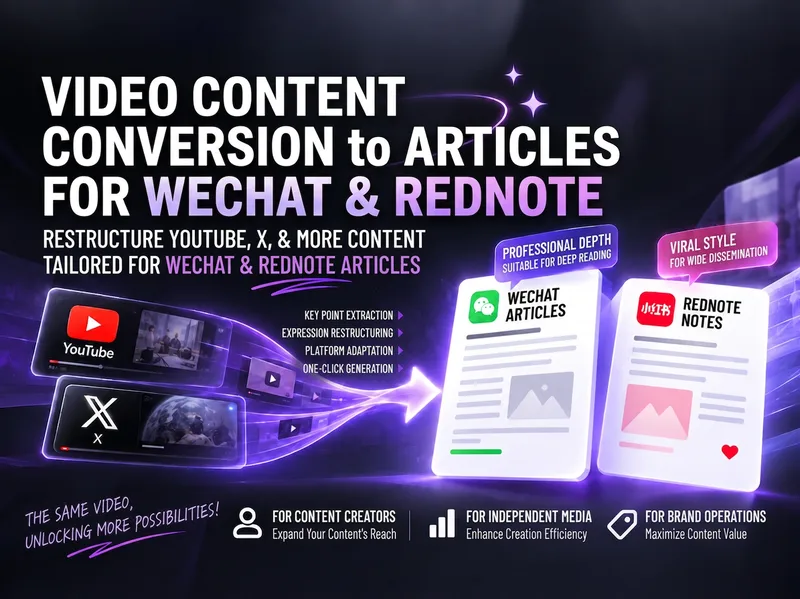
Video to Xiaohongshu/WeChat
Turn content from YouTube, X (Twitter), podcasts, and other sources into high-performing articles for Xiaohongshu and WeChat Official Accounts. You can provide video links, subtitles, timestamped transcripts, post threads, article text, screenshots, summaries, or background materials. The skill extracts viewpoints, methods, tools, prompts, examples, and practical details, then reorganizes them in natural, accessible Chinese rather than translating line by line or simply republishing the source. Each draft is developed independently based on the platform: the Xiaohongshu version focuses on the long-form reading experience, practical value, titles, and hashtags; the WeChat Official Account version provides a more complete article structure, summary, source notes, and questions for reader interaction. The articles do more than explain what the author said: they distinguish facts, opinions, and information that still needs verification; analyze what is worth referencing in a Chinese-language context; and explain how to start applying the ideas, along with boundaries such as cost, permissions, privacy, timeliness, and scope of use. When source material is incomplete or a link cannot be read reliably, the analysis scope is clearly labeled, with prompts to provide subtitles or a transcript and to verify the content before publishing—helping avoid fabricated details and unverified claims.
 Research
Spark | Video Hook Analyzer
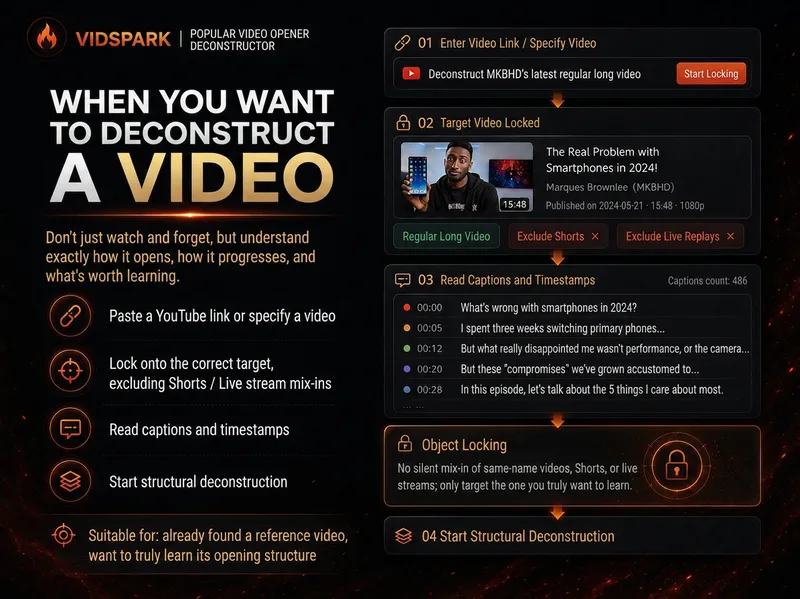
When preparing to make a video, we often run into the same problem: you can clearly see that a reference video “knows how to tell a story,” but when it’s your turn to create, you can only imitate it by feel. 「Spark | Video Hook Analyzer」is designed for this step. Give it a specific YouTube video. It first verifies the video and reads captions that can be checked, then separates three things that are easy to conflate: Literal 30s: What actually happens from 0:00–0:30. Intro: The entire opening before the main content begins. Hook / Re-hook: One or more structural beats that genuinely work to keep viewers watching. So it won’t force the first 30 seconds of every video to be interpreted as the Hook just because “everyone says the first 30 seconds matter most.” If the real Hook comes after the one-minute mark, it will tell you plainly. If the captions or timestamps are insufficient, it will clearly identify the evidence gap instead of filling it with an answer that merely looks professional. After breaking down the opening, it continues by using an outline to reconstruct the structure of the full video: Does it move forward through a timeline, experiment, process, comparison, story, chain of questions, or another organizing device? Finally, it abstracts these structures into [slots] templates. The templates preserve the sequence and function of the structure—not the original creator’s experiences, wording, brand, numbers, opinions, or authority. What you ultimately get is not a video summary, but a Hook Outline + full-video structure template that can be handed off to the next stage of creation. What it does not do It does not: Write the final new Hook for you; Score or rewrite your opening with BRENS; Search the entire niche or channel at scale; Generate a complete script; Generate diagrams, assets, animations, or thumbnails. Finding reference samples at scale belongs to the upstream 「Spark | YouTube Content Researcher」; refining your own Hook belongs to the corresponding follow-up Skill.
Xiaohongshu Hit Breakdown
Seen a viral Xiaohongshu post and want to know exactly what it got right? This Skill breaks down a viral post to the level of its "original sentences": how the cover and title work together to earn the click; what is said in the first 3 seconds and why viewers do not swipe away; the retention tactics and exact lines used in each section; what it gives users that they would be afraid of losing if they did not save it; and finally, a directly reusable structural template, along with an assessment of how feasible it is to adapt to your account. Every breakdown adds the structural template to your template library. The more you analyze, the more structures you can directly use when writing your next post. It will not claim that a title "must be effective" just because a post has high likes. When captions or performance data are unavailable, it clearly tells you what evidence is missing instead of making things up. This Skill focuses only on breakdown analysis. It does not call image or video generation, and each run uses few points (40–100 points in testing, depending on the amount of evidence and video length). Best for Xiaohongshu creators—especially spoken, knowledge, and educational-content creators—along with social media operators and MCN planners who want to understand exactly "why this post went viral" before creating their next one.
Information
- Version
- v3
- Last updated
- Runtime credits
- Usage-based
- Models
- Auto
