
Long-Form Relay Pro
Write chapter by chapter without losing continuity
Long-Form Relay Pro
Write chapter by chapter without losing continuity
Showcase
Description
A long-form writing workspace for textbooks, monographs, and industry guides. Start with a “Book Contract” to lock in the audience, writing approach, and word-count allocation, then define the chapter plan and a one-sentence promise for each chapter. Use the “Five-Part Archive” to keep the book’s settings, glossary, standards, references, and progress documented. Draft each chapter in three passes—“structure, substance, polish”—and finish every chapter with a relay note. When resuming from a break, pick up from the bookmark, then run a final six-part check. Ideal for authors who need to write a dozen or more chapters while avoiding contradictions and setting drift.
Recommended by
Dancang
Why we love this skill
Built for textbooks and monographs, it keeps goals, word counts, terminology, and sources aligned chapter by chapter—and uses relay notes to maintain consistency across writing sessions.
Best for
For authors writing textbooks, monographs, or industry guides who want to reduce contradictions and setting drift across chapters.
How to use this Skill
Provide your input
Provide the book's topic, target readers, the problems it should solve, writing style, length requirements, and any existing materials or chapter ideas.
Run the Skill
Based on your information, build a book contract and chapter blueprint, organize the full-book archives, draft chapters, and check terminology, citations, length, and continuity.
Review your result
Get an actionable book plan, chapter content, handoff records, and a full-book consistency check.
Related Skills
View all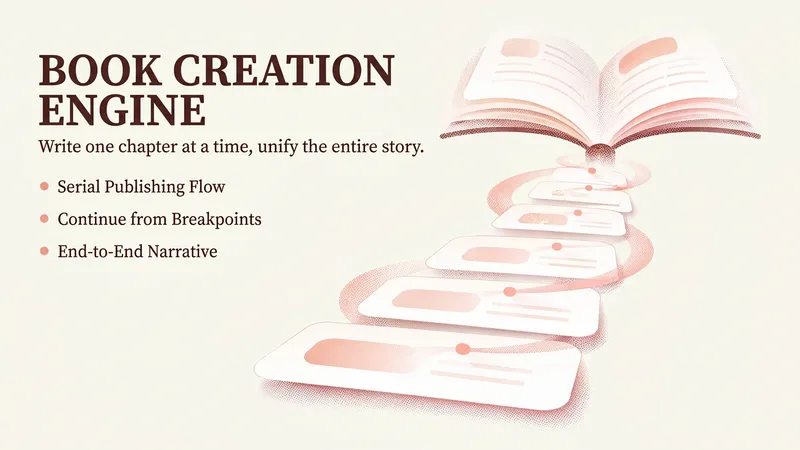
Long-Form Book Engine Pro
A long-form writing engine for bestsellers, industry books, and personal projects. It uses three rules—“focus on one chapter, recall through summaries, and always close the loop”—to manage context, while five reference sets—a book blueprint, chapter memory, terminology dictionary, style guide, and reference library—keep the entire book consistent. Each chapter moves through preparation, section-by-section drafting, and end-of-chapter synchronization, with support for resuming from a stopping point and layered review. Ideal for authors who want to write 20–30 chapters without contradictions or continuity issues.
Academic Writing Engineering
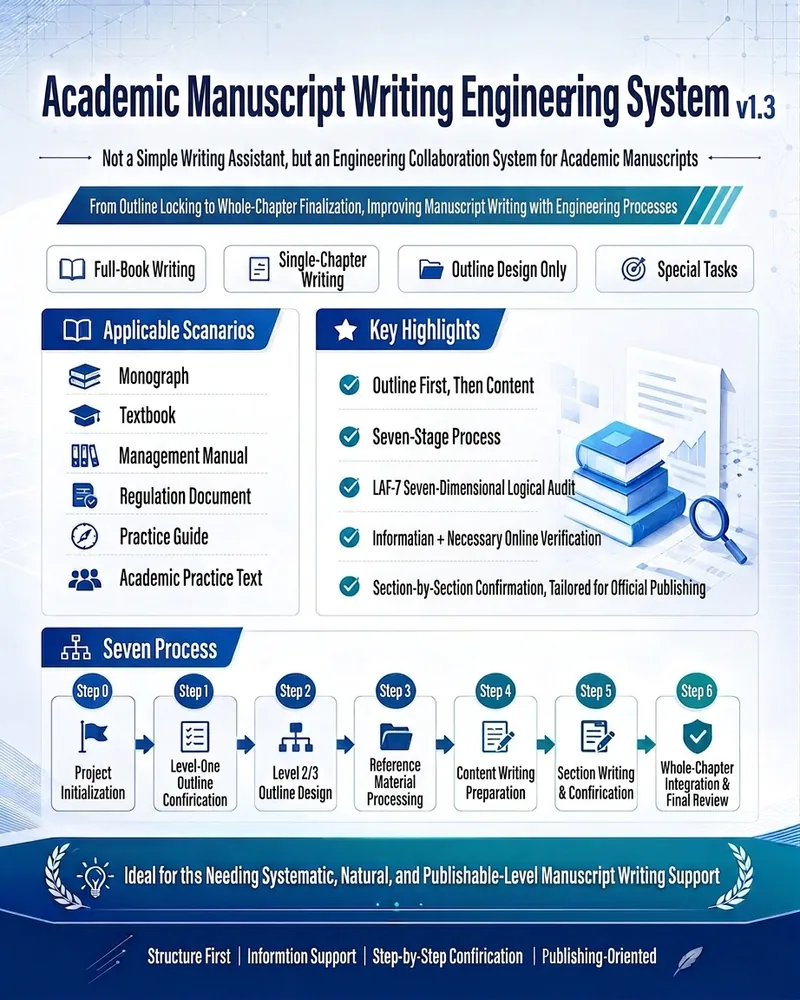
An engineering collaborative agent for scholarly manuscript writing across disciplines, covering monographs, textbooks, chapters, institutional texts, management manuals, practical guides, and academic practice texts in natural sciences, engineering, humanities and social sciences, business, law, education, medicine, and more. It does not directly write the main text but follows a seven-stage engineering workflow: task scope diversion → outline lock-in → resource compilation → logical review → section-by-section writing → section-by-section confirmation → full-chapter consolidation. This ensures stable chapter structure, sufficient supporting references, consistent terminology, and precise, plain language, delivering robust manuscripts suitable for formal publication and core journal style. Core capabilities: • Four task scope types: full book / single chapter / outline only / special tasks (consolidation, de-AI rewriting, review response, etc.) • Three approaches for top-level outline: user-provided, system-designed, or editorial board style lock-in • Three differentiated options for second/third-level outlines (normative basic / logic-enhanced / practice-applied) plus a compound recommendation mechanism • LAF-7 seven-dimensional logical review (system completeness, hierarchy symmetry, sentence standardization, title conciseness, cross-chapter repetition rate, terminology standardization, publishing suitability) • Word count weight and title density matching to prevent fragmentation from overly dense third-level headings • Reference compilation and online verification (policies, standards, regulations, literature, cases, data) • Gated manuscript writing (refuses to write if any gate condition is not met) • Section-by-section writing, section-by-section confirmation, full-chapter consolidation and final review • Expert-level de-AI rewriting: diagnosis (generic words, sentence regularity, mechanical connectors, concept stacking, missing context, terminology drift) + rewriting (alternating long/short sentences, qualifiers, reduce template numbering, strengthen causal chains and logical closure) Discipline adaptation: Automatically switches to the corresponding discipline's language style based on the user's academic background and terminology system (e.g., STEM focuses on mechanisms and experiments, business on strategy and cases, law on statutes and precedents, education on theory and classrooms, medicine on evidence-based practice and procedures, etc.) without imposing a fixed disciplinary framework. Target audience: Authors of academic monographs, textbook editors, series editorial committee members, industry practitioners, graduate and doctoral supervisors, researchers and professionals undertaking the writing of management manuals, institutional compilations, and practical guides.

Academic Monograph Workflow
Turn a research topic, existing notes and papers, research materials, or case materials into a clearly structured academic monograph grounded in rigorous evidence. Whether you are developing a theoretical study, case-based monograph, textbook research project, or policy analysis, you can first define the research positioning, scope, and target length before developing the research questions, chapter structure, and complete project baseline. This helps avoid launching into writing when materials are insufficient or the scope remains unclear. Build an analytical framework around the central line of the book, distinguishing theoretical models, research propositions, and established facts. Match the strength of each conclusion to the relevant type of evidence, including outputs, processes, use, policy, and standards. The Skill supports drafting and integrating chapters while keeping core concepts, terminology, figures, tables, and references consistent. For case studies and limited comparisons, it clarifies the scope of the materials, levels of evidence, and boundaries of applicability to avoid unsupported generalization. After the first draft is complete, it also conducts a systematic review of chapter completeness, cross-chapter consistency, figure and table numbering, citation alignment, media and chart materials, file closeout, and information that still needs verification, while preserving evidence gaps for follow-up. The final deliverables can include a merged full manuscript, verification report, word-count and submission notes, a submission file checklist, and typesetting and publishing handoff items for the publisher. This Skill is suited to academic monograph projects that require rigorous research design and preparation for publication submission.
Information
- Version
- v2
- Last updated
- Runtime credits
- Usage-based
- Models
- Auto
- Use cases
- Writing & content
- What you get
- ReportDocumentPlan