A man sold his software company for around a hundred million euros, spent three years doing nothing, got so bored he called it an existential hole, and then one afternoon built a thing that turns an ordinary box on your desk, the kind that runs from a few hundred to a couple of thousand dollars, into a private AI that never sleeps. That last part is the one worth your attention, because the box is probably already sitting in a store near you.
Here is the shift almost nobody has clocked yet, even though it happened in plain sight over the last year.
For three years, "using AI" meant renting it. You typed into a browser tab, your words went to a server in someone else's data center, a model you do not own processed them, and you paid monthly for the privilege. That was the only option, so nobody questioned it. The intelligence lived in the cloud, you paid rent, the rent went up, the limits got tighter.
That is no longer the only way it works. Quietly, a small machine you can buy off a shelf, the kind of thing people used to put under a TV, became capable of running serious AI models entirely on its own, disconnected from the internet, with no subscription and no per-message meter running. The same models that used to need a rack of servers now load onto a box that draws less power than a light bulb and makes no noise. The cloud did not get replaced, but for the first time it has a real alternative, and that alternative is small enough to sit on a desk.
This is the story of how that happened, who set it off, what the boxes actually do, and the honest version of who should care and who is wasting their money. No hype. The technology is interesting enough without it.
I. THE BOREDOM THAT STARTED IT
Peter Steinberger is an Austrian developer who built a company called PSPDFKit. You have never heard of it, but you have almost certainly used it. Its PDF technology was deployed across more than a billion devices, inside software from companies like Dropbox and SAP. In 2021 a venture firm, Insight Partners, took a strategic investment stake reported at over a hundred million euros, and he stepped back from running it day to day. He did the thing everyone fantasizes about. He stopped.
The stopping did not go well. He has been open about hitting a stretch of profound emptiness afterward, the specific kind that hits people whose entire identity was the work, to the point of seeking therapy. His public code activity went quiet. Then, in late 2025, he started building again, and the rough side project he shipped that November would, within a couple of months, become the fastest-growing software project GitHub had ever seen, blowing past long-standing giants like React and the Linux kernel to roughly a quarter of a million stars by early 2026.
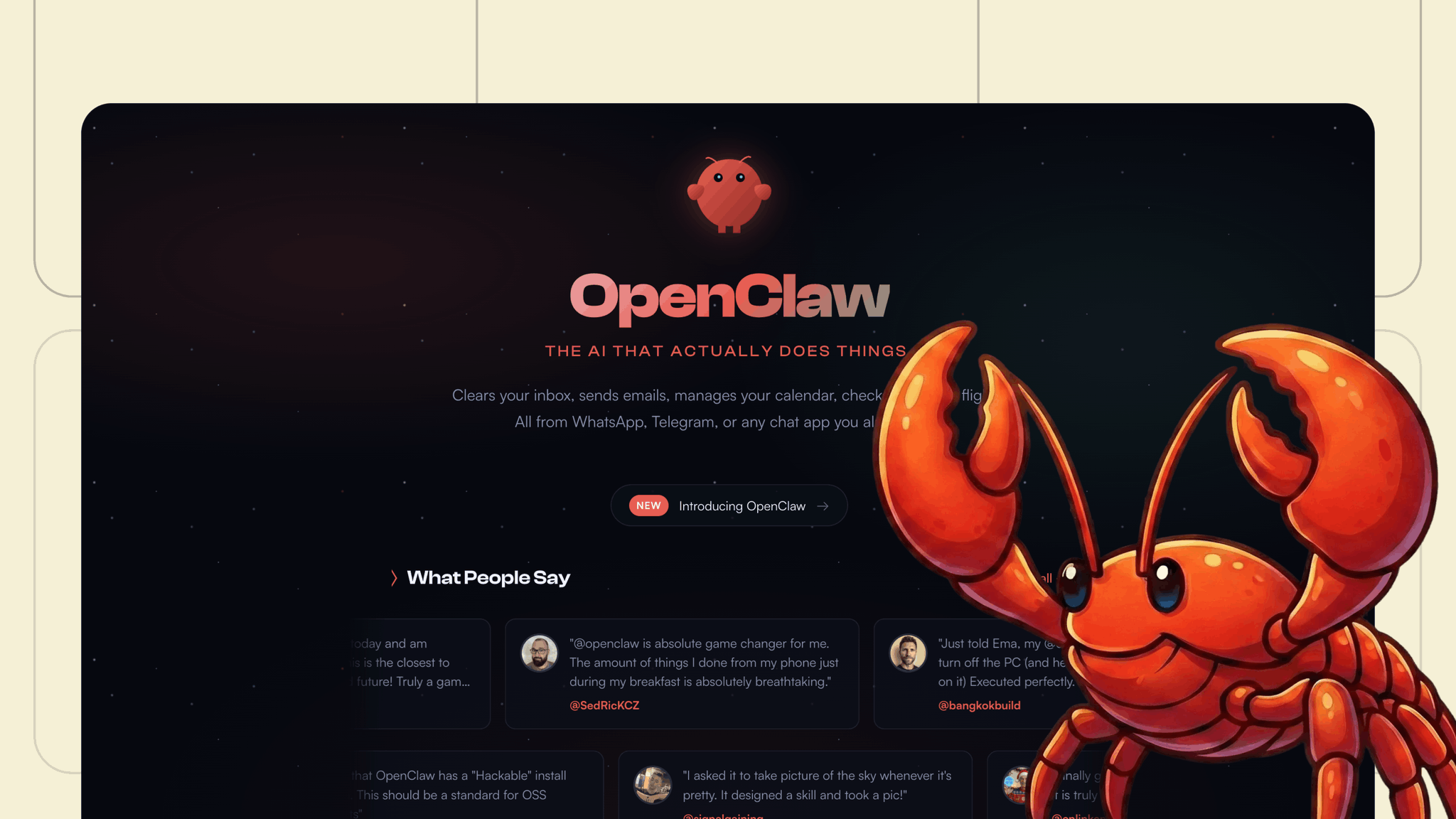
The project's GitHub repository - github.com/openclaw/openclaw
What he built has a simple idea behind it. Every AI assistant up to that point lived in a tab and waited for you to talk to it. It had no hands. It could tell you how to do something but could not do it. His project flipped that. It runs on your own machine, it connects to your messaging apps, your files, your code, and it takes action on its own, running commands, organizing folders, even checking you in for flights. His description of it is the whole pitch in one line: it is not a generic assistant, it is your assistant, with your values, living on hardware you own.
The reaction was not quiet. The project hit nine thousand stars in its first day and crossed a hundred thousand within weeks. Andrej Karpathy, a co-founder of OpenAI and former head of AI at Tesla, publicly marveled at how fast it was taking off. An entire community formed around it, building add-ons and skills, and a strange spin-off appeared: a social network populated almost entirely by these personal AI agents talking to each other.
One detail is too good to leave out, especially if you read the last piece I wrote. The project started life with a name that was a pun on Claude, the AI model, spelled with a claw. Anthropic's lawyers sent a polite trademark complaint that it was too close to their product, and the thing got renamed, twice, before landing on the name it has now. The personal-agent movement was born wearing a costume of the very cloud company it was quietly routing around.
There is an irony worth keeping, because it points at the real story. The man who set this off reportedly told people not to rush out and buy a specific machine to run it on. And not long after, he reportedly went to work for one of the very cloud AI companies this whole movement was quietly pushing against. The movement did not need him to stay. It had already found its hardware.
II. WHY A PLAIN BOX CAN SUDDENLY DO THIS
For years there was a hard wall between "a computer" and "a machine that can run a large AI model," and the wall was memory. Not storage, not the hard drive. The fast memory the chip actually thinks in.
A traditional gaming PC keeps that memory on its graphics card, and there is not much of it. A high-end card might have twenty-four gigabytes. An AI model has to fit inside that space to run at full speed, and the good models are bigger than that, so they simply will not load. You could own a two thousand dollar graphics card and still be locked out of the models worth running. That wall is why local AI used to be a toy.
The thing that broke the wall is an idea called unified memory. Instead of a separate pool of memory trapped on the graphics card, the chip shares one big pool between everything. Apple built its whole desktop line this way, and AMD followed with a chip designed for exactly this. The practical result is blunt: a small box can now hold sixty-four or even a hundred and twenty-eight gigabytes of fast memory that the AI part of the chip can use directly. No graphics card on earth gives you that much at a consumer price. The unglamorous little desktop quietly leapfrogged the thing everyone thought you needed.
So the one number that matters when you look at these machines is not the brand or the benchmark. It is how much unified memory it has, because that single number decides which models you can run at all. As a rough guide, a model in its compressed four-bit form needs somewhere around half a gigabyte of memory for every billion parameters, plus extra room for the conversation and the software overhead on top. A mid-size model lands around eight gigabytes in practice. A large one wants forty or more. Memory is the thing that decides whether a model will even load, so it is the first number to look at, not the last.
III. THE BOXES, AND THE HONEST MATH
There are three families of machine people actually buy for this, and they trade off in ways the spec sheets hide.
The first is the Apple Mac mini. People reach for it for a plain reason: it just works. You buy it, you install one piece of free software, and ten minutes later you are talking to a private model with no further fuss. The widely agreed sweet spot is the M4 Pro with forty-eight gigabytes of unified memory, around eighteen hundred to two thousand dollars, which runs a thirty-billion-parameter model at a genuinely useful speed and stays completely silent doing it, drawing less power than a desk lamp. The base model at six hundred dollars exists, but it only handles the smallest models and you will outgrow it fast.
The second is a newer wave of AMD-based mini PCs built on a chip designed for this work. These go up to a hundred and twenty-eight gigabytes of unified memory, more than the Mac mini can reach, and they cost somewhere between fifteen hundred and three thousand dollars depending on the configuration and the week. The chipmaker's own CEO held one up on stage and signed it, which tells you how seriously the industry is taking this category. The trade is real, though: they run hotter, the fans are audible, they pull several times the power of the Mac, and the software is fussier to set up.
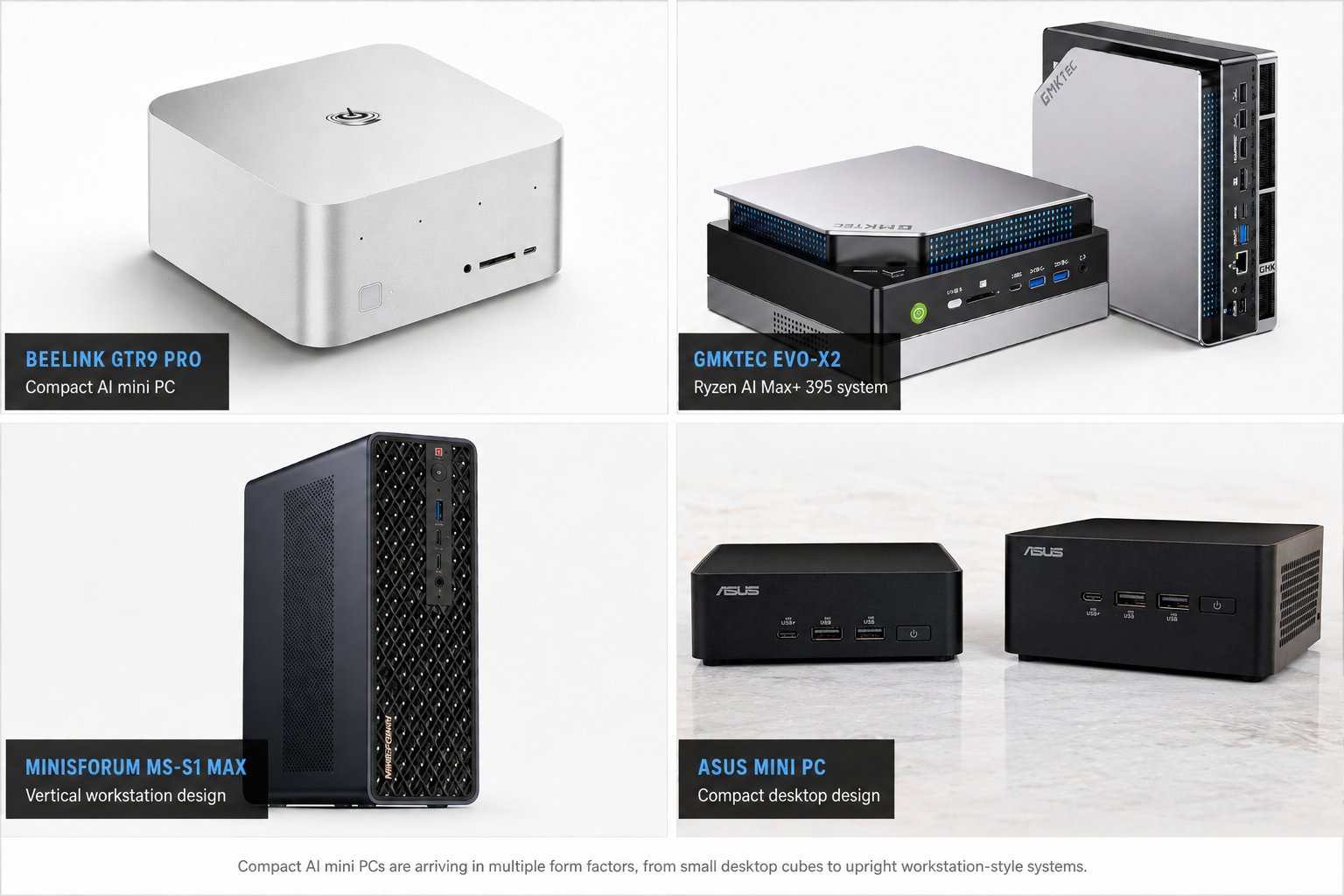
The new wave of AI mini PCs comes in every shape — from desktop cubes to upright workstations. What they share: enough unified memory to run serious models locally
The third is the specialist tier, small purpose-built AI machines and high-end graphics cards. These get faster and bigger but climb past three thousand dollars and turn into a project you maintain rather than an appliance you use.
Now the honest math, the part most of these conversations skip. The dream is "run the biggest models at home for free." The reality is that the biggest seventy-billion-parameter models often crawl into single-digit words per second on many of these mini-PC setups, depending on the exact model, the compression, and the software, slow enough that it can feel like waiting on a bad connection. They technically run. They are frequently not pleasant. The comfortable ceiling on a mini PC tends to be the thirty-billion class, which, to be fair, is more than enough for most real work: writing, summarizing, coding help, answering questions over your own documents. But anyone promising you a private frontier supercomputer for six hundred dollars is selling the dream, not the machine.
The cost side is simpler. A heavy AI user stacks up subscriptions and usage fees that can run anywhere from a hundred to several hundred dollars a month. A box is a one-time cost plus a few dollars of electricity. If you genuinely use AI every day, the hardware pays for itself somewhere around the nine-to-twelve-month mark and everything after is free. If you use AI twice a week, it never pays for itself and you should just keep paying the twenty dollars.
IV. THE SETUP IS GENUINELY TEN MINUTES
The thing that kept normal people away from local AI used to be the setup. That barrier is mostly gone, and it is worth seeing how low it dropped.
You install one free program called Ollama. On a Mac it is a single line in the terminal. Then you type one more line to pull down a model, wait a couple of minutes while it downloads, and you are talking to a private AI. If you want it to look and feel exactly like the chat box you already use, you add a second free piece called Open WebUI, open a tab, and there it is, your own private version running on your own hardware, no account, no login, no meter.
For the people who write code, there is one more trick that does the heavy lifting. Most existing AI tools talk to the cloud through a standard address. You change that address to point at your own machine instead, a single line, and every tool you already use keeps working exactly the same, except now nothing leaves your desk and nothing costs money per request.
The last piece is for reaching your box when you are not home. A free tool called Tailscale stitches your phone and your laptop and the machine under your desk into one private network, so you can be anywhere in the world and still talk to the model running at home, without exposing anything to the open internet. That is the whole stack. Three or four free programs, about ten minutes, and the hardware disappears under a desk and runs on its own.
V. WHO THIS IS ACTUALLY FOR, AND WHO IS WASTING MONEY
What follows decides whether you should close this article and go buy something, or close it and happily keep your twenty-dollar subscription.
This is genuinely for you if your work touches things that should not leave your control. Legal documents, medical records, financial files, anything under a confidentiality agreement, anything a client would be alarmed to learn went to a third-party server. For that work, local AI is not a cost decision, it is the only correct option, because the data physically never leaves the machine. It also fits if you run the same heavy task constantly, like transcribing hours of audio every week, where the per-use cloud fees pile up and a fixed box quietly wins. And it is for you if you are simply tired of hitting usage limits mid-task and want a tool that never says you have reached your cap.
It wastes your money if you are a casual user. If you ask an AI a few questions a week, the math never works, the setup is a chore you did not need, and the twenty-dollar subscription is genuinely the smarter buy. And it is the wrong call if your work depends on the absolute best reasoning available, the hardest coding across huge projects, the frontier of what these systems can do. The honest truth is that the very top tier of capability still lives in the cloud, and a box on your desk does not match it. Local AI covers the broad, everyday eighty percent extremely well. It does not win the hardest twenty percent.
And there is a real risk that belongs in any honest version of this. The same agents that make this exciting, the ones that take action on your machine on their own, are powerful precisely because you hand them the keys. Security researchers have already found holes in the popular tools, exposed data, malicious add-ons slipped into community libraries, ways to trick an agent into doing something you did not ask. Even the person who started the movement calls his own creation a hobby project that demands careful setup. Giving an autonomous program read-and-write access to your computer is not a thing to do casually. The technology is real, and so is the risk of handing it the keys before you understand it.
VI. THE BIGGER POINT
Strip away the boxes and the model names and one thing is moving underneath all of it. For a few years, intelligence became something you rented. You paid a monthly fee to a handful of companies for access to a thing you could never hold, that lived somewhere you could not see, under terms that changed whenever they decided. That arrangement felt permanent because there was no alternative.
There is an alternative now, and it is sitting on a shelf at the price of a decent laptop. Not as fast at the very top end, not free of trade-offs, but yours. The model runs on metal you own, the data stays in your house, and no company decides your limits or your price. The man who kicked this off got bored, built a thing in an afternoon, and accidentally showed a lot of people that renting was only ever one option, not the only one.
Most people will keep renting, because renting is easy and the box requires an afternoon of effort. A small number will spend that afternoon, put a quiet machine under the desk, and stop paying rent on their own thinking. The interesting part is not which group is right. It is that, for the first time since this whole era started, there are two groups at all.
If this was worth your time, a follow keeps more of these coming. A like or a bookmark helps it reach someone still paying rent without knowing there is a door. And I am curious where you land: is owning your AI worth an afternoon and a few hundred dollars, or is the cloud just easier and good enough? Tell me in the replies.