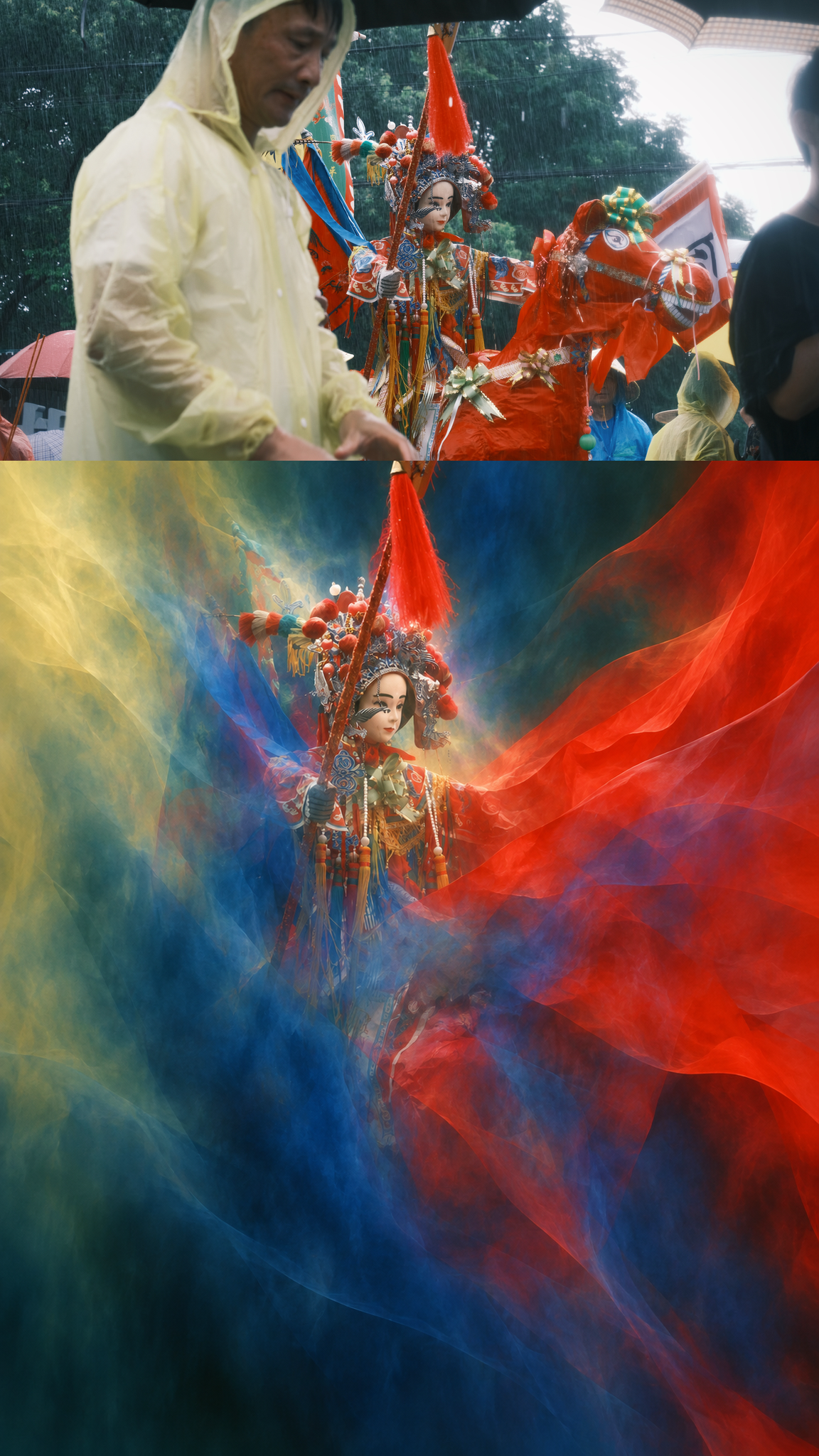
S.015 Night Diffusion
Rebuild photos as surreal vertical artworks
S.015 Night Diffusion
Rebuild photos as surreal vertical artworks
Showcase
Description
Turn a single photo into a complete 9:16 vertical artwork: the top preserves an ungraded and unretouched 16:9 crop of the original as proof of the real source; below, the same subject is reimagined through a nighttime diffused-gradient reconstruction, inviting viewers to first experience a broad, flowing field of color before recognizing identity cues from the person, animal, plant, landscape, building, product, or other subject. The lower scene is not simply a night filter, a blurred photo, or a redraw of the original composition. Instead, it starts from the photo’s subject, mood, key contours, and source colors to redesign scale, space, and material. A nighttime base of deep ocean blue, ink purple, blue-gray, night green, and other hues—not pure black—combines with 3–5 asymmetrical, softly interpenetrating color fields to form an abstract space. The subject may be penetrated by light mist, obscured, suspended, melted, or transformed into a semitransparent structure, while retaining enough recognizable anchors and thematic connections. This is suited to creative work that preserves a photo’s origin while pursuing surreal visual reconstruction, including portraits, animals, plants, landscapes, urban architecture, still lifes, vehicles, and machinery. The final artwork has no border, title, logo, or watermark. The original photo at the top transitions naturally into the generated area below, creating nighttime soft light, low-detail continuous color fields, and a breathable diffused-gradient effect.
Recommended by
淡苍
Why we love this skill
Precisely combines an authentic source strip with a nocturnal diffused reconstruction, creating a traceable yet imaginative 9:16 work through source colors, recognition anchors, and large-scale gradients—not generic filters.
Best for
People who want to preserve a photo’s source while creating visual artwork with a surreal nighttime mood and abstract color fields.
How to use this Skill
Provide your input
Provide one photo as the source for the top original crop and the artistic reconstruction below.
Run the Skill
Turn the photo into a borderless 9:16 vertical artwork: keep the original crop at the top, then reimagine the same subject below with a nighttime diffused gradient and surreal composition.
Review your result
Receive a complete vertical artwork with the original photo at the top and a nighttime diffused-gradient reconstruction below.
Related Skills
View all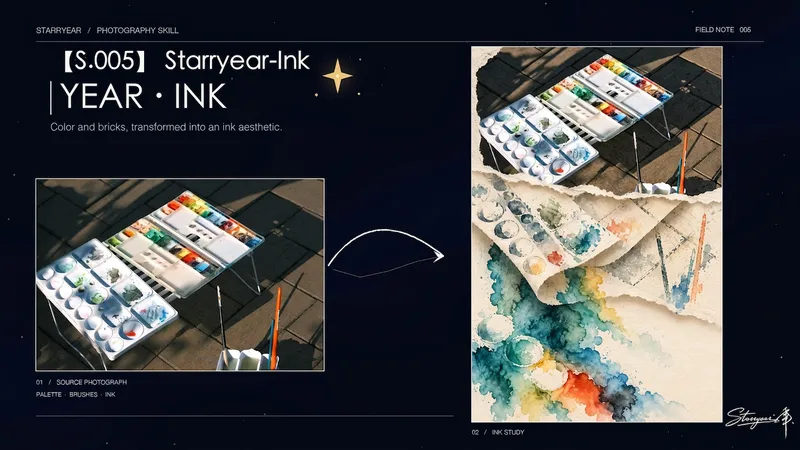 Image
Image【S.005】Photo Ink · Starryear
Transform a single photo into a vertical artwork with tactile quality and narrative depth: the top preserves the source photo as real visual evidence, the middle presents a three-dimensional memory of the photo through lifted, curled, and layered warm ivory handmade paper, and the bottom releases a moist, translucent, diffused afterimage in colored ink. It is suited to creating Starryear ink, torn-paper photo ink, and three-dimensional turning-page ink works with the “original image above, flowing ink released below” structure. It is especially suitable for photos of people, animals, buildings, or landscapes where the original identity, number, direction, and spatial relationships need to remain intact. The finished piece emphasizes one complete vertical composition rather than a simple filter or evenly divided collage. The photo area remains clear and recognizable, while the paper layers carry the rhythm, contours, reflections, or negative space of the scene, using natural paper thickness, deckled fibers, overlaps, and soft shadows to create a convincing page-turning effect. The lower ink section uses a small number of related color families to show water-driven blooming, layered color, backflow, pooling, and seepage, creating a clear spatial transformation as the image moves between materials. The overall design centers on matte warm ivory paper and negative space, avoiding a second complete person, unrelated fantasy elements, decorative paper strips, imitation traditional Chinese painting, or overly saturated visual noise. The final output is a polished vertical artwork.
 Image
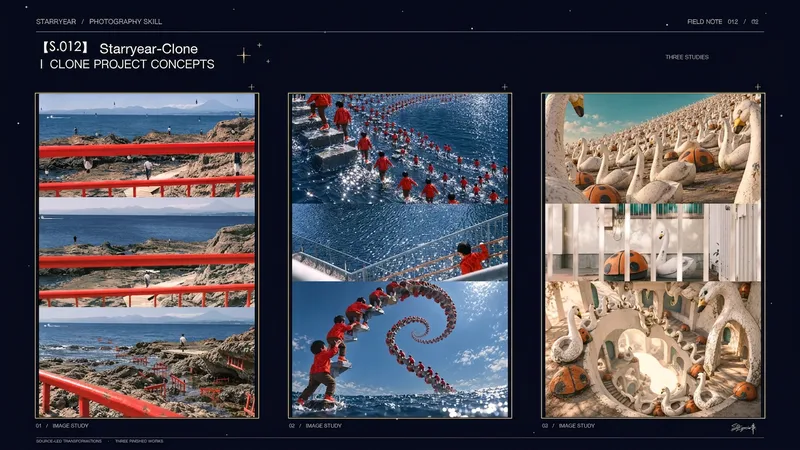
Image[S.012] Year Clone · Photo
Turn one photo into a borderless vertical triptych: the center preserves an unaltered crop of the original image as clear evidence of the scene, while the top and bottom each clone and invert a different subject from the photo. The result is a surreal image rooted in the original environment. The top panel can focus on a primary subject such as a person or animal, while the bottom panel works well with boats, buildings, railings, landmarks, or other clearly structured objects. Each generated area retains one recognizable subject at a clear scale, while allowing smaller inverted forms to blend into the foreground, background, water, rocks, roads, or building edges. The original scene’s lighting, perspective, occlusion, materials, and depth of field are maintained. Ideal for photographic collages with separately duplicated and inverted people and objects, source-photo-driven surreal triptychs, and visual experiments that preserve features such as landmarks, mountains, and skylines. The final output is a single vertical 2:3 image with no text, border, watermark, or decorative title.
 Image
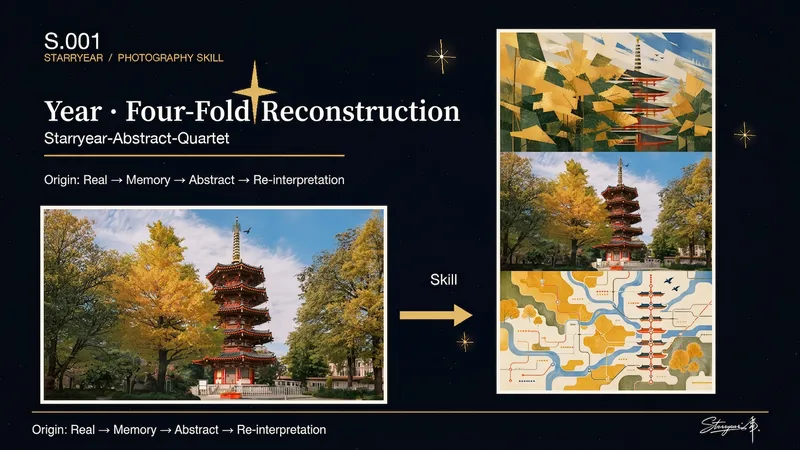
ImageTriple Memory · Starryear
Turn a single user-uploaded photo into a triptych with continuous visual logic: the top panel draws the subject or core space inward, distilling it into an abstract form that is stable, concentrated, and still retains its identity; the middle panel preserves the real original photo as irreplaceable photographic evidence; the bottom panel releases the photo’s colors, contours, textures, and spatial relationships outward, creating a dispersed, transformed, and more surreal new setting. The final image reveals the difference between convergent and diffuse abstraction while allowing viewers to trace their connection to the original photo. This Skill works with single photos of people, animals, objects, architecture, interiors, or natural scenes. The abstract results develop from the photo’s own subject relationships, compositional direction, color relationships, and visual rhythm rather than applying fixed patterns, generic filters, or unrelated decorative styles. It pays particular attention to the number, identity, orientation, and proportions of subjects, as well as important spatial relationships, ensuring that the middle panel remains the original photo without replacement. You’ll receive a finished source-driven triptych, along with a brief summary of the key visual DNA used for the two abstract panels above and below, making it easier to understand which clues the convergent and diffuse treatments extracted from the original image.
Information
- Version
- v7
- Last updated
- Runtime credits
- Usage-based
- Models
- Auto
- Use cases
- Images & design
- What you get
- Image
- Visual styles
- FuturisticSurrealist