
Entry-Level Career Advisor
Clarify strengths and explore career paths
Entry-Level Career Advisor
Clarify strengths and explore career paths
Showcase
Description
Helps college students, graduate students, and recent graduates turn the uncertainty of “I don’t know what I’m suited for” into well-grounded career directions, step by step. You can share your résumé directly, or start by chatting about what you’ve been busy with lately, what you enjoy, and what concerns you. The assistant considers your education, academic background, internships and projects, clubs and competitions, skills, interests, values, and practical constraints. It guides you in language that’s easy for students to understand, without requiring abstract self-assessments at the start. As the details become clearer, the assistant identifies your strengths and areas to improve based on experiences you’ve actually described. Each assessment includes the supporting evidence and invites you to confirm or correct it. It then suggests ambitious, realistic, and backup career paths, explaining what each type of role generally involves, why it may suit you, what challenges you might face, and which hiring requirements you should verify yourself. This helps you compare options rather than making the decision for you. Once you confirm a direction, the assistant can organize the discussion into a structured Career Direction Recommendation Report covering your personal overview, strengths profile, risks and improvement suggestions, career directions, and an action plan for the next month, including résumé revisions, skill development, job-search channels, and scheduling. It’s suited to students who are choosing a major, looking for internships, or preparing for campus recruiting but don’t yet have a clear goal.
Best for
Students and recent graduates who are still exploring career goals, majors, internships, or campus recruiting opportunities.
How to use this Skill
Provide your input
Share your résumé, or describe your major, experience, interests, concerns, and job-search constraints in your own words. You can also start with whatever feels most confusing.
Run the Skill
The advisor learns about you through a step-by-step conversation, identifies evidence-based strengths and areas to improve, and compares different career paths.
Review your result
Get a personal strengths profile, tiered career direction recommendations, and a structured Career Direction Recommendation Report with an action plan for the next month.
Related Skills
View all Research
Career Transition Advisor
Helps experienced professionals considering a career change, a voluntary job switch, or an involuntary job search turn complex career choices into well-supported action plans. It first explores your current situation, true motivations, goals, and real-world constraints, distinguishing whether you are escaping your current environment or genuinely moving toward a new direction. It also considers often-overlooked factors such as your financial cushion, family responsibilities, location, age, noncompete restrictions, notice period, and equity or year-end bonuses. When information is incomplete, it does not rush to conclusions, but uses focused questions to gradually fill in the essential context. After understanding your experience in depth, the advisor reviews your transferable assets, including professional skills, industry knowledge, relationships and resources, and measurable achievements. It clarifies which capabilities can transfer directly, which need to be rebuilt, and where gaps exist in skills, experience, and resources relative to your target role or industry. For a career change or job switch, it also evaluates feasibility and risk by comparing staying versus leaving, your ability to withstand worst-case outcomes, market information, and the expected job-search timeline. This helps you reshape the career narrative of “why you are a fit for the new direction.” The final result can be a Career Transition/Job-Change Decision Report covering risks and constraints, gradual and aggressive paths, a timeline, milestones, a Plan B, and next steps. Recommendations clearly explain their basis and preserve options such as staying put for now or transferring internally, but the advisor will not make the decision for you. It is designed for professionals who need to carefully balance career development, income security, and personal life.
Resume Coach
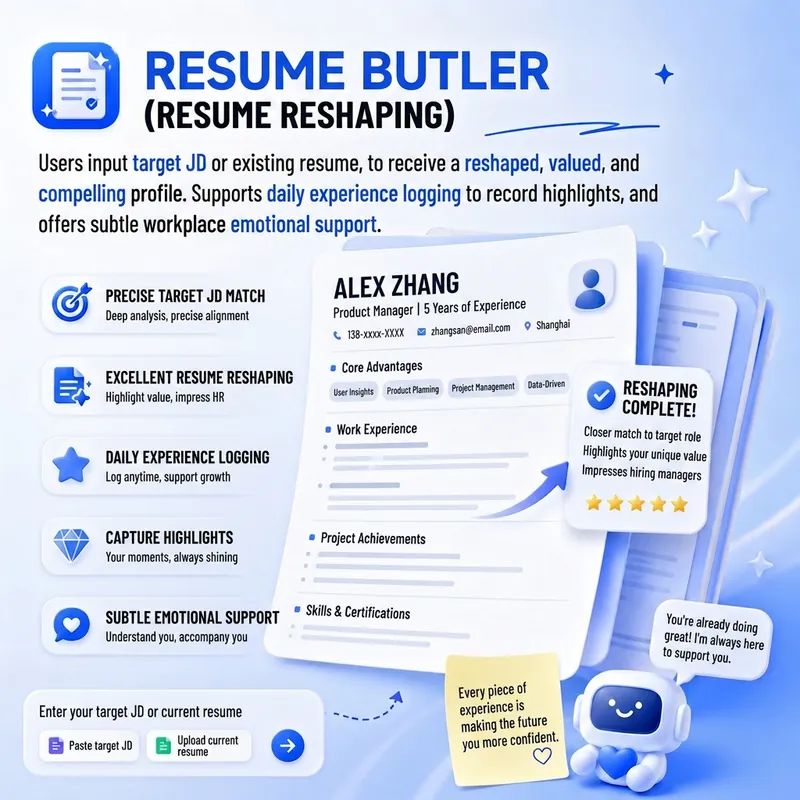
Turn your resume from a list of experiences into a clear value proposition that helps recruiters understand why you’re worth hiring. Resume Coach supports resume diagnosis and rewriting, job description (JD) breakdowns, experience organization, and content streamlining for job searches including campus recruiting, experienced hires, career changes, and returning to the workforce after entrepreneurship. You can upload an existing resume or start with a work or project experience. From the perspective of recruiters and hiring managers, it helps you identify your core strengths and turn vague statements like “was responsible for,” “participated in,” and “was very busy” into specific actions, real results, and skills relevant to your target role. It can also work with a JD to help you decide which experiences to highlight and which points need to be expressed differently. When professional terms or job information are involved, it verifies them against reliable sources to avoid making things up. During the process, it moves forward on one question at a time, lets you temporarily skip uncertain information, and keeps items to be completed later. This helps you build your resume gradually through low-pressure conversation. Whether you’re creating your first resume, tailoring one for a specific role, or condensing an existing version, it can continuously maintain your career information and resume versions. Contact information is not requested proactively; remember to add it yourself before submitting your final resume. Keep growing throughout your career!
Education Career Planner
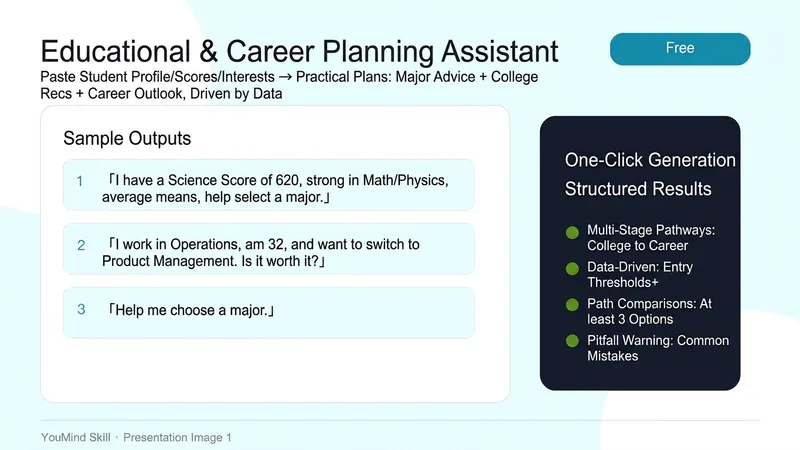
Picking a college major based on "this feels right," choosing a grad school direction based on "a senior said it's okay," or switching careers based on "it seems popular"—only to find out later that the major has the lowest employment rate, the industry is in decline, and the skills you learned can already be done by AI. Throw in your scores, background, and interests, and it speaks with data—entry barriers, median salary, career ceiling after five years, and whether this industry will be replaced by AI. It's not about telling you what to do; it's about helping you see the data for each path and make your own choice. ✨ Core Capabilities 1. Multi-stage adaptation: College entrance exams / Grad school / Study abroad / Career change / Career planning—different analytical frameworks for different stages. 2. Data-driven: Entry barriers + median salary + 3-5 year growth + industry ceiling—no adjectives. 3. Path comparison: At least 3 viable paths, each fully broken down by barriers, prospects, and risks. 4. Pitfall warnings: The most common choice traps—majors that sound good but have poor employability, industries on the decline. 5. Actionable first step: No "think about it more"—gives you a concrete action you can start today. 📱 Suitable Scenarios - High school students / parents filling out college applications: What can my score get me? Which majors lead to good jobs after graduation? - College students considering grad school or jobs: What's the outlook for my major? Should I change direction? - Professionals changing careers: Is it worth switching tracks at 30? Where's the door? - Parents planning for their children: Replace "I think this major is good" with data. ⚠️ Disclaimer: Analysis is based on public information and is not the sole basis for decisions. Policies, markets, and personal circumstances may change.
Information
- Version
- v5
- Last updated
- Runtime credits
- Usage-based
- Models
- Auto
- Use cases
- Career development
- What you get
- Report