
Career Transition Advisor
Assess options and plan your next move
Career Transition Advisor
Assess options and plan your next move
Showcase
Description
Helps experienced professionals considering a career change, a voluntary job switch, or an involuntary job search turn complex career choices into well-supported action plans. It first explores your current situation, true motivations, goals, and real-world constraints, distinguishing whether you are escaping your current environment or genuinely moving toward a new direction. It also considers often-overlooked factors such as your financial cushion, family responsibilities, location, age, noncompete restrictions, notice period, and equity or year-end bonuses. When information is incomplete, it does not rush to conclusions, but uses focused questions to gradually fill in the essential context. After understanding your experience in depth, the advisor reviews your transferable assets, including professional skills, industry knowledge, relationships and resources, and measurable achievements. It clarifies which capabilities can transfer directly, which need to be rebuilt, and where gaps exist in skills, experience, and resources relative to your target role or industry. For a career change or job switch, it also evaluates feasibility and risk by comparing staying versus leaving, your ability to withstand worst-case outcomes, market information, and the expected job-search timeline. This helps you reshape the career narrative of “why you are a fit for the new direction.” The final result can be a Career Transition/Job-Change Decision Report covering risks and constraints, gradual and aggressive paths, a timeline, milestones, a Plan B, and next steps. Recommendations clearly explain their basis and preserve options such as staying put for now or transferring internally, but the advisor will not make the decision for you. It is designed for professionals who need to carefully balance career development, income security, and personal life.
Recommended by
Shuting@YouMind
Why we love this skill
Breaks down motivations, transferable assets, constraints, and worst-case scenarios to quantify risk and provide both gradual and aggressive paths.
Best for
Experienced professionals weighing career growth, income security, and personal life with care.
How to use this Skill
Provide your input
Share your career history, current situation, transition or job-change goals, true motivations, and financial, family, location, legal, or compensation constraints. You can add information in stages.
Run the Skill
The advisor asks focused questions to clarify your situation and motivations, identify transferable assets and gaps, and compare risks, paths, and alternatives.
Review your result
Receive a career transition or job-change decision report based on confirmed information, including feasibility, risks and constraints, gradual and aggressive paths, a Plan B, and next steps.
Related Skills
View all
Entry-Level Career Advisor
Helps college students, graduate students, and recent graduates turn the uncertainty of “I don’t know what I’m suited for” into well-grounded career directions, step by step. You can share your résumé directly, or start by chatting about what you’ve been busy with lately, what you enjoy, and what concerns you. The assistant considers your education, academic background, internships and projects, clubs and competitions, skills, interests, values, and practical constraints. It guides you in language that’s easy for students to understand, without requiring abstract self-assessments at the start. As the details become clearer, the assistant identifies your strengths and areas to improve based on experiences you’ve actually described. Each assessment includes the supporting evidence and invites you to confirm or correct it. It then suggests ambitious, realistic, and backup career paths, explaining what each type of role generally involves, why it may suit you, what challenges you might face, and which hiring requirements you should verify yourself. This helps you compare options rather than making the decision for you. Once you confirm a direction, the assistant can organize the discussion into a structured Career Direction Recommendation Report covering your personal overview, strengths profile, risks and improvement suggestions, career directions, and an action plan for the next month, including résumé revisions, skill development, job-search channels, and scheduling. It’s suited to students who are choosing a major, looking for internships, or preparing for campus recruiting but don’t yet have a clear goal.
High-Value Decision Advisor
When you are grappling with 'whether to do something', 'whether to choose a certain option', 'whether it's worth investing resources', or want to review 'why that decision turned out the way it did', this Skill acts like a warm project evaluation advisor, helping you break down vague thoughts into assessable evidence. It is suitable for: - Career choices: whether to change jobs, switch careers, join a startup, pursue graduate studies; - Education and growth investments: whether to enroll children in classes, buy courses, commit to a long-term learning plan; - Project and opportunity evaluation: whether to start a project, take on a partnership, invest resources; - Relationships and life choices: whether to confess feelings, move, change living arrangements; - Historical decision review: review a resignation, postgraduate exam, investment, partnership, or relationship choice. It automatically adjusts the depth of reasoning based on the decision magnitude: - Lightweight decisions: quickly clarify key variables and give brief advice; - Medium-weight decisions: structured analysis around necessity, feasibility, risk, timing, and alternatives; - Heavyweight decisions: full project-style reasoning, outputting risk warnings, directional recommendation, and action paths; - Review-type questions: helps you reconstruct the judgment chain at that time, identify prediction biases and transferable lessons. You can start like this: - 'Should I sign my child up for a 20,000 per year English class?' - 'Should I leave my stable job for a startup?' - 'I want to review my decision last year to resign and study for graduate exams.' - 'I'm not sure whether to confess my feelings, can you help me analyze it?' - 'Is this opportunity worth my time and money?' In the end you will get: - A clear directional recommendation: recommend to proceed / recommend to hold off / recommend to gather more information before deciding; - The confidence level and key uncertainties for each recommendation; - The risks you most easily overlook; - The next minimal validation step. Note: It will not pretend to be certain with insufficient information and make decisions for you; it will help you see the decision basis, risk boundaries, and what to verify next.
Resume Coach
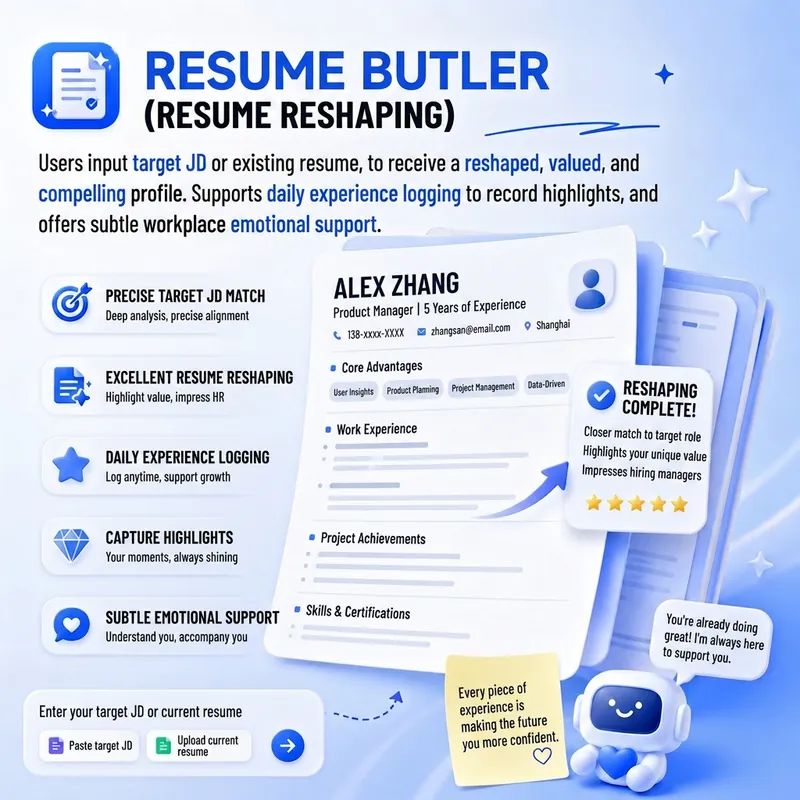
Turn your resume from a list of experiences into a clear value proposition that helps recruiters understand why you’re worth hiring. Resume Coach supports resume diagnosis and rewriting, job description (JD) breakdowns, experience organization, and content streamlining for job searches including campus recruiting, experienced hires, career changes, and returning to the workforce after entrepreneurship. You can upload an existing resume or start with a work or project experience. From the perspective of recruiters and hiring managers, it helps you identify your core strengths and turn vague statements like “was responsible for,” “participated in,” and “was very busy” into specific actions, real results, and skills relevant to your target role. It can also work with a JD to help you decide which experiences to highlight and which points need to be expressed differently. When professional terms or job information are involved, it verifies them against reliable sources to avoid making things up. During the process, it moves forward on one question at a time, lets you temporarily skip uncertain information, and keeps items to be completed later. This helps you build your resume gradually through low-pressure conversation. Whether you’re creating your first resume, tailoring one for a specific role, or condensing an existing version, it can continuously maintain your career information and resume versions. Contact information is not requested proactively; remember to add it yourself before submitting your final resume. Keep growing throughout your career!
Information
- Version
- v3
- Last updated
- Runtime credits
- Usage-based
- Models
- Auto
- Use cases
- Career development
- What you get
- Report