Economic Geography Paper Coach
Write papers from Douyin/Bilibili data
Economic Geography Paper Coach
Write papers from Douyin/Bilibili data
Showcase
Description
A phased writing workflow for empirical papers submitted to Economic Geography: analyze spatial patterns using Douyin and Bilibili data, with interchangeable research subjects; write section by section, maintain an evidence ledger, guard against fabricated data and references, and track progress with a dashboard.
Best for
Researchers who need to turn spatial analysis of platforms such as Douyin and Bilibili into an empirical economic geography paper.
How to use this Skill
Provide your input
Provide the research subject, spatial units, time range, data sources, sampling rules, methods, analysis results, and verifiable references. Missing information may be left blank.
Run the Skill
The tool advances section by section, first confirming the research setup, then drafting and reviewing based on the evidence ledger. It uses placeholders for unsupported content and requests additional evidence.
Review your result
Receive an empirical paper draft for submission to Economic Geography, including section content, an abstract, keywords, references, evidence gaps, and a final review checklist.
Related Skills
View all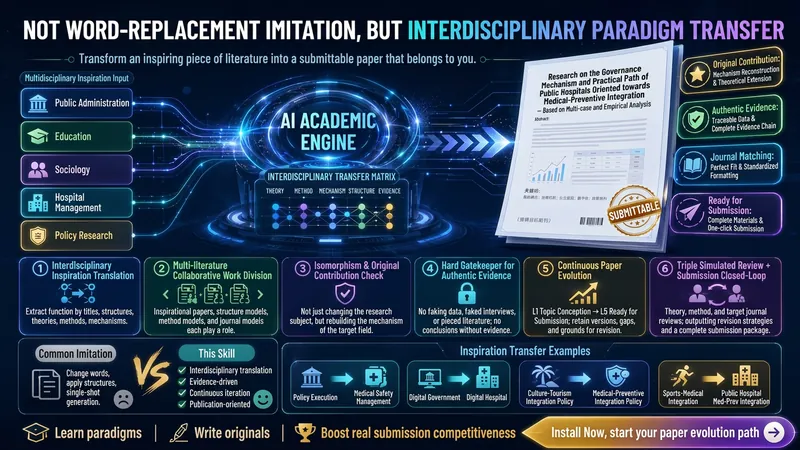
Paper Imitation & Pub. Expert
📚 Paper Imitation & Pub. Expert Develop an inspiring paper into your own high-quality original work step by step. Ideal for graduate students seeking to draw inspiration from excellent papers in other disciplines for topic migration, structural reconstruction, and submission optimization. 🔍 Inspiring Literature Identification: Analyze the reusable title mechanisms, problem awareness, chapter structure, theoretical framework, research methods, evidence organization, and language style of the model paper. 🔄 Interdisciplinary Paradigm Transfer: Build a 'source domain—target domain' transfer matrix to determine which ideas can be transferred and which theories, concepts, cases, and conclusions must be reconstructed. 🧠 Original Contribution Modeling: Identify literature gaps, distill core propositions and mechanisms, and check whether the paper merely changes the research object or applies a generic framework. 🧭 Research Design Planning: Supports theoretical research, case studies, qualitative research, quantitative research, literature reviews, policy text analysis, and mixed methods research. 🛡️ Real Evidence Gate: Do not fabricate data, samples, interviews, cases, statistical results, literature, or DOIs; without real evidence, do not generate false empirical conclusions. ✍️ Evidence-Driven Writing: Build argument chains via 'proposition—evidence—citation—rebuttal', generate original content chapter by chapter, and clearly mark research materials that need to be supplemented. 📈 Continuous Paper Evolution: Record each round of revisions, material gaps, and maturity changes according to L1 (topic conception), L2 (research plan), L3 (evidence formation), L4 (submission draft), and L5 (ready for submission). 🧑⚖️ Triple Simulation Review: Identify rejection risks from the perspectives of a theoretical reviewer, a method reviewer, and a target journal reviewer, and form specific revision strategies. 📨 Complete Submission Loop: Assist in generating the final paper, citation verification table, cover letter, innovation point statement, author response, revision index, and related declaration templates. ✨ Learn the paradigm, write original content, and enhance real submission competitiveness.
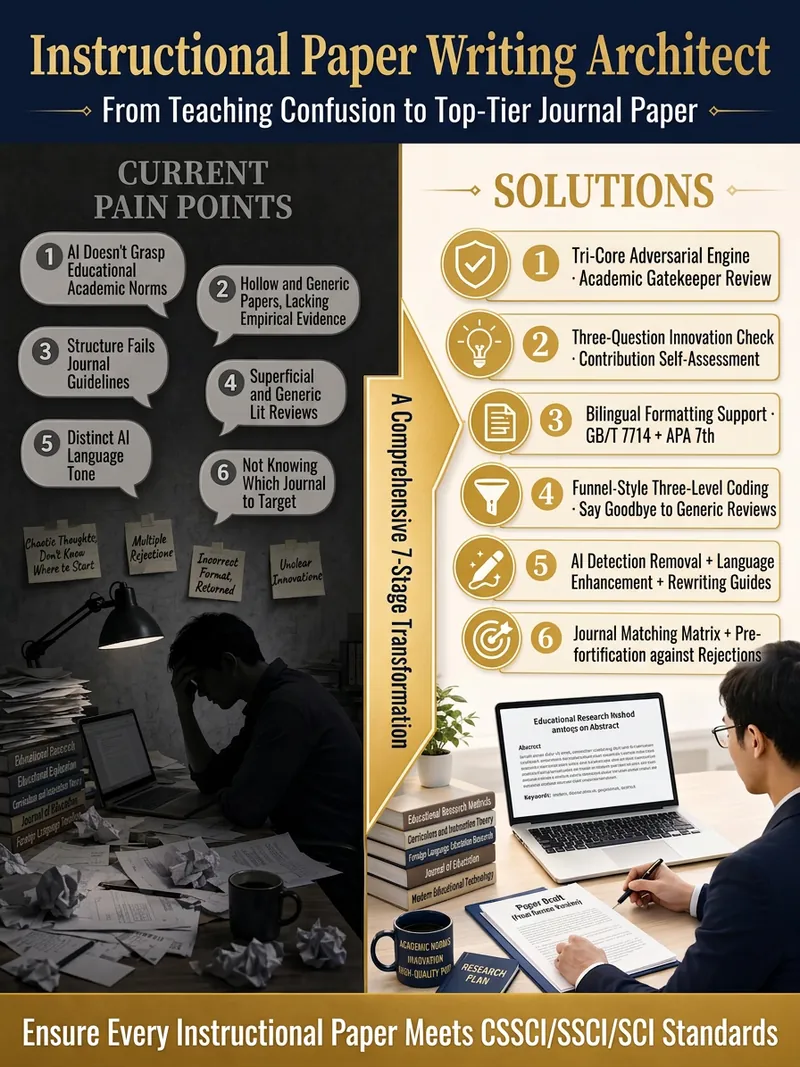
Teaching Paper Architect
From teaching research accumulation to CSSCI/SSCI/SCI — making every teaching paper stand up to peer review. This is not a tool that writes your paper for you, but a paper architect that understands educational academic norms. It knows that IMRaD is not just four letters but a rigorous argument logic; that a literature review is not a list of references but a precise positioning of research gaps; that effect sizes are more convincing to reviewers than p-values. Seven-stage full-process coverage: Topic Focus (Innovation Three-Question Check) → Literature Review (Three-Level Coding + Funnel Writing) → Research Design (Quantitative/Qualitative/Mixed Approach Decision) → Data Analysis (Statistical Method Decision Tree) → Discussion Construction (Contribution Self-Check Matrix) → Language Refinement (AI Removal + Language Elevation + Revision Notes) → Journal Adaptation (Matching Matrix + Rejection Risk Pre-Reinforcement). Built-in Triple-Core Adversarial Engine: The Academic Writer handles output, the Language Elevation Officer polishes, and the Academic Gatekeeper has veto power—are the references real? Is the data reliable? Is the argument grounded in evidence? Does the contribution match the target journal level? Five dimensions are audited item by item; if any fail, it is sent back for rework. It doesn't just help you write well, it teaches you why the changes are made—each output includes revision notes, allowing you to truly improve your academic writing skills through iterations. Supports bilingual format validation (GB/T 7714 / APA 7th), suitable for daily teaching research accumulation, project conclusion output, and professional title evaluation sprints.
 Research
Gaokao Geography Exam Patterns
Extract question patterns from past Gaokao geography exams, deduce the examiners' academic backgrounds and preferences, cross-validate policy hotspots and academic trends, generate analysis reports on question trends and provide original practice exams. Suitable for geography teachers' lesson planning, research, and test creation. Emphasizes pattern analysis rather than prediction. Methodology can be applied to other subjects with adjusted analysis dimensions.
Information
- Version
- v3
- Last updated
- Runtime credits
- Usage-based
- Models
- Auto
- Use cases
- Writing & contentResearch & analysis
- What you get
- ArticleReportPlan
