
Roast It First
Spot key flaws and get ready-to-use fixes
Roast It First
Spot key flaws and get ready-to-use fixes
Showcase
Description
Some things only seem off after you publish them—and by then, it’s too late. Paste in the copy, product description, or proposal you’re preparing to publish. “Roast It First” reviews it from the reader’s perspective and points out up to three places that are hardest to defend: promises that go too far, vague selling points, gaps in the logic, or unclear next steps. For each issue, you’ll get the original line, one question a reader might ask, and wording you can use as a direct replacement. It will also tell you: “If you only fix one thing, fix this.” The feedback can be blunt, but every judgment should have a basis. It focuses on problems in the draft, not the person who wrote it; if the original doesn’t have many issues, it won’t force three. Useful for pre-publication checks, polishing product descriptions, and finding gaps in general proposals. It does not guarantee traffic, sales, or actual reader reactions, and it does not replace fact-checking, professional compliance review, or pricing decisions that require complete business context.
Recommended by
Dancang
Why we love this skill
Pinpoints up to three issues that most affect clarity, trust, and action, then provides replacement-ready fixes grounded in evidence—not insults.
Best for
For anyone who wants to check whether copy, product descriptions, or general proposals are clear, credible, and actionable before publishing.
How to use this Skill
Provide your input
Paste the copy, product description, or general proposal you plan to publish, and add the target readers and desired action, if available.
Run the Skill
Review the content from the reader’s perspective for evidence, selling points, logic, and calls to action. Identify the most important distinct issues.
Review your result
Get up to three issues with the exact lines involved, likely reader questions, ready-to-use replacement wording, and the one change to prioritize.
Related Skills
View all
Chinese Jargon & SVO Review
Rewrites Chinese materials that “sound professional but leave readers unsure who needs to do what” into language readers can understand, act on, and verify directly. It applies to reports, proposals, notices, articles, product documentation, project updates, policy training, customer service content, official WeChat articles, and AI-generated text, with a focus on Chinese jargon, vague slogans, abstract nouns, and writer-centered framing. Without changing facts, quantities, dates, names, scope, the strength of conclusions, or the boundaries of the evidence, this Skill turns difficult-to-act-on phrases such as “empower,” “strengthen management,” “drive implementation,” “close the loop,” and “align through collaboration” into more specific people, actions, objects, conditions, and outcomes. It also checks whether key sentences clearly state the subject, action, and object, so readers know who is responsible for what, what is affected, and how to determine whether the work is complete. When necessary, it retains specialized terms from regulations, standards, and products while adding explanations in plain language. The output typically includes a ready-to-use rewrite, the key changes that affect understanding, and any people responsible, timelines, data, evidence, or specialized definitions that cannot be confirmed from the original. It does not invent information or rewrite suggestions, records, or system statuses as facts that are completed, resolved, or verified. It is suited to writers, editors, and business teams who want to improve the readability, accuracy, and actionability of Chinese materials.
 Write
WriteHuman-Voice WeChat Writing
Turn a hot event, social phenomenon, workplace or relationship issue, personal experience, industry observation, product material, or existing draft into a WeChat Official Account article with a clear stance, genuine emotion, and shareable tension. Instead of settling for a safe “everyone has a point” perspective, it helps you find an angle that fits your target readers, identify the real conflicts and pain points, and use specific scenes, everyday details, and memorable judgments to make the article sound like it was written by a real person with experience, preferences, and an honest awareness of their limits. Along with a ready-to-publish article, it also produces a publication blurb of no more than 120 characters. This is not a summary of the full piece, but a hook designed to spark curiosity and suspense with as few words as possible, encouraging people who see it in their feeds to open the article. Throughout the process, it also applies originality and citation controls: the article does not use long passages copied from third parties; wherever possible, information is paraphrased, and any necessary quotations are kept brief with sources listed together at the end. This helps avoid being classified by the platform as low-originality content that may receive less distribution. It also organizes the creative decisions, title directions, and core points of the article, then prepares authorial responses for realistic comment scenarios such as factual challenges, opposing views, personal experience sharing, and out-of-context quotations. This makes it easier to handle discussion after publication. For hot topics, controversial events, and high-risk subjects such as law, medicine, and finance, it distinguishes known facts, reasonable inferences, and the author’s judgment, avoids fabricated information, and flags details that still need additional sources or verification. It is suited to WeChat Official Account writers, independent media editors, and content teams working on social observation, workplace expression, relationship perspectives, personal growth, and industry commentary. It is especially useful when you want to move beyond overly neutral writing and an AI-like voice without relying on personal attacks, exaggerated claims, or unnecessary conflict to gain attention.
 Write
WriteMaster Writing Advisor
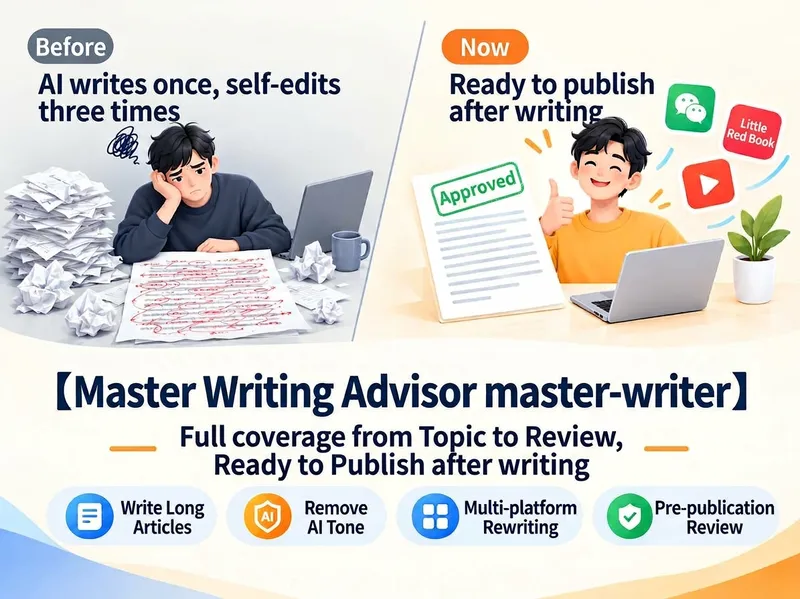
Who it's for: Content creators, WeChat Official Accounts and Xiaohongshu operators, short-video voiceover copywriters, e-commerce and brand copywriters, and anyone who wants to spend fewer rounds editing AI-written content. Core features: Write long-form content WeChat Official Accounts posts, deep-dive articles, and opinion pieces. It checks the source material before writing and says when information is insufficient—no padding or fabrication. Remove the AI feel Keeps numbers, names, and original quotes intact while changing only the phrasing, so the result reads like it was written by a real person. It can also diagnose without rewriting. Write short-form content Xiaohongshu posts, Douyin voiceovers, Zhihu posts, WeChat Moments, X, LinkedIn, and YouTube scripts. Get multiple opening options each time, and adapt one idea for multiple platforms. Write conversion copy Landing pages, product detail pages, and ads. Get multiple headline and button options, along with the trade-offs behind them. Review before publishing Three outcomes—stop, polish, or approve—check facts, risks, and AI-like phrasing in one pass. Understand your voice Share a few older pieces, and it can write in your style. For drafts that need citations, it researches the material before writing.
Information
- Version
- v2
- Last updated
- Runtime credits
- Usage-based
- Models
- Auto
- Use cases
- Writing & contentBusiness & strategy
- What you get
- Report
