
Help Me Understand
Understand mechanisms, evidence, and limits
Help Me Understand
Understand mechanisms, evidence, and limits
Showcase
Description
Helps readers understand papers, reports, complex proposals, or difficult AI answers. It identifies barriers caused by terminology, relationships, steps, and changing conditions, then automatically chooses clear text, diagrams, or interactive HTML while preserving sources, evidence, and applicable limits. It is useful for requests like “help me understand this,” “draw this process,” “what happens if this condition changes,” or “I still don’t get it.” Ordinary polishing, simple factual questions, and writing ready-to-publish copy do not require the full process.
Recommended by
淡苍
Why we love this skill
It goes beyond simplifying complex content by tracking mechanisms, evidence strength, and applicability limits while preserving conditions and uncertainty—and avoiding claims that correlation proves causation.
Best for
For readers, learners, and researchers or analysts who need to understand papers, reports, complex proposals, or difficult answers.
How to use this Skill
Provide your input
Provide a paper, report, complex proposal, AI response, file, or accessible material, and say what you want to understand or which condition changes you want to explore.
Run the Skill
The system identifies terms, relationships, steps, evidence, and applicable limits, then chooses text, diagrams, or interactive pages based on the learning challenge. It separates source facts from teaching assumptions.
Review your result
Get traceable explanations of mechanisms, relationship diagrams, or interactive HTML while preserving key numbers, assumptions, uncertainty, evidence scope, and situations where the material does not apply.
Related Skills
View all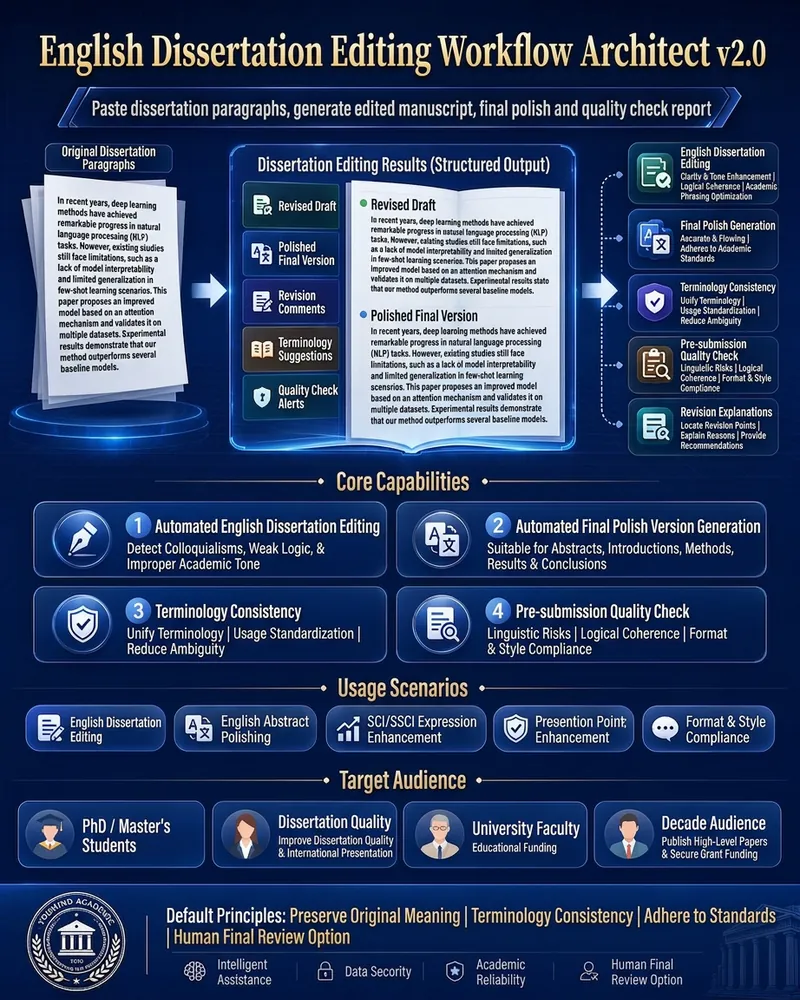 Write
WriteAcademic Paper Editor
Paste a paper paragraph to generate a polished version, an English translation, and a quality-check report. It can help you: 1. Automatically polish Chinese academic papers Identify conversational wording, loose expression, logical jumps, and insufficiently academic tone, then produce more standardized and clearer academic Chinese. 2. Automatically generate an English translation Translate Chinese paper paragraphs into English that follows academic writing conventions while preserving terminology, logical relationships, and the tone of the research. 3. Automatically perform bilingual quality checks Check terminology consistency, logical flow, semantic deviations, grammar issues, long-sentence risks, and whether the academic phrasing is sound. 4. Automatically explain revisions In addition to providing the results, explain what was changed and why, making it easier to continue revising the full paper. Suitable for: PhD students, master's students, university instructors, researchers, paper submission authors, research group members, and writers of English abstracts and SCI/SSCI papers. How to use: Paste a paper paragraph and say what you want to do: “Please polish this Chinese academic paragraph.” “Please translate it into English.” “Please polish the Chinese first, then translate it into English.” “Please check whether this English paragraph fits academic writing conventions.” If you do not specify a mode, I will default to “Chinese polishing + English translation + quality-check report.”
 Research
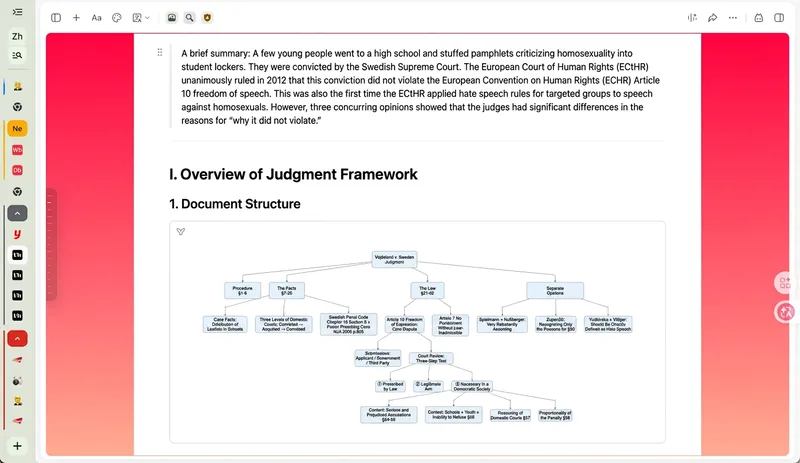
Read Legal Papers/Cases
Turn difficult legal research papers or cases into clear, accessible Chinese explanations that are easy to review and useful for research. After you provide a paper or case, the analysis focuses on the original text’s research framework, reasoning, and key points. It helps you quickly understand what question the author raised, how it was analyzed, and the logical relationships between different views, rather than stopping at simple excerpts or a linear summary. The result is written to a new document named after the paper title or case name for easy reference, archiving, and further research. For academic papers, the explanation first presents the overall structure, then breaks down the connections between the research question, central claims, supporting evidence, and conclusions. When legal concepts or technical terms appear, they are explained in context with the corresponding English terms to make the material easier to read. For legal cases, the analysis covers the disputed issue, applicable rules, application of the facts, and conclusion. It may also reconstruct the legal reasoning as “major premise—minor premise—conclusion,” while explaining the relevant statutes, causes of action, and analytical assumptions. This Skill is designed for students, researchers, and legal professionals who need to read legal scholarship, prepare literature reviews, study case analysis, organize legal reasoning, or explain legal materials clearly to others.
 Research
Technical Term Explainer
What should you do if you don't understand professional terms while reading? Let AI help you analyze and explain them.
Information
- Version
- v2
- Last updated
- Runtime credits
- Usage-based
- Models
- Auto
- Use cases
- Research & analysisLearning & education
- What you get
- DocumentWebpageDiagram
