
De-AI Chinese Rewriter
Remove AI traces while preserving facts
De-AI Chinese Rewriter
Remove AI traces while preserving facts
Showcase
Description
Make your Chinese drafts sound more like they were written by a real person in a specific scenario, while preserving the original facts, stance, and tone strength. Whether it is WeChat messages, emails, Xiaohongshu posts, work reports, or academic papers, it first identifies the style and expression issues, then targets clichés, empty phrasing, mechanical structures, nominalizations, and inappropriate tones. This makes the text more specific, natural, and smooth without becoming overly colloquial. It strictly guards factual boundaries during rewriting: it does not arbitrarily add numbers, dates, names, organizations, cases, promises, or effects, nor does it change "might" to "will," or delete key qualifiers and conclusions. Where necessary information is missing, it clearly marks content to be added to avoid fabricating details for completeness. Formal expressions in academic papers and work reports are not misjudged as "AI-sounding" and overly altered. You will receive a fact-checked and doubly verified Chinese rewrite, ready for direct communication, publishing, reporting, or academic writing. When needed, you can also view specific trace judgments, modification rationales, and pending information to clearly understand what was adjusted and how information consistency was maintained.
Recommended by
Dancang
Why we love this skill
It first identifies AI traces and factual boundaries across Chinese text, then rewrites by genre (WeChat, email, report, paper) with a final review sweep. Uniquely, it strictly guards claim strength, avoids fabricating details, and flags formal conclusions that shouldn't be over-colloquialized.
Best for
Writers who want to make their Chinese texts natural and context-appropriate while preserving facts, stance, and tone strength.
How to use this Skill
Provide your input
Provide a Chinese text and specify the use case or target style, along with any recipient, publishing channel, or tone requirements.
Run the Skill
Adjusts expressions based on the specified or detected style, clearing out clichés, vague phrasing, and inappropriate sentence structures while verifying facts, stance, and tone strength.
Review your result
Receive a more natural, specific Chinese revision ready for direct use, complete with change explanations, AI trace analysis, and missing information notes.
Related Skills
View all
Human-Sounding WeChat Writing
Make WeChat Official Account articles, posts, and spoken scripts sound more like a real person talking: grounded in specific situations, shaped by personal judgment, and carried by natural emotion and conversational rhythm. Readers will find the writing relaxed and fluid rather than stiff or formal, with a clear sense of the author and their point of view. Whether you are writing from scratch, rewriting an existing draft, polishing copy, or reviewing it for a more human feel, less AI-like wording, or a more authentic voice, this Skill helps reduce clichés, excessive parallel phrasing, and overly structured expression while preserving facts, brand tone, and key information. The writing will better match WeChat reading habits, with a natural opening, a clear point of view in the middle, and an ending that avoids empty slogans. When needed, everyday details, actions, dialogue, or small conflicts can make the content more specific and vivid. You will get a publication-ready WeChat article, along with multiple title options, optional quotable lines, image suggestions, and feedback from a human-voice review. It will not invent experiences, data, or quotes to create a more human feel, nor overuse internet slang, rely on excessive sentimentality, or compromise the brand’s character. It works well for personal accounts, brand content, and spoken scripts that need a natural voice.
 Write
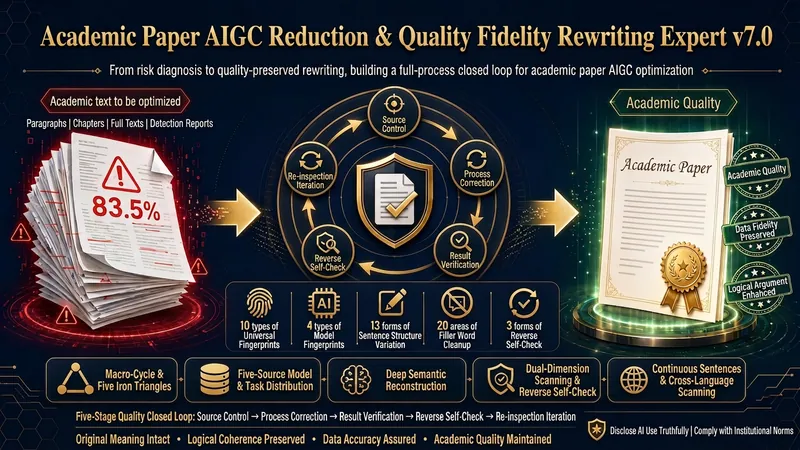
AIGC Reduction & Rewrite v7.0
📚 Academic Paper AIGC Reduction and Quality-Preserving Rewriting Expert v7.0 Designed for graduate students, researchers, and paper authors, this academic text optimization skill operates on a core closed loop of 'source control → process correction → result verification → reverse self-check → iterative re-check'. It systematically diagnoses and optimizes issues such as templated expressions, mechanical logic, vague content, inaccurate terminology, and style inconsistencies while preserving original meaning, technical terms, data, and core conclusions. 🔍📝 🌟 Core Capabilities 🔬 Multi-layer Risk Diagnosis Covers 10 types of universal text fingerprints and assists in identifying common expression patterns of models such as ChatGPT, Claude, DeepSeek, and Wenxin Yiyan. 🧠 Deep Semantic Restructuring Goes beyond synonym replacement to rebuild more natural and in-depth academic reasoning by adjusting proposition expression, information order, argument approach, and evidence organization. ✍️ Quality-Preserving Rewriting Comprehensively applies 13 sentence transformation strategies and 20 methods for cleaning high-frequency templated expressions, improving mechanical sentence structures, repetitive connectors, and overly rigid formatting. 📊 Full-text Structure Diagnosis Through macro-cycle and five key triangles, checks whether research problems, theory, literature review, methods, results, conclusions, and innovation form a complete closed loop. 🧩 Fine-grained Section Adaptation Develops differentiated diagnostic and rewriting strategies for abstract, introduction, literature review, research methods, results, discussion, and conclusion respectively. 🌐 Cross-language Risk Scanning Assists in identifying translationese, passive voice stacking, long sentence nesting, and mixed Chinese-English formatting abnormalities to make Chinese academic expression more natural and accurate. 🔄 Reverse Self-check Loop After rewriting, re-verifies from three aspects: technique distribution, new text fingerprints, and information integrity, to avoid 'becoming more templated' or losing key content. 🛡️ Academic Integrity Protection Does not fabricate literature, data, cases, or policy evidence; separately marks information requiring author verification and reminds users to honestly disclose AI usage. 🎯 Use Cases ✅ Single paragraph or partial section optimization ✅ Targeted modification of marked paragraphs from inspection reports ✅ Polishing of abstract, introduction, literature review, discussion, and conclusion ✅ Full-text AIGC risk feature diagnosis ✅ Language and structure adaptation for target journals ✅ Pre-submission quality review and consistency check 📦 Final Deliverables 📄 Quality-preserving rewritten text 🔎 Risk and issue diagnosis report 🛠️ Rewriting strategy and technique description ✅ Reverse self-check and information integrity report 💡 Items requiring author verification and subsequent revision suggestions 🎓 Original meaning preserved · Logic intact · No fabricated data · Academic quality maintained ⚠️ This skill aims to improve academic expression quality and reduce text risk features. It does not guarantee passage through any specific detection platform or achieving a particular detection score.

Chinese Jargon & SVO Review
Rewrites Chinese materials that “sound professional but leave readers unsure who needs to do what” into language readers can understand, act on, and verify directly. It applies to reports, proposals, notices, articles, product documentation, project updates, policy training, customer service content, official WeChat articles, and AI-generated text, with a focus on Chinese jargon, vague slogans, abstract nouns, and writer-centered framing. Without changing facts, quantities, dates, names, scope, the strength of conclusions, or the boundaries of the evidence, this Skill turns difficult-to-act-on phrases such as “empower,” “strengthen management,” “drive implementation,” “close the loop,” and “align through collaboration” into more specific people, actions, objects, conditions, and outcomes. It also checks whether key sentences clearly state the subject, action, and object, so readers know who is responsible for what, what is affected, and how to determine whether the work is complete. When necessary, it retains specialized terms from regulations, standards, and products while adding explanations in plain language. The output typically includes a ready-to-use rewrite, the key changes that affect understanding, and any people responsible, timelines, data, evidence, or specialized definitions that cannot be confirmed from the original. It does not invent information or rewrite suggestions, records, or system statuses as facts that are completed, resolved, or verified. It is suited to writers, editors, and business teams who want to improve the readability, accuracy, and actionability of Chinese materials.
Information
- Version
- v2
- Last updated
- Runtime credits
- Usage-based
- Models
- Auto
- Use cases
- Writing & content
- What you get
- ReportDocument