
Brand Deal Pricing Coach
Evaluate deals, set rates, and negotiate terms
Brand Deal Pricing Coach
Evaluate deals, set rates, and negotiate terms
Showcase
Description
The hardest part of taking a brand deal isn't finding one—it's knowing what the deal is worth. You spend three days negotiating, then the client says, “That’s the entire budget.” You don’t know whether it’s a firm limit or a negotiation tactic. Quote too high and you may lose the deal; quote too low and you may finish the work after staying up late, only to realize you lost money. This skill brings in the knowledgeable friend who knows the business. Share the basic details of the deal—who the client is, the format, how many deliverables and revision rounds are required, and what price they offered. It will first ask for key missing information, then provide a Brand Deal Pricing Evaluation Report: ✨ Core capabilities 1. Break-even price calculation: Time costs + hard costs + taxes and commissions + revision and payment-term risks, so you can first determine “below what price am I losing money?” 2. Three pricing tiers: Floor price / target price / ideal price, with the reasoning behind each tier and the amount tied to every add-on and discount item 3. Contract checklist: Payment, advance payment, revision limits, licensing scope and duration, exclusivity period, and the right to publish the work as a case study—beginners often lose out more on terms than on price 4. Negotiation scripts: For the initial quote, “the budget is limited,” “let’s test the results first,” exclusivity requests, requests for free trial work, and more. Each scenario includes a ready-to-copy version with tone and risks noted 5. One-page quote letter: Once you reach an agreement, generate a quote letter you can send directly to the client with one click 6. Pricing archive: Remember your past deal prices and minimum hourly rate, becoming more accurate the more you use it 🛡️ Three firm principles · No invented market figures: All amounts come only from the anchors and cost calculations you provide. Estimated ranges are clearly marked as “not the market average” · No sugarcoating: If the price is below your costs, it will tell you directly, “Taking this deal means losing money,” and calculate where the loss comes from · No deciding for you: It provides analysis and supporting reasons; the decision remains yours 📱 Who it’s for Bloggers, creators, and up creators handling brand partnerships, platform deals, or sponsored content; public-account writers; Xiaohongshu and Douyin creators; as well as designers, writers, and podcast hosts taking on projects. 💡 How to use it Simply describe your deal. You can also use /报价 /还价 /条款 /出函 /复盘 /档案 for precise access. Getting one quote right can mean a difference of hundreds or even thousands.
Best for
Content creators, freelancers, and independent service providers handling brand partnerships, sponsored content, or project-based work.
How to use this Skill
Provide your input
Provide the client, content format, deliverables, revision requirements, and offered price, along with your costs, past deal prices, and time involved.
Run the Skill
After you describe the deal, the skill asks for key missing details, then evaluates it using the costs and price anchors you provide. It does not make the final decision for you.
Review your result
Get a brand deal pricing report with a break-even price, three pricing tiers, contract recommendations, negotiation scripts, and a ready-to-send quote letter.
Related Skills
View all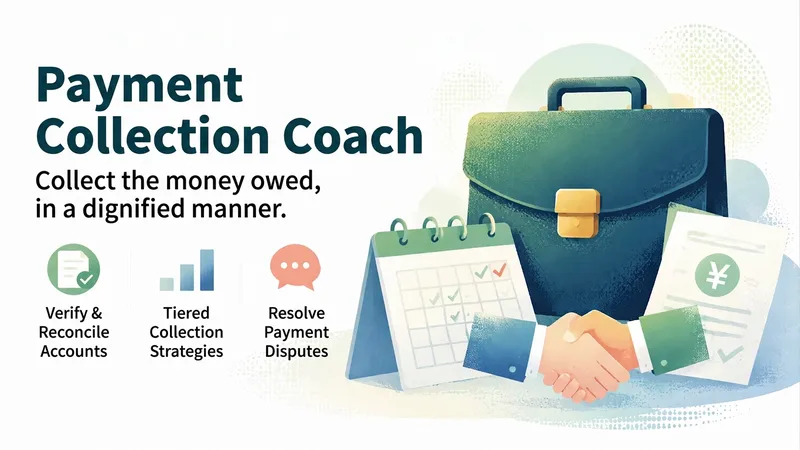 Write
WritePayment Collection Coach
The work is done, but the payment hasn’t arrived—that’s a hurdle no one who takes on client work can avoid. The hardest part isn’t waiting; it’s not knowing how to bring it up. Push too gently and it feels like you’re begging. Push too hard and you worry about losing the client. They say, “Finance is processing it,” and you wait another two weeks. When payment finally comes through, part of the balance is withheld for “poor results.” This Skill helps you collect what you’re owed professionally. Share the details—who owes you, how much, when payment was promised, and how much you’ve already received. It will reconcile the account first, then give you the one message to send today. ✨ Core capabilities 1. Reconcile before requesting payment: Check the amount due, invoices issued, and payments received item by item. Classify the difference into five categories (invoice not issued / invoice issued but unpaid / payment terms not triggered / disputed deduction / inconsistent figures). Requesting payment before the account is clear means giving away your leverage. 2. Escalate in stages: L0 heads-up → L1 friendly → L2 firm → L3 serious → L4 formal. Set the level based on days overdue, then adjust it according to the importance of the relationship—so you know what to say at each stage. 3. Give you only the message to send today: One version each for WeChat, email, and a phone opening, with the tone and risks labeled, plus three likely responses from the other party. 4. Handle final-payment disputes: Separate approaches for clients withholding payment over “poor results,” saying “Finance is processing it,” going silent, or leaving the money stuck with an MCN. 5. Accounts receivable overview: See all unsettled jobs in one table, sorted by days overdue, with the most urgent at the top. 6. Preserve evidence and facts: When agreements were only verbal and there is no contract, learn how to clearly state the facts shown in your chat history (not legal advice). 🛡️ Three firm principles · Reconcile first, then request payment · No legal advice and no threatening language; the highest level is only “Handle this according to the contract.” · If the amount or name is missing, always ask—never use placeholders like “Dear Customer.” 📱 Who it’s for Creators whose payments are overdue, YouTubers, freelance designers, writers, photographers, indie developers, and small studio owners. 💡 How to use it Describe your situation; you can also use /对账 /催 /升级 /争议 /序列 /总览 /档案 for precise actions. The goal of requesting payment isn’t to win an argument—it’s to get your money back.
 Write
WriteCreator Outreach Pro
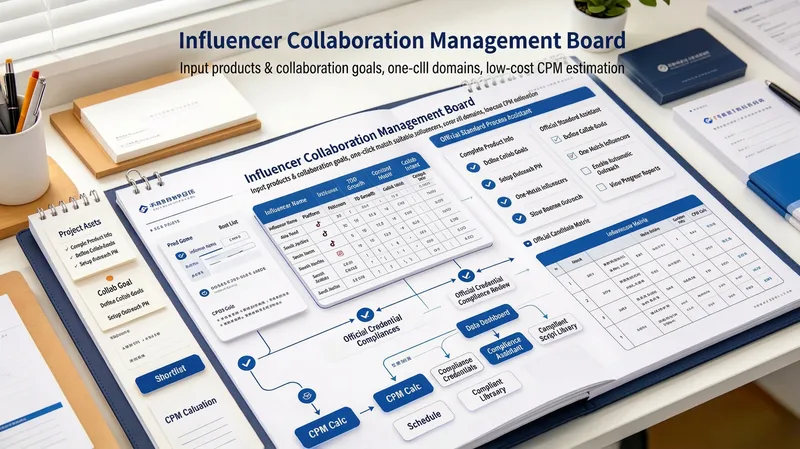
SKILL FEATURES Reverse-engineer your creator profile: Start with goals such as promoting a mini program or driving product sales, then determine the creator category, follower range, content format (short video, image-and-text, or livestream), and price range—so you do not start by aimlessly searching for big-name creators. Candidate shortlist: Organize 10–30 candidates using public information, including platform, follower range, category, content style, estimated rate range, recommendation, and official outreach channels (Xingtu homepage, Pugongying creator marketplace, or a publicly listed MCN business email). Rate and budget model: Estimate costs using flat fees, CPM, CPE, and commission (CPS), then show “total budget → creator tier allocation (top-tier 10% / mid-tier 60% / long-tail 30%) → expected impression range,” with platform service fees noted (about 5% for Xingtu and 10% for Pugongying). Tiered outreach script package: Generate four versions—a Xingtu task Brief, a Pugongying brand invitation, an MCN business email, and a first-contact direct message to the creator—each checked for platform-restricted terms. Brief generator: Automatically create a complete Brief covering product benefits, required and prohibited talking points, number of verbal mentions, publishing window, retention period, component linking (shopping cart / LINK / anchor), and data tracking requirements. Three-part compliance check: Check ad identifiability (clearly labeling content as “Advertisement”), platform disclosure rules (mandatory disclosure on Pugongying; disclosure required for product exchanges valued at ¥500 or more), and prohibited absolute claims or efficacy promises. When a risk is found, provide rewrite suggestions. Follow-up CRM sheet: Output fields that can be pasted into a spreadsheet (creator / platform / follower count / rate / outreach date / channel / reply status / script pending confirmation / publish date / acceptance / review data), with support for updating statuses through follow-up questions. Post-campaign review template: Compare views, engagement, conversions, CPM, and CPE with expectations, then build reusable creator whitelists and blacklists. Suggested prompts I want to promote a bookkeeping mini program with a ¥30,000 budget, mainly on Douyin and Xiaohongshu. Create a shortlist and estimate rates. Write a Pugongying brand invitation and post Brief for a low-sugar snack category, and run the three-part compliance check. I have a list of 20 creator accounts. Assess which are worth investing in and how to allocate the budget. For product sales, should I use a flat fee or commission? Compare CPM/CPE estimates for both options. Rewrite this outreach direct message so it does not trigger restricted terms or get treated as spam. How should I review creator content after publishing? Give me a post-campaign data review template and whitelist criteria.
Work Review MAX: Logs→Review
Does your weekly report look like this: “Moved Project A forward this week, participated in discussions for Meeting B, supported the team with Request C, delivered xx documents, and will continue next week.” Your manager glances at it and moves on. It’s not that you didn’t work hard. It’s that you wrote a log, not a review. When evaluators review promotion materials and managers read monthly reports, they care about just five things: ① Why was this work worth doing? (judgment) ② What benchmark shows that the result was good? (data anchoring) ③ Which parts did “you” do, and which were done by the team? (contribution boundaries) ④ What reusable insight did you take away from the work? (growth curve) ⑤ What do you commit to delivering next cycle? (commitment mindset) 99% of review drafts fail to make even one of these clear. They just list features: “Iterated on X,” “launched Y,” “supported Z”—like a robot. This Skill is a structured compiler I refined through frontline business reviews as an AI OPC. Paste in your raw work log exactly as it is—no matter how messy or scattered—and it will produce a complete review that meets senior-level promotion and performance-review standards: 📊 One-line overall assessment (help readers understand your value in 30 seconds) 🎯 Key achievements (STAR + judgment-based narrative, not a feature list) 📈 Data benchmark table (with baselines, definitions, and your share of the contribution) 🧠 Methodology and lessons learned (showing your growth curve) 📅 Next-cycle plan (commitment-letter format, with measurable goals + deadlines + resource needs) ⚠️ Risks and support needed (surfacing risks shows ownership) 📋 Missing-data checklist (everything you need to look up, all at once) Bonus: ✓ Review of 3 key improvement areas (showing which weaknesses in the raw material were addressed) ✓ Defense-risk forecast (which points evaluators may challenge in a promotion review + suggested responses) ✓ Reusable template variables (make a few edits and reuse it next time) How is it different from a typical “AI weekly report” Skill? Others: Rephrase your work log and output it again—it’s still a work log. This one performs structural surgery on it, upgrading it from a “feature-listing format” to a “judgment-based narrative.” What it will never do: ✗ It will not invent data—anything you didn’t provide is marked “needs to be added,” with no made-up numbers ✗ It will not write filler like “As an AI,” “In conclusion,” or “Thank you, leadership” ✗ It will not flatter you or ask, “Can you tell me more?” It gets straight to work Who should use it: People tired of weekly reports and hoping to log off early P6→P7 / M1→M2 / mid-level→senior professionals aiming for promotion Anyone facing a midyear or annual performance review with materials still unwritten Project leads who need to write quarterly reviews for managers, evaluators, or clients Anyone who works hard and wants their work to be truly seen Doing good work doesn’t automatically mean you know how to report it. With the same workload, people who know how to write effective reviews get promoted a year faster. Use it for your next weekly report and make your work visible.
Information
- Version
- v3
- Last updated
- Runtime credits
- Usage-based
- Models
- Auto
- Use cases
- Marketing & growthBusiness & strategy
- What you get
- ReportDocumentScript
