
Corporate Accident Review
Turn accident reports into corrective actions
Corporate Accident Review
Turn accident reports into corrective actions
Showcase
Description
Turn the full company “Accident Investigation Report” into a clear, measured accident review that leads to action. Centered on what happened, it traces direct, indirect, and root causes step by step—helping you see the triggering behavior or condition on the day of the accident, as well as potential internal issues involving systems, training, inspections, site conditions, resource allocation, and safety culture. Direct causes are kept strictly in the report’s original wording, with only specific company names anonymized. The report’s original statements are distinguished from findings made during the later investigation. Indirect and root causes are condensed without changing their original meaning. Information not mentioned in the report is explicitly retained as “Not mentioned in the report.” No accident data, times, locations, or causes are added, and unrelated content is not forced into the cause chain. Each level of cause is paired with an author’s perspective based on the report and corresponding corrective recommendations. Suggestions such as “strengthen training” or “improve inspections” are further translated into specific people, timing, items, and actions—for example, who inspects, how often, where it is recorded, and what to check after correction. This is suitable for corporate accident reviews, safety discussions, corrective action planning, and organizing safety training materials, helping the analysis move from what happened to why it happened and finally to a small action that can begin soon.
Why we love this skill
Preserves direct-cause wording, separates later findings, and turns each cause into specific owners, timing, records, and actions.
Best for
For corporate safety managers, accident review participants, and training material organizers.
How to use this Skill
Provide your input
Provide the full company accident investigation report.
Run the Skill
Organize the accident sequence, distinguish direct, indirect, and root causes, and link each cause to specific corrective actions. Do not add information not mentioned in the report.
Review your result
Create a measured, clear accident review with a cause chain, the author’s perspective, and actionable corrective recommendations. Anonymize company names.
Related Skills
View all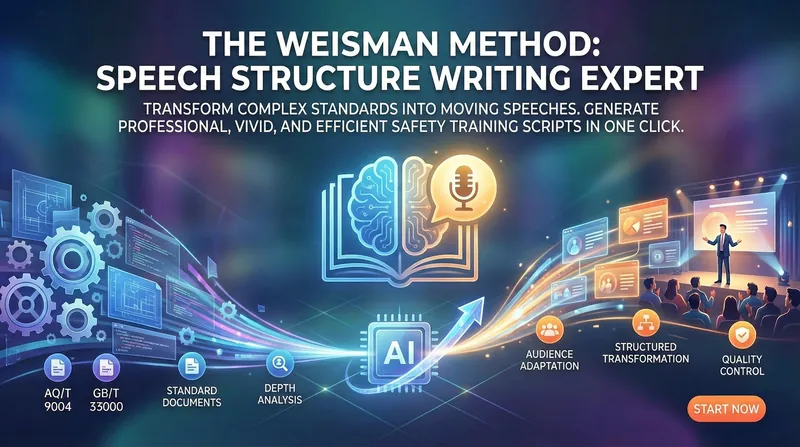
Weissman Course Writer
This skill is specifically designed for corporate safety training. It turns dry, abstract safety production standards into engaging, practical training courses. By deeply analyzing various safety standard documents, it precisely extracts core frameworks and mandatory requirements, and adjusts the tone and depth of examples for different audiences, such as executives, managers, or frontline workers. Whether interpreting complex industry regulations or crafting daily work guides, it ensures the output is both professionally rigorous and easy to read for adult learners. When building content, this skill strictly follows structured instructional logic. Each lesson includes a cognitive-conflict opening, easy-to-understand conceptual metaphors, vivid comparisons of positive and negative examples, and impactful summary phrases. It not only provides a clear course outline, but also generates detailed text with specific calls to action, helping learners grasp immediately actionable tasks while understanding professional terms. In addition, the system automatically weaves in group interaction segments and hazard-warning design, keeping the training highly interactive. You can adjust the course direction at any time based on actual needs—for example, adding class hours, strengthening hands-on steps, introducing more scenario simulations, or designing post-course quizzes. It consistently maintains a positive language orientation, emphasizing “how to do it” rather than simply “don’t do it,” helping companies build a more effective safety-training culture so safety standards truly reach employees and translate into action.

Chinese Jargon & SVO Review
Rewrites Chinese materials that “sound professional but leave readers unsure who needs to do what” into language readers can understand, act on, and verify directly. It applies to reports, proposals, notices, articles, product documentation, project updates, policy training, customer service content, official WeChat articles, and AI-generated text, with a focus on Chinese jargon, vague slogans, abstract nouns, and writer-centered framing. Without changing facts, quantities, dates, names, scope, the strength of conclusions, or the boundaries of the evidence, this Skill turns difficult-to-act-on phrases such as “empower,” “strengthen management,” “drive implementation,” “close the loop,” and “align through collaboration” into more specific people, actions, objects, conditions, and outcomes. It also checks whether key sentences clearly state the subject, action, and object, so readers know who is responsible for what, what is affected, and how to determine whether the work is complete. When necessary, it retains specialized terms from regulations, standards, and products while adding explanations in plain language. The output typically includes a ready-to-use rewrite, the key changes that affect understanding, and any people responsible, timelines, data, evidence, or specialized definitions that cannot be confirmed from the original. It does not invent information or rewrite suggestions, records, or system statuses as facts that are completed, resolved, or verified. It is suited to writers, editors, and business teams who want to improve the readability, accuracy, and actionability of Chinese materials.
 Research
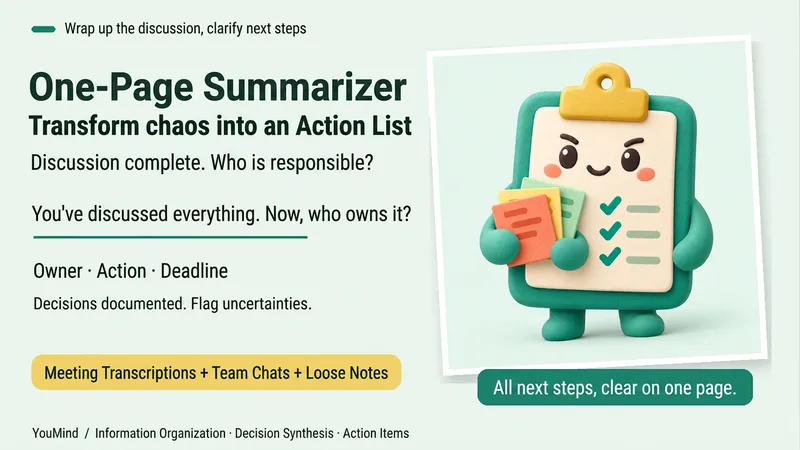
One-Page Action Planner
The meeting is over, the chat has filled several screens, yet nothing is moving forward. Bring in meeting transcripts, chat logs, scattered notes, or multiple documents, and the One-Page Action Planner will organize them into one page: the current situation, decided items, blockers, and who will do what next—and when. Each action includes an owner, timing, status, and source. Agreed decisions are preserved, personal suggestions are marked separately, and conflicting information or missing owners and dates are labeled “To confirm.” It will not make decisions for the team just to fill in a table. Useful for post-meeting follow-up, project handoffs, organizing multiple sources, and personal planning. It ends by highlighting one question that most urgently needs confirmation, making the next step clearer. Supports text and attachments, screenshots, audio transcripts, and links that the current platform can read; when something cannot be read, it will say so clearly. “One page” refers to a compact reading structure; the actual length varies with the complexity of the materials.
Information
- Version
- v10
- Last updated
- Runtime credits
- Usage-based
- Models
- Gemini 3 Pro
- Use cases
- Research & analysisLearning & educationBusiness & strategy
- What you get
- ReportPlan
