HSS Blue Ocean Topic Assistant
HSS Blue Ocean Topic Assistant
Showcase
Description
Think like an academic strategist to turn research red oceans into blue oceans. Discover 5 original topics that break tradition and lead new academic frontiers.
Related Skills
View all
Research Proposal Assistant
Tailored for university faculty and researchers, this AI assistant provides comprehensive guidance in writing humanities and social science research proposals, covering the entire process from topic generation to outcome planning. Whether you need to brainstorm a topic from scratch or optimize a specific section of your proposal, this tool offers expert-level guidance and support. This assistant combines expert experience with a strategy of 'example guidance + writing theory integration' to help you efficiently produce high-quality proposals. You receive targeted analysis of research hotspots in your discipline, topic refinement suggestions, and—based on your research direction and project type—generate a rigorous background, in-depth literature review, and insightful research value statement. In the research content design phase, the assistant helps you define the research subject, build a logically clear research framework, and recommend innovative research ideas and methods. It also helps you distill key points and difficulties, set clear research objectives, and plan a detailed research schedule and feasibility analysis, ensuring your proposal is rigorous and well-structured. Additionally, you can use this tool to deeply explore the innovative aspects of your topic in terms of academic ideas, viewpoints, and research methods, and systematically plan multiple forms of expected outcomes, their applications, and social benefits. Finally, all content is integrated with one click to generate a complete, logically rigorous proposal that meets submission standards, helping you increase your success rate.
 Research
NSSFC/MOE Psych-Edu-AI Gen
This tool generates topic proposals for NSSFC, MOE Humanities, or provincial-level projects. It deeply integrates a trending topic methodology, focusing on interdisciplinary research across psychology, education, and artificial intelligence. By combining your disciplinary background, it creates innovative, cutting-edge, and feasible cross-disciplinary topic proposals. The tool automatically applies appropriate topic strategies and styles based on the project level (NSSFC vs MOE Humanities). It covers all key elements: topic background, research value, innovation points, research content, and expected outcomes.
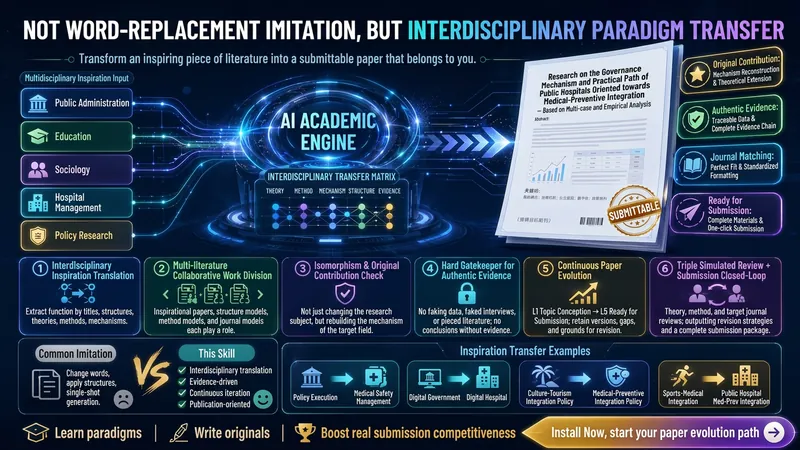
Paper Imitation & Pub. Expert
📚 Paper Imitation & Pub. Expert Develop an inspiring paper into your own high-quality original work step by step. Ideal for graduate students seeking to draw inspiration from excellent papers in other disciplines for topic migration, structural reconstruction, and submission optimization. 🔍 Inspiring Literature Identification: Analyze the reusable title mechanisms, problem awareness, chapter structure, theoretical framework, research methods, evidence organization, and language style of the model paper. 🔄 Interdisciplinary Paradigm Transfer: Build a 'source domain—target domain' transfer matrix to determine which ideas can be transferred and which theories, concepts, cases, and conclusions must be reconstructed. 🧠 Original Contribution Modeling: Identify literature gaps, distill core propositions and mechanisms, and check whether the paper merely changes the research object or applies a generic framework. 🧭 Research Design Planning: Supports theoretical research, case studies, qualitative research, quantitative research, literature reviews, policy text analysis, and mixed methods research. 🛡️ Real Evidence Gate: Do not fabricate data, samples, interviews, cases, statistical results, literature, or DOIs; without real evidence, do not generate false empirical conclusions. ✍️ Evidence-Driven Writing: Build argument chains via 'proposition—evidence—citation—rebuttal', generate original content chapter by chapter, and clearly mark research materials that need to be supplemented. 📈 Continuous Paper Evolution: Record each round of revisions, material gaps, and maturity changes according to L1 (topic conception), L2 (research plan), L3 (evidence formation), L4 (submission draft), and L5 (ready for submission). 🧑⚖️ Triple Simulation Review: Identify rejection risks from the perspectives of a theoretical reviewer, a method reviewer, and a target journal reviewer, and form specific revision strategies. 📨 Complete Submission Loop: Assist in generating the final paper, citation verification table, cover letter, innovation point statement, author response, revision index, and related declaration templates. ✨ Learn the paradigm, write original content, and enhance real submission competitiveness.
Information
- Version
- v2
- Last updated
- Runtime credits
- Usage-based
- Models
- Claude Sonnet 4.5