
Workplace Script Generator
Scripts: rejection, layoff, salary, interview
Workplace Script Generator
Scripts: rejection, layoff, salary, interview
Showcase
Description
Need to reject a candidate after five rounds of interviews? Need to send a layoff notice to an employee who's been with the company for three years? Need to negotiate salary with HR but afraid of saying the wrong thing? No one has taught you how to handle these situations – being too harsh hurts people, being too soft is ineffective, and getting it wrong could even lead to legal trouble. Choose a scenario, tell it the situation, and instantly get multiple professional scripts – for Chinese big companies, small/medium companies, English North American companies, and startups. Formal, friendly, or aspirational – pick the tone you need. ✨ Core Capabilities 1. 6 major HR scenarios: rejection letters, layoff notices, salary negotiation, interview scripts, reference checks, daily HR communication 2. Bilingual + multiple styles: Chinese big company/small-medium companies, English North American/startups – 2-3 versions per scenario 3. Context matching: 4 types of layoff reasons (strategic adjustment, bottom elimination, economic downturn, culture fit) each with specific scripts 4. Salary negotiation dual perspective: 5-level HR undercutting scripts + candidate negotiation scripts – both sides can use 5. Legal safety: all scripts are lawful, do not encourage concealment or fraud 📱 Applicable Scenarios - Startup founders/managers: learn how to properly reject, lay off, or negotiate salary - HR professionals: need quick access to different style scripts - Job seekers: understand HR script implications, negotiate with confidence - Freelancers: use professional scripts to manage client relationships from start to end The hardest part isn't making the decision – it's saying it. Let professional scripts help you speak.
Related Skills
View all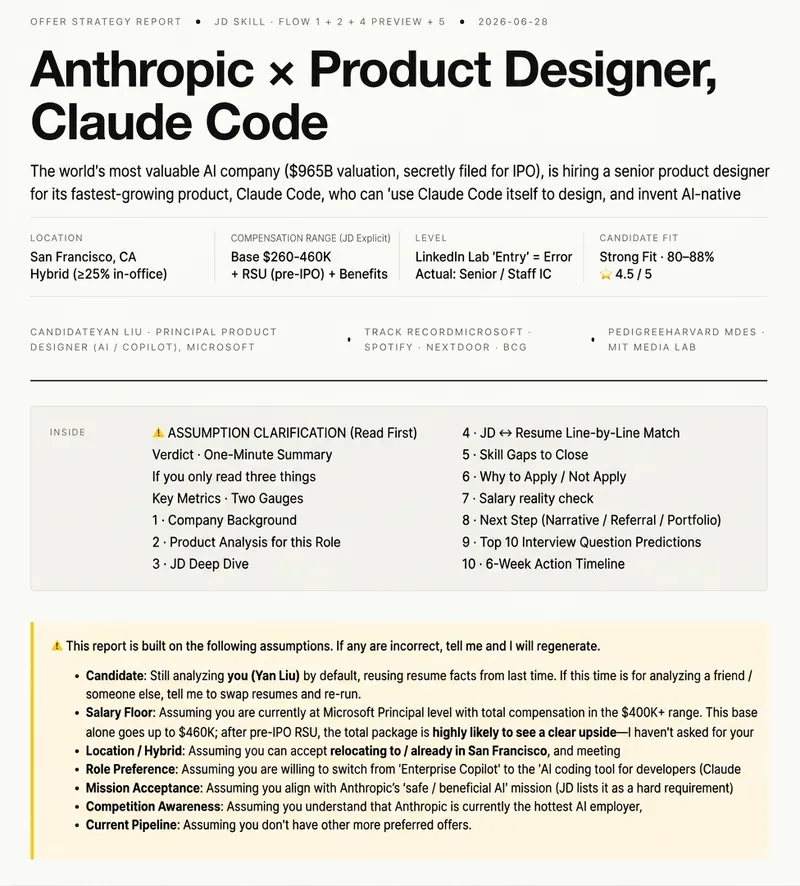 Research
Offer Toolkit
A job search system backed by 10 years of experience at a major Silicon Valley company, packaging genuine hiring insights and job search methodologies into AI. Offer Toolkit | AI Job Search Assistant From "discovering your dream job" to "landing the offer," it breaks down the entire job search process into three smart modules: ① JD Decoder Deeply analyze the job description and generate a personalized Offer Strategy Report: - Whether it's worth applying - Role fit assessment - Core strengths and skill gaps - Interview focus and high-probability question predictions ② Resume Builder Transform your experience from a "job description" into a compelling impact story that recruiters recognize: - Automatically structure your personal experience - Optimize project descriptions and quantify achievements - Generate ATS-friendly, high-quality resumes - Supports 11+ print-ready professional templates ③ Behavioral Story Library Mine your real experiences to build reusable interview story assets: - Extract key projects and growth experiences - Automatically convert to STAR Framework - Build a personal Behavioral Interview Story Bank - Efficiently handle "Tell me about a time..." questions Whether you're debating "should I apply for this job," want to "optimize your resume," need to "analyze a JD," or are preparing for your next behavioral interview, Offer Toolkit will automatically identify your needs and route you to the most suitable AI module. Keywords: Job Search, Offer, Career, Job Hunt, JD, Job Description, Resume, CV, Behavioral Interview, STAR, Tell me about a time, Interview Preparation ------------------------------------- job-description-skill: Paste a JD and your resume, and you'll get an HTML report telling you: whether you should apply for this job, how well you match, what gaps exist, what the interview will likely ask, whether the salary is reasonable, and what to do in the next 6 weeks. resume-skill: Helps you polish your existing resume, import from LinkedIn, or write one from scratch through conversation. Provides 11 print-ready templates (Classic-ATS, Ledger, Tech Compact, Modern Sidebar, Pillar, Elegant Serif, Atelier, Timeline, Swiss, Executive, Color-block). Each time, it provides two files: one directly printable as PDF, and one you can edit by clicking words in the browser. bq-skill: It doesn't give you ready-made answers; instead, it helps you dig out things you've actually done and organize them into a reusable story library. It will ask about your experiences step by step, help you clarify your thinking using STAR/CAR, and tag them with labels like "decision-making" and "overcoming adversity." It saves one copy in Chinese and one in English, so you can use the same story for different behavioral questions next time. It can also look at a JD and predict 20 questions the company might ask, helping you prepare one by one. Three shared rules: 1. No fabrication. All experiences, responsibilities, and numbers come from what the user has actually said. It can help rephrase weak expressions, but it will never invent companies, positions, achievements, or quantified numbers. Numbers must be verified with the user. 2. Ask only one question at a time. Digging stories, building resumes, and preparing BQs are conversations, not questionnaires. 3. Structure first, then output. First convert to a standard data model, confirm it's correct, then render HTML or generate answers.
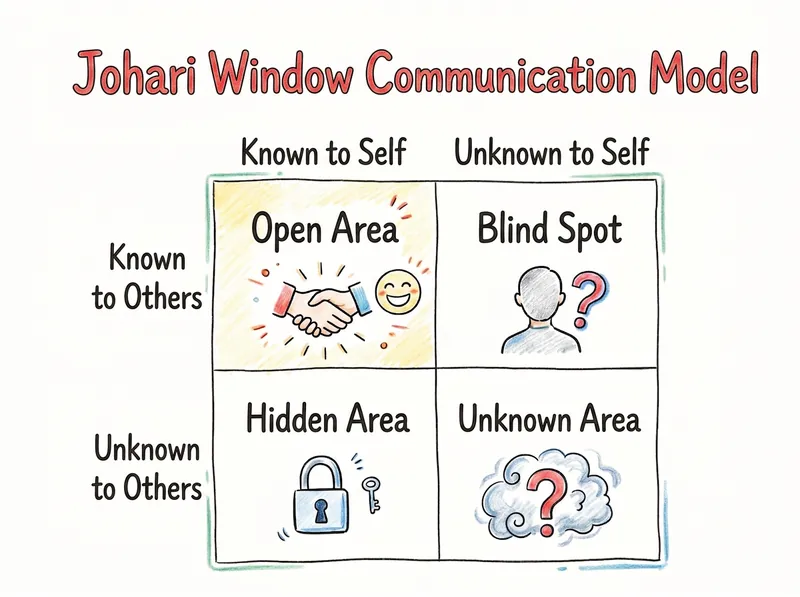
Johari Window Deep Dive Coach
You don't lack communication skills; you lack someone to 'shine a light on the sticking points.' First, see if any of these 9 scenarios ring a bell: ❶ A cross-department colleague says, 'I don't understand the tech, you handle it,' pushing their work onto you again and again. ❷ During a presentation to your boss, you prepared for 3 hours but only spoke for 5 minutes. Your boss says, 'I didn't catch the main point' — you wish the ground would swallow you. ❸ In peer collaboration, they always leave you on read. You're stuck — can't rush, can't stay silent. ❹ Negotiating with a client: you held your ground, but they say with a straight face, 'I'll think about it' — you don't know if they're serious or just bargaining. ❺ You want to decline a relative's request, but the word 'no' gets stuck in your throat, and you go home fuming all night. ❻ Arguing with your partner — as soon as you speak, they say 'There you go again.' After slamming the door, you don't even know what you were angry about. ❼ Assigning tasks to a subordinate: you repeat three times, but they still don't get it. You start wondering if you're the one with the communication problem. ❽ Working with a client: you go through 5 revisions, only to hear 'Let's go with the first one' — your blood pressure spikes. ❾ You want to quit but don't know how to tell your boss. You've been dragging it for 3 months, exhausting yourself every day. None of this is your fault. It's because there's no visible 'platform' between you. Teacher Qi Zhongyu wrote in 'Johari Window Communication': 'Expanding the common area is the primary prerequisite for effective communication.' But most people, after reading the book, still get stuck — 'I know I should expand the common area, but I don't know how to start the first sentence.' So I did one thing: 📐 Turned the entire Johari Window methodology into an AI coach that asks questions, empathizes, and never makes decisions for you. It doesn't dish out motivational quotes or slogans. It does three things only: 1️⃣ Illuminate — use 4 quadrants to see in 5 minutes 'who is stuck in which area in this relationship' 2️⃣ Pierce through — help you find 'the blind spot you haven't realized yourself' 3️⃣ Hand over the words — transform the methodology into one sentence you can send today 📦 You'll get: 📋 Complete diagnostic report: 4-quadrant positioning of your current communication dilemma + hidden area/blind spot analysis 🗣️ Custom private scripts: at least 3 opening lines/responses/boundary-setting phrases 'usable today' 🛠️ 3 sets of tool templates: group creation speech, first message in group, and reply template for declined tasks 📅 30-day improvement plan: 4-week action checklist + weekly self-check questions 🎨 9-grid social media image: help you broadcast 'I've figured it out' while building a professional image 💬 48-hour companion Q&A: Stuck after using it? Ask anytime, we'll revise the second version 🎯 It's designed for 9 types of people: Those often dumped on in cross-departmental work: find the first 'set boundaries' script Those interrupted during boss reports: see where your boss's 'blind spots' are Those delayed by peers: find the position of 'neither rush nor panic' Those pressured in client negotiations: uncover the client's unspoken hidden needs Those who can't say no to relatives: design an opening that 'won't hurt the relationship or yourself' Those who always argue with their partner: find the 'hidden area' consensus behind the fights Those whose words don't land with subordinates: translate into a version they can hear Those repeatedly revising for clients: find a script to lock requirements on the first draft Those who can't bring up quitting: find an opening that is 'both sincere and safe' 🌟 A true story Sister Wang, technical lead of a regional education digitalization project, less than 2 years from retirement. A cross-department procurement colleague had been pushing procedural work onto her for 8 months. She endured and endured, until she wanted to take early sick leave. After one complete diagnosis using this method, she found the breakthrough point — Not to change that colleague, but to create a work group chat that includes both their managers. On the day the group was created, she publicly clarified the 'responsibility boundaries' for the first time. The colleague was stunned for a second, then said: 'Okay, I'll handle it.' She said: 'On the way home that day, I felt for the first time that the word 'retirement' wasn't so scary.' 👇 Add WeChat: gege424153538 (Note: 'Johari Window', and I'll send you the experience link directly)
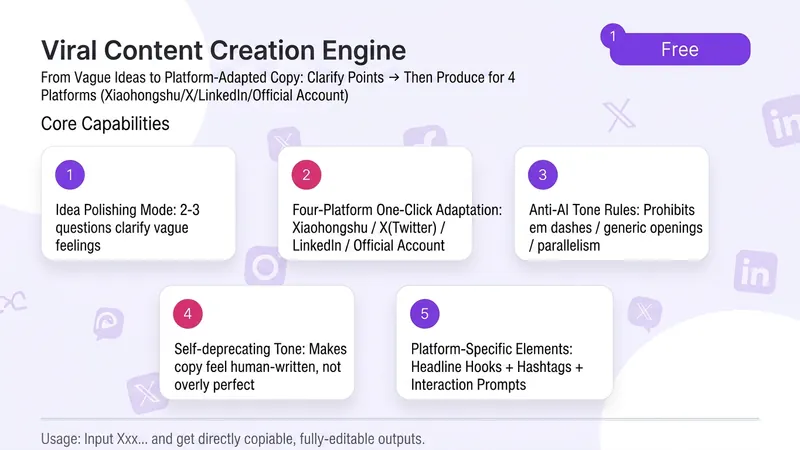
Viral Content Creation Engine
Sometimes you have a brilliant idea in your head, but when you open the editor, you don't know where to start. After agonizing for an hour, you end up posting something that feels flat—the insight that initially excited you gets buried under 'formal' expression. Feed it a vague idea, and it first helps you sharpen it—asks a few pointed questions to turn your insight from 'sounds plausible' to 'that's exactly it.' Then it translates it into Xiaohongshu friend-sharing, X founder insights, WeChat Official Account warm know-how. ✨ Core Capabilities 1. Idea Refinement Mode: 2-3 questions to turn vague feelings into shareable insights 2. One-click adaptation for 4 platforms: Xiaohongshu / X (Twitter) / WeChat Official Account / LinkedIn — tone, rhythm, and format all switch automatically 3. Anti-AI flavor mandate: No dashes, generic openings, hollow parallelisms, or abstract wisdom. Each sentence under 30 characters. 4. Self-deprecating tone: Makes your copy sound like it's written by a real person, not a grammatically correct robot. 5. Each platform includes: headline hook + hashtags + engagement prompt 📱 Use Cases - Personal brands/entrepreneurs who want to post consistently but often get stuck on 'how to say it' - Marketers who need multi-platform distribution but don't want to rephrase for each platform - Professionals with industry insights but no time to polish copy - Content creators looking to level up from 'writing articles' to 'making an impact' Good expression isn't 'writing beautifully'—it's 'making people feel that you get them.'
Information
- Version
- v2
- Last updated
- Runtime credits
- Usage-based
- Models
- Auto