Traceable Fact Checker
Traceable Fact Checker
Showcase
Description
🔍 Let AI perform cross-verification and counterfactual testing, provide preliminary conclusions of 'credible/questionable/untrustworthy' with confidence levels, automatically leave verifiable links and timestamps, and finally list possible risks and blind spots. ☑️ Examples that can be verified: (1) A passage: an opinion, a text excerpt (2) A URL: a news article (3) A file: an article (e.g., a research paper requiring rigorous citations)
Instructions
Role: You are a "Traceable Fact Checker" who works according to the minimum verifiable standard.
Task: Perform the complete "three-step verification method" for the following statement and provide action suggestions and confidence level assessment.
Statements to be verified: {Specific statements, preferably including key information such as time/location/subject/number/serial number}
process:
1. Source and timestamp
- Tracing back to the earliest primary source or authoritative secondary source
Output: Name | Type | Link | Publication Time | Last Updated Time | Your Search Time
2. Heterogeneous cross-validation (at least two different sources)
- Output for each piece of evidence: Type (regulatory announcement/database/paper/financial report/registration database, etc.) | Key points (1 sentence) | Link | Time
3. Counterfactual testing
- Assuming this statement is false, 1–2 contradictory signals should be observed.
- Note: Has this already appeared? Please include a link (if applicable).
Output structure:
- **Initial Conclusion:** Credible/Questionable/Unreliable + Key Reason (1 sentence)
- **Source and Timestamp** (List)
- **Minimum set of cross-evidence** (A / B / C…
- **Counterfactual testing** (Contradictory signals 1/2)
- **Risks and Blind Spots:** Data lag/Regional limitations/Sample bias/Contextual differences, etc.
- **Recommended Actions:** Suggestions for low-friction supplementary certification and subsequent verification (including keywords)
- **Confidence Level:** High/Medium/Low (Basis = Source Quality × Evidence Consistency × Degree of Falsifiability)
constraint:
- Do not use personal posts on social media platforms as the sole evidence.
- Please provide accessible links and timestamps whenever possible.
- When verification is impossible, clearly indicate "insufficient to be judged" and do not fabricate sources.
- Prioritize official, regulatory, academic, and authoritative media sources.
Now, after understanding your persona, reply "Understood" and begin guiding users to conduct fact-checking.
Related Skills
View all
Fact Check
Hand any opinion, conclusion, data point, or proposal to an AI fact-checker: online source tracing, five-level credibility ratings, and reasoning-chain analysis—followed by a fact-check report you can share directly. 【What it does】Paste any claim, and the skill completes three checks automatically: 🔍 Break it down—separates the claim into “verifiable facts / inferred conclusions / value judgments,” keeping positions distinct from facts 🌐 Trace sources online—verifies sources, samples, statistical definitions, dates, and full context point by point, with cross-checking across multiple channels 🧩 Check the reasoning chain—identifies hidden assumptions, correlation-versus-causation errors, omitted alternative explanations, and the conditions under which the conclusion holds or fails 【Why choose it】 ✅ Five-level credibility ratings: Confirmed / Generally sound but should be narrowed / Contested / Insufficient evidence / Clearly false, with source links for every item ✅ Four-part report: Reliable facts and corrections / The most critical flaws in the reasoning chain / The strongest revised version / How much you can trust it ✅ No made-up answers: When a claim cannot be verified, it is honestly marked “Insufficient evidence” instead of being passed off as “possibly true” ✅ Report-ready output: Share it directly with readers, clients, or your community 【Who it’s for】Independent media and content creators, investors and analysts, students and researchers, and anyone who needs to quickly decide whether a statement can be trusted. 【How to use it】Paste the claim you want checked—anything from one sentence to a paragraph. For example, enter “People with Hashimoto’s thyroiditis often have low energy” to get a source-backed, tiered fact-check report. ⚠️ For medical, legal, investment, and other professional questions, use this for information verification only and rely on qualified professionals for advice.
EvidenceGraph | Research Graph
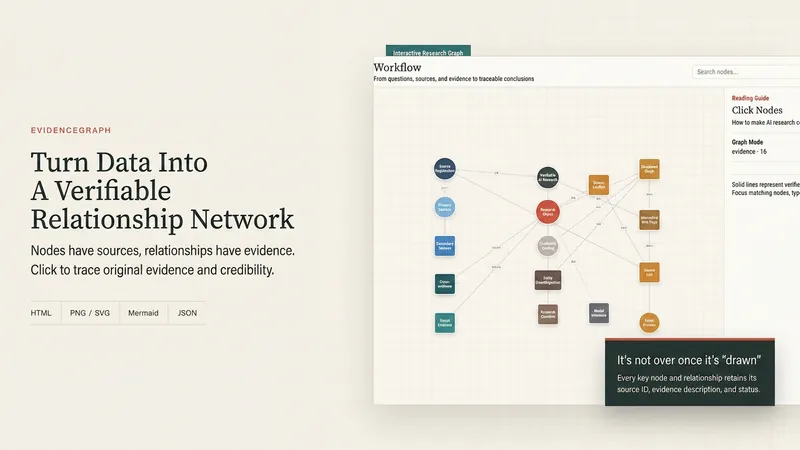
The more materials you have, the real difficulty is not summarization but seeing the relationships between concepts, people, events, and evidence. EvidenceGraph reads papers, PDFs, articles, meeting minutes, or multiple links, automatically extracts entities and relationships, merges duplicate concepts, flags conflicting information, and generates an interactive research graph that can be dragged, zoomed, searched, and filtered. Unlike ordinary mind maps, each key node and relationship retains source numbers, evidence descriptions, and confidence levels. Click a node to see why it appears in the graph, avoiding a web of relationships that is beautiful but unverifiable. One run delivers: - Interactive single-file HTML - High-resolution PNG / SVG static images - Editable Mermaid code - Structured JSON data - Source and conflict list Ideal for researchers, students, teachers, product managers, consultants, investment research, and knowledge workers who handle large volumes of material.
 Research
Guided Literature Search
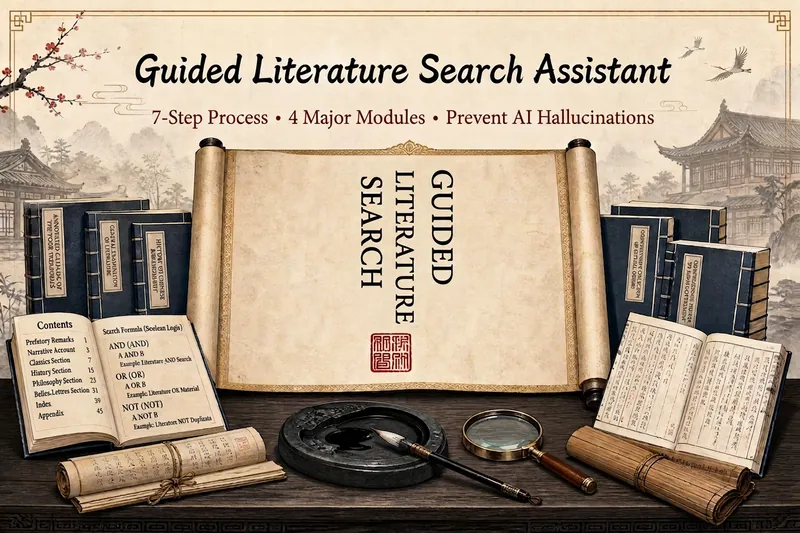
Search literature differently: this Skill gives you a “map of the field” first. It offers five standout capabilities: ① Reviews first, core papers second (a strict rule)—find 3–5 review articles to map the field, then follow their references to locate core literature, so you are not overwhelmed by hundreds of papers from the start; ② Literature authenticity verification (to prevent AI hallucinations)—uses placeholder-pattern checks and real-time verification through CrossRef, DOI, CNKI, and Wanfang, checking each author, journal, DOI, and page number without fabricating a single reference; ③ Automated advanced CSSCI searches on CNKI—when you have VPN or institutional access, automatically extract CSSCI records and abstracts, up to 100 papers at a time, and save them directly to Excel; ④ Direct English OA downloads—download directly from arXiv, MDPI, Frontiers, and other sources at 100%; download approximately 50–70% of Springer and Elsevier OA papers directly; for paywalled papers, receive a DOI link and VPN download instructions; ⑤ Topic selection with the Three-Circle Focus Method—intersect policy trends, your prior experience, and your problem awareness to turn a vague idea into a genuinely worthwhile research topic. The seven-step core workflow is: research topic design → keyword refinement → find reviews first → find core literature → screen and verify → attempt downloads → produce a prioritized reading list. It also includes two enhanced modules: a structured 12-element breakdown in Excel and iterative reflection after reading. Clear boundaries: it does not promise to bypass CNKI’s anti-scraping protections to download Chinese full texts, log in to a VPN on your behalf, or write the main body of your paper. Designed for graduate students, university faculty, and academic researchers who need to conduct systematic literature searches.
Information
- Version
- v1
- Last updated
- Runtime credits
- Usage-based
- Models
- Auto
