
Social Science Lit Review
Step-by-step narrative review writing
Social Science Lit Review
Step-by-step narrative review writing
Showcase
Description
A staged guidance system for narrative literature reviews in the social sciences. It follows the AFP methodology—building the background → creating a classification framework → critical evaluation → deriving research gaps → integration audit—to gather information step by step, save intermediate results, and generate a review with traceable citations. Example: “Use the Social Science Literature Review Guide to help me write a literature review.” Scenario: undergraduate thesis proposal; topic example: mechanisms for improving organizational resilience in small and medium-sized enterprises undergoing digital transformation; literature: Zhang San (2022)… (provide 3–5 entries in the format author (year): one-sentence finding); length: 5,000–8,000 words, GB/T 7714 format.
Related Skills
View all Research
AI-Assisted Literature Review
Guides users through a structured process for writing academic literature reviews based on the Five-Source AFP methodology. It covers four core stages: building the review background, developing a classification framework, conducting critical evaluation, and deriving research gaps. Built-in anti-hallucination safeguards, iterative loop validation, and academic compliance checks help ensure literature review text that is academically sound and logically rigorous.
Social Sci Lit Review Coach V3
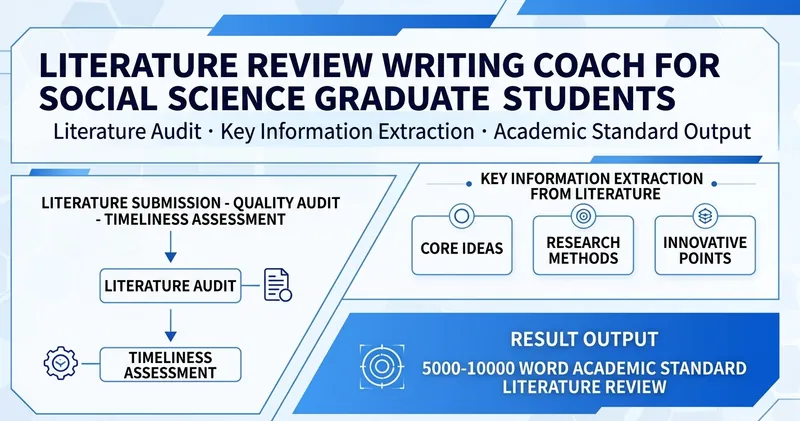
A literature review writing coach for social science graduate theses. Graduate students provide their literature, and the coach reviews the quality and timeliness of the materials. It deconstructs key information, including core arguments, research methods, and innovations, helping students deeply understand the core content. The coach then organizes, summarizes, and refines the literature, synthesizing it into a complete literature review of approximately 5,000 to 10,000 words that meets graduate academic standards.
 Research
Thesis Topic & Intro v3.2
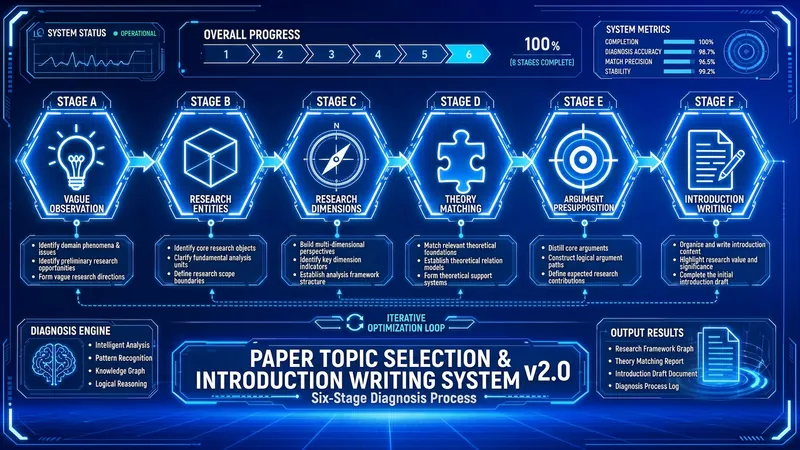
Read in 10 seconds: turn a vague observation into a defensible topic, then into an introduction that can pass review. Throughout, it uses only the real materials you provide — no fabricated references. Trigger words: thesis topic, topic selection, introduction, research gap, academic writing, thesis proposal, topic selection before literature review. Applies to: journal papers / dissertations / conference papers / course papers, across all disciplines — humanities and social sciences, STEM, agriculture, medicine, and life sciences. Up and running in 3 minutes: lock in your discipline and starting point → shape the topic layer by layer → strict evidence-chain gate → module-by-module introduction → ratchet finalization. [Division of labor with other skills] The health check comes first, writing comes after, and polishing comes last. This skill handles the middle stretch: topic shaping + introduction draft. It does not write the full paper (that's the Academic Paper Full-Process Writing System v4.x), and it does not polish language sentence by sentence (that's the Academic Paper Three-Track Polishing System v8.x). [Six gates] 1. Discipline placement: classify into one of four categories — 1A humanities/arts, 1B social sciences, 2A STEM, 2B agriculture/medicine/life sciences — and load the corresponding red-line norms; for category 2B, ethics review status is always checked. 2. Stage positioning: are you at a vague observation, have a unit but no angle, have an object but no theory, lack a method, lack a viewpoint, or only lack an introduction? Start from the corresponding gate instead of starting over from scratch. 3. Topic shaping: research unit → dimension compass → theoretical perspective → research method → research viewpoint, locked layer by layer; before locking each layer, first judge whether the previous layer holds. 4. Strict evidence-chain gate: before the introduction, your references are registered into an M1/M2… material library, each entry verified on four elements — author/year/title/locator; if fewer than 3 references are registered in the conversation, the system refuses to generate the research-gap statement — not a downgrade, a refusal. 5. Module-by-module generation: the introduction is produced in five inverted-pyramid modules, and each module must be annotated with citation numbers [Mn]; no source, no sentence. 6. Ratchet finalization: only versions that have passed receive credit; qualifying modules are locked and no longer changed; scores only go up, never down. [Deliverables] A '[Topic Keyword] · Topic & Introduction' document + a sentence-level traceable citation mapping table + a ⚠️ to-verify checklist + an AFP archive code. The archive code works across four systems — the proposal health-checker, the v4.x full-process system, and the three-track polishing system — so switching skills doesn't require re-stating your discipline, topic, journal, or material library. [Explicitly not done] It does not fabricate authors, years, volumes, issues, page numbers, or DOIs; any bibliographic records retrieved online are marked ⚠️ to-verify and can only be written into the reference list after you verify them; it makes no promises of acceptance or passing review. Authorship and responsibility are yours — please verify every citation and data point.
Information
- Version
- v8
- Last updated
- Runtime credits
- Usage-based
- Models
- Auto
- Use cases
- Writing & contentResearch & analysisLearning & education
- What you get
- ArticleReportDocument