
Organizational Structure Analysis
Power analysis, position diagnosis, insights
Organizational Structure Analysis
Power analysis, position diagnosis, insights
Showcase
Description
Based on sociological theory, it deeply analyzes organizational power structures, diagnoses personal positions, and provides actionable insights. It automatically identifies the type of need, prioritizes a framework for precise analysis, helping users see the situation clearly and understand power dynamics.
Related Skills
View all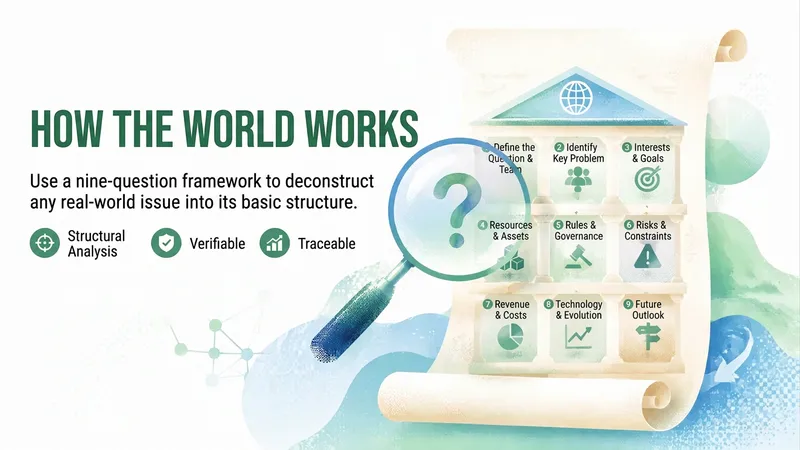
How the World Works
Breaks complex real-world issues down into verifiable underlying structures, helping you see the relationships among participants, interests, resource allocation, rules, risks, returns, and technological change. Whether you are examining cross-border payment costs, the platform economy, stablecoins and monetary sovereignty, or capital cycles in computing power and electricity, you can start with a specific question, an abstract concept, or the current landscape and establish clear analytical boundaries. The skill selects a diagnostic, teaching, or observation path based on your needs, while defining the timeframe, geographic or market scope, key actors, and required data. Throughout the analysis, it distinguishes verified facts, evidence-based inferences, and participant narratives, and records dates, sources, and uncertainty. When sources conflict, it preserves the disagreement rather than replacing facts with promotional messaging. The result is a traceable structural analysis document. It examines the key mechanisms behind an issue layer by layer—from scarcity and choice, property rights, and rules to organizations, finance, the macro environment, and changes in technology costs—and brings each core question to a clear conclusion. It is suited to researching business models, institutional arrangements, financial infrastructure, technology industry cycles, and other real-world issues that require looking beneath the surface.
Multi-Framework Analysis
Turn complex problems into structured, multi-perspective analyses that can be reviewed, verified, and used to support next steps. Whether you are evaluating career choices, business and product decisions, social phenomena, controversial issues, trending topics, innovations, or abstract concepts, this Skill first clarifies the subject, goals, constraints, known information, and key unknowns. It then selects complementary cognitive frameworks based on the task, avoiding a pileup of concepts or repeated versions of the same conclusion. The analysis clearly distinguishes between information provided by the user, verified facts, general principles, assumptions, inferences, and content that still needs validation. It places evidence, mechanisms, counterevidence, alternative explanations, and uncertainty within a clear chain of reasoning. For time-sensitive, controversial, specialized, or high-risk facts, it can use targeted web searches and verify original sources. When sources conflict, it preserves the differences rather than filling gaps with unverified data or overly certain claims. The final output typically includes a problem profile; the framework selection and analysis of each framework; areas of agreement and disagreement across perspectives; sensitive variables; blind spots and failure conditions; and conditional conclusions with confidence levels. It does not replace professional medical, legal, investment, tax, or other advice. Instead, it helps you identify the factors that truly affect judgment and design minimal validation steps, information-gathering plans, decision gates, or reversible next steps. Simple questions can be condensed into a brief assessment, while complex or multi-subject tasks can be developed into a complete analytical report.
 Research
First-Principles Insight
This skill helps you see through complex surfaces and get back to the most fundamental physical facts and logical origins. Whether you're dealing with a tricky business challenge, an abstruse theoretical concept, or a disruptive innovation that must begin from scratch, it applies rigorous logical deconstruction to help you question assumptions that are taken for granted, identify the key elements that drive a system, and distill penetrating, essential insights. During analysis, it guides you through a complete thinking exercise that moves from deconstruction, to questioning, to reconstruction. By scanning across dimensions such as causality, systems, and value, it precisely distinguishes phenomena from essence, filters out distracting secondary information, and pinpoints the key leverage points of a problem. This approach not only helps uncover root causes, but also frees you from fixed mindsets and allows you to build simpler, more scientific frameworks for understanding. Building on deep essential findings, this skill also offers a systematic strategy for generating innovation. It can leverage multiple thinking modes, such as combinatorial innovation, constraint inversion, and analogy transfer, to tailor diverse solutions for you, from incremental improvements to cross-domain integration. In the end, you'll receive a structured report containing the deconstruction process, core questions, essential insights, and actionable recommendations, giving you a solid logical foundation for decisions in a complex and ever-changing environment.
Information
- Version
- v2
- Last updated
- Runtime credits
- Usage-based
- Models
- Auto