
Interview & Focus Group Protocol Writer
Builds a semi-structured interview or focus group guide
Interview & Focus Group Protocol Writer
Builds a semi-structured interview or focus group guide
Showcase
Description
Prepares a complete semi-structured interview guide or focus group protocol, from warm-up questions to closing, based on your research question and participant profile. Produces non-leading, open-ended questions and suggests an a priori code list for MAXQDA/NVivo. Who it's for: researchers and graduate students conducting qualitative or mixed-methods research.
Recommended by
Shuting@YouMind
Why we love this skill
An editor’s pick for turning a research purpose and participant profile into a rigorous, field-ready protocol. It combines neutral, single-concept questions with targeted probes, focus group facilitation notes, and an a priori coding framework for smoother analysis.
Best for
Researchers and graduate students planning qualitative or mixed-methods interviews and focus groups.
How to use this Skill
Provide your input
Provide your research question or purpose, participant profile, interview format, and key themes.
Run the Skill
Describe the study context and select an individual interview or focus group format.
Review your result
Receive a semi-structured protocol with warm-up, open-ended main and probing questions, closing prompts, and a preliminary coding list.
Related Skills
View all Research
Thematic Analysis & Codebook Builder
Builds a systematic codebook and theme map from your raw data excerpts or initial open codes; suggests a parent-child structure for use in MAXQDA/NVivo. Supports inductive, deductive, or hybrid analytic approaches. Who it's for: researchers conducting thematic analysis or content analysis.
 Research
Signal Room: Interview Synthesis
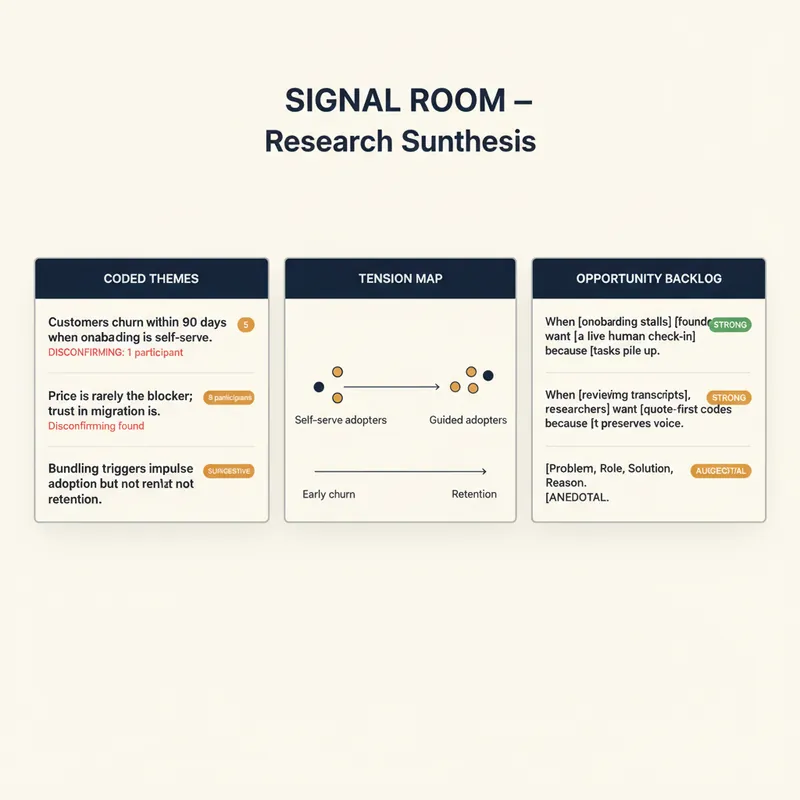
YouMind already transcribes your calls, interviews and podcasts. Signal Room is what happens next. Drop in one transcript or twenty and get back a research synthesis an actual analyst would sign: coded themes, verbatim evidence with timestamps, the places people disagree, and a ranked answer to the decision you are trying to make. The method is real qualitative practice, not summarisation: • Open coding that works quote-first — no quote, no code — with codes named in the participant's own words rather than analyst jargon • Every code tagged Behaviour, Belief or Wish, because "I would definitely pay for that" is not the same class of evidence as "I paid for that last month" • Themes stated as falsifiable sentences, with strength counted in participants rather than quotes, and disconfirming evidence hunted for on purpose • A tension map showing where your participants genuinely split and what predicts which side they fall on • An opportunity backlog written as "when [situation], [who] wants [outcome] because [reason]", each rated Strong, Suggestive or Anecdotal • A direct answer to your decision question, with a stated confidence level and what would change it • The three questions this round could not answer, and who to interview next Guardrails that matter: it never invents or polishes a quote, it refuses to report percentages on fewer than twelve participants, it pseudonymises participants by default, and it will tell you to your face when n=1 means you have a hypothesis rather than a finding. For product managers, UX and market researchers, journalists, consultants, founders doing customer discovery, and anyone sitting on hours of recordings and no findings.
 Research
Qualitative Rigor & COREQ Auditor
Writes a Methods section based on Lincoln & Guba's trustworthiness criteria from your qualitative study design; then reveals which COREQ checklist items are missing or weakly reported, without concealment. Who it's for: researchers seeking reporting robustness before journal submission and graduate students writing a thesis.
Information
- Version
- v2
- Last updated
- Runtime credits
- Usage-based
- Models
- Auto
- Use cases
- Research & analysisLearning & education
- What you get
- Document