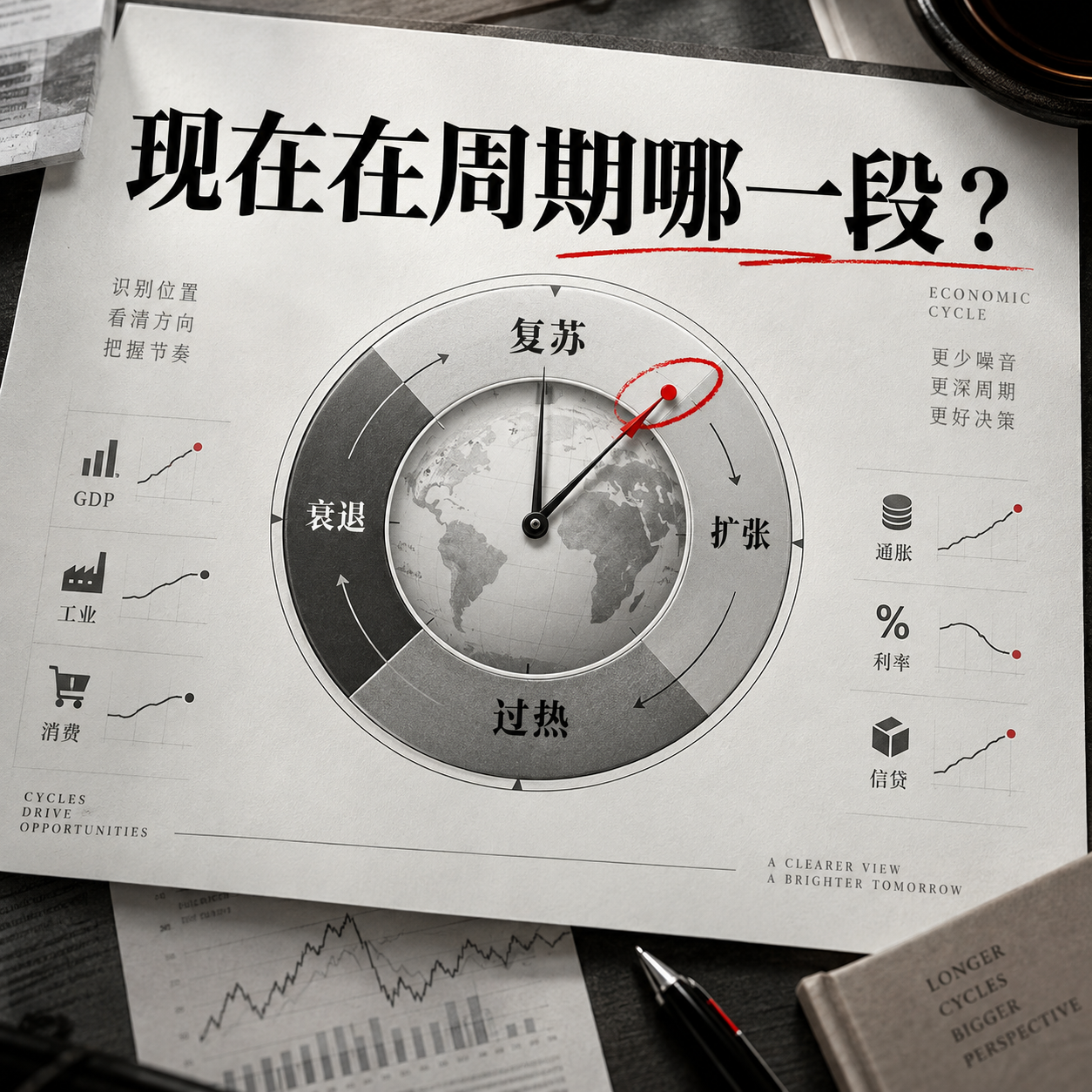
Where Are We in the Cycle?
Gauge the industry phase before adding exposure
Where Are We in the Cycle?
Gauge the industry phase before adding exposure
Showcase
Description
Helps assess the industry cycle position and identify risk signals and leading indicators.
Related Skills
View all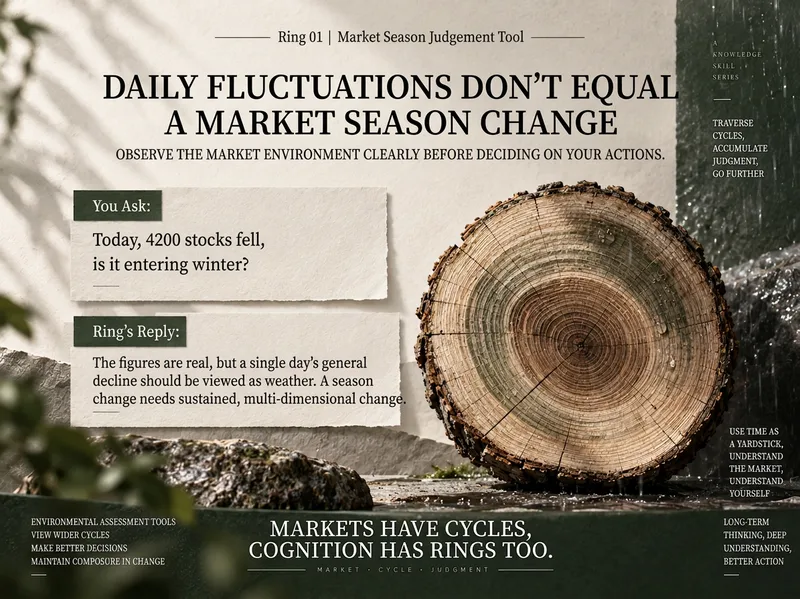
Market Season Indicator
Investment judgments go wrong not because you misread a single news story, but because you failed to first identify the environment you are in. The same decline may be mere volatility at the end of summer, but signal accumulating risk at the start of fall. The same positive news can also mean completely different things at different stages. This Skill does not try to predict whether prices will rise or fall tomorrow. Instead, it first answers a more fundamental question: What kind of market environment are we in now? It considers: Valuation levels Sentiment and crowding Policy direction Market behavior The economic backdrop Structural differences between sectors and the broader market It then determines: Which season the market most closely resembles Whether it is in a transition zone between seasons Which evidence supports the assessment Which pieces of evidence conflict Whether recent changes are merely “weather” or significant enough to warrant a reassessment What future developments could invalidate the current assessment It does not reduce the four seasons to a mechanical score, or give falsely precise answers such as “an 82% probability of entering fall.” More importantly, it allows: The broader market and individual sectors to be in different seasons. The overall A-share market may still be at the end of summer, while a highly crowded growth sector already shows signs of fall. Meanwhile, another sector that has been depressed for a long time may just be beginning to thaw at the end of winter. Four typical use cases What season are we in right now? Is the overall A-share market closer to spring, summer, fall, or winter? xiaoxiaodong uses the latest verifiable evidence to assess the environment rather than looking only at today’s price movement. Is today’s sharp drop just weather? More than 4,000 stocks fell today. Does that mean we have entered winter? xiaoxiaodong first determines whether this is a one-day shock, then examines whether the medium-term trend, policy, valuation, and sentiment have also changed persistently. Why can the broader market and sectors be in different seasons? What seasons are the A-share market, AI/compute, and consumer sectors in? xiaoxiaodong assesses them separately instead of copying the broader-market conclusion directly to every sector. Can a single policy announcement really change the market season? Does the central bank’s latest policy mean the market has entered spring again? xiaoxiaodong distinguishes between a one-time event and an ongoing policy direction, and assesses whether the impact is on short-term sentiment or medium-term fundamentals. Example prompts Which season—spring, summer, fall, or winter—is the overall A-share market in right now? Assess the current seasons of the A-share market, AI/compute, and consumer sectors separately. More than 4,000 stocks fell today. Is this just weather, or has the market changed seasons? Trading volume has continued to shrink recently while the indexes remain near their highs. Does this look more like the end of summer or the start of fall? Could the central bank’s latest policy change the current market season? Why are the indexes still rising while most stocks have become harder to profit from? What it does not do: Precisely predict market tops and bottoms; Give a specific date for a seasonal transition or a falsely precise probability; Provide individual stock price targets or precise buy and sell points; Recommend personalized portfolio allocation percentages; Force a seasonal conclusion when the evidence is insufficient. It is a market-environment assessment tool, not a market-timing prediction tool.
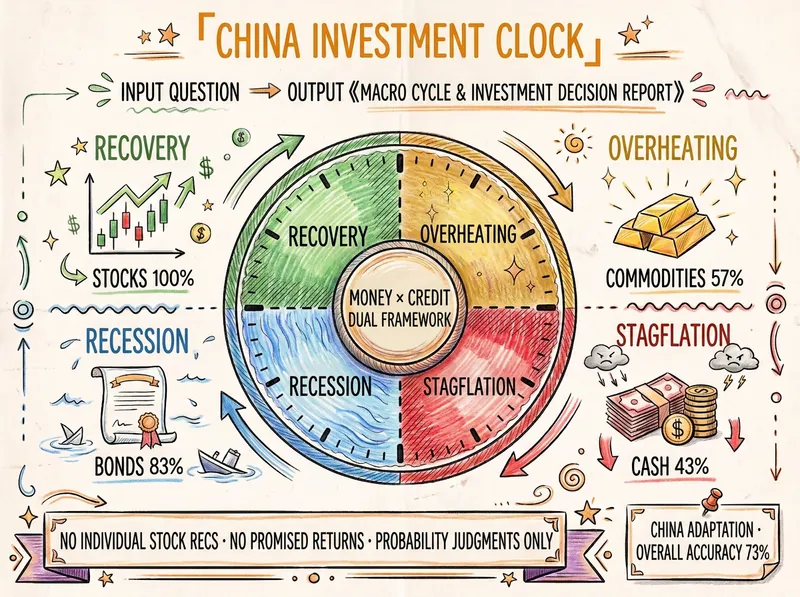
China Investment Clock V3
A Chinese macroeconomic cycle reasoning engine based on a dual money-and-credit framework and an enhanced Merrill Lynch Investment Clock. It provides investors with probability-based guidance on cycle positioning, sector rotation, and asset allocation decisions. It does not recommend individual stocks or promise returns.
Information
- Version
- v6
- Last updated
- Runtime credits
- Usage-based
- Models
- Auto