
Gaokao Application Checker v16
Check each choice: slip, reject, adjust traps
Gaokao Application Checker v16
Check each choice: slip, reject, adjust traps
Showcase
Description
Built on Zhang Xuefeng's gaokao application methodology, this skill runs a six-dimension risk scan on your application list and uses data-driven rank conversion to protect every choice. It reviews only — it never recommends — helping you check whether your already-filled application list has any hidden landmines. [v16 Core Upgrades] ✅ Three-tier operating architecture: governance layer (mode selection / step control / quality red lines) + cognitive layer (5-phase role switching) + execution layer (6-step workflow) ✅ Review-mode recognition: full review / quick pre-check / single-dimension deep dive — pick as needed ✅ 5-phase expert roles: intake planner → data analyst → risk-control auditor → lead report writer → delivery consultant ✅ Six-dimension risk scan: slip / rejection / adjustment traps / tuition / major match / safety-choice sufficiency — per-dimension checklist quality control ✅ Rank-equivalence conversion: dynamic year strategy (based on actual run time), automatically queries admission ranks from the past 3 years ✅ Three-level risk alerts: red (blocking) / yellow (advisory) / green (informational) — fix suggestions for every choice ✅ Full-list gradient diagnosis: checks whether your reach-match-safety ratio follows the golden 20%-50%-30% split ✅ Standardized variable dictionary + anti-hallucination rules: data sources always cited, estimates always flagged [Trigger words] Review application list / Check application list / Slip risk / Rejection risk / Adjustment trap / Reach-match-safety diagnosis / Gaokao application review [Use cases] - You've filled in your application list and want a professional review to avoid careless mistakes - You're unsure about certain choices and want to know your admission odds - You're worried about "adjustment traps" in a major group and want to check in advance - You want to use Zhang Xuefeng's rank-conversion method to verify your choices make sense Provide: province + score + rank + application list → AI automatically queries historical data → generates a risk-scan report + fix suggestions
Why we love this skill
For already-filled forms, it checks each item for rank matching, slip/rejection, adjustment traps, tuition, major limits, and safety gradient, without blind recommendations. Six-dimensional risk scan with official data sourcing and red-flag alerts helps you spot real pitfalls before submitting.
Related Skills
View all
Gaokao Application Advisor v2.0
🎯 Core Features ✅ Smart selection of eligible colleges and majors: Automatically filter the best schools and major pools based on your scores, ranking, and provincial policies, avoiding blind selections. ✅ Accurate admission probability calculation: Based on 3 years of historical admission data, calculate admission probability for each choice (85% safety, 30% reach...), saying goodbye to "gut-feeling applications". ✅ Generate structured "reach, moderate, safety" plans: Based on your risk preference (conservative/balanced/aggressive), automatically allocate proportions and output a complete application table (simulating real application format). ✅ Provide risk audit and Plan B: Identify sliding risk, adjustment traps, major misconceptions, and prepare contingency plans for worst-case scenarios (e.g., how to change majors after adjustment, how to remedy if you slide). 📱 How to Use Super easy to start: Simply provide your Gaokao score, province, subject combination, and ranking. The system will automatically guide you through priority ranking and risk preference selection, then step by step generate a complete plan. Fully interactive: Instead of dumping a bunch of information at once, it proceeds in 6 phases (information collection → feasible domain analysis → plan generation → risk audit → Plan B → final delivery). At each phase, it pauses for your confirmation and allows adjustments anytime. ✨ Why Choose This Skill? - ✅ V2.0 version, refined through 5 rounds of professional audits and real testing - ✅ Based on AFP super prompt architecture, with rigorous logic, real data, and controllable risk - ✅ Applicable to all 31 provinces, automatically adapts to each province's application policies (parallel application, major group mode, etc.) - ✅ All admission data is queried online in real time, never fabricated, ensuring accurate recommendations 💡 Who Is It For? - 📚 Gaokao candidates: Those who don't know how to fill out applications and need professional guidance - 👨👩👧 Parents of candidates: Want to help their children but are unfamiliar with application rules - 🎓 Education consultants: Need efficient tools to assist in batch plan generation ⚠️ Important Tips - The plans generated by this skill are for reference only. Final applications should be based on official data. - It is recommended to regenerate the latest plan one week before the official application (data updates). - When filling out, please double-check college and major codes to avoid errors. Wishing you success in your Gaokao! 🎓
 Research
2026 Gaokao Major Group Expert
Based on the latest employment data from recent years, the green/red major list from the Employment Blue Book, new majors added by the Ministry of Education in response to national strategic new tracks, and school graduate recommendation rates (baoyan rates) and related information, this skill provides a 'no score slippage, no pitfalls, ensure employment' reach-match-safety gradient volunteer plan for students and parents in provinces using the new Gaokao 'college-major group' mode. Anchored by rank position, it verifies admissions data in real-time via internet and provides visual warnings for adjustment traps within groups. Main features: 1. Subject selection strong validation: Automatically identifies major restriction risks caused by subject combinations (e.g., physics+geography+bio lacking chemistry) under the 'college-major group' mode. 2. Reach-match-safety gradient: Rank-based scientific gradient plan to avoid score slippage and adjustment traps within groups. 3. Dual-track employment prospect labeling: MyCOS green major data + national strategic new tracks. 4. Graduate recommendation rate dimension: Displays school baoyan rates in recommendation table (source/year noted). 5. Adjustment risk visualization: Early warning of 'pitfall' majors within groups.
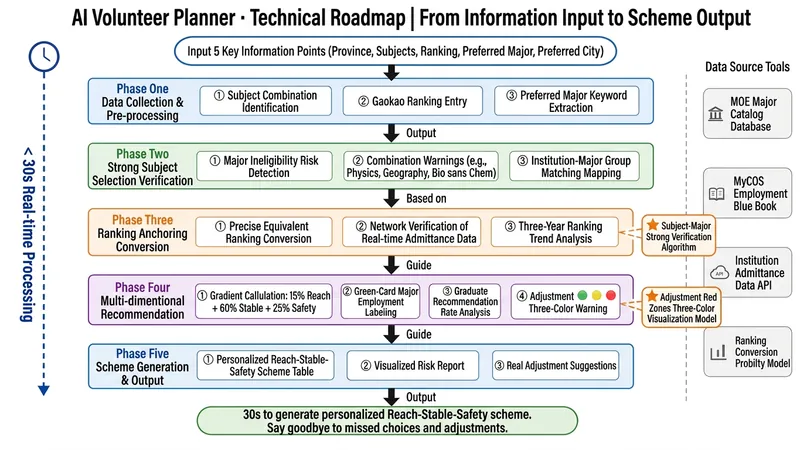
Gaokao Application Expert
An AI volunteer planning expert who understands 'college-major groups', tells the truth, and uses data to speak. Why do you need this skill? After the new Gaokao reform, the 'college-major group' model has made application exponentially harder: 😱 A slight misstep in subject selection can disqualify you from your desired major 😰 One 'pitfall' major in a group, and agreeing to adjustment gets you trapped 😨 Incorrect rank conversion leads to wasted high scores or missed opportunities 😵 Information asymmetry leaves well-meaning parents giving bad advice This skill is designed to solve these pain points. #What it can do? 🎯 **Subject Combination Validation**: Instantly identify forbidden major risks for combinations like 'Physics, Geography, Biology without Chemistry' 📊 **Rank Anchoring**: Use equivalent rank as anchor, verify real-time admission data online 🚦 **Safe, Stable, Reach Gradients**: Scientifically allocate 15% reach + 60% stable + 25% safe plan ✅ **Green-List Major Labeling**: Powered by the latest MyCOS employment blue book data 🚀 **Strategic Track Tracking**: New ministry-added majors like AI, integrated circuits, low-altitude economy 🎓 **Graduate Admission Rate Transparency**: Clearly present graduate admission rate for each university (with source year) ⚠️ **Adjustment Risk Warning**: 🟢🟡🔴 Three-color visualization of 'pitfall' risk within a group ## Who uses it? ✔️ Students from all Gaokao provinces ✔️ Rational parents who don't want their children in 'pitfall' majors ✔️ Potential candidates balancing graduate admission rate and employment ✔️ Ordinary families overwhelmed by information and in need of professional advice ## Its spirit Combines **Zhang Xuefeng-style sharp frankness** + **MyCOS employment data rigor** + **Latest Ministry of Education policies authority**, to be your personal volunteer planning consultant who 'dares to tell the truth and gives real solutions'. **Input 5 key pieces of info, get a customized safe-stable-reach plan in 30 seconds.** Start now → Make sliding, pitfalls, and adjustment a thing of the past.
Information
- Version
- v19
- Last updated
- Runtime credits
- Usage-based
- Models
- Auto