
Copy Editing & Dual Rewrite
Diagnose prose and rewrite it with crisp precision
Copy Editing & Dual Rewrite
Diagnose prose and rewrite it with crisp precision
Showcase
文字剔骨师是我和AI多轮对话之后得到的文字重塑方法论,我自认为这套方法论可以帮助任何文字写作者提升审美和品味以及创作技能和功力。
🔪 剔骨解剖 1. 作者抢戏 · 心理垫字:“我自认为这套方法论可以……” - 诊断:下刀之前先给自己发个奖状。“自认为”是心虚的缓冲垫,等于当众承认这结论没底,一句就把底气泄光。 - 处置:整段切除。方法由方法自证,不由作者代言。 2. 同义内耗 · 三字一组站岗:“提升审美和品味以及创作技能和功力” - 诊断:“审美≈品味”,“技能≈功力”,两对近义词并排报销,字数翻倍,信息原地踏步。四个大词摞在一起,密度为零。 - 处置:每对只留一个能上秤的词,砍到见骨。 3. 抽象空转 · 物理失明:“提升审美和品味……” - 诊断:满腔“审美、品味、技能、功力”,拿不出一件有重量、有温度、有声响的东西。读者听你敲锣,看不见舞台。 - 处置:把“提升”换成人能看见的动作——写作者究竟多做了什么、少写了什么。 4. 语义叠影 · 定语压死主干:“文字剔骨师是我和AI多轮对话之后得到的文字重塑方法论” - 诊断:“剔骨”与“重塑”本是一回事,前后重复报销;“我和AI多轮对话之后得到的”这串长定语又软又长,几只手一起摁住主干,主语半天喘不上气。 - 处置:砍掉语义重复,把长定语切成独立短句,让“文字剔骨师=一套方法”当场咬合。 5. 虚词注水:“任何文字写作者” - 诊断:“文字”与“写作者”语义重叠,多挂一字;“任何”是虚张声势的放大词,兑水不提味。 - 处置:撤掉“文字”与“任何”,只留“写作者”。 🔨 双重重塑 1. 平实版(骨架端正 · 极高密度) > 文字剔骨师,是我和 AI 多轮对话磨出的一套文字重塑法。它能让写作者分辨好坏,也知道坏在哪里、怎么改。 2. 冷峻版(骨相凛冽 · 跃迁四阶法) > 一具文字摊上案台。骨头松的,挑断;皮肉烂的,剜掉;脂肪厚的,削平。三刀走净,血水抹去,铅字才肯立起来。 ⚡ 课后一刺 你给一把剔骨刀配了段软塌塌的自我介绍。先拿它割自己一句,再谈它能救谁。
文案剔骨与双版重写
记者朋友们对十八大作了大量报道,向世界传递了许多“中国声音”。我代表大会秘书处向大家表示衷心的感谢。 刚才,我们召开了中国共产党第十八届中央委员会第一次全体会议,选举产生了新一届中央领导机构,选举我为中央委员会总书记。我代表新一届中央领导机构成员感谢全党同志的信任,定当不负重托,不辱使命。 全党同志的重托,全国各族人民的期望,是对我们做好工作的巨大鼓舞,也是我们肩上的重大责任。
I'll load the specified skill to process this text. 🔪 剔骨解剖 1. 代表代表代表——公文复读机:"我代表大会秘书处向大家表示衷心的感谢"、"我代表新一届中央领导机构成员感谢全党同志的信任" - 诊断:三段文字里"代表"出现两次,"感谢"出现两次,"信任"与"重托"互为近义反复。整段话是一台自我循环的致谢机器,主语永远是"我代表XX",宾语永远是"感谢/不负",句式完全同构。这不是文章,是填空题。 - 处置:砍掉重复的"代表"句式,合并致谢动作,一次说完。 2. 四字成语流水席:"不负重托,不辱使命"、"巨大鼓舞"、"重大责任" - 诊断:四字格排列整齐得像宴席上的冷盘,每一道都正确、得体、毫无营养。"巨大鼓舞"与"重大责任"是标准公文填充物,拆开看没有一个字携带真实信息量。"不负重托,不辱使命"对仗工整到令人怀疑它是从哪个模板里复制粘贴来的。 - 处置:拆掉四字格拼盘,逼出具体承诺或具体动作。 3. 物理代币全面缺席 - 诊断:三段话里没有一件实物、一个场景、一帧画面。全是"声音"、"信任"、"重托"、"期望"、"鼓舞"、"责任"——六个抽象名词撑起三段话。读者听完,脑子里什么都没留下,只剩一团温热的空气。 - 处置:冷峻版需植入物理锚点,让权力交接这件事有重量。 4. 时间线黏连:"刚才,我们召开了……选举产生了……选举我为……" - 诊断:"选举产生了新一届中央领导机构"与"选举我为中央委员会总书记"是同一事件的两次叙述,前者是集合,后者是元素,拆成两个分句纯属官样文章的冗余习惯。 - 处置:合并为一句,削掉重复动词。 --- 🔨 双重重塑 1. 平实版(骨架端正 · 极高密度) > 感谢在座记者对十八大的报道。 > > 十八届中央委员会第一次全体会议刚刚结束,选举产生了新一届中央领导机构,我被选为总书记。这份信任是鼓舞,更是责任。我们会扛住它。 2. 冷峻版(骨相凛冽 · 跃迁四阶法) > 话筒还没关,票已经点完了。 > > 新的名字填进旧的表格。灯光打在证书的钢印上,墨迹未干。 > > 九亿双眼睛盯着这张纸。纸很轻,担子不轻。 --- ⚡ 课后一刺 这不是文章,是仪式。仪式不需要文笔,只需要正确。但你既然把它摆上手术台,就该知道——正确是文字最低的及格线,而这三段话,刚好踩在线上,一毫米都没多出。
十八大讲话文案剔骨与重写
光着膀子坐在桌前,渐觉身上冷了,站起身去拿了衣服穿上,回到桌前继续码字。
🔪 剔骨解剖 1. 动作串珠,平均用力:“光着膀子坐在桌前……站起身去拿了衣服穿上,回到桌前继续码字” - 诊断:四个动作等距排列,逗号一逗到底,每个动作都用同样的力气,没有一个咬住物理落点。这是监控录像的流水账,不是文字。 - 处置:拆掉均匀节奏,压缩次要动作,让真正的受力点顶出来。 2. 时空悬空,动线含糊:“站起身去拿了衣服” - 诊断:摄像机原则失效。衣服挂在衣柜、椅背还是隔壁房间,作者没看见,读者更看不见。“去”是个空动作,去哪儿都是废话。 - 处置:把衣服钉死在一个可见的位置上。 3. 心理垫字遮蔽观察:“渐觉身上冷了” - 诊断:“渐觉”是颅内过程,摄像机拍不出“渐渐觉得”。作者用一个抽象词,替自己免掉了“冷在哪块皮肤、起没起鸡皮疙瘩”的观察义务。 - 处置:把“冷”降维到具体的身体与物件。 4. 软词自嘲:“继续码字” - 诊断:“码字”是网络自嘲腔,与全句白描的语域打架;“继续”在此处空转,只占字数不承重。 - 处置:换一个带物理摩擦的动词。 🔨 双重重塑 1. 平实版(骨架端正 · 极高密度) > 光着膀子坐到桌前,身上发凉,起身取衣套上,再坐回去接着写。 2. 冷峻版(骨相凛冽 · 跃迁四阶法) > 皮肉贴着凉桌板,指节发僵。椅子后撤一声,椅背的外套两臂捅进去,布料蹭过肩胛。坐回去,光标还钉在原地闪。 ⚡ 课后一刺 你写了四个动作,却没有一个动作有重量。冷在哪块皮肤、衣服什么面料、椅子什么声响,你一个都没看见,却指望读者替你补全整个房间。
文案剔骨与双版重写
昨晚晚饭后和老婆出去散步。回来时天已经黑透。小区门口的人行道上,趴着一只虫子。我走近一看,是天牛。黑的。我跟老婆说,小时候一道夏天,我们就爬树去抓它。我们管它叫老水牛。那树结一种红果子。像杨梅,但是甜的。老婆说她小时候也吃过。还说老水牛的牙很厉害,咬到人特别疼。
I'll load the specified skill to process your text. 🔪 剔骨解剖 1. 主语脱落与视角晃动:"昨晚晚饭后和老婆出去散步" - 诊断:主语"我"被省略,尚可接受。但"和老婆出去散步"紧跟"晚饭后",句法松散,像发微信不像写文章。全篇主语在"我"和"老婆"之间反复跳切,却从未给过清晰交接。 - 处置:开头锚定一个干净的时间-动作起笔,砍掉"出去"这种口语赘词。 2. 字法错误:"一道夏天" - 诊断:"一道"应为"一到"。基础用字滑丝,整句判残。 - 处置:纠正为"一到"。 3. 口语黏连与信息散装:"我跟老婆说,小时候一到夏天,我们就爬树去抓它。我们管它叫老水牛。那树结一种红果子。像杨梅,但是甜的。" - 诊断:四个短句全是陈列式碎片,像菜市场报菜名。"我跟老婆说"是典型的口语转述垫字,写进去等于把读者推远一层。"我们……我们……"主语重复,骨头黏连。信息之间缺乏因果或感官动线,树、果子、虫子三件事散落一地,没人收拾。 - 处置:砍掉"我跟老婆说",将对话内容直接嵌入叙事动线;"我们"只出现一次;树和果子用一个从属句收拢,不要各占一句。 4. 收尾泄气:"还说老水牛的牙很厉害,咬到人特别疼" - 诊断:"很厉害""特别疼"是两块死概念——没有物理痛感,没有牙的形状,没有皮肤的反应。读者读完只得到一个"疼"字,等于什么都没给。结尾停在老婆的转述上,全篇散步的夜色、虫子趴在地上的画面、童年记忆被唤醒的那个瞬间,全部被这句廉价的"特别疼"按死了。 - 处置:要么给出牙咬下去的物理细节,要么在虫子或夜色上收住,让画面自己说话。 5. 短句堆砌的伪风格:"是天牛。黑的。" - 诊断:两个断句试图制造冷硬节奏,但前后文全是松软口语,这两句硬不起来,反而像气短。如果要用短句,前后的文字密度必须配得上这个节奏。 - 处置:平实版里合并为一个干净判断句;冷峻版可以保留断裂感,但需要整体节奏托住。 --- 🔨 双重重塑 1. 平实版(骨架端正 · 极高密度) > 昨晚散步回来,天黑透了。小区门口人行道上趴着一只黑天牛。我蹲下看了一眼,跟她说,小时候一到夏天就爬树抓这东西,我们叫它老水牛。那种树结红果子,像杨梅,但甜。她说小时候也吃过。又说老水牛咬人,牙嵌进肉里,能疼半天。 2. 冷峻版(骨相凛冽 · 跃迁四阶法) > 散步回来,路灯把两个人的影子踩在脚底下。小区门口的水泥地上趴着一只黑天牛,触须没动,像钉在那儿的。我蹲下去。老水牛。小时候爬上树够它,树皮的碎屑掉进领口。那树结一种红果子,比杨梅甜,汁水染得满手指。她站在旁边说,被它咬过,两排锯齿嵌进指头肚,印子三天没消。天牛还趴着。我们绕过它进了门。 --- ⚡ 课后一刺 你的记忆里有树、有虫、有果子的甜味、有牙齿的痛感——素材全在手里,却用发微信的方式一条条扔出来。下次落笔之前问自己一个问题:你到底是在写,还是在说。
童年天牛回忆文案重写
Description
Use this skill to sharpen your observation and writing.\n\nIt turns loose, overdecorated, and logically uneven articles and copy into finished drafts with a clear structure and forceful language. Whether you’re working with short sentences, paragraphs, or expressed ideas, it carefully diagnoses issues such as typos, overuse of filler words, disconnected syntax, stacked modifiers, and confusion in time or space, then points out the specific problems and how to revise them.\n\nWhile preserving the original meaning, it produces two rewritten versions: the plain version removes excess and strengthens information density and sentence structure; the austere version compresses abstract judgments further, shifting toward more concrete actions, objects, and scenes. The result is less self-conscious performance and more solid, resonant prose. It’s suitable for novel excerpts, essays, commentary, social media copy, and personal writing that needs refinement.\n\nYou’ll receive a direct diagnosis of the writing issues, along with two rewrite options for easy comparison and further polishing. This helps identify habitual clichés, vague concepts, and the writer’s unconscious posturing, so every sentence becomes more precise and concise.
Related Skills
View all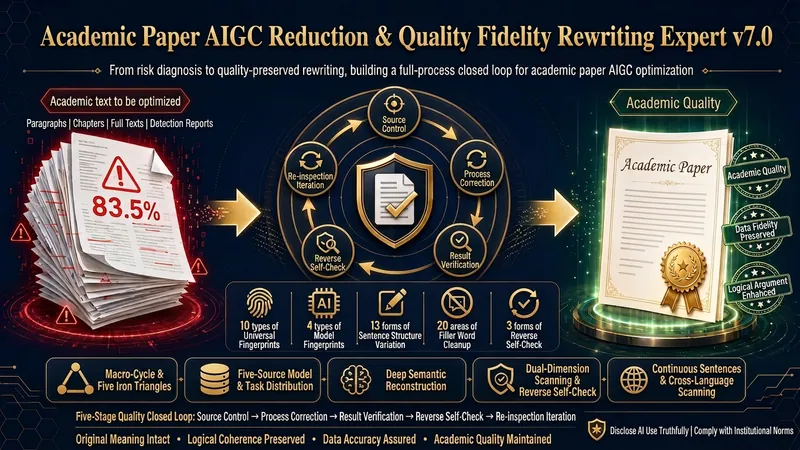 Write
WriteAIGC Reduction & Rewrite v7.0
📚 Academic Paper AIGC Reduction and Quality-Preserving Rewriting Expert v7.0 Designed for graduate students, researchers, and paper authors, this academic text optimization skill operates on a core closed loop of 'source control → process correction → result verification → reverse self-check → iterative re-check'. It systematically diagnoses and optimizes issues such as templated expressions, mechanical logic, vague content, inaccurate terminology, and style inconsistencies while preserving original meaning, technical terms, data, and core conclusions. 🔍📝 🌟 Core Capabilities 🔬 Multi-layer Risk Diagnosis Covers 10 types of universal text fingerprints and assists in identifying common expression patterns of models such as ChatGPT, Claude, DeepSeek, and Wenxin Yiyan. 🧠 Deep Semantic Restructuring Goes beyond synonym replacement to rebuild more natural and in-depth academic reasoning by adjusting proposition expression, information order, argument approach, and evidence organization. ✍️ Quality-Preserving Rewriting Comprehensively applies 13 sentence transformation strategies and 20 methods for cleaning high-frequency templated expressions, improving mechanical sentence structures, repetitive connectors, and overly rigid formatting. 📊 Full-text Structure Diagnosis Through macro-cycle and five key triangles, checks whether research problems, theory, literature review, methods, results, conclusions, and innovation form a complete closed loop. 🧩 Fine-grained Section Adaptation Develops differentiated diagnostic and rewriting strategies for abstract, introduction, literature review, research methods, results, discussion, and conclusion respectively. 🌐 Cross-language Risk Scanning Assists in identifying translationese, passive voice stacking, long sentence nesting, and mixed Chinese-English formatting abnormalities to make Chinese academic expression more natural and accurate. 🔄 Reverse Self-check Loop After rewriting, re-verifies from three aspects: technique distribution, new text fingerprints, and information integrity, to avoid 'becoming more templated' or losing key content. 🛡️ Academic Integrity Protection Does not fabricate literature, data, cases, or policy evidence; separately marks information requiring author verification and reminds users to honestly disclose AI usage. 🎯 Use Cases ✅ Single paragraph or partial section optimization ✅ Targeted modification of marked paragraphs from inspection reports ✅ Polishing of abstract, introduction, literature review, discussion, and conclusion ✅ Full-text AIGC risk feature diagnosis ✅ Language and structure adaptation for target journals ✅ Pre-submission quality review and consistency check 📦 Final Deliverables 📄 Quality-preserving rewritten text 🔎 Risk and issue diagnosis report 🛠️ Rewriting strategy and technique description ✅ Reverse self-check and information integrity report 💡 Items requiring author verification and subsequent revision suggestions 🎓 Original meaning preserved · Logic intact · No fabricated data · Academic quality maintained ⚠️ This skill aims to improve academic expression quality and reduce text risk features. It does not guarantee passage through any specific detection platform or achieving a particular detection score.

Chinese Jargon & SVO Review
Rewrites Chinese materials that “sound professional but leave readers unsure who needs to do what” into language readers can understand, act on, and verify directly. It applies to reports, proposals, notices, articles, product documentation, project updates, policy training, customer service content, official WeChat articles, and AI-generated text, with a focus on Chinese jargon, vague slogans, abstract nouns, and writer-centered framing. Without changing facts, quantities, dates, names, scope, the strength of conclusions, or the boundaries of the evidence, this Skill turns difficult-to-act-on phrases such as “empower,” “strengthen management,” “drive implementation,” “close the loop,” and “align through collaboration” into more specific people, actions, objects, conditions, and outcomes. It also checks whether key sentences clearly state the subject, action, and object, so readers know who is responsible for what, what is affected, and how to determine whether the work is complete. When necessary, it retains specialized terms from regulations, standards, and products while adding explanations in plain language. The output typically includes a ready-to-use rewrite, the key changes that affect understanding, and any people responsible, timelines, data, evidence, or specialized definitions that cannot be confirmed from the original. It does not invent information or rewrite suggestions, records, or system statuses as facts that are completed, resolved, or verified. It is suited to writers, editors, and business teams who want to improve the readability, accuracy, and actionability of Chinese materials.
 Write
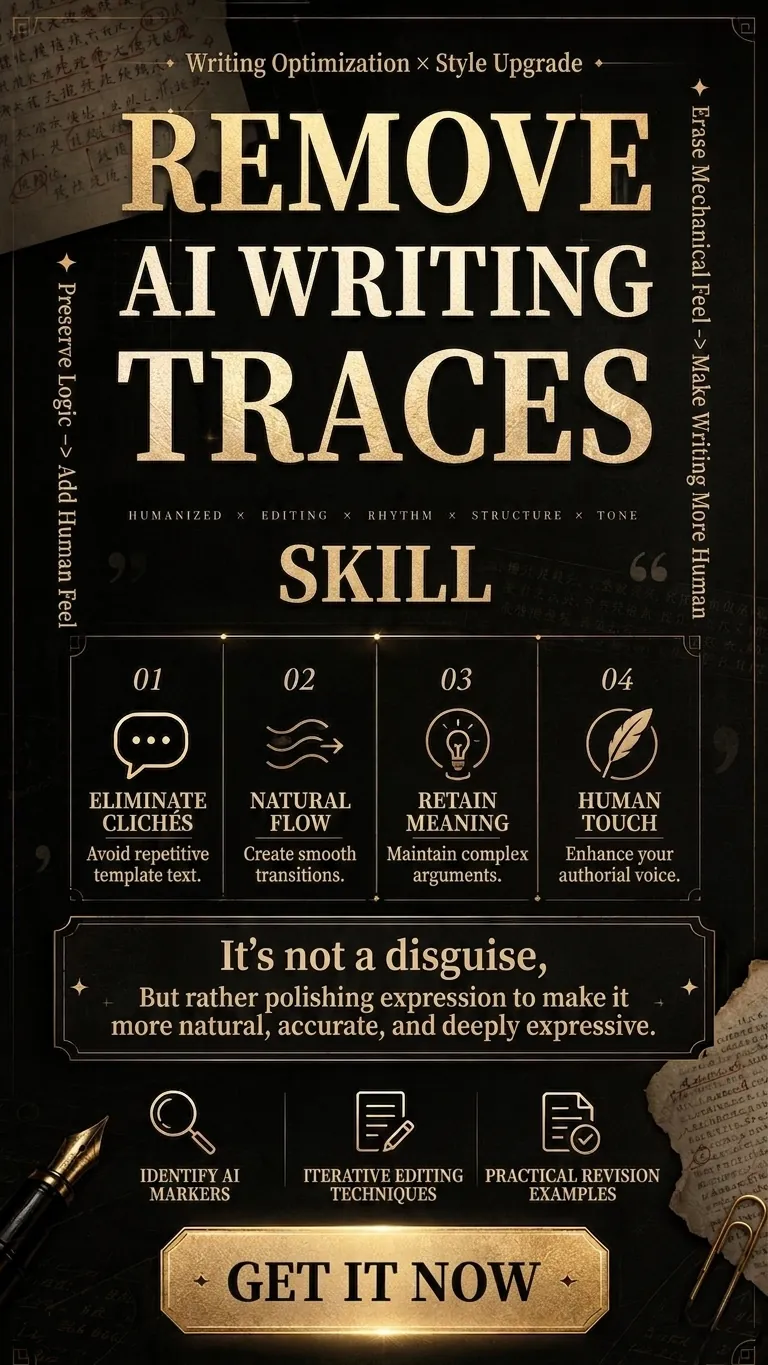
WriteAI Writing Humanizer
Want to eliminate the common 'industrialized' traces in Chinese AI text, giving your writing genuine human warmth and depth? This skill focuses on removing formulaic expressions in AI writing, injecting lively judgment, natural rhythm, unique emphasis, rich details, and authentic tone. It is especially adept at handling in-depth content such as comments, personal essays, historical analysis, political philosophy, social observations, reading notes, and long-form WeChat articles. By identifying and rewriting rigid aspects—from word choice and sentence structure to overall argumentation—this skill helps you transform grand, universally correct narratives into specific, nuanced insights, giving your writing a smooth and natural flow. Without altering the original meaning, it carefully diagnoses AI traces, such as identifying vague clichés, repetitive sentence patterns, and overly balanced tones. It replaces these mechanical elements with more concrete and insightful expressions, infusing your article with the author's personal thoughts and judgments rather than a cold logical construct. Additionally, for issues that mere polishing cannot solve, it points out where facts, examples, or arguments are needed, ensuring both depth and breadth. The result is a Chinese article that is not only clear in viewpoint but also full of human touch and personalized expression. It retains necessary professionalism while removing exaggerated adjectives and stiff connectors, making the text as natural as breathing—powerful yet warm, and far from being 'correct nonsense'.
Information
- Version
- v8
- Last updated
- Runtime credits
- Usage-based
- Models
- Auto