Consumer Brand Lab
For leaders doing deep competitor analysis
Consumer Brand Lab
For leaders doing deep competitor analysis
Showcase
Description
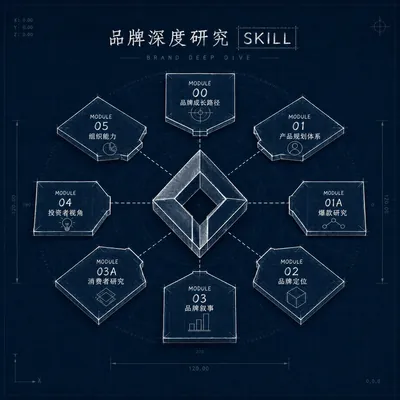
Most people assess brands through their websites, ads, and trending topics—that’s what brands want you to see. The true logic of a brand is hidden in its product structure, pricing, channels, breakout products, user discussions, and financial statements. This Skill takes any brand and, through 2–4 rounds of in-depth web research, reconstructs a complete Operating System spanning “Founder Origin → Brand Formation → Style Evolution → Product Assets → Hero Product Formation → Organizational Capabilities → Brand Growth → Current State”: covering the Founder → Brand Causality Map, brand history and turning points, style evolution and Brand Code, product architecture and Hero Product Portfolio, growth path and evolution of brand assets, then consolidating the findings into a Brand Operating System document series (positioning reverse-engineering, narrative system, investor perspective, organizational capabilities, growth path, product planning + Hero Product lifecycle and breakout path research). It strictly distinguishes evidence-backed facts from reasonable inferences, preserves source citations item by item, and does not fabricate data, sales, rankings, repurchase rates, causality, or quotations. The output is not a brand story, but a reusable brand operating system for brand strategy reference and competitive analysis.
Related Skills
View all
Competitive Intel Analyst
Start with a broad view to build a persuasive competitor database, then focus the output on the company’s core business and decision-making needs. This elevates competitor research from “case hunting” to a decision basis that can be verified, compared, and acted on. This is not a prompt that merely lists a few competitors and stitches together webpage screenshots, nor one that crams every database detail into a PPT. “Competitive Intel Analyst” is suitable for consumer goods, technology products, software services, healthcare, education, retail, manufacturing, and other industries. It first defines the research scope and builds a multidimensional search framework covering markets, companies, products/services, user value, technology paths, business models, pricing and channels, intellectual property, partners, and evidence sources. It then creates a continuously updateable, deduplicated, traceable competitor database. Finally, based on the company’s core business, intended use cases, and leadership’s decision questions, it selects a small number of highly relevant benchmarks and produces a conclusion-first leadership briefing PPT, opportunity gaps, and an action roadmap. Suitable for: Panoramic scans of new markets or product categories Product planning, technology planning, and annual strategy research Tracking key competitors, patents, suppliers, or partner ecosystems Adding to, cleaning, and updating evidence in existing competitor databases or PPTs Investment, business development, and management decision briefings Condensing large volumes of material into conclusions that leaders can understand and teams can act on Typical deliverables include a complete competitor database, a shortlist of core competitors, a leadership briefing PPT, technology/patent/ecosystem maps (as needed), an opportunity and risk list, 90/180/365-day action roadmaps, and a source index.
 Image
Brand Packaging Proposal Board
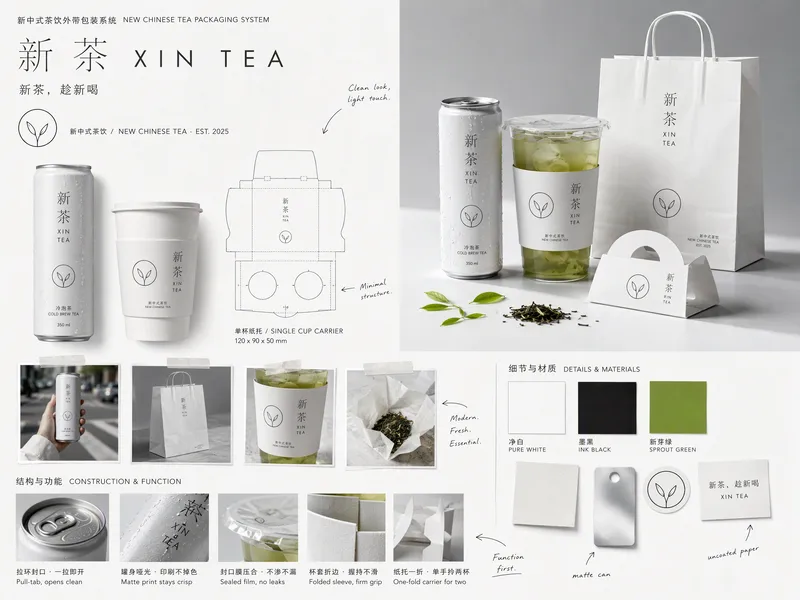
Turn a brand name into a packaging proposal board ready for discussion and further development, suitable for categories such as coffee, tea drinks, baked goods, chocolate, florals, alcohol, fragrance, and skincare. You can provide the brand name in Chinese and English, slogan, category, brand voice, specified materials, or formal logo; even with incomplete information, suitable packaging directions can be developed based on consumer contexts. The proposal selects packaging materials and application details around real-world delivery scenarios, such as paper bags, cups, gift boxes, tea tins, labels, stickers, or structural dielines, and pairs them with brand color palettes that can be applied to paper, ink, foil, and textiles. The visual style is adjusted to the brand’s character through color temperature, contrast, typographic feel, and decorative density, rather than applying the same “premium minimalist” template to every brand. The final output is a landscape 4:3 bilingual English-Chinese packaging design proposal board containing a brand title, primary packaging mockup, flat artwork, structural diagram, application scenes, color swatches, material samples, and functional details. It is presented as a design proposal for clients to review, not as a standard advertising image. If you provide a formal logo, it will be used as a brand asset throughout the packaging and layout wherever possible; slogans and system titles can also be developed based on the category and later replaced or extended.
 Research
Rapid Industry Understanding
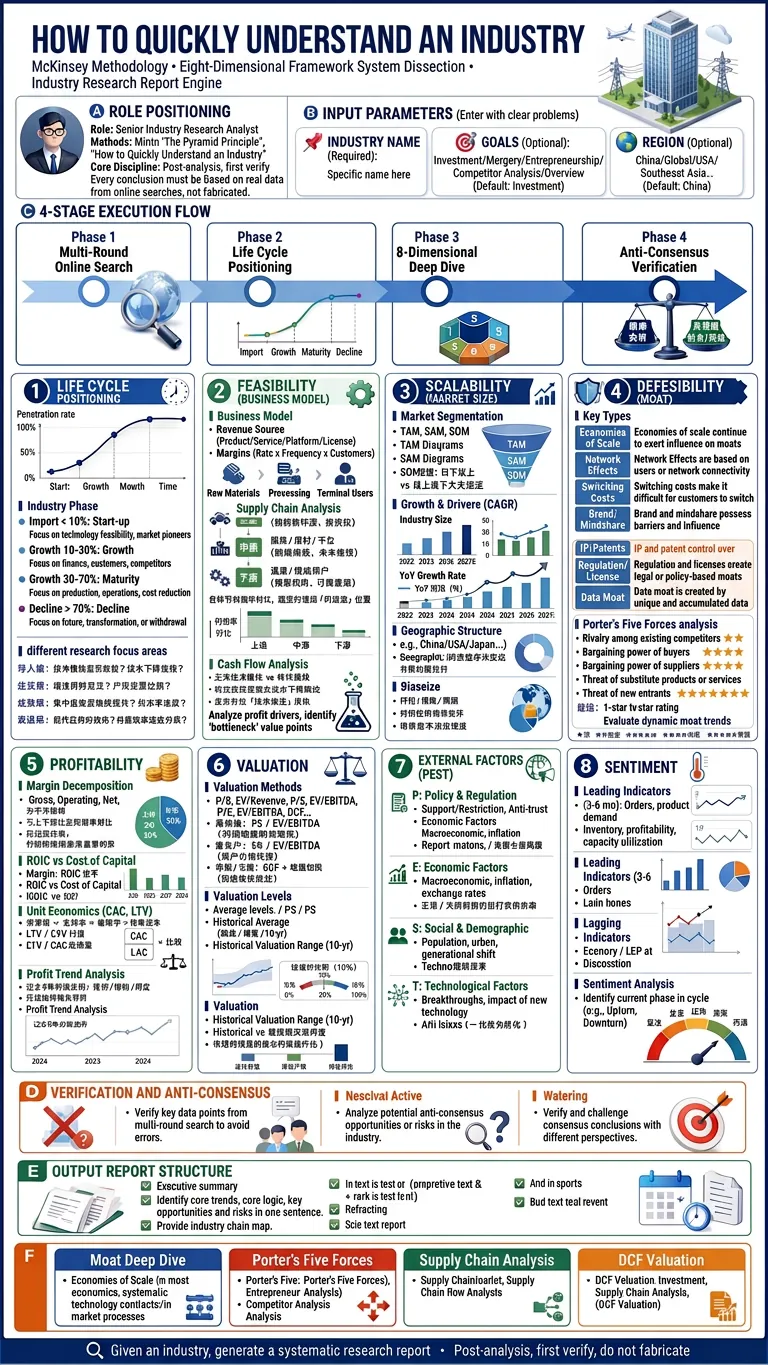
📋 Usage Guide This Skill is an industry research engine based on McKinsey methodology, using the eight-dimension framework from Xiao Jing's "How to Quickly Understand an Industry". Tell it an industry name, and it produces a systematic research report. —————————————————————————————— 🚀 Basic Usage Just tell me the industry you want to research—the more specific, the better: a. "Analyze the solid-state battery industry" b. "Look at the humanoid robot supply chain from an entrepreneurial perspective" c. "Is the solar industry still investable now?" You can optionally provide three details (if missing, I'll use defaults): 1. Industry name: be specific, e.g., "perovskite solar" instead of "new energy"—required; 2. Goal: investment / career / entrepreneurship / competitive analysis / education, default: investment; 3. Region: China market / global / US / Southeast Asia..., default: China market; —————————————————————————————— ⚙️ What it does automatically? The entire process has 4 stages: 1. Multi-round web searches for market size/growth/penetration rate, supply chain, competitive landscape, moat evidence, policy, valuation—every conclusion has a source and timestamp, never fabricated; 2. Lifecycle positioning: use penetration rate to determine if the industry is in introduction/growth/maturity/decline—different stages have completely different research focuses; 3. Eight-dimension deep dive: business model → market size → moat (forced deep dive into dynamic trends) → competitive landscape (forced scoring on each of Porter's Five Forces) → valuation → PEST → business cycle; 4. Contrarian check: distinguish market priced-in consensus from overlooked real issues, and provide decision recommendations; —————————————————————————————— 📊 What it outputs? A professional research report in Markdown format, structured as: 1. ⚡ 30-second verdict — stage / core profit logic / biggest opportunity / biggest risk / one-sentence conclusion; 2. Research object and boundary definition; 3. Lifecycle positioning (with penetration rate data); 4. Eight-dimension analysis (moat includes dynamic trend table, Porter's Five Forces scoring table); 5. Contrarian check; 6. Conclusion and decision recommendations; 7. Key risk list; 8. Data sources and time notes; —————————————————————————————— 🔑 Two Core Highlights 1. Forced deep dive on moat: not just the type of barrier, but must answer "has it widened or narrowed in the past 2-3 years?" using market share/gross margin/pricing power data; 2. Porter's Five Forces scored individually: all five forces scored to avoid shortcuts, determining who has the strongest bargaining power now and whether the landscape is favorable or deteriorating for leaders; —————————————————————————————— ⏱️ Time Approximately 2-4 minutes, due to multiple rounds of search + dimension-by-dimension analysis + report writing —————————————————————————————— 🧩 Subsequent Extensions After the report is generated, you can continue with two specialized analyses (requires manual confirmation, won't run automatically): 1. "Unchain to find bottlenecks": identify physical bottlenecks in the supply chain that can't be bypassed when trends scale, locking in true beneficiary targets; 2. "DCF valuation": run a full discounted cash flow model for a specific company within the industry; —————————————————————————————— ▶️ Want to try? Just tell me an industry name, e.g., "Take a look at the AI agent industry from an entrepreneurial perspective" or "What's the situation with the hydrogen energy supply chain?"
Information
- Version
- v12
- Last updated
- Runtime credits
- Usage-based
- Models
- Auto