ArguScope: Argument Insight
Detect argument flaws, strengthen conclusions
ArguScope: Argument Insight
Detect argument flaws, strengthen conclusions
Showcase
Description
ArguScope is a professional argument analysis tool designed to help users deeply understand the argument quality of any text or audio/video content (requires a transcript), and determine whether the strength of its conclusions matches the evidence provided. This tool is suitable for content creators, researchers, commentators, and any user looking to improve critical thinking and argument analysis skills. It can identify the core claims, supporting evidence, implicit assumptions, and reasoning processes in a text, and evaluate the strength of the conclusions. Users can thus understand the strengths and weaknesses of arguments, enhancing their ability to discern the truthfulness of information and the validity of arguments. ArguScope's core features include extracting the argument skeleton, analyzing the text type, reasoning method, and evidence level; identifying five key logical issues: evidence gaps, causal gaps, conceptual gaps, generalization gaps, and value gaps; and performing fact-checking as needed. Finally, it provides a detailed argument analysis report, including an overall score, argument strength assessment, key issue analysis, and a fact-check checklist, to help users comprehensively evaluate the argument quality of the content.
Recommended by
Nico@YouMind
Why we love this skill
This skill takes a unique approach, not just listing logical fallacies, but delving deeper into the argument skeleton, accurately assessing whether the conclusion's strength exceeds the evidence, helping you become a true thinker.
Related Skills
View all
Fact Check
Hand any opinion, conclusion, data point, or proposal to an AI fact-checker: online source tracing, five-level credibility ratings, and reasoning-chain analysis—followed by a fact-check report you can share directly. 【What it does】Paste any claim, and the skill completes three checks automatically: 🔍 Break it down—separates the claim into “verifiable facts / inferred conclusions / value judgments,” keeping positions distinct from facts 🌐 Trace sources online—verifies sources, samples, statistical definitions, dates, and full context point by point, with cross-checking across multiple channels 🧩 Check the reasoning chain—identifies hidden assumptions, correlation-versus-causation errors, omitted alternative explanations, and the conditions under which the conclusion holds or fails 【Why choose it】 ✅ Five-level credibility ratings: Confirmed / Generally sound but should be narrowed / Contested / Insufficient evidence / Clearly false, with source links for every item ✅ Four-part report: Reliable facts and corrections / The most critical flaws in the reasoning chain / The strongest revised version / How much you can trust it ✅ No made-up answers: When a claim cannot be verified, it is honestly marked “Insufficient evidence” instead of being passed off as “possibly true” ✅ Report-ready output: Share it directly with readers, clients, or your community 【Who it’s for】Independent media and content creators, investors and analysts, students and researchers, and anyone who needs to quickly decide whether a statement can be trusted. 【How to use it】Paste the claim you want checked—anything from one sentence to a paragraph. For example, enter “People with Hashimoto’s thyroiditis often have low energy” to get a source-backed, tiered fact-check report. ⚠️ For medical, legal, investment, and other professional questions, use this for information verification only and rely on qualified professionals for advice.
LessWrong: Disputes & Decisions
Turn controversial issues, policy discussions, article arguments, and comment-section disputes into clearer, testable analysis that can guide action. This skill draws on the LessWrong rationalist tradition, but does not represent an official LessWrong position. Its focus is not on winning debates, but on distinguishing facts, causal explanations, value judgments, policy proposals, predictions, and personal strategies—and avoiding the mistake of treating emotion, conviction, or volume as evidence. It helps you examine evidence quality, unknowns, base rates, and alternative explanations; identify exaggerated claims such as “everyone thinks,” anecdotal reasoning presented as a general rule, attacks on motives, and identity-based arguments; and steelman the other side’s most reasonable position. It also looks for the real disagreements that would change the conclusion and analyzes the relationship between incentives, constraints, and practical action. Whether you are reviewing a controversial article, improving your own argument, understanding a comment-section conflict, or comparing options with incomplete information, you will receive tentative conclusions, key reservations, conditions for updating your judgment, and suggested next steps. For time-sensitive or specialized facts, it will clearly identify what needs further verification rather than filling gaps with false certainty.
 Research
Sprout | Thesis Auditor
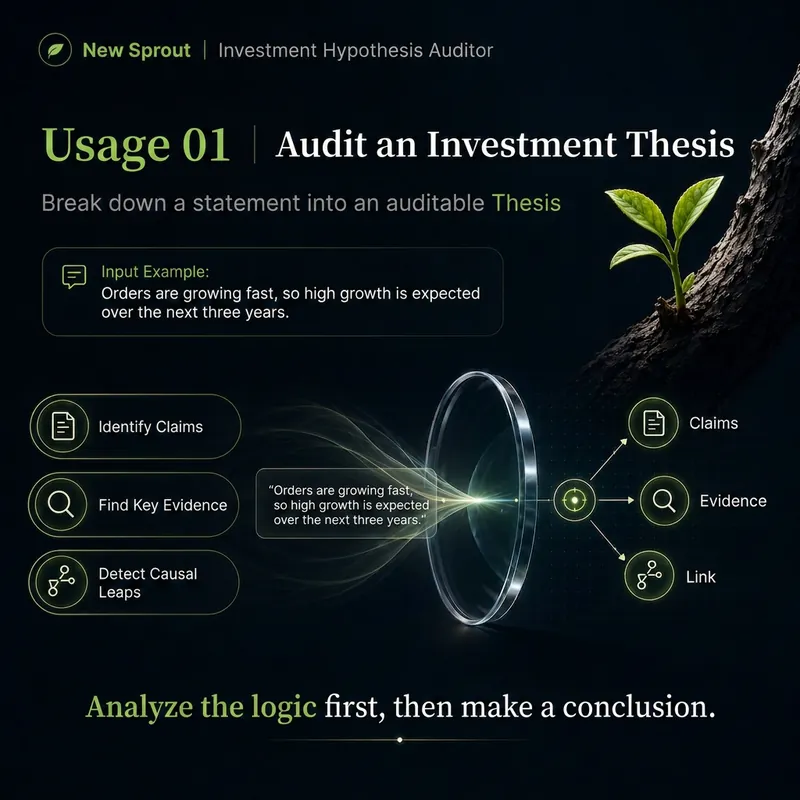
Don't help prove my thesis. Help audit it. Many investment judgments fail not because the data is entirely wrong, but because accurate data supports an overextended conclusion. For example: “AI orders are abundant, so profits will definitely grow rapidly over the next three years.” “The company's business is strong, so the stock is cheap right now.” “Customers keep increasing, so the company has already achieved network effects.” “Management says the technology is leading, and it is stated in the financial report, so the moat has been proven.” 「Sprout | Thesis Auditor」does not help you find more reasons to prove yourself right. It breaks your investment thesis into an auditable Critical Path and checks each layer: Facts → Evidence → Causal Relationships → Hidden Assumptions → Commercialization → Economic Outcomes → Valuation By prioritizing primary sources, it answers the questions that truly matter: Which parts have already been supported by evidence? Which are merely reasonable inferences? Which necessary link is most fragile? Is there counterevidence that genuinely attacks the Thesis? What evidence is most likely to change the conclusion? It ultimately assigns one of five ratings: SUPPORTED / PARTIALLY SUPPORTED / FRAGILE / BROKEN / INSUFFICIENT DATA The conclusion must be traceable to specific Necessary Claims and evidence, rather than a vague “on balance” assessment.
Information
- Version
- v5
- Last updated
- Runtime credits
- Usage-based
- Models
- Auto