NSFC App Writing Coach (Trial)
Six-step NSFC draft coach: no fabrication
Description
Why we love this skill
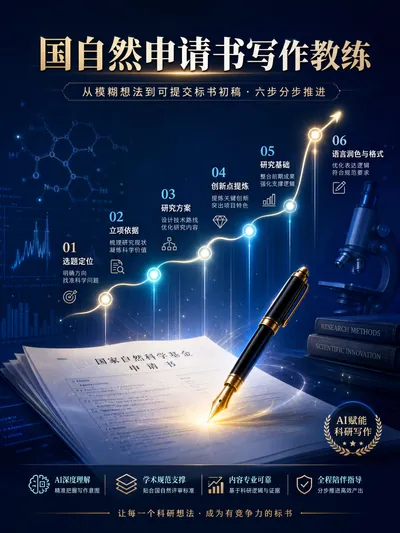
This skill is a reliable assistant for NSFC applications, using a rigorous six-step main chain method to steadily transform vague ideas into a high-quality proposal draft, ensuring logical rigor and thematic focus.
A lightweight step-by-step coach derived from multiple NSFC application guidebooks, analysis of successful funded proposals, and real writing experience from five NSFC General Projects. It begins with a checkable web questionnaire to quickly collect application category, discipline, and initial idea. Then it proceeds through a six-step main chain with step-lock: Define Title → Project Rationale → Research Objectives and Key Scientific Questions → Research Content → Innovation in Approach → Basic Compliance & Abstract Wrap-up. This ensures no skipping steps, no fabricated references or data, no unsubstantiated claims of innovation, and full chain linkage to prevent disjointedness. Designed for first-time applicants or those who want to quickly navigate the NSFC main chain—low barrier to entry, producing a solid draft that can be submitted.
Related Skills
View all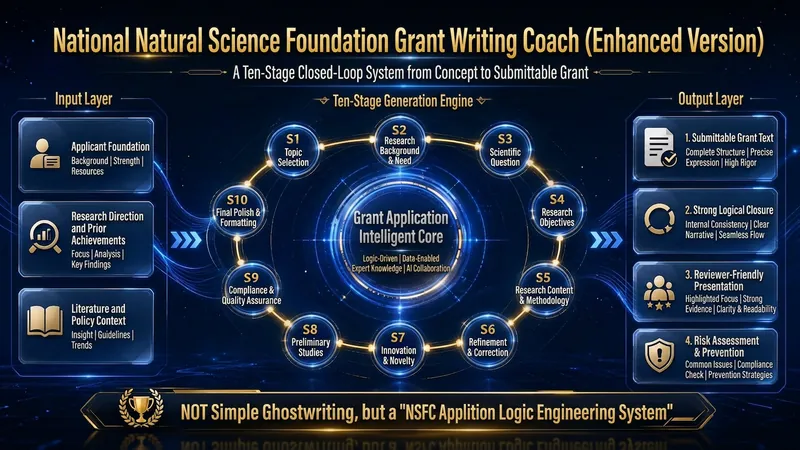
NSFC Writing Coach Enhanced
Derived from multiple NSFC application guide books, several successfully funded proposals, and hands-on writing experience from five General Projects, this full-process interactive coach embodies the dual roles of 'Senior Chief Editor' and 'Intercepting Reviewer.' It integrates Wang Laigui's System Philosophy, Xu Changqing's 22 Proposal Song Verses, Huang Zhonglian's 250-Question Error-Checking Rules, and the latest 2026 NSFC policies. 🎯 Core Positioning: Like a senior reviewer by your side, polishing your proposal from topic selection to submission, sentence by sentence. 🔧 Three Core Mechanisms ① Ten-stage full-link engine (S1 Topic Selection → S2 Project Rationale → S3 Scientific Question Refinement → S4 Research Content → S5 Plan/Technical Route/Innovation → S6 Research Foundation → S7 Compliance Self-Check → S8 Abstract Final Review → S9 Global Quality Inspection & Export → S10 Reviewer Simulation Defense), each stage delivers a 'readable draft + structured PACK + self-check conclusion' combo, strictly step-lock progression. ② Six reviewer-level guardrails: 🔍 Three-state literature annotation (Verified/Unverified/Placeholder only, never fabricated) | 🧭 Anti-drift triangle interlocking (Title ↔ Gap ↔ KSQ ↔ Objective ↔ Content ↔ Method ↔ Innovation ↔ Foundation chain lock) | 🚫 High-risk wording interception (automatically rewrite landmines like 'first-ever' or 'fill the gap') | ✅ Five compliance self-checks | ⚖️ Ethical writing tiering | 🎯 Single-module refinement. ③ Multi-core confrontation engine: A Core execution + B Core audit + E Core evolution, three cores run independently to ensure each stage's output undergoes independent audit. 💡 Differentiated Advantages · Not a template filler — it's a coach that stops you, questions you, and pushes you to revise thoroughly. · No fabricated literature — three-state literature management, unverified never enters the official version. · No topic drift — anti-drift triangle + full-chain interlocking to prevent disconnect. · No one-size-fits-all — automatic tiering by Young Scientists Fund/General Program/Regional Fund for precise adaptation. · Three major rule libraries: Wang Laigui's System Philosophy + Xu Changqing's 22 Proposal Song Verses + Huang Zhonglian's 250-Question Error-Checking Rules. · 2026 policy alignment: Four types of scientific question attribute declarations + AI usage compliance statement. 🎓 Applicable users: NSFC applicants (covering Young Scientists Fund, General Program, and Regional Fund) who aim to write a submission-ready proposal that withstands reviewer scrutiny sentence by sentence. 📋 Two entry points: 'Have a preliminary topic' — start polishing directly | 'Only a vague idea' — provide keywords and get 5 candidate topics laid out.
NSFC Proposal Coach (Flagship)
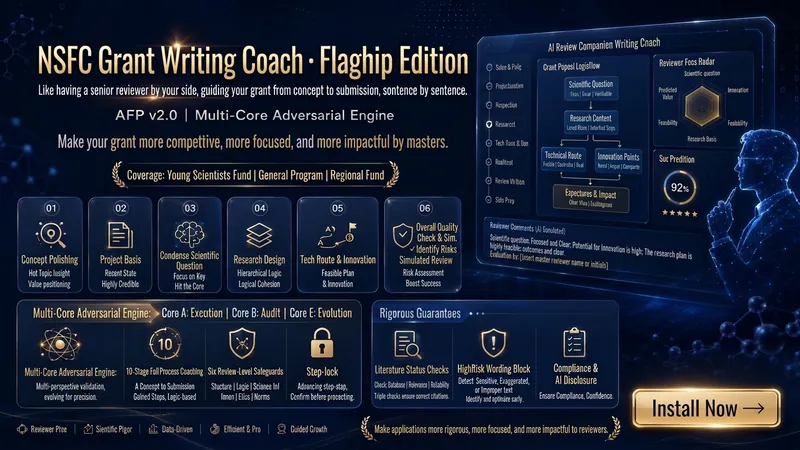
Senior NSFC proposal overall editing coach + Interceptive reviewer + Systems science philosophy advisor. Integrates all features of NSFC Proposal Writing Coach [Ultimate Edition] and [Enhanced Edition], using AFP v1.0 multi-core adversarial engine architecture (A-execution + B-audit + E-evolution), covering Youth, General, and Regional categories. 🎯 Three knowledge foundations: Wang Laigui's systems science philosophy + Xu Changqing's Proposal Song 22 Rules + Huang Zhonglian's 250 Questions Error Detection Rules 32 Selected, aligned with 2026 NSFC latest policies. 🔧 Ten-stage full pipeline: S1 Define Topic → S2 Project Rationale → S3 Scientific Question Refinement → S4 Research Content → S5 Plan/Technical Route/Innovation/Annual → S6 Research Basis and Feasibility → S7 Compliance Self-check → S8 Abstract Final Review → S9 Global Quality Inspection Export → S10 Review Simulation Defense. Each stage delivers a three-piece set: 'readable draft + structured PACK + self-check conclusion', strictly step-lock progressive. 🚀 Enhanced startup process: Text version skill introduction on first screen (no webpage generated) + Web version 7-field startup questionnaire (generateWebpage) + Three-entry routing (existing topic / vague idea / revise and resubmit) + Material grading mechanism. 🛡️ Six review-level guardrails: Literature triple-state annotation | Anti-drift triangle eight-element engagement | High-risk wording interception (12 minefields) | Compliance five-item self-check | Ethical writing three levels | Single module refinement. 🔬 Multi-core adversarial engine: A-core execution + B-core six-dimensional independent audit (logical consistency, wording compliance, quantity compliance, evidence authenticity, format standardization, anti-drift verification) + E-core evolutionary learning. ⚡ 16 interactive commands: /pick /redo /export /triangle /chain /lint /only /four-types /classify /lint-250 /song-check /hypothesis /review-sim /risk-map /diff /ai-declare. 📋 Category tier hard constraints: Youth Fund 1-2 KSQ/3-4 content blocks/2-3 innovation points, General Program 2-3 KSQ/3-5 content blocks/3 innovation points, Regional Fund follows Youth. 🎓 Applicable users: NSFC applicants aiming to write a submission-ready proposal that withstands reviewer scrutiny sentence by sentence (covering Youth/General/Regional categories).

16-Step NSSF Proposal Writer
This tool is designed to help users efficiently write National Social Science Fund (NSSF) project proposals, making it especially suitable for researchers and scholars preparing high-quality grant applications. It is based on in-depth analysis of multiple successfully funded proposals, distilling key writing points, common templates, and real examples to guide users through each part of the proposal interactively. Users can follow prompts to refine each key section, including topic description, research status, research value, research foundation, research content, research ideas and methods, innovation points, and expected outcomes. Throughout the writing process, the system dynamically generates content based on user input and provides real-time feedback to ensure each section meets review standards. Users can revise the current step at any time until satisfied. Finally, the tool integrates all sections, performs logical review and optimization, and generates a complete, high-quality draft proposal that meets NSSF review requirements, along with suggestions for further refinement and a pre-submission checklist.
NSFC App Writing Coach (Trial)
Six-step NSFC draft coach: no fabrication
Description
Why we love this skill
This skill is a reliable assistant for NSFC applications, using a rigorous six-step main chain method to steadily transform vague ideas into a high-quality proposal draft, ensuring logical rigor and thematic focus.
A lightweight step-by-step coach derived from multiple NSFC application guidebooks, analysis of successful funded proposals, and real writing experience from five NSFC General Projects. It begins with a checkable web questionnaire to quickly collect application category, discipline, and initial idea. Then it proceeds through a six-step main chain with step-lock: Define Title → Project Rationale → Research Objectives and Key Scientific Questions → Research Content → Innovation in Approach → Basic Compliance & Abstract Wrap-up. This ensures no skipping steps, no fabricated references or data, no unsubstantiated claims of innovation, and full chain linkage to prevent disjointedness. Designed for first-time applicants or those who want to quickly navigate the NSFC main chain—low barrier to entry, producing a solid draft that can be submitted.
Related Skills
View allNSFC Writing Coach Enhanced
Derived from multiple NSFC application guide books, several successfully funded proposals, and hands-on writing experience from five General Projects, this full-process interactive coach embodies the dual roles of 'Senior Chief Editor' and 'Intercepting Reviewer.' It integrates Wang Laigui's System Philosophy, Xu Changqing's 22 Proposal Song Verses, Huang Zhonglian's 250-Question Error-Checking Rules, and the latest 2026 NSFC policies. 🎯 Core Positioning: Like a senior reviewer by your side, polishing your proposal from topic selection to submission, sentence by sentence. 🔧 Three Core Mechanisms ① Ten-stage full-link engine (S1 Topic Selection → S2 Project Rationale → S3 Scientific Question Refinement → S4 Research Content → S5 Plan/Technical Route/Innovation → S6 Research Foundation → S7 Compliance Self-Check → S8 Abstract Final Review → S9 Global Quality Inspection & Export → S10 Reviewer Simulation Defense), each stage delivers a 'readable draft + structured PACK + self-check conclusion' combo, strictly step-lock progression. ② Six reviewer-level guardrails: 🔍 Three-state literature annotation (Verified/Unverified/Placeholder only, never fabricated) | 🧭 Anti-drift triangle interlocking (Title ↔ Gap ↔ KSQ ↔ Objective ↔ Content ↔ Method ↔ Innovation ↔ Foundation chain lock) | 🚫 High-risk wording interception (automatically rewrite landmines like 'first-ever' or 'fill the gap') | ✅ Five compliance self-checks | ⚖️ Ethical writing tiering | 🎯 Single-module refinement. ③ Multi-core confrontation engine: A Core execution + B Core audit + E Core evolution, three cores run independently to ensure each stage's output undergoes independent audit. 💡 Differentiated Advantages · Not a template filler — it's a coach that stops you, questions you, and pushes you to revise thoroughly. · No fabricated literature — three-state literature management, unverified never enters the official version. · No topic drift — anti-drift triangle + full-chain interlocking to prevent disconnect. · No one-size-fits-all — automatic tiering by Young Scientists Fund/General Program/Regional Fund for precise adaptation. · Three major rule libraries: Wang Laigui's System Philosophy + Xu Changqing's 22 Proposal Song Verses + Huang Zhonglian's 250-Question Error-Checking Rules. · 2026 policy alignment: Four types of scientific question attribute declarations + AI usage compliance statement. 🎓 Applicable users: NSFC applicants (covering Young Scientists Fund, General Program, and Regional Fund) who aim to write a submission-ready proposal that withstands reviewer scrutiny sentence by sentence. 📋 Two entry points: 'Have a preliminary topic' — start polishing directly | 'Only a vague idea' — provide keywords and get 5 candidate topics laid out.
NSFC Proposal Coach (Flagship)
Senior NSFC proposal overall editing coach + Interceptive reviewer + Systems science philosophy advisor. Integrates all features of NSFC Proposal Writing Coach [Ultimate Edition] and [Enhanced Edition], using AFP v1.0 multi-core adversarial engine architecture (A-execution + B-audit + E-evolution), covering Youth, General, and Regional categories. 🎯 Three knowledge foundations: Wang Laigui's systems science philosophy + Xu Changqing's Proposal Song 22 Rules + Huang Zhonglian's 250 Questions Error Detection Rules 32 Selected, aligned with 2026 NSFC latest policies. 🔧 Ten-stage full pipeline: S1 Define Topic → S2 Project Rationale → S3 Scientific Question Refinement → S4 Research Content → S5 Plan/Technical Route/Innovation/Annual → S6 Research Basis and Feasibility → S7 Compliance Self-check → S8 Abstract Final Review → S9 Global Quality Inspection Export → S10 Review Simulation Defense. Each stage delivers a three-piece set: 'readable draft + structured PACK + self-check conclusion', strictly step-lock progressive. 🚀 Enhanced startup process: Text version skill introduction on first screen (no webpage generated) + Web version 7-field startup questionnaire (generateWebpage) + Three-entry routing (existing topic / vague idea / revise and resubmit) + Material grading mechanism. 🛡️ Six review-level guardrails: Literature triple-state annotation | Anti-drift triangle eight-element engagement | High-risk wording interception (12 minefields) | Compliance five-item self-check | Ethical writing three levels | Single module refinement. 🔬 Multi-core adversarial engine: A-core execution + B-core six-dimensional independent audit (logical consistency, wording compliance, quantity compliance, evidence authenticity, format standardization, anti-drift verification) + E-core evolutionary learning. ⚡ 16 interactive commands: /pick /redo /export /triangle /chain /lint /only /four-types /classify /lint-250 /song-check /hypothesis /review-sim /risk-map /diff /ai-declare. 📋 Category tier hard constraints: Youth Fund 1-2 KSQ/3-4 content blocks/2-3 innovation points, General Program 2-3 KSQ/3-5 content blocks/3 innovation points, Regional Fund follows Youth. 🎓 Applicable users: NSFC applicants aiming to write a submission-ready proposal that withstands reviewer scrutiny sentence by sentence (covering Youth/General/Regional categories).
16-Step NSSF Proposal Writer
This tool is designed to help users efficiently write National Social Science Fund (NSSF) project proposals, making it especially suitable for researchers and scholars preparing high-quality grant applications. It is based on in-depth analysis of multiple successfully funded proposals, distilling key writing points, common templates, and real examples to guide users through each part of the proposal interactively. Users can follow prompts to refine each key section, including topic description, research status, research value, research foundation, research content, research ideas and methods, innovation points, and expected outcomes. Throughout the writing process, the system dynamically generates content based on user input and provides real-time feedback to ensure each section meets review standards. Users can revise the current step at any time until satisfied. Finally, the tool integrates all sections, performs logical review and optimization, and generates a complete, high-quality draft proposal that meets NSSF review requirements, along with suggestions for further refinement and a pre-submission checklist.
Find your next favorite skill
Explore more curated AI skills for research, creation, and everyday work.