You already run AI agents. You just can't trust them.
That's the problem we built Unicity AOS to solve, and today the open source Community edition is public. Try it here >>
The problem with running AI agents today
- You can't enumerate your Agents - shadow agents spin up across teams, unseen, ungoverned
- You can't govern Agent spend - token and tool costs run open-loop
- You can't attribute Agent actions - no line from a decision back to the human who authorized it
- And when the auditor asks, you have logs - not evidence
Every OS until now assumed a human at the keyboard. Today, Unicity Labs is open-sourcing the one built for the day when no one is watching:
What Unicity AOS is
Unicity AOS: the first actual operating system for autonomous AI.
Every ability is a sealed capsule: the model, the memory, the tools, the guards. Snap them together into an agent, swap any part later, and it can never take more than you gave it. Unicity Astrid OS slots in underneath the agent you already use.
A real OS is the claim, so here's the test. An OS isn't marketing - it's syscalls, IPC, permissions, quotas, drivers. Everyone claims the label; here, every primitive is a real implementation:
- Processes → capsules. Sealed WASM programs, isolated by construction.
- Syscalls → the host ABI. A framework is a library you call; an OS is a boundary you can't cross.
- Permissions → capability tokens. Stricter than Unix — power only narrows.
- Quotas → budgets. CPU and RAM, plus the two resources no OS ever had to meter: tokens and money.
- IPC → the bus. Every message routed, observable, governable.
- Drivers → provider capsules. Models are the peripherals of the agent era. Swap one like a driver; nothing above notices.
What Unicity AOS makes possible for your workflows
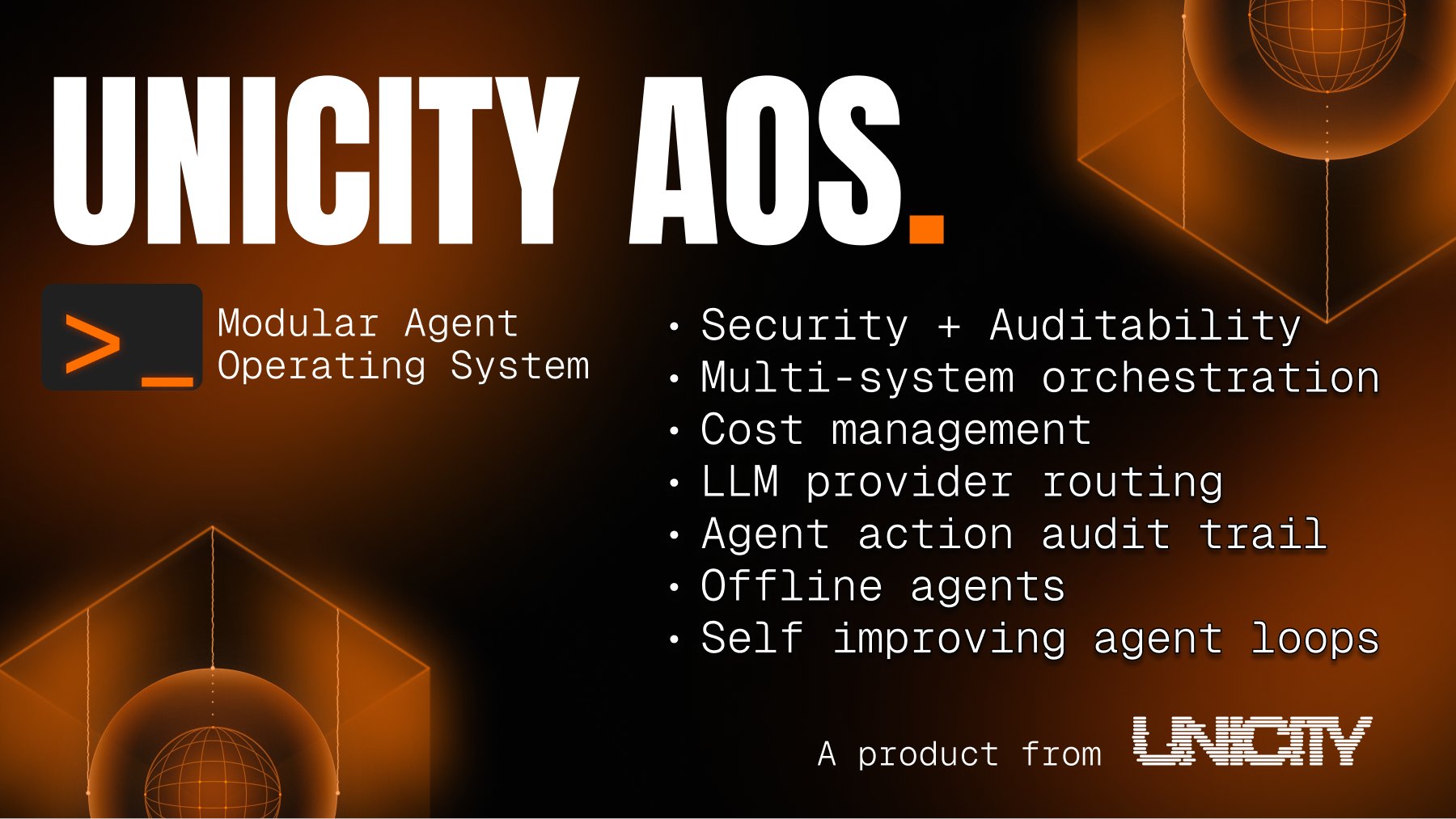
- Security and auditability. Every sensitive action is gated by policy, capability, budget, and approval before it runs, then signed into a hash-linked audit chain. Alter one record and the chain stops verifying.
- Cost control. Budget caps enforced atomically in the kernel, per session and per workspace. The cap holds even if the agent rewrites its own prompt to ask for more.
- Multi-provider routing. A routing capsule picks the provider by complexity, cost, or latency. Every provider speaks the same schema underneath, so switching one out is a config change, not a rewrite.
- Take it offline. Swap the provider capsule for a local Ollama or vLLM build and the rest of your agent runs unchanged: air-gapped, no data leaving the network.
Unicity AOS works with your harnesses
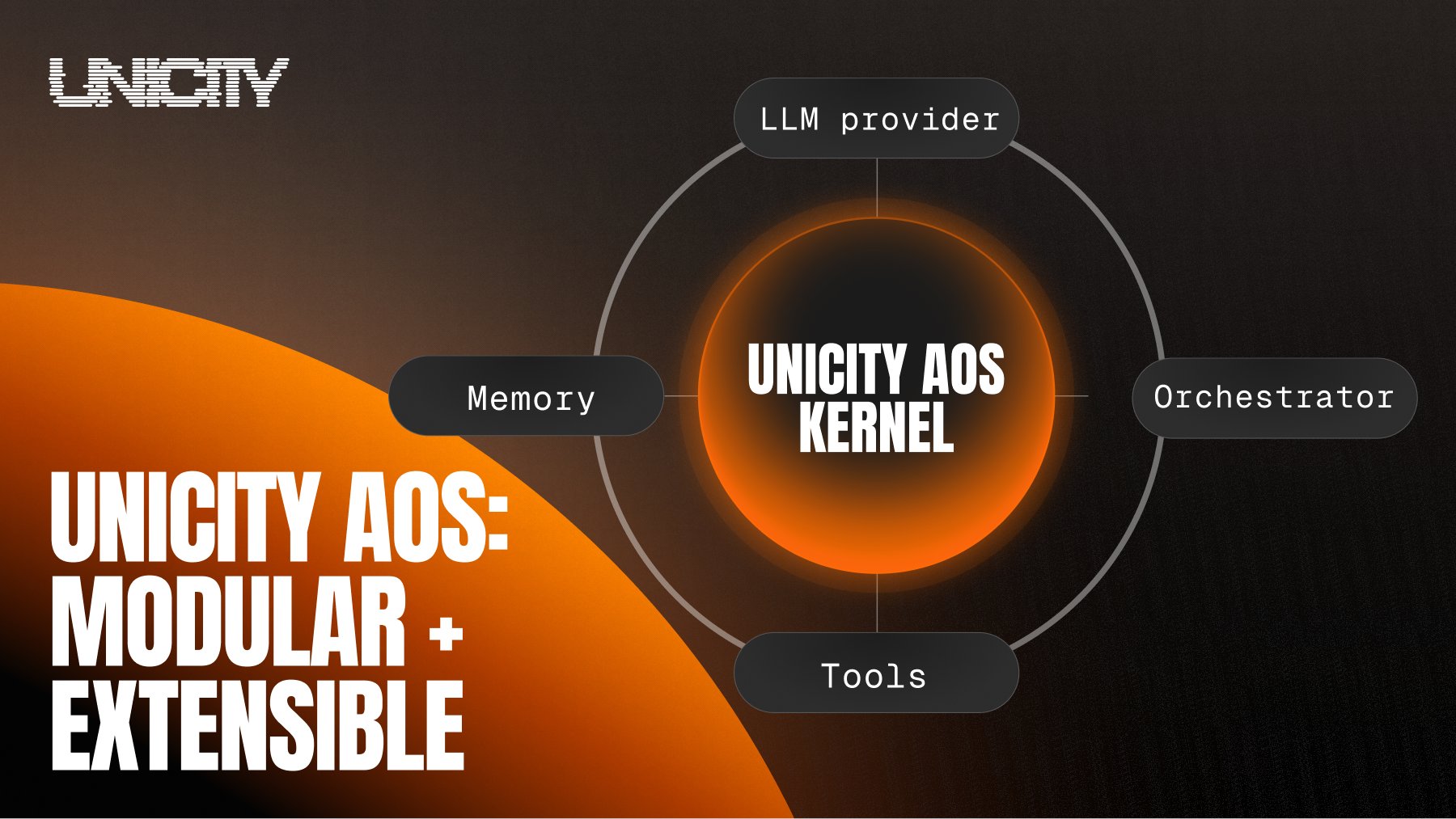
We don't compete with harnesses - we run them. Claude Code, Codex, and Grok Code run on Unicity AOS today, unmodified. Owned by no model vendor. Running all of them.
The whole OS runs inside your network, behind one egress gate. Agent activity and data never leave your boundary. And every decision is signed into a tamper-evident chain — logs can be edited; this is rewritable by no one, verifiable by anyone. Proof, not logs.
Free and open. MIT / Apache-2.0. Eight capsules shipped, Rust SDK on GitHub.
If you build with AI agents, or know someone who does, this is worth a look.