First, one most important thing.
"Being busy" and "getting results" are two different things.
Replying to emails, responding to Slack, making a little progress on documents... moving constantly gives you the feeling of "I did a lot today." But that feeling and the actual amount of progress made do not match at all.
In fact, the more you move, the more your results might be decreasing. Today, I will explain the reason using analogies.
And finally, I will clearly answer the counter-argument many people have: "But successful people succeed through multitasking, right?"
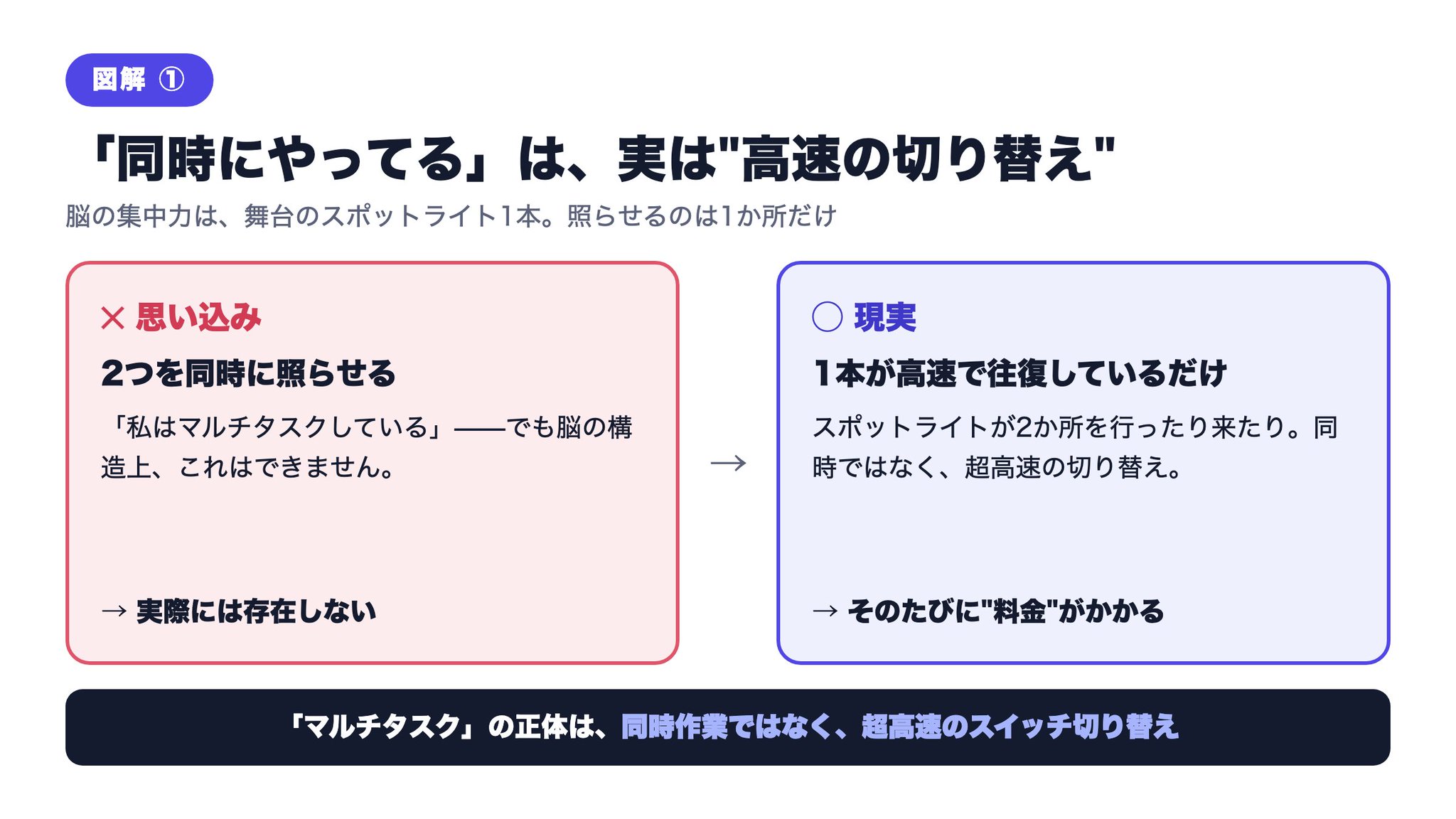
- The brain's spotlight can only illuminate one thing.
First, the premise. Think of human concentration as a single spotlight on a dark stage.
You can only illuminate one spot at a time. When you feel like you are "doing two things at once," what is actually happening is the spotlight is just moving back and forth between two spots at high speed. It's not simultaneous; it's ultra-fast switching. This is the starting point.
And this "back and forth" comes with an invisible fee.
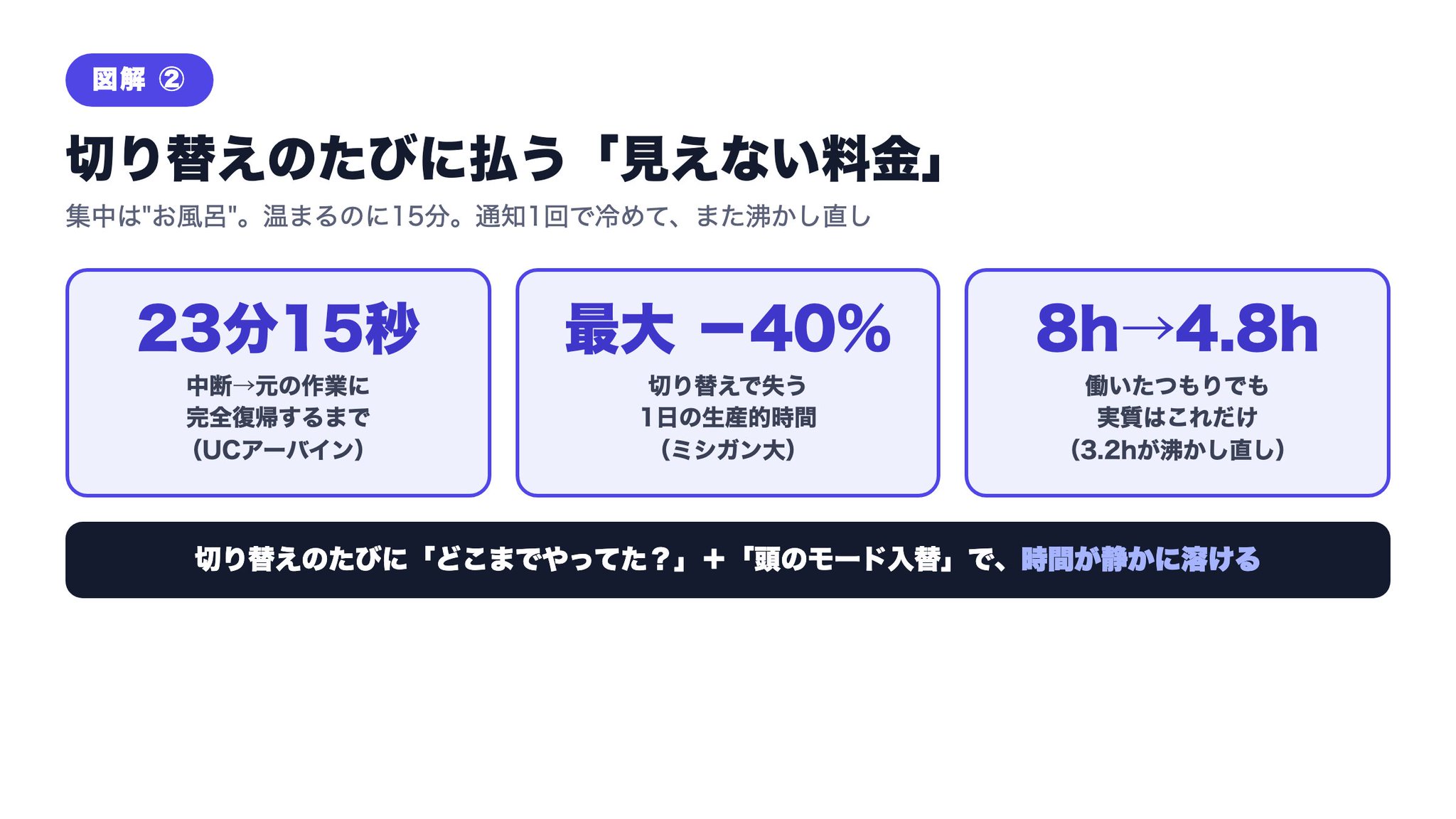
- The "invisible fee" paid every time you switch.
Imagine you are creating a document. An email arrives, and you reply to it briefly. Then you return to the document.
At this moment, two operations are happening in your brain:
① The work of searching for "Wait, where was I?"
② The work of switching your brain mode from "email brain" to "document brain."
The brain for writing emails and the brain for thinking about documents use different modes. Every time you switch, you pack up the previous mode and restart the next one. This "loading and unloading" takes a subtle amount of time.
To use an analogy, it's like boiling bathwater. Concentration is cold the moment you get in, and it finally gets warm after about 15 minutes. However, every time a notification comes, the water cools down, and you have to boil it again. Spending all day "re-boiling" and ending up with lukewarm water—this is the true nature of multitasking.
Research figures back up exactly how much you lose:
- According to a survey by Professor Gloria Mark at UC Irvine, once interrupted, it takes an average of 23 minutes and 15 seconds to fully return to the original task.
- A study from the University of Michigan shows that this accumulation of switching can result in losing up to 40% of productive time in a day.
In other words, even if you think you worked for 8 hours, only 4.8 hours worth of work actually moved forward. The remaining 3.2 hours vanished into "re-boiling."
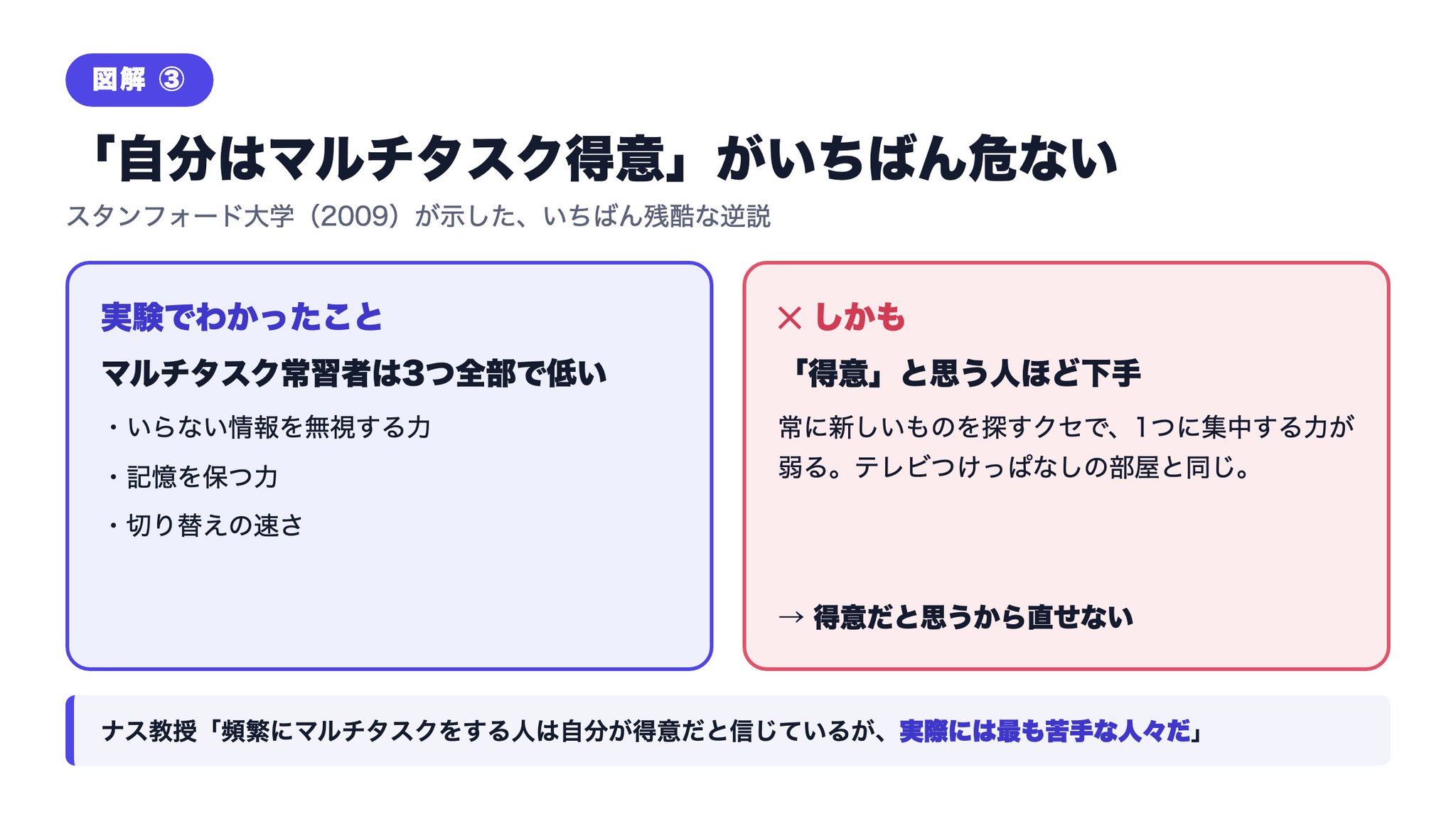
- "I'm good at multitasking" is the most dangerous mindset.
Here's a slightly scary story.
People who are always looking at emails and SNS simultaneously train their brains to "always look for the next new thing." As a result, the power to concentrate on the one thing in front of them (the power to ignore unnecessary information) weakens.
It's like growing up in a room where the TV is always on; you become uncomfortable in quiet places. A brain accustomed to stimulation becomes a constitution that cannot concentrate without stimulation.
A 2009 Stanford University study demonstrated this. People who multitask regularly scored lower in all three areas: "power to ignore information," "power to maintain memory," and "speed of switching."
And this is the sentence that hits hardest:
"People who think they are good at multitasking were actually the worst at it" (Professor Nass).
Because they think they are good at it, they don't try to fix it. So the gap continues to widen. This is the most troublesome part of this problem.
- Why can't we stop? (Notifications = Gacha)
"I understand it in my head. But I end up looking at notifications." Of course. It's not because your will is weak.
Notifications are built with the same mechanism as Gacha (slots).
You don't know if it's a "win" (like, happy contact) or a "loss" until you open it. This "maybe it's a win" is the most addictive form for the brain. Every time you win, the brain releases a small reward (dopamine), creating a state of "looking forward to the next notification."
Neuroscientist Daniel Levitin explains this as "multitasking creates a dopamine loop." In other words, you are just being "made to spin the Gacha" by your smartphone. If you know the mechanism, you can deal with it.
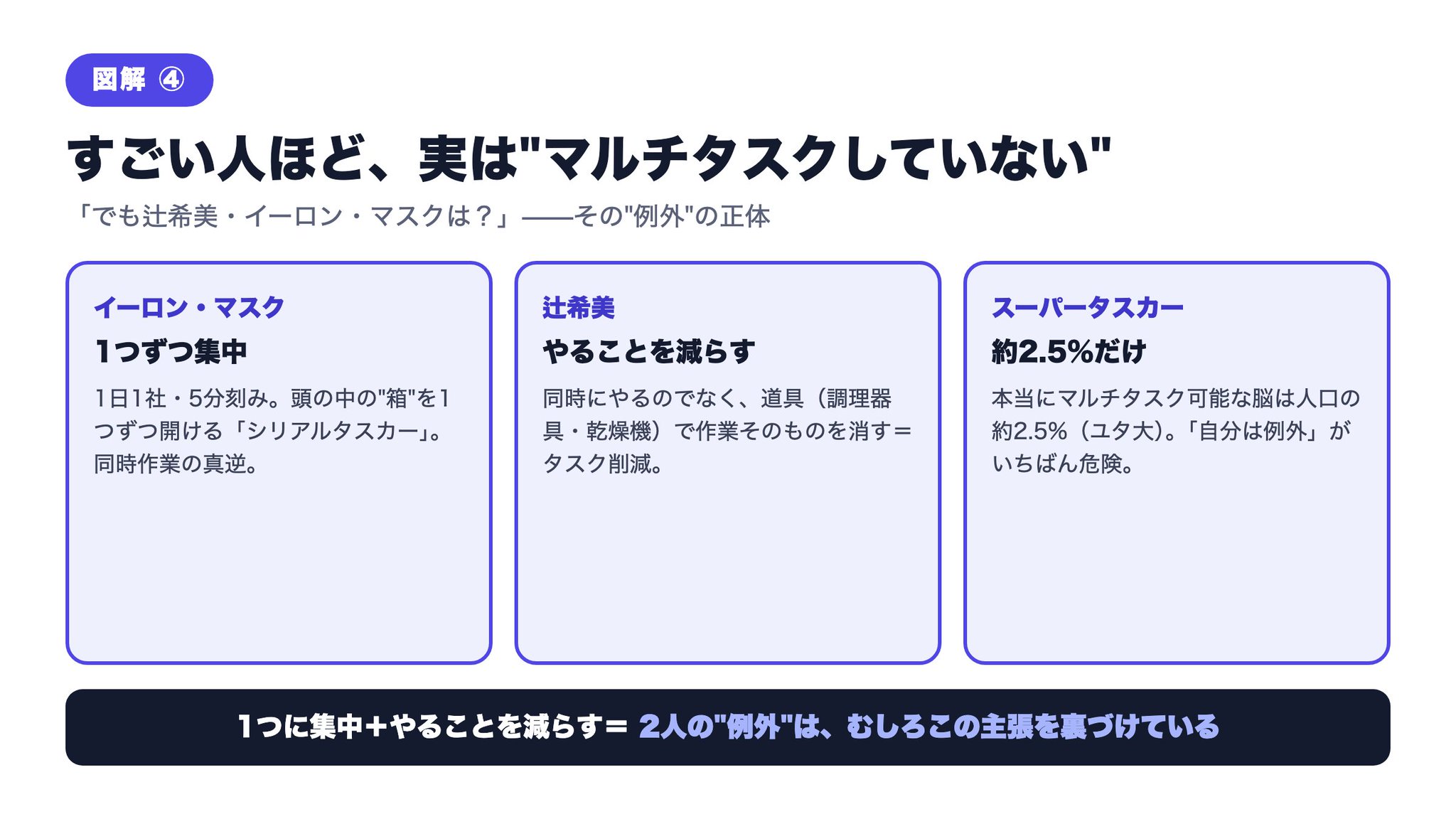
- The "Exceptions" of Nozomi Tsuji (mother of 4) and Elon Musk—two opposite successful people.
Now, let's answer the first counter-argument. This is the most interesting part of this article.
Elon Musk seems like the "ultimate multitasking human," running several companies like Tesla, SpaceX, and X simultaneously.
However, Isaacson, who wrote his biography, reached the exact opposite conclusion. Musk's true nature was not multitasking, but a "person who finishes things one by one in succession (serial tasker)."
He divides his day into 5-minute increments and narrows it down to one company per day, like "Today is SpaceX day, tomorrow is Tesla day." While concentrating on one company, he temporarily puts the other companies into different "boxes" in his head. It looks like he's doing them simultaneously, but in reality, he's just "opening boxes one by one." This is the polar opposite of multitasking.
What about Nozomi Tsuji? From her appearance of handling work while raising four children, she is called a "master of multitasking," and she herself talks about "working while doing other things."
However, the time-saving tips she actually lists were "tools that reduce the work itself." Cooking utensils that finish chopping in an instant, dryers that eliminate the effort of hanging clothes. In other words, she's not doing them simultaneously; she's having machines eliminate the tasks. And "doing while" is only possible when one side is a "task that doesn't require thinking" (folding, carrying).
Furthermore, there is a decisive factor. A University of Utah study shows that special brains that can truly handle multitasking (supertaskers) make up only about 2.5% of the population. For the remaining 97.5%, results will definitely drop if they try. And as mentioned before, the more people think "I'm good at it," the worse they are.
Therefore, the most dangerous thing is to think, "I might be that 2.5% exception."
To summarize—the more amazing the person, the less they actually multitask. They concentrate on one thing (Musk) and reduce what they do (Tsuji). The two "exceptions" perfectly support the claim of this article rather than overturning it.
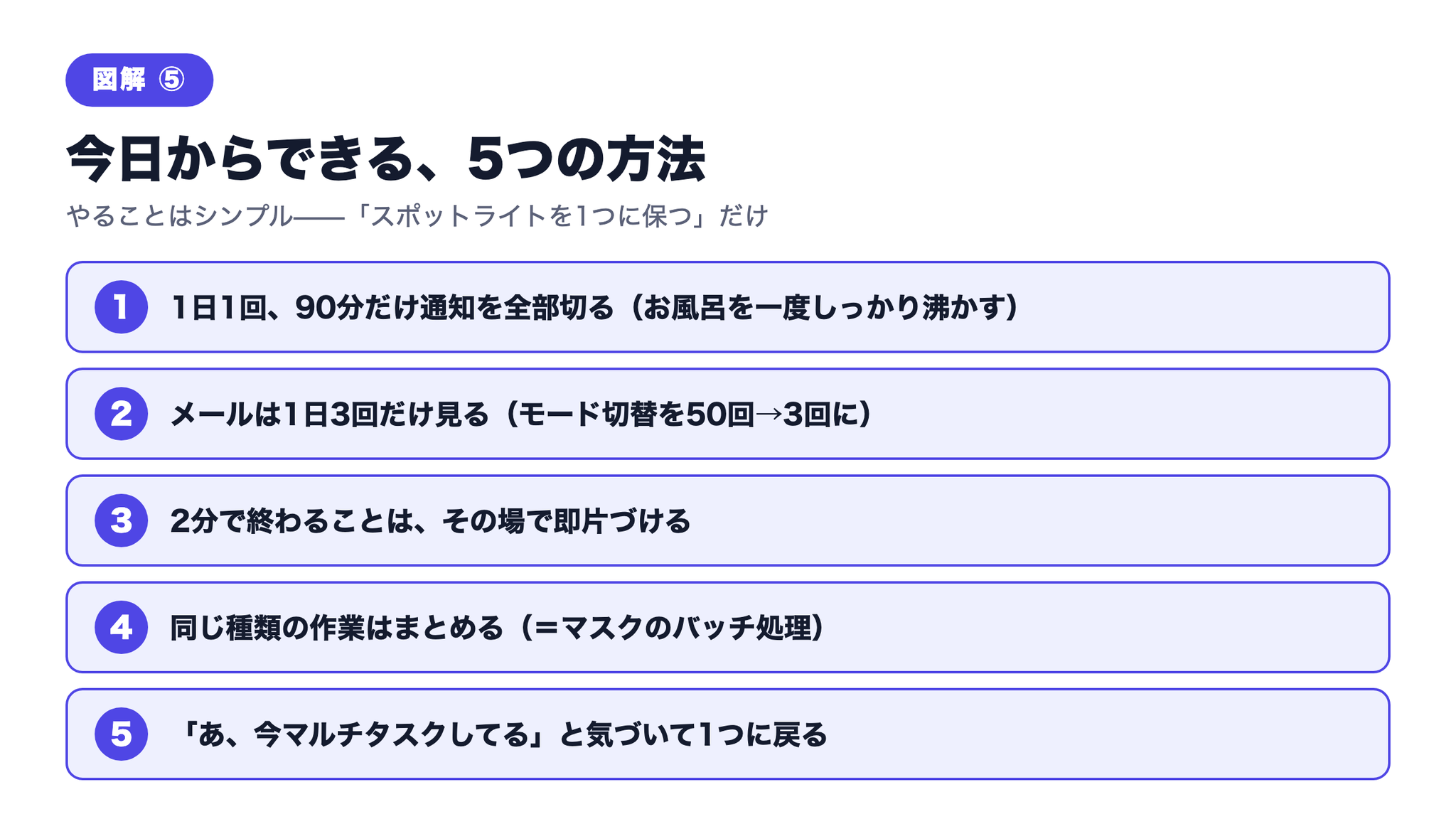
- Five methods you can start today.
やることはシンプルです。「スポットライトを1つに保つ」だけ。
① Once a day, turn off all notifications for just 90 minutes
Create time to boil the bathwater thoroughly once. Put your phone in airplane mode and close email and Slack. If it's difficult, 45 minutes is fine. Write "Concentration Time" on your calendar and don't put meetings there. This alone will change the lightness of your head in the afternoon.
② Check email only 3 times a day
Fixed to three times: morning, early afternoon, and before leaving work. The reason is to reduce switching to "email brain" from 50 times a day to 3 times. "What if it's an emergency?"—Truly urgent matters will result in a phone call.
③ If it takes 2 minutes, finish it on the spot
Small unfinished tasks keep pulling at the corner of your head saying "It's not finished yet" (this also saps concentration). If it takes 2 minutes, do it immediately. The cost of putting it on a "to-do later list" and remembering it is higher. However, if it exceeds 2 minutes, group it into concentration time.
④ Do the same type of work together
This is exactly Musk's method. The cost of switching brain modes is highest when going back and forth between "different types" of work. Therefore, solidify "document creation," "email," and "meetings" by type, and don't sandwich them alternately. Every time you go back and forth between email and concentrated work, those 23 minutes disappear.
⑤ Notice, "Oh, I'm multitasking now."
The most fundamental countermeasure. You won't notice multitasking as long as you believe you are "good at it." At the end of the day, spend just 5 minutes reflecting: "When were the moments I was doing two things at once today?" Were you looking at emails during a meeting? The moment you notice, return to one. This repetition changes habits.
Summary
Today's talk can be summarized into these three points:
- Concentration is one spotlight. "Simultaneous" is actually high-speed switching, and every time, a "re-boiling" fee is charged (up to 40% disappears)
- "People who think they are good at it" are worse at it. That's why they can't fix it
- Successful people (Musk, Tsuji) multitask less. They concentrate on one thing and reduce what they do
If you feel like "I'm busy but not getting results," it's not a matter of ability. Your spotlight is just scattered.
First, try turning off notifications for just 90 minutes today. That is the easiest and most effective first step.
Finally
Regarding specific business methods and useful information, I will introduce them in the future only to those who register from the profile link. You won't be able to receive them unless you are registered at that time, so please register before you forget.