Math is not calculation. It is the deepest set of tools humans have for seeing what is actually there, and school hands almost none of it over.
Most people carry a small wound from a math classroom. A test, a teacher, a moment where a door closed and the message landed: this is not for you. That wound came from a swap. What you were handed in school was arithmetic and procedure. Calculate this. Memorize that. Move the symbol to the other side. Real mathematics is almost the opposite of a chore. It is the closest thing we have to a language for how reality is built, and once you see even a little of it, the world stops looking like noise and starts looking like structure.
This is not about passing an exam. It is about what math actually is, and what it does to the way you see, once nobody is grading you. Here is the real subject, in six pieces.
1. Math is the language reality appears to be written in
The strange fact at the center of everything is this. Abstract marks invented by people, pushed around on paper according to rules, keep predicting the physical world with absurd accuracy.
Someone works out an equation with no application in mind. Decades later it turns out to describe how planets move, or how a current flows, or how a population grows. This has happened so often that physicists gave it a name: the unreasonable effectiveness of mathematics. Nobody fully knows why it works. But it means math is not a notation we bolt onto reality to describe it. Reality seems to run on the same logic the math runs on. Learn the language and you are not memorizing a subject. You are reading the source code of how things behave.
That reframes the whole thing. Math stops being one subject among many. It becomes the layer underneath physics, biology, finance, music, and every machine that now thinks.
2. It finds order inside what looks like pure noise
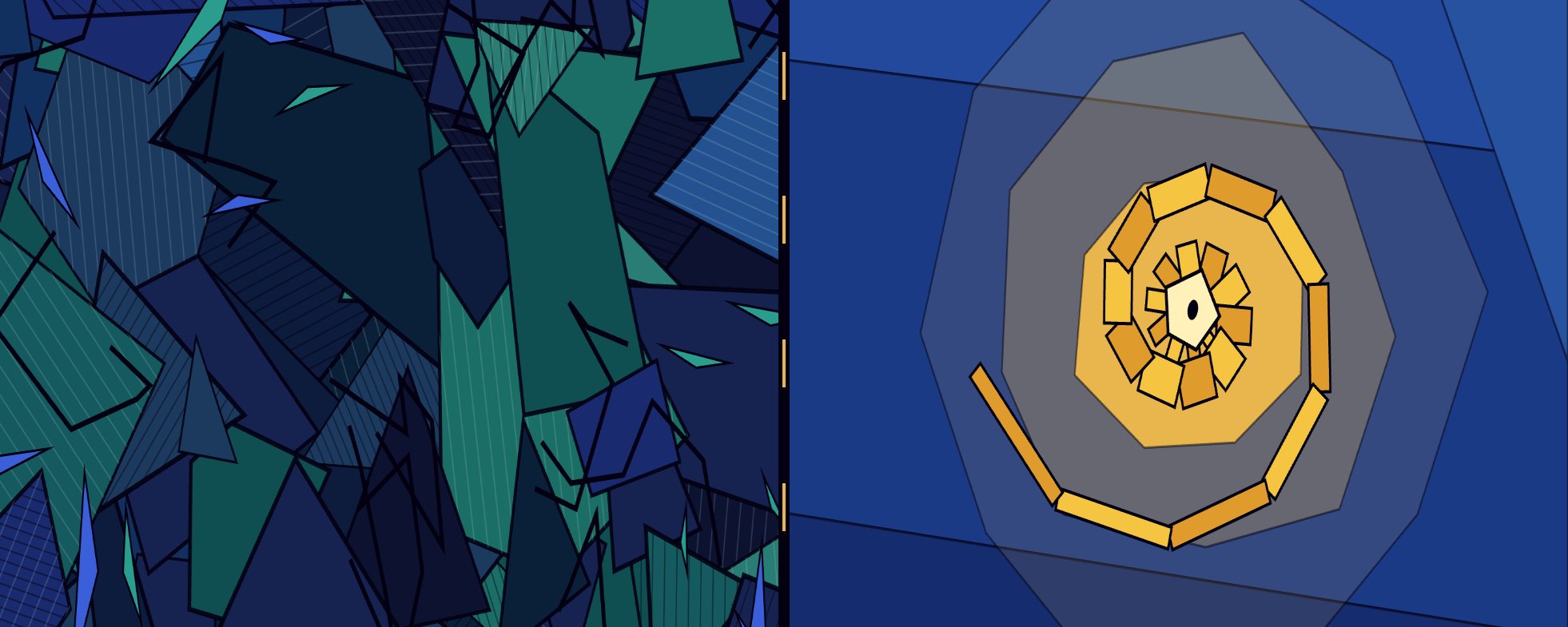
The clean shapes you were taught, the circles and triangles and smooth curves, describe almost nothing you can actually touch. Coastlines are not lines. Clouds are not spheres. Mountains are not cones. The real world is rough, broken, and irregular.
Math's power is that the roughness is not chaos. It has rules. A jagged coastline repeats its own pattern at every scale, from a satellite view down to a single rock, and a short formula can capture that repetition. The same idea, structure hiding inside apparent mess, runs through the whole field. Prime numbers look random and hide deep regularities. A crowd, a market, a turbulent fluid all look disordered and follow laws you can write down. This is the core move of mathematical thinking: stop seeing noise, start finding the rule the noise obeys. Once you have it, you can predict where raw looking gives you nothing.
3. It is the only place humans get real certainty
Every other field deals in evidence that could be overturned tomorrow. A scientific result is our best guess until a better experiment arrives. A math proof is different in kind.
When something is proven, it is settled forever. The Greeks proved there are infinitely many prime numbers more than two thousand years ago, and no discovery since has dented it or ever will. That permanence is unique in all of human knowledge. A proof is a chain of steps so tight that if you accept the starting rules, you are forced to accept the conclusion, with no room to wriggle. Learning to think in proofs is learning the difference between something that feels true and something that is true. It builds a kind of mental hygiene you carry into everything else: the habit of asking not do I believe this, but does this actually follow.
In a world flooded with confident claims, the ability to tell a real argument from a persuasive one is close to a survival skill.
4. It tames infinity instead of flinching at it
Infinity breaks ordinary intuition. Math is the one tool that handles it without panic, and the results are genuinely strange.
There is more than one size of infinity. The counting numbers go on forever, and so do the decimals between 0 and 1, and yet the second infinity is provably larger than the first. That sounds impossible until you follow the argument, and then it is airtight. This is not a party trick. The same machinery for handling the infinitely large and the infinitely small is what calculus is built on, and calculus is how we describe anything that changes: motion, growth, heat, money, the curve of a falling object. Math looked directly at the thing the human mind refuses to hold, the endless, and built precise tools for working with it. That is the discipline at its most fearless.
5. It turns uncertainty into something you can calculate
Most of life is not certain, and math does not pretend otherwise. Its deepest practical power is reasoning clearly when you do not know what will happen.
Probability gives exact structure to chance. It tells you how a rare event should be weighed, why your intuition about coincidences is usually wrong, and how much a piece of evidence should actually shift your belief. From the same roots came the idea that information itself can be measured. Any message, any signal, any stream of text can be reduced to bits, and there is a hard mathematical limit on how much can be squeezed through a noisy channel. That single insight underpins every phone call, every file, every model that generates language. The lesson underneath all of it: uncertainty is not an excuse to guess. It is a quantity you can put a number on and reason about.
This is the part that separates people who are fooled by randomness from people who are not.
6. What you actually get back
Reclaiming math is not about passing anything. It is a direct upgrade to how you see.
You start noticing structure where you used to see mess: a trend, a risk, a repeating shape in your own work. You gain a defense against being fooled by numbers, which is most of how people are fooled now. You get a taste for real certainty, so a tight argument and a slick one stop looking alike. And you gain a language that physics, finance, music, and every AI system are all quietly speaking, so fields that looked unrelated begin to rhyme. None of this needs a rare gene. It needs the undoing of one false belief installed early, that this was never for you.
The Whole of It
Six faces of one subject. Math is the language reality runs on. It finds the rule hiding inside noise. It gives the only certainty humans ever get. It handles the infinite without flinching. It turns not knowing into a number. And it hands back a new set of eyes.
That is what was actually on offer in every math class you sat through. Almost none of it was the calculation you were drilled on. The calculation was the scaffolding. This was the building.
The Close
The equations on an old chalkboard look like a wall built to keep you out. That is the trick, and it was played on nearly everyone, at an age when a bad afternoon could decide what you believed about yourself for life.
Math was never the wall. It was the clearest description of the world anyone has ever written down. The door was open the whole time.