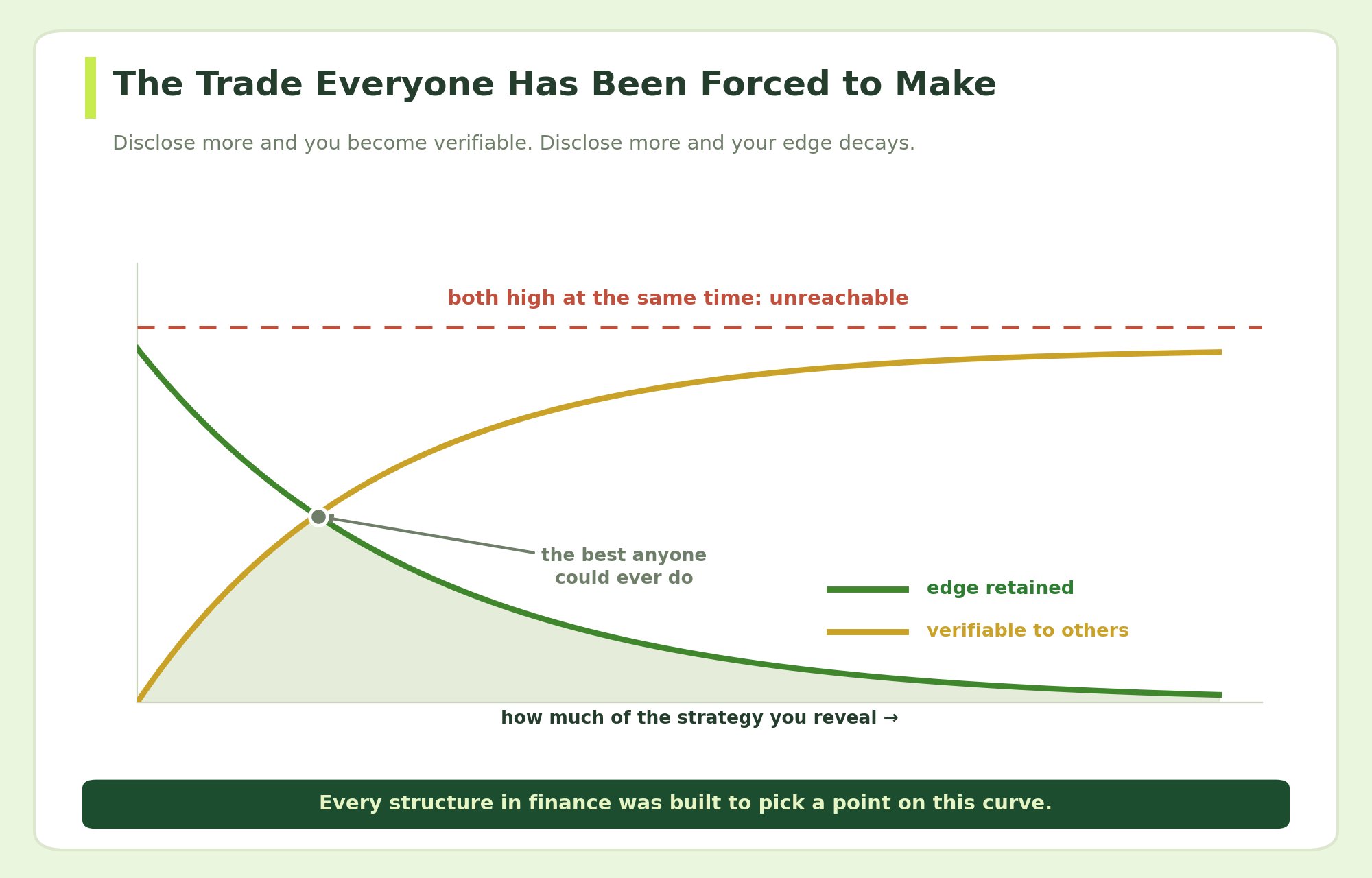
To attract capital, you have to prove your strategy works. To prove it works, you have to show what you do.
And the moment you show what you do, the edge is gone, because an edge everyone can see is not an edge anymore.
That is the transparency paradox, and it has quietly shaped who gets rich in this industry for fifty years.
Notice what it selects for. The people with a real, capacity-constrained edge stay invisible, because disclosure is expensive and the downside of being copied is total.
The people loudest about performance are frequently the ones with the least to protect.
Retail then allocates on the only signal available, which is noise, and concludes the whole game is rigged. It is not rigged. It is built on a verification system that has never worked.
Follow @MossAI_Official if you want the structural view of this stuff rather than the timeline version, because this problem is finally solvable and almost nobody is discussing why.
The paradox is old, formal, and never actually solved
This is not a vibe. It is a documented feature of markets.
Grossman and Stiglitz laid out the core version in the American Economic Review in 1980. If prices perfectly reflected all available information, nobody would have any incentive to go gather information, because they could not be paid for it.
Information has to stay partly private for anyone to bother producing it. The market needs opacity to function, and opacity is exactly what makes trust impossible.
Traditional finance never solved this. It built workarounds, and every workaround has a cost.
1. Delayed disclosure
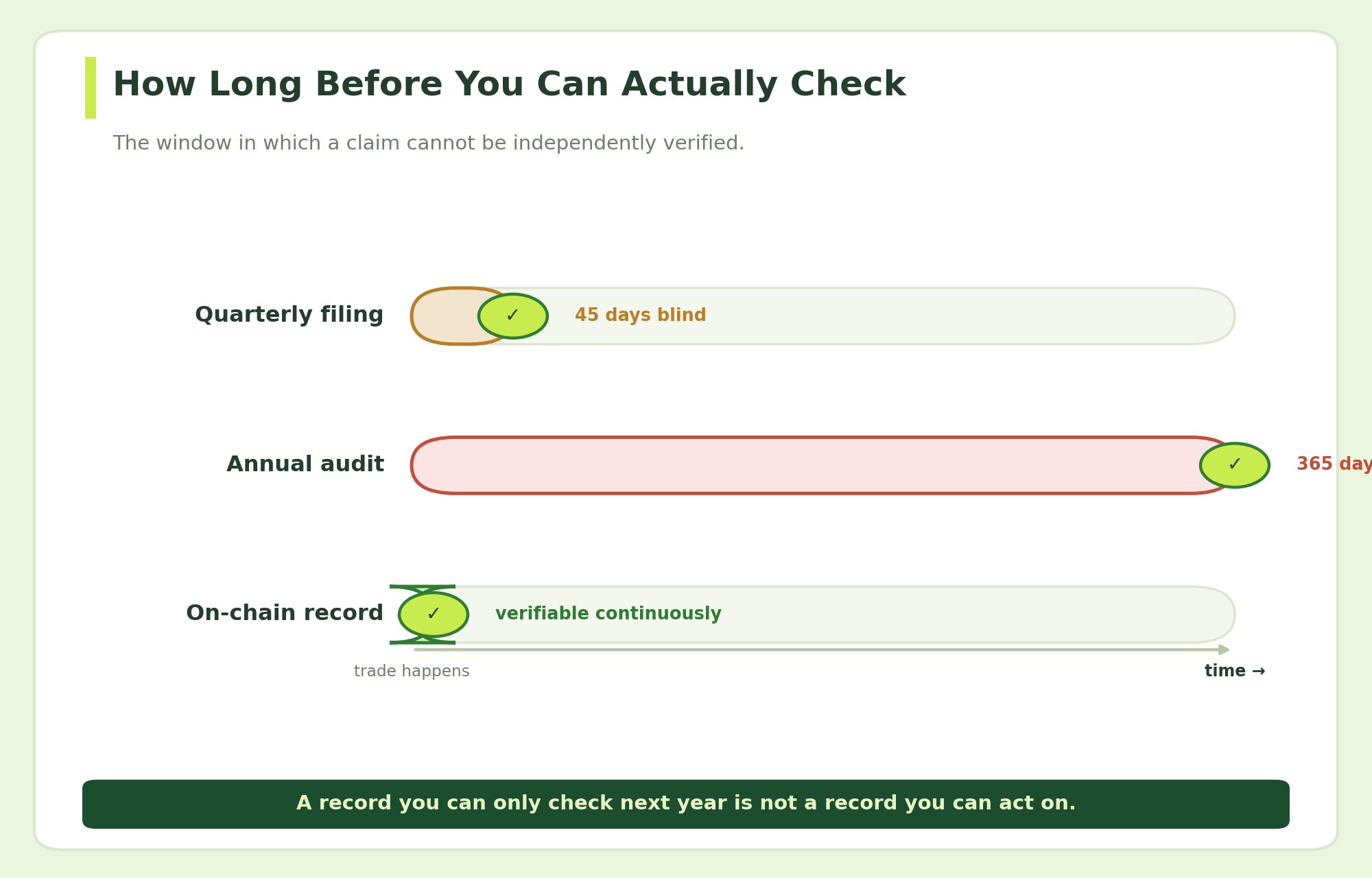
Institutional managers over a size threshold file quarterly holdings with the SEC, but with a 45-day lag, and only positions, never the reasoning or the exits. The delay exists precisely so the strategy is stale by the time it is public. That is disclosure designed not to be useful.
2. Gated diligence
Serious allocators get to look under the hood, but only after signing legal agreements, and only if they are large enough to be worth the conversation. Everyone else gets a fact sheet. The verification is real, but it is reserved for people who already have capital.
3. Audits
Independent, credible, and once a year. A record you can verify twelve months after the fact is not a record you can act on. Underneath all three sits the same fallback. Trust me. Which is why the industry's history of scandals is a history of people who were trusted, audited, and still fabricated returns.
Crypto and agent trading did not fix it. They made it louder.
Move to crypto and the paradox gets worse, because the workarounds disappear and nothing replaces them.
No filing requirement. No auditor. No gated diligence room. The only remaining artifact is a screenshot.
So the market runs on them, and the failure modes are structural rather than accidental.
Survivorship. Launch twenty strategies, quietly bury the nineteen that died, market the survivor as skill.
Overfitting. Tune a backtest until the curve is beautiful, then never mention it fell apart the moment it met live fills and fees.
Undefined metrics. Publish a win rate with no sample size, no window, no fee assumption, and no way for anyone outside to check it.
AI agents inherit every one of these and add scale.
Anyone can generate an agent in an afternoon now, which means anyone can generate a hundred and show you the one that lived. Verification does not get easier when the trader is software. It gets industrialized.
Here is the part that matters.
Every one of these failures is a verification failure, not a trading failure.
The market is not short on people who can build something that works. It is short on any way to tell them apart from people who got lucky, without asking them to hand over the thing that makes them good.
The paradoxes stacked underneath it
Transparency is the headline problem. Three more sit under it, and they compound.
1. Custody
To have someone trade on your behalf, you historically had to give them your money. That single requirement is the source of most catastrophic losses in this industry's history, and it is why serious allocation is gated behind legal structures retail cannot access. Skill and custody were bundled together for historical reasons, not technical ones.
2. Survivorship
Failed strategies vanish. The graveyard is private. Which means every performance claim you have ever seen was measured against a sample with the losers already removed. You cannot compute an honest base rate when the denominator has been quietly edited.
3. The cold start
You cannot get capital without a track record, and you cannot build a track record without capital. That bootstrap problem locks out exactly the people the market should want to find. It makes the ability to raise money correlate with existing wealth and network rather than with skill. Four problems. All of them verification and structure problems. None of them are solved by better models or smarter strategies.
What actually changes on-chain
Here is why this is now an engineering problem rather than a permanent condition of markets.
When execution happens on-chain, the record is not a report. It is the ledger.
Every order, fill, position, entry, and exit is written to a public, timestamped, tamper-resistant history that anyone can independently recompute, without permission from the person being evaluated.
That single property dismantles the workarounds one at a time.
It kills survivorship structurally. On a public chain you cannot delete the strategies that died.
The failures stay on the record next to the successes, permanently, which means an honest base rate is computable by anyone. Not promised. Computable.
It separates skill from custody. Execution rights and withdrawal rights are different permissions in a smart contract.
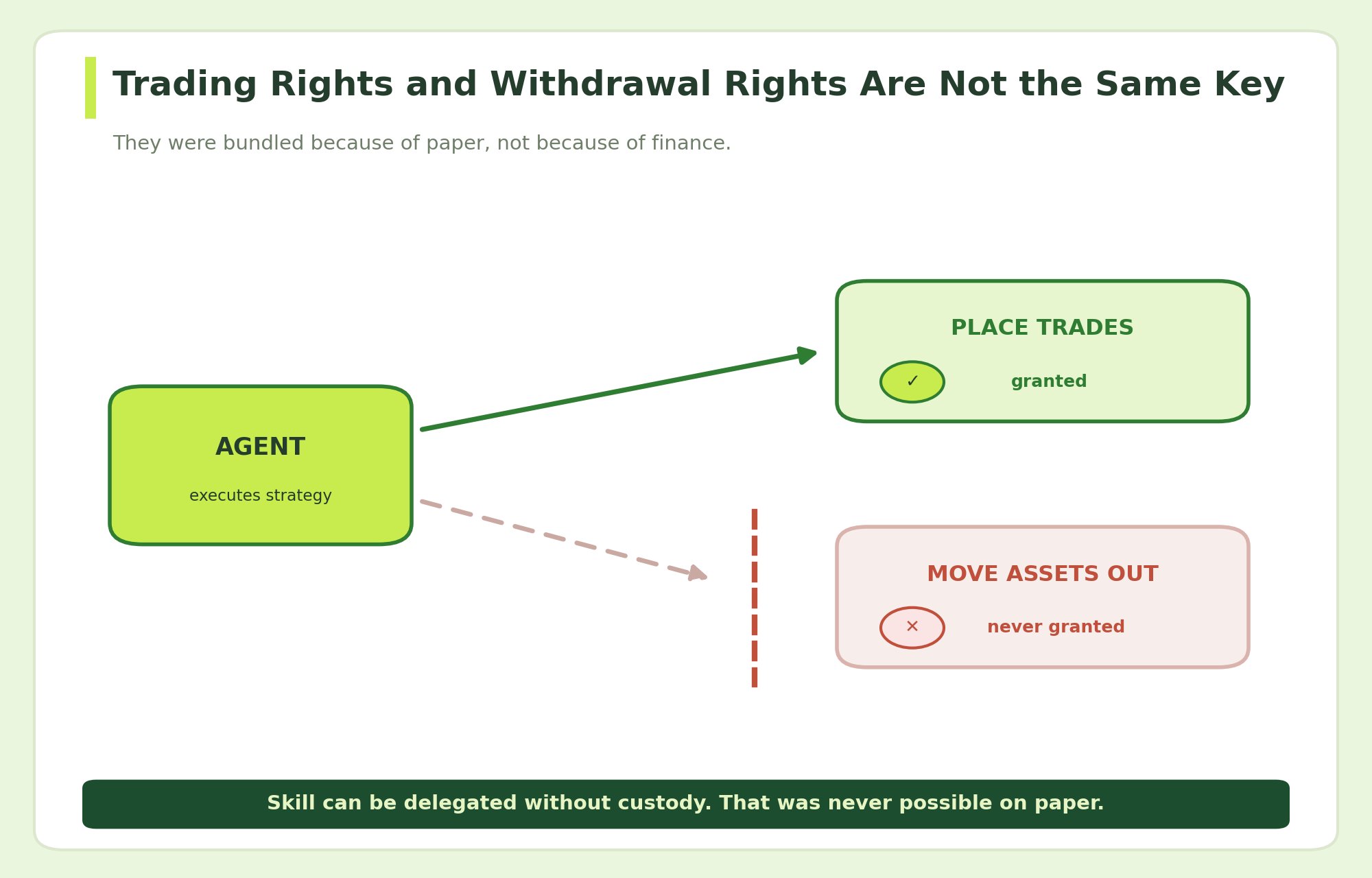
An agent can be authorized to trade without ever being able to move assets out. The bundling that caused decades of blowups was a limitation of paper, not of finance.
It collapses the verification lag. Not 45 days. Not an annual audit. A record verifiable continuously, in real time, by anyone who wants to check.
It removes the cold start. A verifiable record can be built at any size and still counts, because it is written to the same ledger the large accounts use.
Nobody has to grant you the chance to prove yourself.
And then the important one. The actual resolution of the paradox.
Results public, logic private
The reason disclosure destroyed edges is that we only ever had one way to prove a strategy was good, which was to show the strategy.
That is no longer true.
Cryptographic attestation lets you prove a claim about something without revealing something.
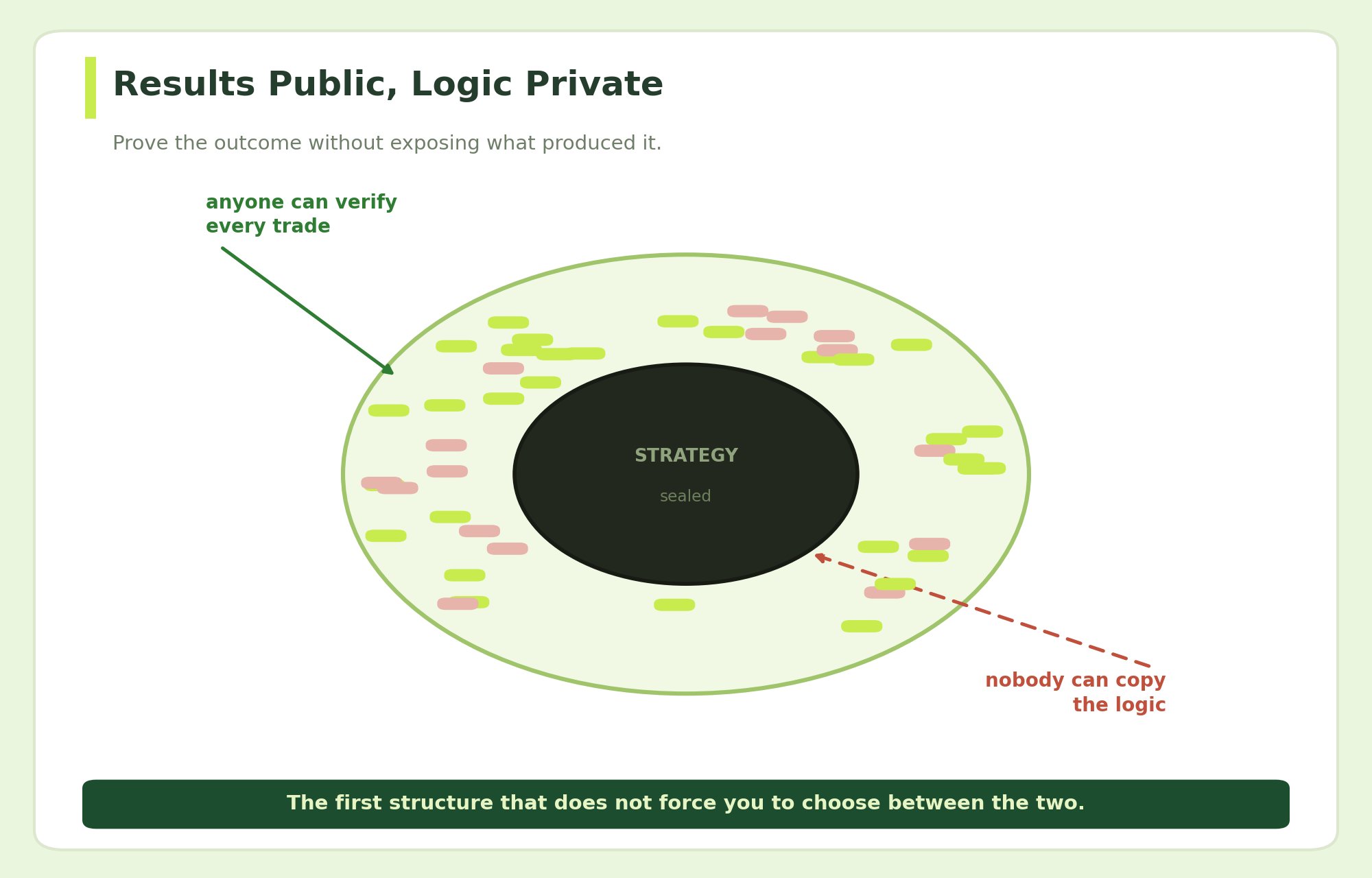
Applied here, the performance record can be fully public and continuously verifiable while the strategy that produced it stays private.
Anyone can confirm what an agent did, when, at what size, with what drawdown, and how consistently. Nobody has to see the logic that generated the decisions.
Results public. Logic private.
Read that again, because it is the exact thing that was impossible before.
The trader no longer has to choose between being verifiable and being copied.
The allocator no longer has to choose between trusting a stranger and getting no information.
Fifty years of that trade-off existed because the ledger was private and the proof required disclosure. On-chain, the ledger is public and the proof does not.
That is not an incremental improvement on fact sheets. It is the removal of the constraint the entire industry structure was built around.
What that unlocks
Once verification is solved without disclosure, things that were previously impossible become straightforward.
You can be evaluated on evidence rather than on marketing.
You can be discovered without being copied.
You can build a record from a standing start and have it mean something.
And the person who built the thing that works can be recognized and rewarded for it, instead of functioning as unpaid marketing for whoever controls the platform, which is how nearly every previous version of this has worked.
Create something. Prove it in public without giving it away. Own what you built. Let it work.
That loop is what we have been building Moss around, and the marketplace is where those four steps stop being separate and become one flow.
We are not walking through mechanics today. It is close, and we would rather ship it than describe it.
The takeaway
The transparency paradox is not a crypto problem. It is finance's oldest structural trap.
Every solution the traditional industry built was a compromise that protected either the trader or the allocator, but never both.
Payments got solved. Identity got standardized. Execution got fast.
But the question of how you prove something works without giving away why it works stayed open, and it kept good operators invisible while rewarding whoever was loudest.
On-chain, that question finally has an answer, because the record is public by construction and the proof does not require the strategy.
Results public, logic private is not a slogan. It is the first version of this that does not force anyone to choose.
Keep an eye on this account. What we have been building sits precisely in that gap, and it is close.
The Moss Agent Marketplace is coming soon, and the first look lands here.
In the meantime, the best thing you can do is start early. Go to moss.site/agent and create your agent now, so that when the marketplace opens you already have something running and a record behind it, instead of starting from zero like everyone else.