You finish a great book. Two weeks later you cannot remember a single chapter. Not because you are dumb. Because nobody taught you how to actually learn.
Save this :)
Richard Feynman won the Nobel Prize in Physics in 1965. The thing he is most remembered for is not the physics. It is a 4-step learning method he used at Caltech. So simple a 12 year old can run it. So powerful that MIT, Stanford, and UCLA still teach it 38 years after his death.
Almost nobody knows you can run the same 4 steps inside Claude in 20 minutes.
That is the entire fix. 4 prompts. Twenty minutes. Knowledge that actually sticks. Here is the full method.
Phase 1: Why You Forget Everything
You read an article yesterday. Can you explain what it said right now? Not the topic. The actual insight.
Most people cannot. And here is the most important sentence in this whole article:
You are not bad at learning. Your brain is doing exactly what brains do.
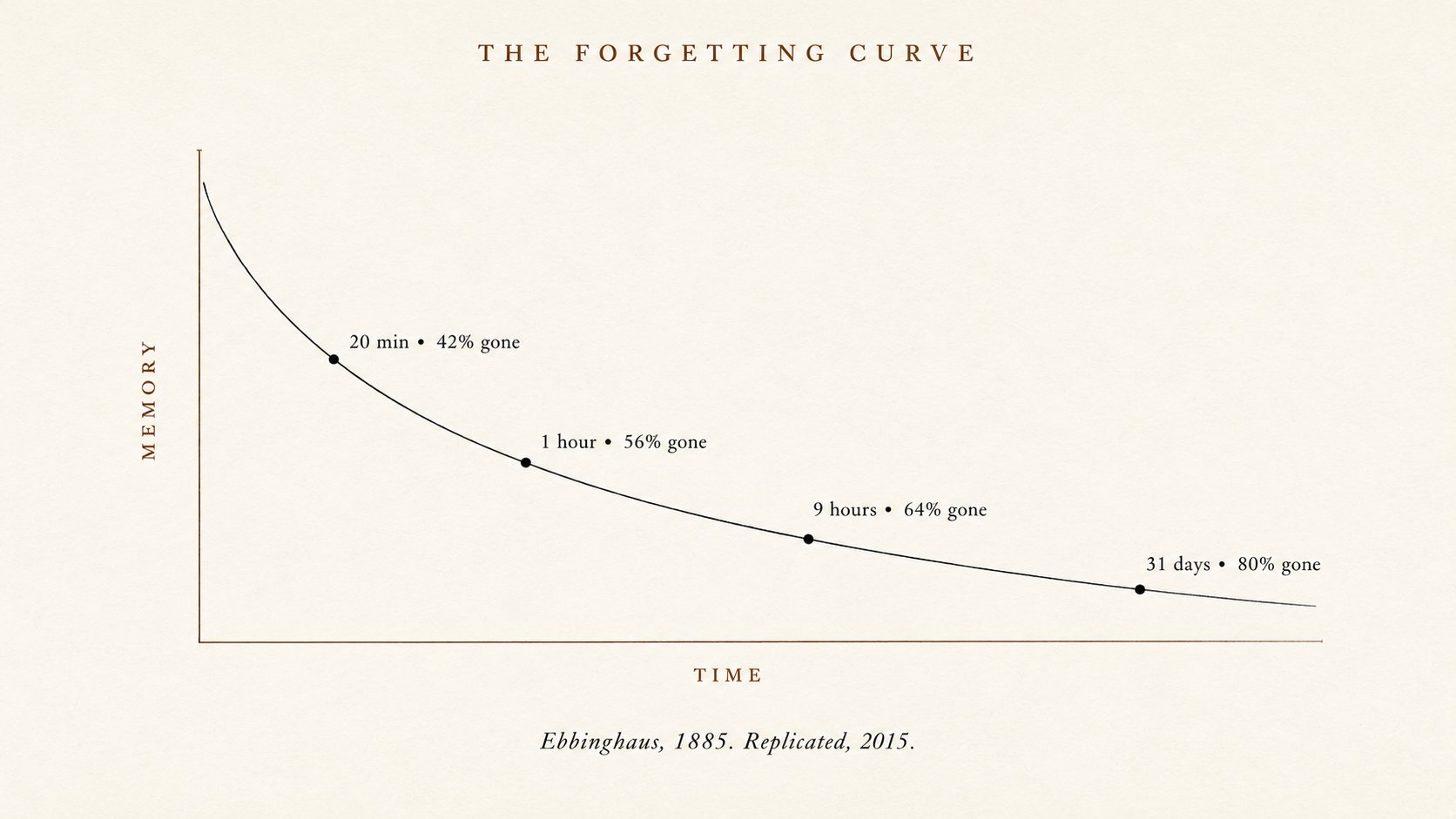
In 1885 a German psychologist named Hermann Ebbinghaus ran the first scientific study on memory. He memorized lists of nonsense syllables and tested himself over time. What he found is now one of the most replicated results in all of psychology, confirmed again in a 2015 replication study.
- After 20 minutes you have lost about 42 percent
- After 1 hour you have lost about 56 percent
- After 31 days you have lost up to 80 percent
That is the forgetting curve. It holds for nearly every kind of learning. Books. Courses. Lectures. Online articles. Without active reinforcement, most of what you read is gone within a month.
Here is the deeper reason this happens. Cognitive scientists call it the fluency illusion. The ease of reading something gets mistaken for actual understanding. A clear paragraph feels like knowledge. It is not. It is recognition. You have only seen the idea. You have not used it.
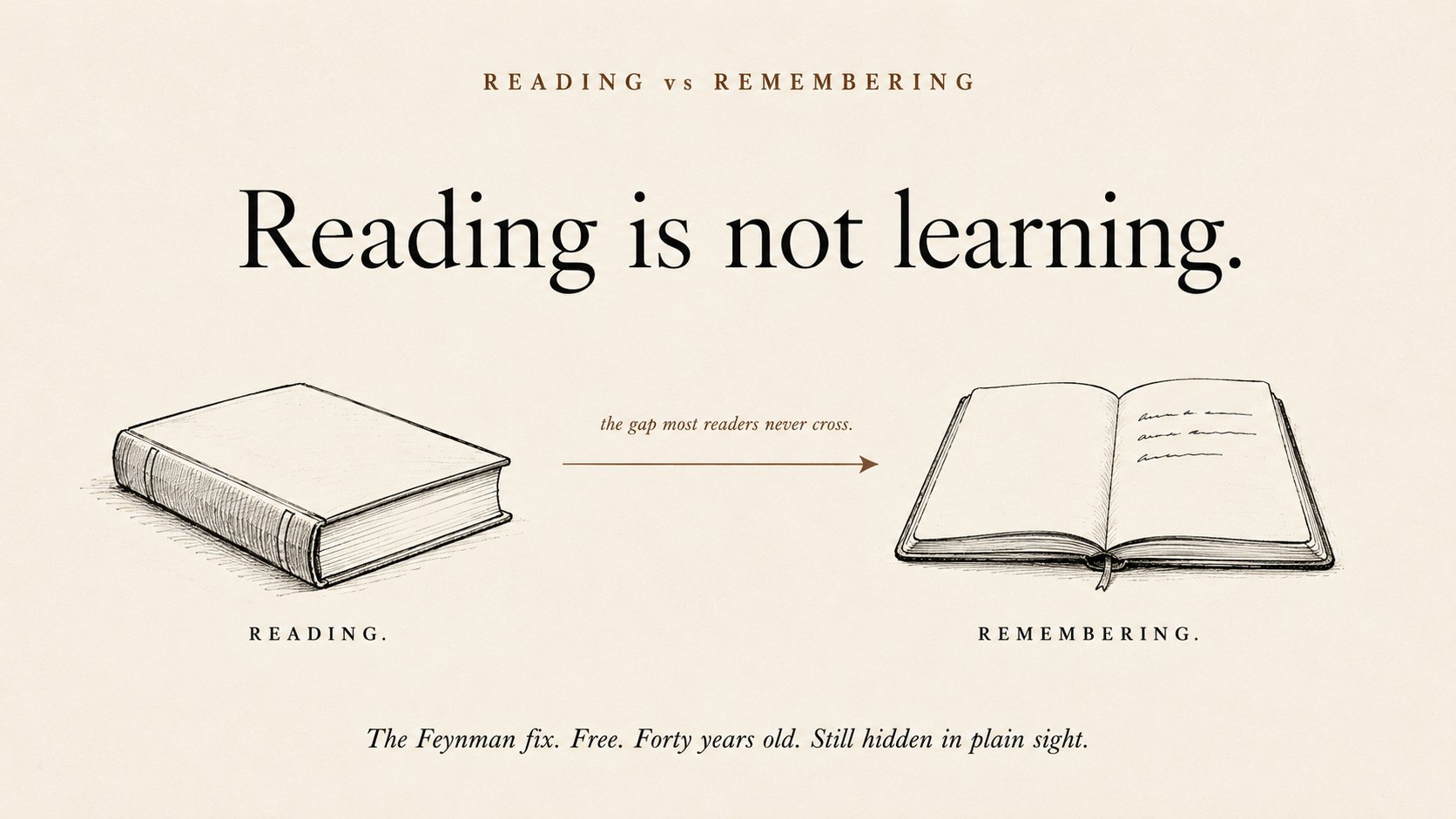
Reading is proof of attention. Explaining is proof of understanding. These are not the same thing.
Phase 2: What Feynman Actually Did
Richard Feynman taught at Caltech from 1950 until his death in 1988. His lectures were so good that scientists from other universities would fly in just to hear him explain things they already knew.
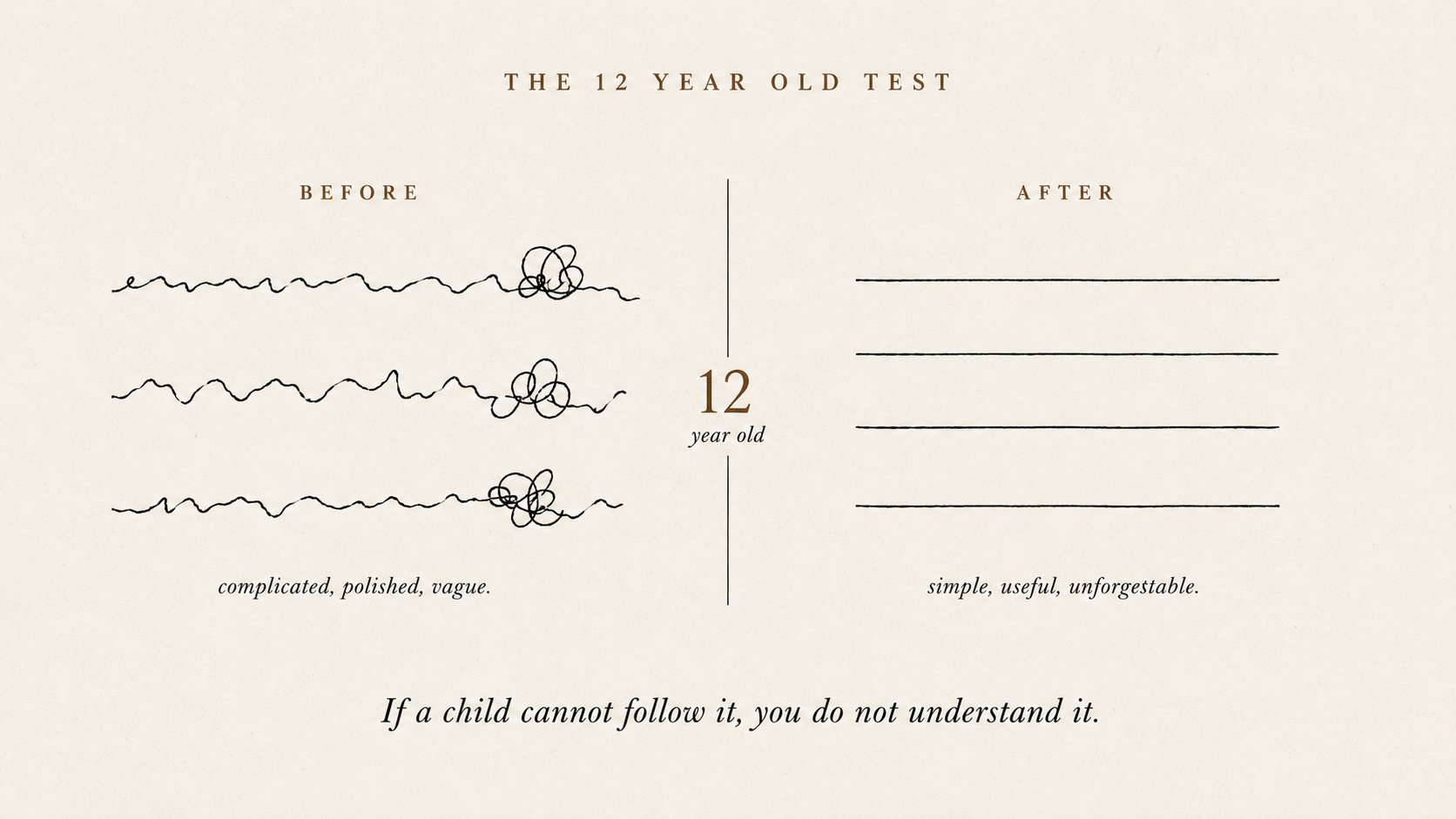
The reason was simple. Feynman refused to hide behind jargon. If he could not explain a concept to a 12 year old, he said he did not understand it himself. So he would tear the concept apart until he could.
Here is a story almost nobody tells. While preparing for his qualifying exams at Princeton, Feynman opened a fresh notebook and wrote on the title page: "Notebook Of Things I Don't Know About." Then he worked through each gap one by one. He did not study what he knew. He studied what he could not yet explain.
That single notebook is the entire Feynman Method in its purest form. Find the gap. Close the gap. Move to the next gap.
After his death, his students wrote down the method into 4 steps that researchers have studied ever since.
Step 1: Pick one concept. Write it on a blank page.
Step 2: Explain it like you are teaching a 12 year old. Plain words only. No jargon.
Step 3: Find every gap in your explanation. Wherever you get stuck or vague, mark it.
Step 4: Go back to the source, fix the gap, and simplify with an analogy.
Four steps. Each one forces your brain to do the one thing reading alone never does: retrieve.
Phase 3: The Science That Proves It Works
Feynman never published research on his method. He just used it. But 60 years of cognitive science has now confirmed exactly why it works.
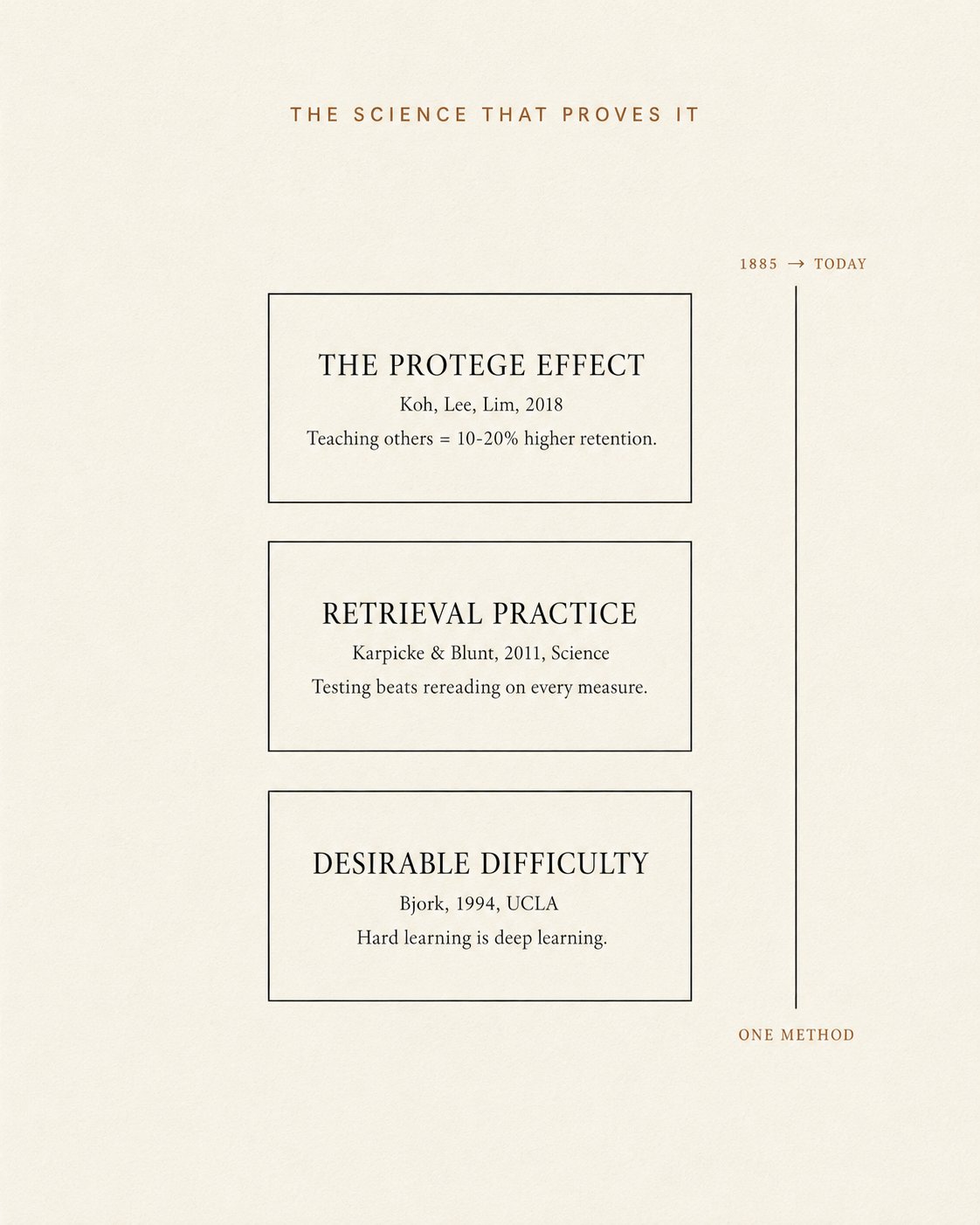
The Protege Effect. Koh, Lee, and Lim (2018) found that students who taught material to others scored 10 to 20 percent higher than students who only studied. The act of teaching forces retrieval. Retrieval is what builds memory. Prompts 1 and 4 below activate this effect.
Retrieval Practice. Karpicke and Blunt (2011), published in Science, showed that pulling information OUT of your brain works dramatically better than putting more in. Self-testing beat rereading on every single measure. Prompts 2 and 3 below force retrieval.
Desirable Difficulty. Robert Bjork (1994) coined this phrase at UCLA. Learning that feels easy is shallow. Learning that feels hard is deep. The discomfort you feel while typing your own explanation is not failure. It is the exact moment your brain builds stronger connections.
This is the entire research foundation. Teaching beats studying. Retrieval beats rereading. Difficulty beats comfort. Feynman knew it 40 years before the data caught up.
The 4 prompts below stack all three effects in one 20 minute session.
Phase 4: Prompt 1, The Concept Map
Paste this into Claude. Replace the topic in the brackets.
1I just finished reading about [TOPIC].2I want to run the Feynman Method to make sure it sticks.3Step 1: Concept Map.4List the 5 most important ideas from this topic that I5should fully understand.6For each idea, give me:7- The 1 sentence definition in simple English8- Why this idea matters in the real world9- The 1 question I should be able to answer if I truly10understand it11Do not use jargon. Do not assume I have a background in12this field. Write like you are talking to a smart 1613year old.
What comes back: a clean map of the 5 ideas that actually matter. Most topics have 50 facts. Only 5 are load bearing. This prompt finds them in 30 seconds.
Most people leave a book with a vague feeling of "good book." After this prompt you walk away with 5 named ideas you can list out loud. That is the difference between a feeling and a memory.
Phase 5: Prompt 2, The 12 Year Old Test
Now do the hard part. This is the prompt that activates the Protege Effect.
1For each of the 5 ideas above, I am going to try to2explain it in my own words like I am teaching a 12 year3old.4But first, write me a model answer for each idea. Use5only words a 12 year old would understand. No jargon.6Use an everyday example for each one.7Format:8IDEA 1: [name]912 year old version: [your explanation]10Everyday example: [your example]11Then ask me to write my own version of each. Wait for12my answers before continuing.
What comes back: Claude writes the simple version first. Then it pauses and asks you to write yours. You type your own version of each idea in plain words.
This is the entire point. The moment you type your version is the moment learning actually happens. Not when you read the book. Not when you highlighted. Not when you took notes. The moment you put it in your own simple words.
If you skip this step you will forget 80 percent. If you do it, you will remember most of it for years. That is not a guess. That is the Koh 2018 study.
Reading is proof of attention. Explaining is proof of understanding.
Type your answers. Send them to Claude. Now you are ready for the next prompt.
Phase 6: Prompt 3, The Gap Finder
This is the prompt that makes Feynman magical. Claude reads your explanations and tells you exactly where your understanding broke.
1Here are my 5 explanations:2[PASTE YOUR ANSWERS]3Now play the role of a strict but kind tutor.4For each of my 5 explanations:51. Mark it as STRONG, WEAK, or WRONG.62. If it is WEAK or WRONG, tell me exactly what I got7confused about. Be specific. Do not be polite. I8want to know.93. Give me the corrected version in 12 year old words,10using a DIFFERENT analogy from before.114. Ask me 1 follow up question that would prove I now12understand it.13End with: which 1 idea should I restudy first to fix14the biggest weak spot.
What comes back: an honest report card on your own thinking.
This is the step a book can never give you. A book does not know what you missed. Claude does. It read your explanation. It can see exactly where the logic broke.
I have used this on physics topics, finance topics, AI topics, and even on negotiation tactics. Every single time Claude found at least 2 ideas I thought I understood but did not. Every single time.
The "restudy this first" line is gold. It tells you the one highest-leverage gap to fix. You no longer need to reread the whole book. You reread one paragraph.
Phase 7: Prompt 4, The Analogy Lock
Step 4 of the original Feynman Method is the most underrated. Lock each idea with an analogy from your own life. The brain stores things 3 times longer when they are tied to something it already knows.
1For each of the 5 ideas, build me 2 analogies:2ANALOGY 1: from everyday life3(cooking, driving, sports, weather, family, money)4ANALOGY 2: from common adult experience5(working a job, using a phone, dealing with money,6managing time)7For each analogy:8- Show where the analogy works9- Show exactly where the analogy breaks down10(this part is critical, all analogies break somewhere)11End with the 1 sentence summary I should write down and12re-read tomorrow morning.
What comes back: two anchors per idea. Plus a 1 sentence summary you can carry forever.
The "where the analogy breaks" part is what makes this prompt different. Most teachers give analogies and stop. Feynman insisted on showing the limit. That stops you from carrying the wrong mental picture into the next conversation.
Tomorrow morning when you re-read those 5 summary sentences, the analogies will pull the full ideas back into your head. That is the lock.
Phase 8: The 20 Minute Workflow
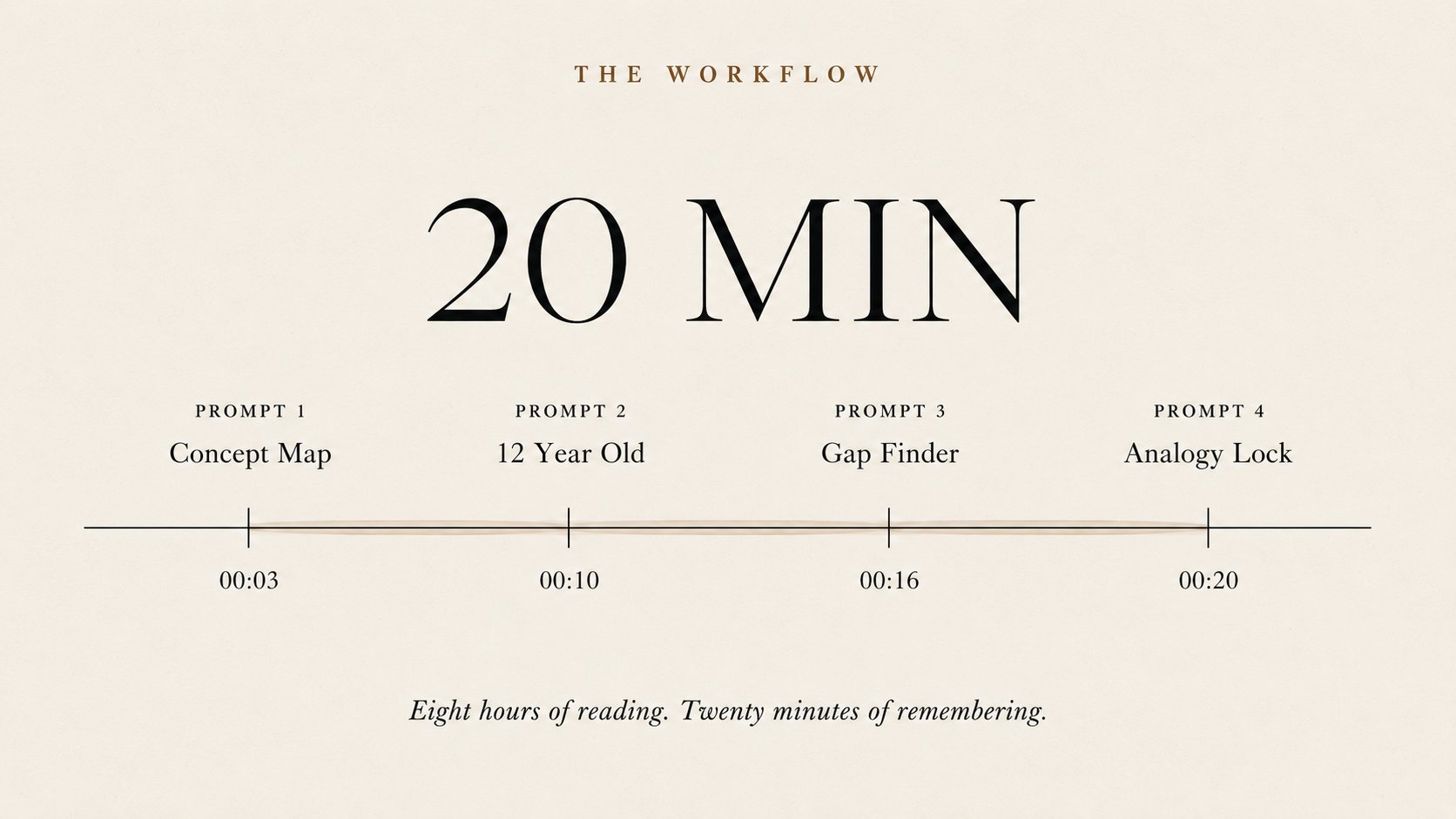
Minutes 1 to 3: Prompt 1. You have a clean map of the 5 ideas that matter.
Minutes 4 to 10: Prompt 2. Read Claude's model answers. Then write your own. This is the slow part. Do not rush. Typing is the whole point.
Minutes 11 to 16: Prompt 3. Get your report card. Find your gaps. Restudy the 1 weakest idea for 2 minutes.
Minutes 17 to 20: Prompt 4. Lock each idea with 2 analogies. Save the 5 summary sentences.
Total time: 20 minutes per topic. Four rounds of active retrieval. More genuine learning than most people do in an entire online course.
Compare that to the alternative. The alternative is reading a 300 page book for 8 hours and forgetting 80 percent. Or buying a $300 course and forgetting most of it by next quarter.
The Feynman Method through Claude turns 8 hours of reading into 8 hours of remembering.
Phase 9: 7 Places to Use This Right Now
1. After every nonfiction book. Run the 4 prompts the same day you finish reading. The book sticks. Forever.
2. After every online course. Most $300 courses leave 80 percent in the dust. Run Feynman on each module the day after you watch it.
3. Before any interview. Pick the 5 hardest topics you might be asked about. Run Feynman on each. You will speak with clarity nobody else has.
4. Before any meeting. Your boss mentioned a concept you pretended to understand. Run the 4 prompts tonight. Tomorrow you are the one explaining it to the team.
5. Before teaching anything. If you have to explain a topic at work, run the prompts first. Your audience will think you are 10 years more experienced than you are.
6. After reading a research paper. Papers are dense. The Feynman pass through Claude is the fastest way to actually understand one.
7. On any topic your competitors talk about. Kubernetes. RAG. Fine-tuning. MCP. Whatever you nod at without really understanding. 20 minutes. Permanent.
The Persona Block
You are someone who reads. You buy the books. You take the courses. You sit through the lectures.
And then you forget. Not because you are lazy. Because the system was never designed for memory. It was designed for sales.
You want to remember what you learn. You want the courses to pay off. You want the books to stay with you.
That is who this method is for.
If that is you, save this article. Use the 4 prompts. Watch what your brain holds on to from now on.
The Uncomfortable Truth
Here is what nobody tells you.
The reading industry sells you books. The course industry sells you courses. The note-taking apps sell you subscriptions. None of them sell you the one thing that makes any of it stick. Active recall.
The Feynman Method has been free for 40 years. The science behind it (Koh, Karpicke, Bjork) has been settled for over a decade. The 4 prompts above run inside a tool you already pay for. And almost nobody is doing this.
We are in an 18 month window. The people who learn to use AI for active recall will out-think the people who use AI to summarize. By a lot. Not because they are smarter. Because they are typing their own version while everyone else is highlighting paragraphs.
In 18 months, this kind of workflow will be a default feature in every reading app. The edge will be gone. Today it is still a quiet trick.
Stop consuming. Start explaining.
Pick the next thing you want to actually remember. Open Claude. Paste Prompt 1.
Twenty minutes from now you will know the difference between reading and learning.
hope this was useful. Nav ❤️