AI agent M365 integration has been repeatedly killed by internal security walls.
M365 MCP → Connection impossible
Claude in Chrome → Not working
Notion MCP → Dead
As a 'window-seat' manager at a large corporation, I seriously thought about this after seeing the Microsoft Scout announcement today (June 2, 2026).
Scout is inside the fence from the start.
But the biggest shock today was that the personal information policy wall is much higher than the security policy wall.
Note: This article is a reflection based on my specific environment. It does not guarantee operation in other companies or environments (Information as of June 3, 2026).
Chapter 1: Organizing Scout and OpenClaw
Scout is an enterprise-ready, always-on agent for M365 based on OpenClaw (an open-source AI agent).
OpenClaw is a personal AI agent released in January 2026 by Austrian developer Peter Steinberger.
OpenClaw spread explosively immediately after its release. Even after the developer joined OpenAI, development continued under a community-led independent foundation, recording over 300,000 GitHub stars by April 2026.
I have been following OpenClaw for a while and was testing a clone environment called NemoClaw at home. I expected enterprise maturity to take six months and planned full-scale verification at work in the latter half of this fiscal year. I was testing it in my personal environment as a warm-up.
However, from an enterprise adoption perspective, OpenClaw had three challenges:
① Security concerns could not be wiped away.
While OpenClaw offers high freedom, using it in a corporate environment is scary. Security issues have been pointed out, which was a factor in hesitating for enterprise adoption.
② High hurdles from implementation to maintenance.
The technical hurdles for setup, configuration, and operation are high, making continuous operation difficult for companies without engineer resources. On X, I often see comments like, "Even if we could install it, maintenance is so hard we can't use it for actual work."
③ Weak integration with M365.
As of March 2026, native M365 integration for OpenClaw was the most requested feature from the community, but it hadn't been realized. In contrast to the mature integration with Google Workspace (gog), Outlook, OneDrive, and Teams calendars remained in a basic "scheduling function" state.
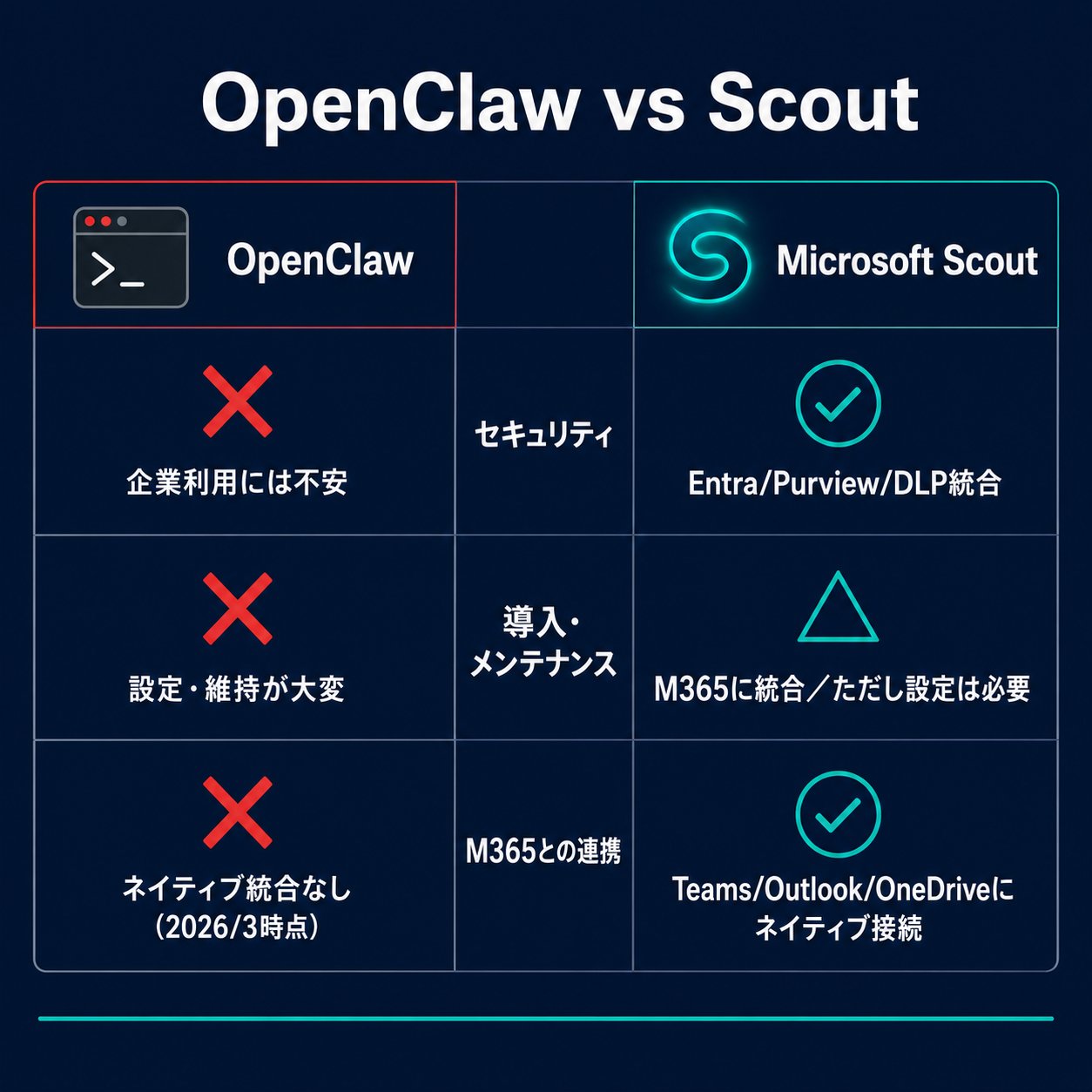
Scout has largely cleared ① Security and ③ M365 integration among these OpenClaw challenges. The answer lies in built-in enterprise security controls, governance integration via Intune, Purview, and Entra, and native connections to Teams, Outlook, OneDrive, and SharePoint. Regarding ② implementation and maintenance hurdles, improvements are expected, but observations on X suggest configuration via Frontier is still complex, so it's not entirely cleared yet.
Scout constantly monitors Teams messages and Outlook emails, proactively handling meeting scheduling, deadline detection, and calendar blocking. Microsoft positions this as an "always-on personal agent." It doesn't wait for a prompt; it moves first.
However, it is currently limited to the Frontier program and requires a GitHub Copilot license and Intune configuration. It will be a while before general users in large corporations can use it.
Chapter 2: Why MCP Dies in Large Companies: The Structural Reason
It gets killed because it tries to connect from the outside. This is the sole reason MCP dies.
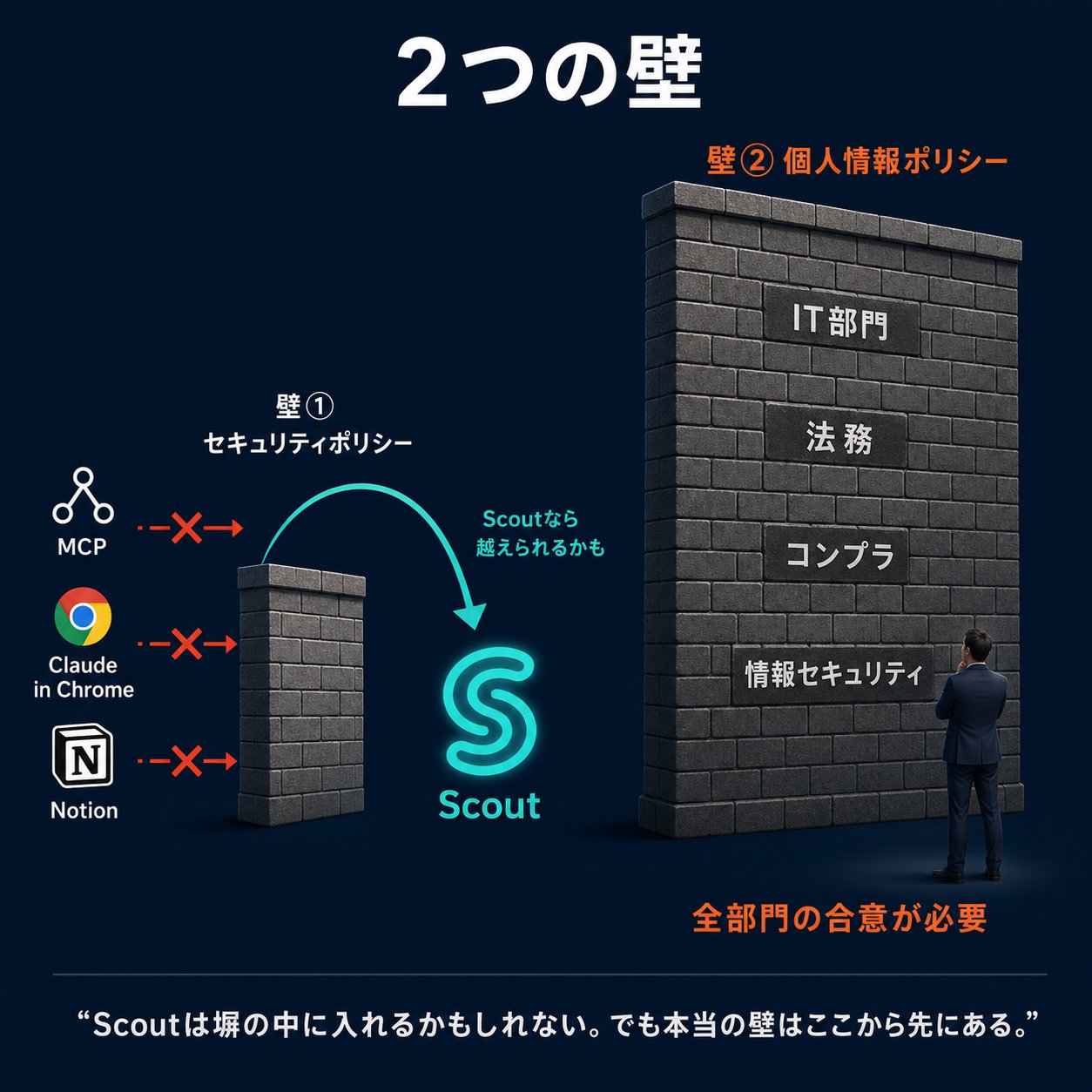
This was the wall I faced when introducing Claude Enterprise. M365 MCP, Claude in Chrome, Notion MCP—almost all the external integration features I expected died.
No matter how many times I checked the settings, it wouldn't connect. I finally realized the cause was the internal security policy.
In corporate network environments, HTTPS and WebSocket connections to external services are subject to inspection and restriction by security tools.
It is common for communication using the protocols MCP relies on to be blocked.
The design of "trying to connect to an MCP server outside M365 from the outside" is fundamentally incompatible with corporate security policies.
Because you are trying to poke a hole from outside the fence, the guard stops you.
The reason MCP dies isn't because security is too strong, but because of the design itself: "connecting directly from an internal terminal to an external MCP server."
Understanding this makes the next chapter click.
Chapter 3: Why Scout Might Break Through This MCP Death
Scout runs inside M365. Therefore, it has a higher chance of surviving the internal network than external MCPs.
Connections to Teams, Outlook, OneDrive, and SharePoint have a different structure than direct connections to external MCP servers. If Scout is provided as an official M365 feature, I believe it is highly likely to survive the internal network.
It gets killed because it tries to connect from the outside.
Scout is inside the fence from the start.
This is the most important point of this announcement.
What people on the ground have been doing is trying to "connect to external MCP servers across the internal security wall." That is structurally difficult. Since Scout works as an official M365 feature, the "need to poke a hole" itself may disappear.
Furthermore, remote server integration is already progressing in Copilot Studio, and paths for connecting from the M365 side to tools are being established. There is a possibility that MCPs, which were dead due to internal security policies, could be revived through managed paths on the M365 side. However, this is a "possibility." I cannot say for sure it will survive.
Chapter 4: But We Can't Just Rejoice. Three Realities
This is the biggest discovery today. There is a wall much higher than the security policy wall elsewhere.
① It won't reach general users in large companies yet
Currently, Scout is an experimental release limited to the Frontier program. It requires a GitHub Copilot license and Intune settings, so it cannot be deployed company-wide immediately.
Additionally, Scout is currently only offered for testing in the US (Nikkei Shimbun reported on June 2, 2026, "Testing provided in the US"). The Frontier program follows a pattern where "initial releases start from English/US-based," so deployment to Japanese environments will be even further out.
In my company's case, even Microsoft's Copilot Cowork hasn't been deployed more than two months after its announcement. We must factor in that it will take considerable time for Scout to reach general users.
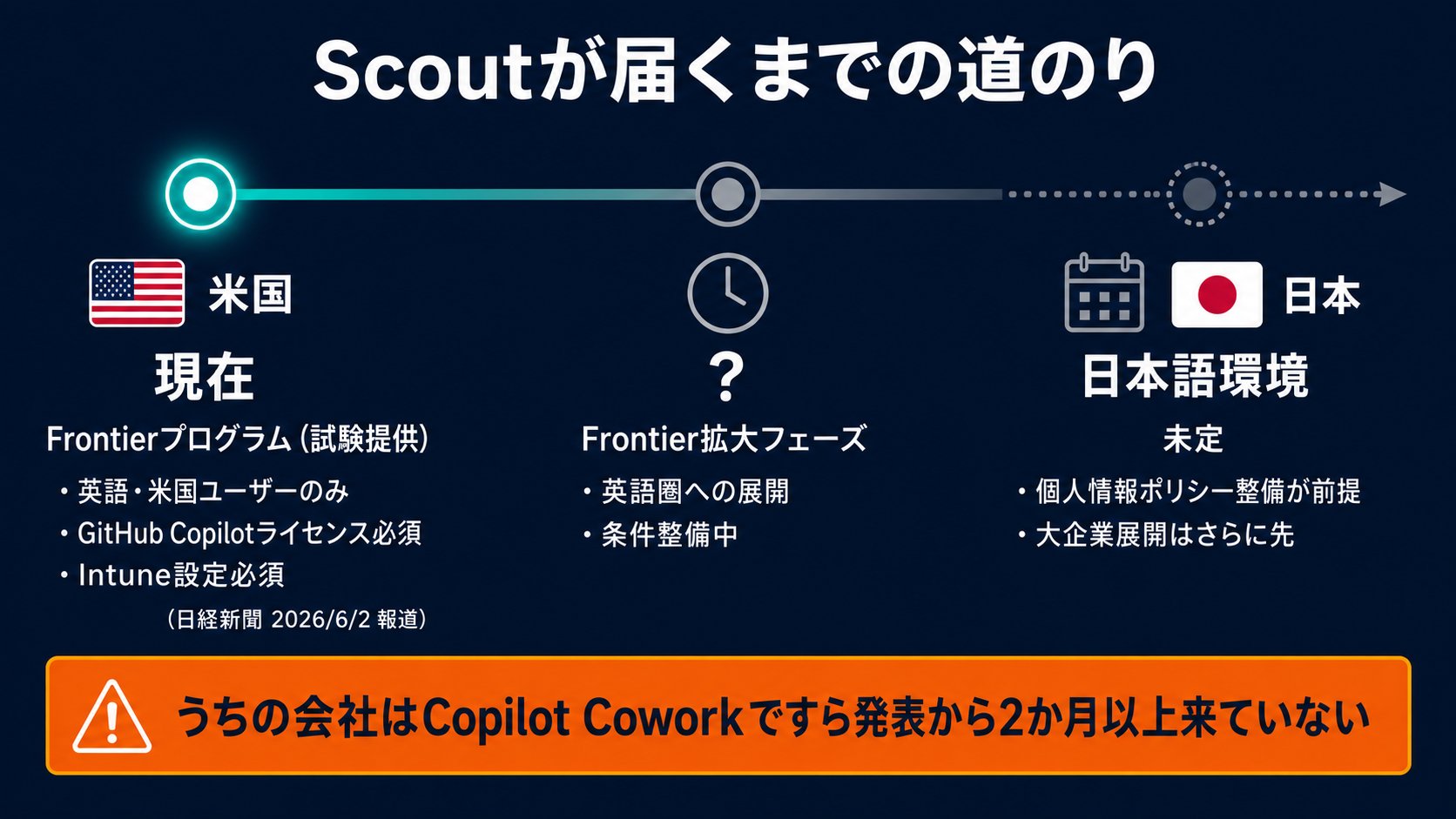
② The GitHub Copilot License Requirement—and the Pay-As-You-Go Problem from June 1
Scout requires a GitHub Copilot license. However, starting this month, the pricing structure for GitHub Copilot has changed significantly.
On June 1, 2026, GitHub moved all Copilot plans to a pay-as-you-go model (GitHub AI Credits, 1 credit = $0.01). Each plan includes a credit quota equal to the monthly fee, and normal code completion remains unlimited. However, chat and agent actions consume this credit quota based on token usage, and anything exceeding the quota incurs additional charges.
Scout is an "always-on" agent. It continues to process in the background while constantly monitoring email, calendars, and Teams. Whether this continuous operation fits within the monthly credit quota or significantly exceeds it is something we won't know until we try it.
Even with normal Copilot use, there have been reports of costs ballooning to 10–50 times the included credit quota when using agent mode heavily. If the always-on Scout continues to run in the background for hundreds of people, there is a significant risk of greatly exceeding the basic credit quota.
The requirement for a GitHub Copilot license isn't just about "getting the license"; it's a different wall of whether you can explain in a budget proposal "whether it fits within the credit quota and what the cost will be if it exceeds it."
It will be essential to grasp the actual AI Credits consumption through a small-scale PoC (Proof of Concept) before full-scale implementation.
③ The Real Wall was the "Personal Information Policy"
Intune environments and GitHub Copilot routes. The technical prerequisites are likely coming together.
So why hasn't even Microsoft's Copilot Cowork arrived after more than two months?
Scout naturally reads employee emails, calendars, and chat histories to automate tasks.
What we need to confirm here is that employee names and email addresses also fall under personal information. Any information that can identify an individual is personal information. The emails, calendars, and chats that Scout reads contain a large amount of this personal information.
Technically, it's a matter of Copilot processing user emails, schedules, chats, and files via Microsoft Graph. However, under internal regulations, we cannot avoid the task of clarifying "whether AI is allowed to process personal and confidential information."
This is not a technical talk; it's a policy talk. It's not something the IT department can just fix by changing a setting. It's a decision of "whether the company recognizes AI reading employee emails." Only after agreement is reached there will Scout begin to move.
I hit this wall myself when introducing Claude Enterprise. There was no LLM service in the company that could handle personal information to begin with, so we introduced it with the arrangement that "inputting confidential information is OK, but inputting personal information is NG." Most large companies likely have a similar wall.
Technical walls can be crossed by changing settings. But policy walls require people, time, and consensus.

There is a case that illustrates this difficulty.
In April 2026, information security researchers reported that in the Microsoft 365 environment of Japanese courts, personal identifiers for at least 14 staff members were in a state where they could be obtained externally.
According to the report, the cause was a combination of the "Safe Links" feature in Teams and Outlook embedding staff information in plain text when rewriting URLs, and the external contact search function being enabled by default. If the report is correct, M365's "kind design" was leaking personal information.
In my observation, I haven't seen the AI cluster pick up this incident. I believe this fact cannot be ignored when talking about Scout.
Scout is indeed inside the fence. But even inside the fence, information could leak out through other paths due to M365's own specifications.
Internal security policies might be overcome with technical setting changes.
But the personal information policy wall cannot be moved until the IT department, legal, compliance, and information security all agree.
Chapter 5: Three Actions to Start Today
① Make noise about this in the internal Copilot community
If there is no direct path to the IT department, the Copilot community is the only place to speak up. Drop the information that "to use Scout, we need to organize the personal information policy." Raising your voice as an AI promotion lead is the first action.
② Confirm the current status of the "Copilot Personal Information Policy"
The prerequisite for Scout to work is internal agreement on Copilot processing personal information data within M365. Confirm what that policy is in your current company, and if it's not organized, identify who needs to be approached. I plan to check this promptly.
③ Keep your antenna up for information on the US early release
Scout is currently starting with a test offering in the US. Experience stories from actual users, methods for organizing personal information policies, and actual consumption of GitHub Copilot pay-as-you-go credits should start appearing on X and in the English-speaking world. Organize how it might apply to your own environment as information comes out. That is the most realistic action you can take now.
If you are hitting the same wall where MCP dies in a large company, please let me know.
How did you create the opportunity to cross the personal information policy wall in your company?
Thank you for reading this far.
As a 'window-seat' manager at a large corporation, I continue to experiment while throwing Claude Cowork into the field every day.
For managers in the same position who are struggling with "wanting to use Claude but can't use it internally" or "MCP dying," I share actual working examples and prompts on X from time to time.