How a Side Project on YouMind Turned Into a Near-Six-Figure Income

AI handed ordinary people a shot at reinvention. He decided to take it with everything he had.
SU CHUANLEI.
If you've ever browsed the YouMind Skill marketplace, you've seen the name. "Content-to-Anything," "AFP 3.0 · Meta-Architecture Engine," "Chapter-by-Chapter Book Engine" — his premium Skills routinely top the bestseller charts, despite price tags that make casual buyers think twice.
He was the first creator to cross $1,000 in personal earnings after YouMind launched its Skill Rewards Program in May. And as of yesterday, his YouMind Skills revenue alone has surpassed $7,600, with total side-income from related ventures approaching six figures.

Su Chuanlei's latest earnings from the YouMind Skills Creator Rewards Program
Outside the YouMind community, Su's day job is teaching AI agents at an ed-tech company, which serves academic researchers. Over 60,000 scholars and PhD students at top universities call him "Professor Su", although he's a 1995-born English major from an unremarkable university. No PhD, no research pedigree, no prestigious alma mater.
And just three years ago, he was pulling in roughly $700 a month, stuck in a career rut, drifting through Beijing with no clear path forward.
So what changed?
How AI Rewrote a Young Migrant Worker's Trajectory
In 2023, Su had just lost a family member and hit rock bottom at work. He jumped ship to his current job out of necessity rather than ambition.
The company served graduate students and researchers — people with serious academic credentials. Su, without that pedigree, was sidelined to grunt work, far from the core business. He felt expendable.
The turning point came in March of that year, when GPT-4 dropped. The company's founder saw immediately that AI would reshape academic work and mandated company-wide AI training.
"I figured, I'm already the most marginal person here," Su recalls. "Might as well go all in on the one thing nobody else was taking seriously."
The bet paid off. Months of intensive self-study earned him recognition from students and leadership alike. He went from running internal AI workshops to heading an entirely new business unit — AI agent training — owning curriculum development, operations, and sales. The program attracted 60,000 students, expanding the company's audience well beyond academia into professionals across industries hungry to learn AI.
Finding YouMind
Su credits one person for the introduction: JackyWine, a YouMind power user and content creator who launched a YouMind course in November last year. Su enrolled, got hooked, and within days had explored every corner of the platform.
"I've tried more AI tools than I can count," he says. "But YouMind's IPO framework is the first one that actually maps to how I work every day."
IPO — Input, Process, Output — is the creative methodology baked into YouMind's product design. Su's daily rhythm fits it perfectly: morning news scanning is Input, digesting material is Process, producing documents and courseware is Output. He added a fourth letter — D for Deposit (building a lasting knowledge base) — making it IPOD.
From that point on, everything — blog posts, video scripts, course materials, marketing plans — lived in YouMind. Two social media accounts he run, grew past 30,000 followers in short order.
Before YouMind even launched its paid Skills marketplace, Su had already built dozens of free Skills for his students, earning him official YouMind Ambassador status. When the marketplace opened in May, he moved fast — iterating and listing paid Skills over a single holiday weekend, crossing $1,000 in revenue before the week was out.
In six months on YouMind, between referral bonuses, Skill sales, and external course invitations, Su's side income has approached six figures.
Anatomy of a Bestselling Skill
Building a Skill isn't hard. Building one that sells consistently requires market intuition and the patience to iterate based on real feedback.
Take Su's proudest creation: "Content to Slides." The insight was simple. Image-generation models can already make beautiful slide decks, but finding the right visual style still means trial and error — burning credits and time testing templates one by one.
His question: what if a Skill offered nearly every common presentation style upfront, letting users choose before generating? He spent weeks studying PPT aesthetics across the market — including templates from well-known AI influencers — and shipped a Skill with over 30 selectable visual styles.
The workflow: feed YouMind your material, pick a style and page count, review the AI's content layout for each slide, then generate. The Skill controls details down to text line count, centering, and image placement — left corner or right, top or bottom.
It racked up hundreds of installs immediately. But Su didn't stop. As feedback rolled in, he realized 30+ styles created decision fatigue. He trimmed to 17, added a "remember my preference" feature so the Skill would default to a user's last-used style for similar topics.
"Content to Slides" is now in its third major version, with over 432 paid installs and hundreds of thousands of credits earned.
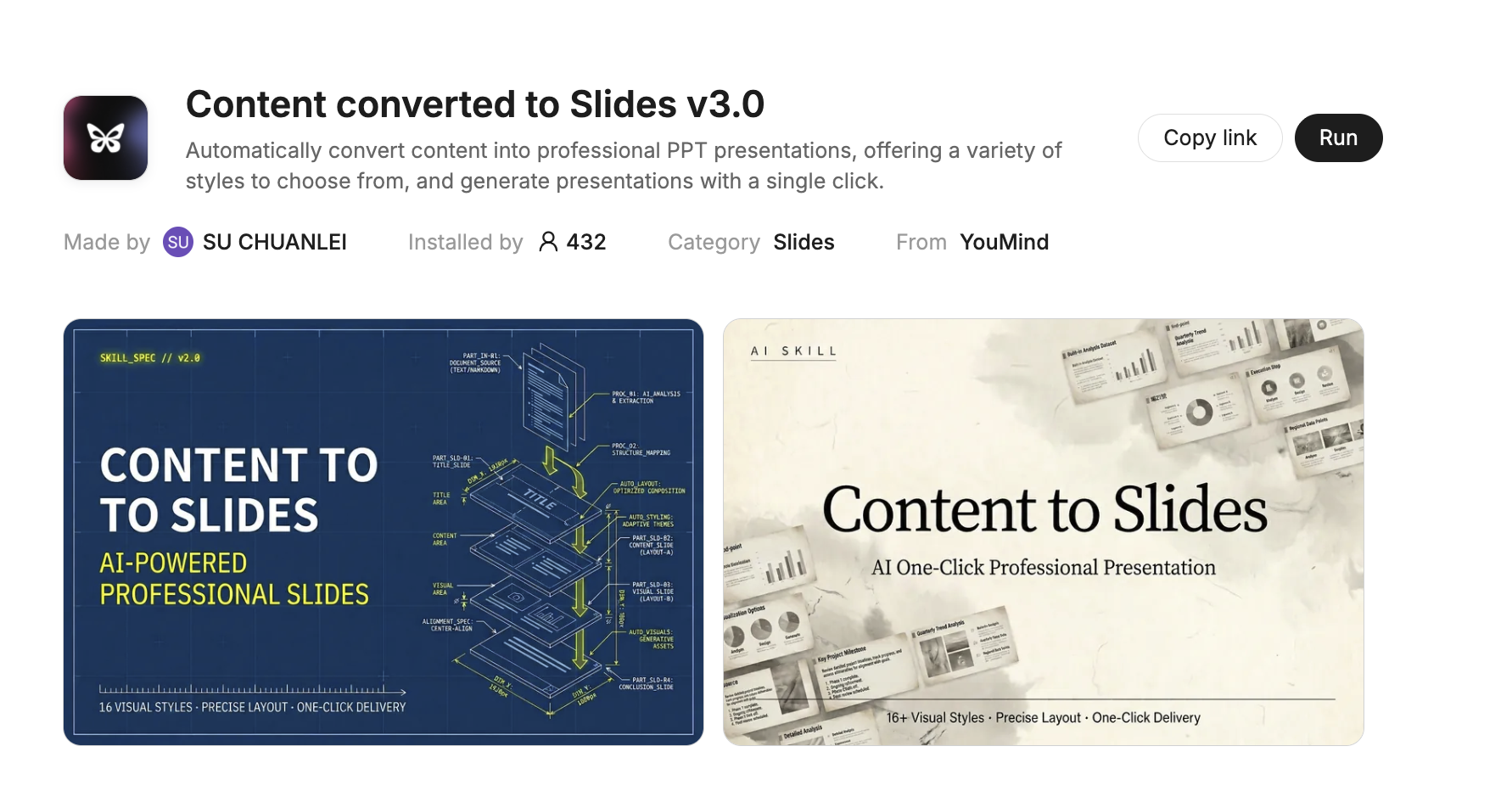
Content to Slides: https://youmind.club/skills/article-to-slides-generator-Lg2w5F2OOG2rHd
Pricing and Promotion
Su does the math openly. Between testing, debugging, and iterating, each Skill costs him 20,000–30,000 credits to develop. Pricing needs to be at least a third of that cost to break even, so quality Skills can — and should — be priced boldly.
To make sure a well-priced Skill actually sells, he follows three distribution rules:
- Early stage (owned channels): Post new Skills in YouMind community groups immediately. Don't be shy about selling — these are high-intent users. The first job is visibility.
- Format matters: One Skill per message. No roundups, no long lists. Each post gets a link, a one-line description, and a screenshot of the output. Long messages get scrolled past.
- Later stage (public channels): Building Skills in public is inherently shareable content. Posts about the process attract organic reach on social media, growing both Skill sales and personal brand simultaneously.
Three Rules for Beginners
For newcomers, Su offers blunt advice:
Don't cram everything into one Skill. The most common beginner mistake is the "do-it-all" Skill — one prompt that picks a topic, writes the article, formats it, generates images, and drafts it to a CMS. Long context windows degrade output quality. Break each step into its own Skill. If you need an integrated workflow, use a parent Skill that routes between child Skills, controlling flow and keeping context manageable.
Do the work manually first. YouMind's Skill Creator can turn a description into a working Skill with AI. But a fully AI-generated Skill is like a fully AI-generated article — technically complete, spiritually empty. You need deep familiarity with the workflow a Skill automates: every step, every edge case, every failure mode. That lived knowledge is what makes a Skill worth paying for.
Control inputs, outputs, and checkpoints. If you do use the Skill Creator, feed it explicit reference samples and hard rules. Don't let the AI improvise the structure.
Su admits that when he started, monetization was the entire motivation. But the more Skills he built, the clearer something became: every Skill eventually trends toward open-source. That doesn't make paid Skills pointless — what you're buying is a proven methodology, a framework someone tested and refined. But after purchasing, you still need to adapt it to your own context.
That realization flipped his thinking: a Skill that's built to sell but isn't genuinely useful will fail. A Skill built to solve your own problem first, then noticed by others, is the one that earns.
Epilogue
Six months of teaching AI has given Su more professional fulfillment than the previous decade of his career combined.
Among his students: someone who returned concert tickets to attend his in-person AI workshop. A complete beginner who earned over $100 from Skills within 28 days. A retired professor from China's top conservatory who learned AI from scratch and now guest-lectures in Su's program.
Most of his students are professionals between 30 and 50, carrying the weight of family, career, and financial pressure. They're learning AI not just for productivity — they're trying not to get left behind.
Su says he feels their urgency personally, because he was that person not long ago. He got lucky: he spotted the AI wave early enough to ride it out of a dead-end career.
But luck came at a cost. Two years of 16-hour days. Health problems by his early thirties. Too little time with family.
Now he's learning to pull back. Evenings and weekends for family. Fewer business trips. More delegation. Stepping into a strategic role instead of grinding at the front lines.
AI gave him the chance to seize the moment, and he seized it with everything. AI also gave him the freedom to choose differently — to slow down, to be present for the people around him. Both choices honor the opportunity.