I am Suzuki, CEO of overflow Inc., which operates Offers, an engineer recruitment platform for the AI era.
Yesterday (June 1st), we announced the brand renewal of Offers. Under the tagline "Recruitment in the AI era starts with Offers," we shared that we will be delivering new initiatives sequentially.
Click here for yesterday's article 👇️
As promised, starting today, I will reveal the contents one by one at a pace of one post per day. As the first installment, today I will talk about Offers' core service, AI RPO—what it is and why Offers is doing it.
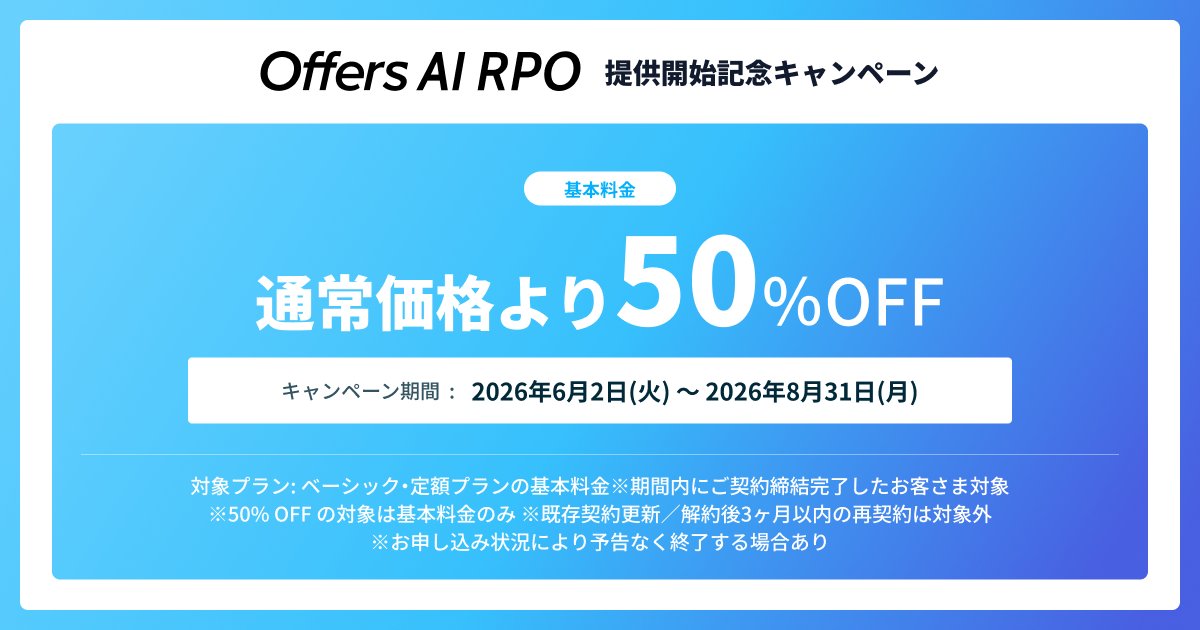
Additionally, today we announced the official launch of Offers "AI RPO." We have summarized the overall service and the Launch Commemoration Campaign (50% OFF regular price) mentioned later, so please take a look.
Click here for the press release 👇️
https://prtimes.jp/main/html/rd/p/000000287.000053307.html
0. What is AI RPO in the first place?
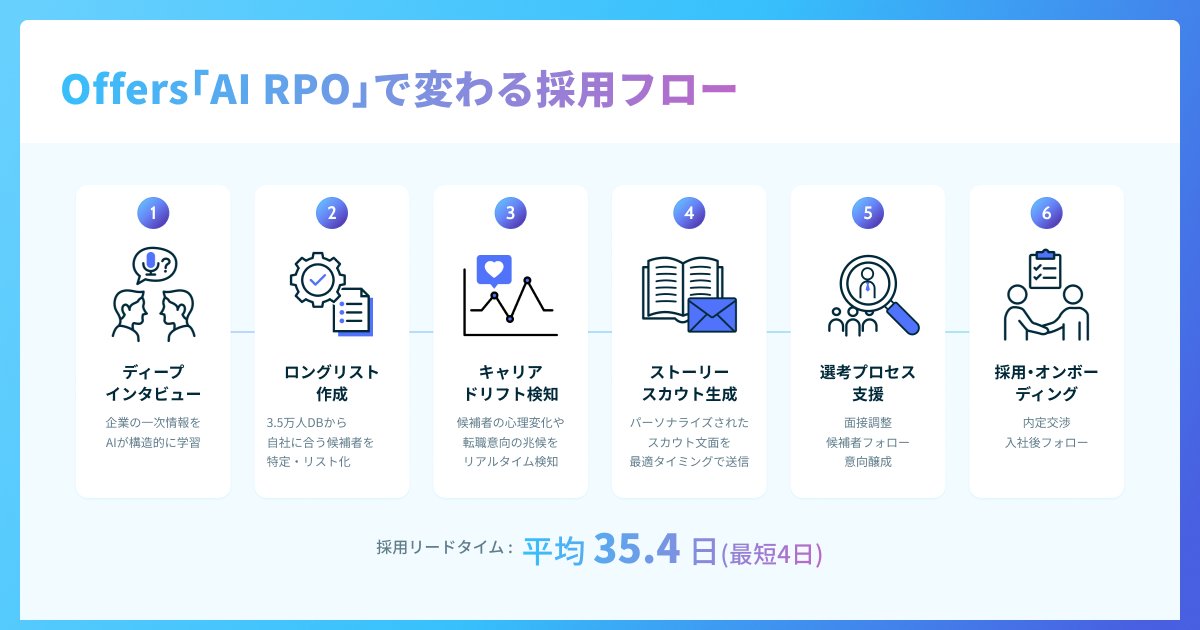
First, in a nutshell:
AI RPO is a service where AI and a specialized RPO team "completely outsource" the recruitment of rare talent in the AI era.
AI Engineers, FDEs (Forward Deployed Engineers), AI Builders, GTM Engineers—the so-called AI Talent. And technical leaders such as CTOs, VPoEs, and Tech Leads. Offers takes over the entire recruitment process for these individuals who lead businesses in the AI era, from candidate selection to scout design, sending, tracking, and timing management.
All the company needs to do is the initial interview and the candidate meetings/selection. The concept is simple: "Reproducibility in high-class recruitment." It's about creating a state where you can hire through a system, rather than just by chance.
The potential of AI is unlocked by data. By optimizing from the platform side, which holds a vast amount of data, we maximize matching accuracy and speed.
Why is this service necessary? I will explain in order.
1. Why we created AI RPO
The people you really want don't apply
If you are involved in recruitment, you must have felt this at least once:
"The people we really want to join don't apply for jobs."
AI Talent, such as AI Engineers, FDEs, AI Builders, and GTM Engineers, currently hold important positions somewhere. They are busy every day and aren't actively browsing job sites. Most are in a state of "I'd be interested if there's a good opportunity, but not enough to move on my own."
Moreover, as AI becomes commonplace, the value of such talent is actually rising. Designing entire systems by integrating fragmentary code written by AI, spotting hallucinations or security holes to protect quality, and judging "where and how to use this technology in business." These are jobs AI cannot replace, and the talent who can do them is in high demand. That's why they don't appear on the market.
Traditional Direct Recruiting (DR) hardly reaches this layer. Scouts can only be sent to the small fraction of the market that has already started "looking for a job." According to our data, only about 2% of the talent companies truly want are currently moving on their own.
The vast majority are not yet moving. But they will someday. The problem is not a "lack of talent," but the "way of meeting" and "way of engaging" them. This is what we have become convinced of over 7 years of operation.
"Blast" scouting no longer works
Another thing happening on the ground:
It takes an average of 30 minutes to carefully write one scout message. You send 100 and only a few come back. If you try to increase efficiency by using templates, the response rate drops. Engineers immediately see through and, above all, dislike "obviously mass-sent scouts."
And the recruiters responsible for this task become exhausted. Candidate searching, drafting, sending, scheduling. Chased by enormous operational man-hours, they can no longer spend time on what should be most important: "facing and talking with candidates."
If the person in charge moves to another department, the accumulated know-how returns to zero. As long as recruitment remains dependent on specific individuals, you cannot meet talent in the AI era. We wondered if we could rebuild this using the power of AI and a specialized team. That was the starting point for AI RPO.
2. From "Target and Wait" to "Medium-to-Long-Term Engagement"
Hunt-type vs. Farm-type
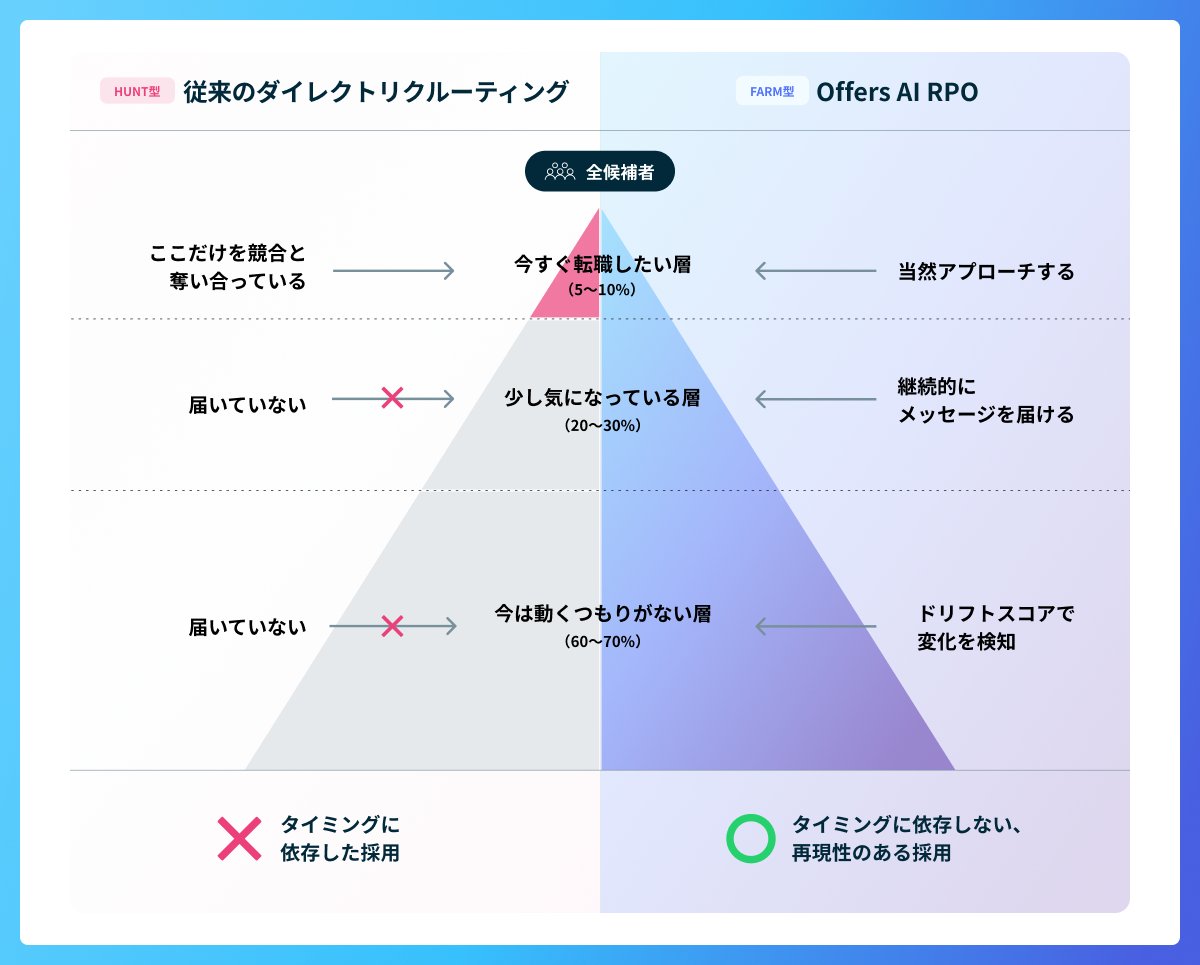
We are trying to rethink the recruitment approach itself.
Conventional DR was, so to speak, Hunt-type. You send one message to the active layer that has appeared in the market. If there's no reply, it's over. Whether the timing matches is half luck.
AI RPO adds the concept of Farm-type. We keep the potential layer that hasn't moved yet in view and nurture the relationship over the medium-to-long term until that person's feelings move.
When I talk about this, people say, "So Offers is a service for the potential layer." But that's not it. Targeting the active layer is a given. Approaching people who are currently moving is the basic premise. On top of that, whether you can engage with the non-moving potential layer over the medium-to-long term is what will differentiate recruitment from now on.
"Becoming the first presence they remember when they start moving"—that is the goal of adding the Farm-type approach.
Companies only do 3 things
"I can't possibly spare the man-hours to keep engaging over the medium-to-long term."
You might have thought that. But this is the core of AI RPO. AI and the specialized RPO team handle almost all of that work.
We only ask the company to do the following three things:
- Answer a Deep Interview (Initial, 60-90 mins) — Our specialized team digs deep into business strategy, technical debt, team composition, and culture.
- Review the Long List (30 mins) — You provide feedback on the candidate list extracted by AI, such as "this direction is right/wrong."
- Conduct Candidate Meetings and Selection — You focus on the most important part: facing the candidates who replied.
Offers takes care of everything: candidate selection, scout message design, sending, and timing management. As a result, the recruiter's operational man-hours become almost zero.
A workplace that spent 50 hours a month on drafting messages now spends zero. The freed-up time can be used solely for seriously engaging with candidates. In yesterday's article, I wrote "leave the answers to AI and increase the time humans spend facing questions," and AI RPO is exactly the implementation of that in the recruitment field.
3. The Hidden Truth — Engineers ARE "Reading" Scouts
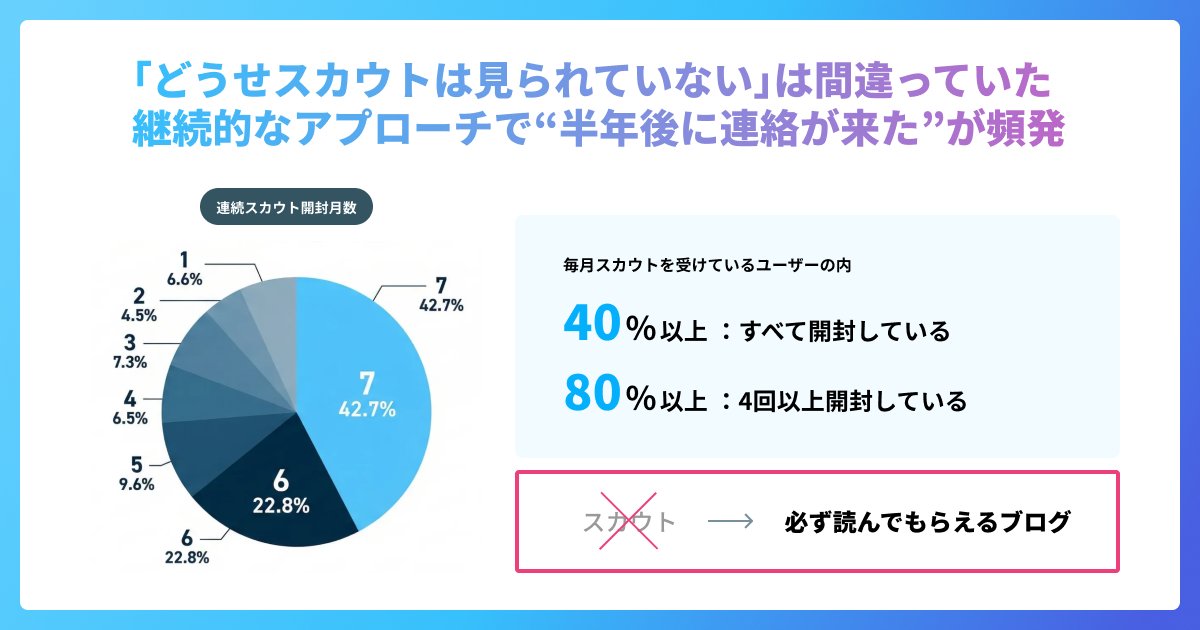
Here, I'll share a somewhat surprising fact we found from 7 years of data. Many people involved in recruitment assume this:
"Scouts aren't being read anyway."
This was a mistake.
In our data, among users who receive scouts every month, more than 40% "open all of them." And more than 80% "open them 4 or more times." Furthermore, 42.7% of people continued to open scouts for 7 consecutive months.
In other words, if delivered carefully, a scout is not a one-off "projectile" but can become something like a "blog" that is properly read every month. In fact, as a result of continuous delivery, cases where "a contact suddenly came after six months" are not rare.
Then, why don't they reply even though they are reading?
The answer was simple.
Because "it's not the 'now'."
It's not that they aren't interested or the content is bad. It's just that the timing to move is "not now." And the reason isn't just one thing; it's always fluctuating within a single candidate's mind.
Through repeated interviews with candidates, we found that what everyone cares about is roughly divided into these five categories:
- Tech Stack/Skill Up (Is the next environment modern? Can I use my experience?)
- Work Style/Conditions/Compensation (Remote work? Salary range? Actual overtime?)
- Career Goals/Role Selection (Management or technical player? How much decision-making power?)
- Organization/Evaluation/Culture (Team size? Will technical skills be correctly evaluated?)
- Market Value/Future Anxiety (Risks from AI/automation/age? Vague anxiety about "is it okay to stay as I am?")
To summarize these in one sentence, the true feelings of AI Talent are:
"I want to build a career that will be needed in the AI era over the medium-to-long term while keeping risks to a minimum."
(Source: Career interview data with candidates by Offers / June 2025 – April 2026)
This fact has great meaning for me. Recruitment is not about forcing someone who isn't replying despite reading to turn around. It's about sincerely responding to the questions they value at just the right timing. AI RPO is the mechanism to make that possible.
4. Why we know the "Just Right Timing" — 3 Unique Technologies
It's easy to say "deliver at the right timing to each fluctuating individual," but to actually do it, you must continuously judge when, to whom, and what to send. Supporting this are three technologies that only Offers possesses.
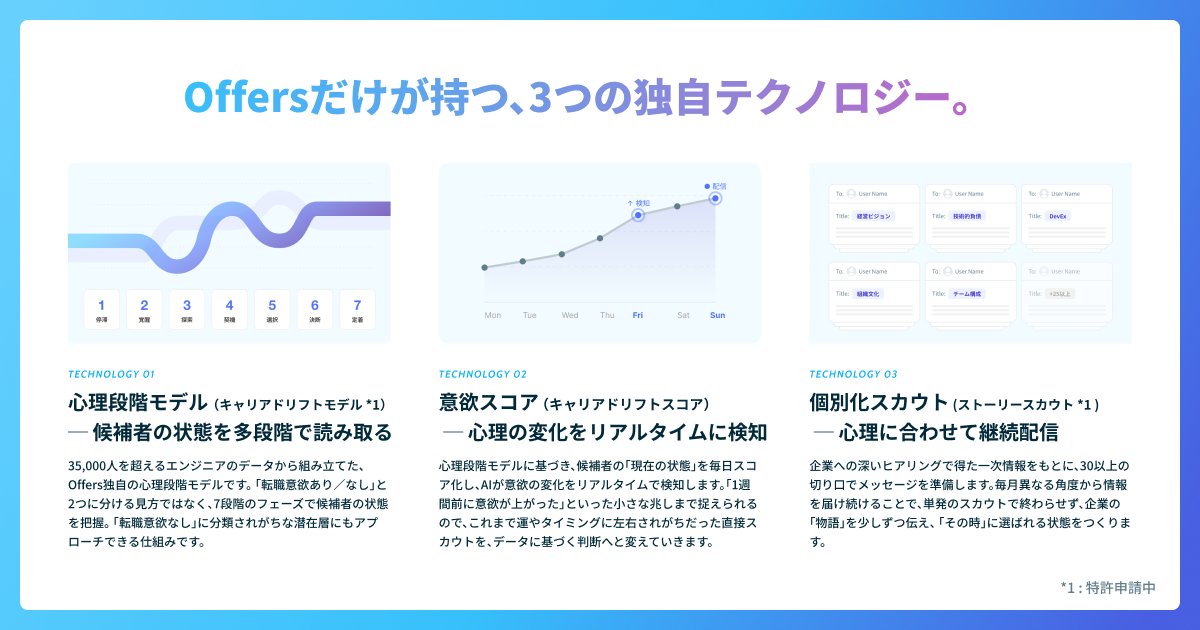
I often explain these three as "The Map, The Current Location, and The Next Move."
① Career Drift Model — "The Map"
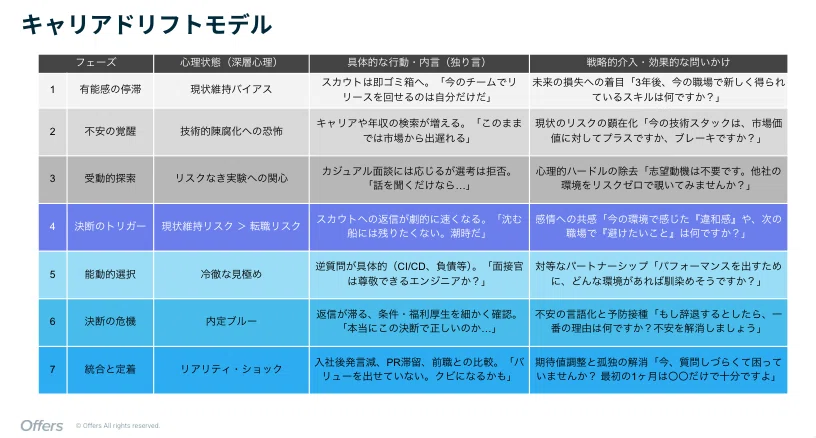
This is a map of psychological transformation built from the data of over 35,000 engineers over 7 years.
Engineers' feelings toward changing jobs cannot be simply divided into "want to change / don't want to change." We capture it in 7 phases.
① Stagnation of Competence → ② Awakening of Anxiety → ③ Passive Exploration → ④ Decision Trigger → ⑤ Active Selection → ⑥ Decision Crisis → ⑦ Integration and Retention.
For example, Phase ① is a state of "My current job is fun, but I feel my growth has stopped." This is a stage to just watch over them without sending anything. Only when they reach Phase ③, "I'd like to hear if there's a good opportunity," do we deliver information from the perspective of tech stack or business vision. The words and timing that resonate are different for each phase.
② Career Drift Score — "The Current Location"
Even with a map, you can't move if you don't know "which phase the person is in now."
The Career Drift Score quantifies each candidate's state based on their actions on Offers and gently senses changes in their feelings. It captures subtleties like "their interest has returned a bit recently." It turns "timing," which previously depended on luck, into a judgment based on data.
③ Story Scout — "The Next Move"
Once we understand the movement of the heart with the map and capture the timing with the current location, the final step is the actual move to deliver.
Based on primary company information obtained through deep interviews, AI designs over 30 patterns of message scenarios. It selects the angle according to the phase and generates the text. Instead of ending with one message, it delivers the company's "story" from a different angle every time.
And all scouts generated by AI are quality-checked by the RPO specialized team before being sent. We only send things that make the recipient feel "this was written for me." We don't send a single template-like message.
Because these three are linked, reproducible recruitment that isn't pushy becomes possible.
5. Numbers and the Actual Scene
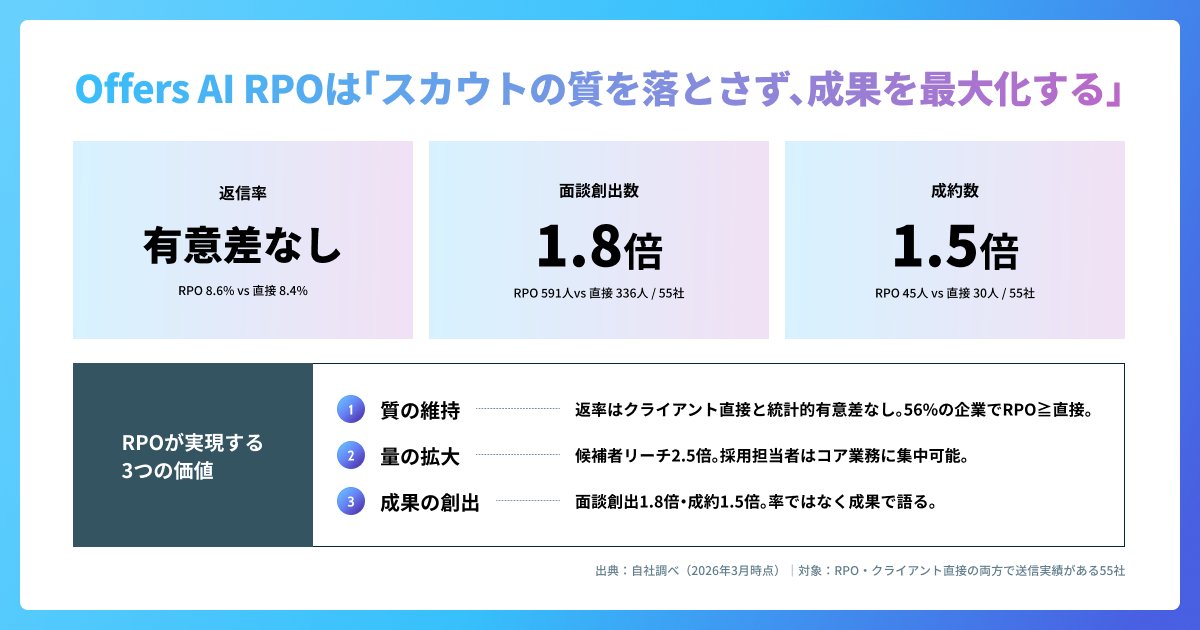
I've been talking about the mechanism, but let me show you the results.
We compared "cases handled by Offers" and "cases operated directly by the company" within the same company across 55 companies over one year.
- Reach of offer sending: 2.5x
- Number of people who proceeded to interviews: 1.8x
- Number of successful hires: 1.5x
Interestingly, there was no significant difference in the response rate itself. In other words, the value of AI RPO is not a "magic to raise the rate," but to expand reach to candidates while maintaining quality, and increase the "results" of interviews and hires.
Recruitment lead time has also been shortened to an average of 35.4 days, compared to the usual 180 days.
In fact, cases where positions that had been struggling for years finally moved are increasing.
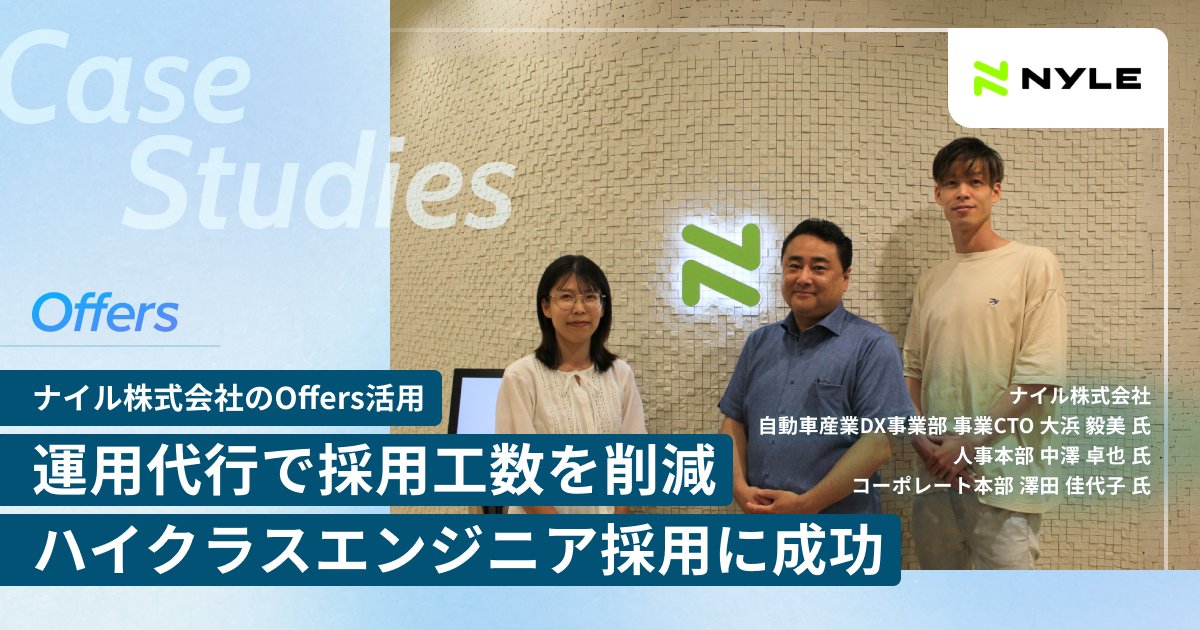
Nyle Inc. — Successfully hired a Lead Engineer while minimizing internal man-hours using AI RPO, despite struggling with talent pool formation in the red-ocean engineer market.
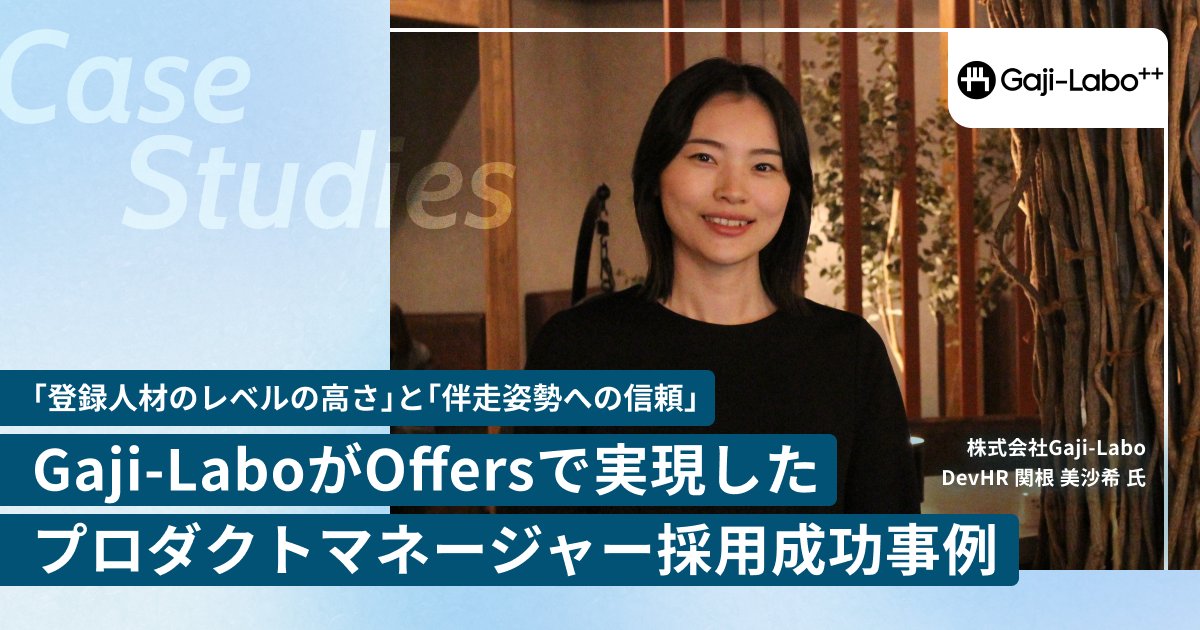
Gaji-Labo Inc. — Successfully hired a high-class Product Manager suitable for their partnership-style business, whom they couldn't meet through traditional DR.
6. Aiming for a state where both candidates and companies are happy
So far, I've written mainly from the perspective of the hiring company. Finally, let me talk about the world I truly want to realize.
What I am aiming for is very simple:
The right information reaches at the right timing.
When this is realized, I believe both candidates and companies can be happy.
For candidates, they will no longer be showered with sloppy scouts when they aren't interested, and when they truly want to think about their career—"at that time"—useful information—market value, tech trends, options—will be at hand. For companies, instead of continuing to pour effort into places that won't turn around, they can sincerely meet people whose feelings have moved at the right timing.
Instead of "I don't like being analyzed by AI" or "I don't like being chased," I want to perform the subtraction of "not sending when they don't seem interested." It exists to eliminate those unpleasant mass-blasts that keep being sent even when they aren't being read. And in the end, whether to meet, talk, or decide is always 100% yours. AI takes over the timing and administration, and in exchange, humans regain the time to properly talk with each other.
AI RPO is a process to realize that world where "the right information reaches at the right timing." The reason why Offers is doing this service also lies here when you get down to it. We don't want to just make recruitment efficient; we want to make the way candidates and companies meet a little fairer and a little happier. That is why we are betting on AI RPO.
Finally
From tomorrow onwards, I will deliver the initiatives previewed in the rebranding, one per day. Tomorrow (June 3rd), I plan to talk about Budget-based Retainers.
Information on the Launch Commemoration Campaign
To commemorate today's launch of AI RPO, we are running a Launch Commemoration Campaign. We are offering the basic fee for target plans at 50% OFF the regular price.
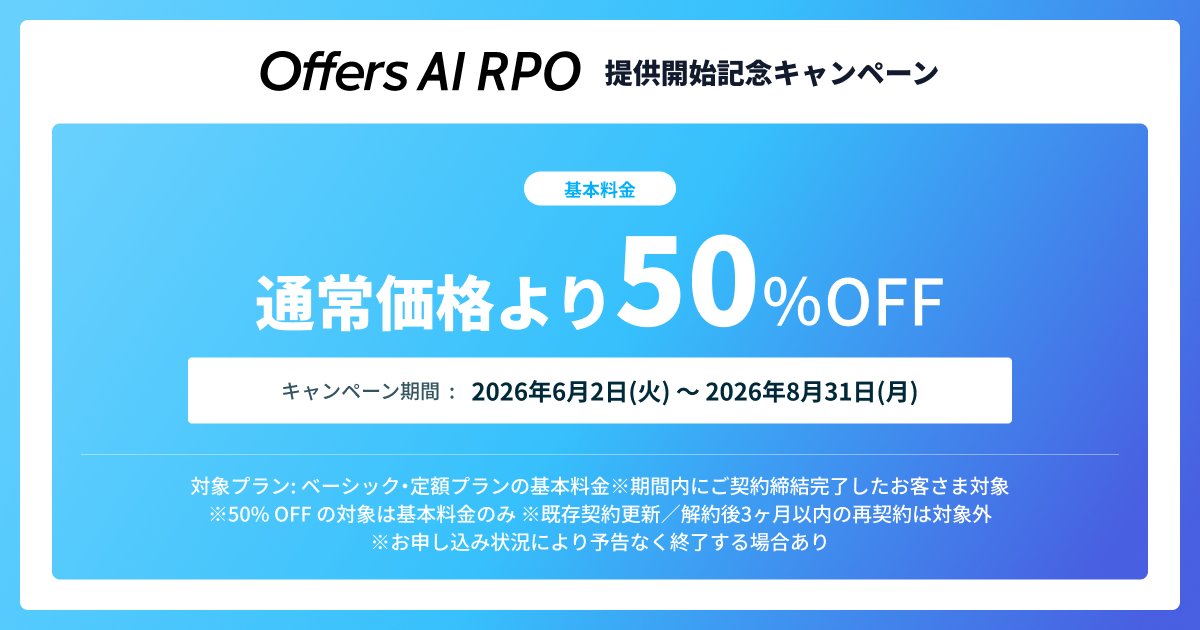
- Target: Companies signing a new contract (Excludes renewals of existing contracts or re-contracts within 3 months of cancellation).
- Period: June 2, 2026 (Tue) – August 31, 2026 (Mon). Companies that complete the contract signing within this period are eligible (Judgment is based on the timing of contract signing, not the timing of application).
- Scope: Basic fee only. Optional costs and additional service fees are excluded.
If you are a company that would like to try AI RPO at this timing, please take advantage of it.
Click here to apply for the Launch Commemoration Campaign
👇
️
If you want to know more specifically about AI RPO, please go here.
- AI RPO Service Details / Document Download: Download documents here
- For Corporate Recruiters: Service introduction is here
- For Engineers and AI Talent: New registration is here
Thank you for reading to the end.