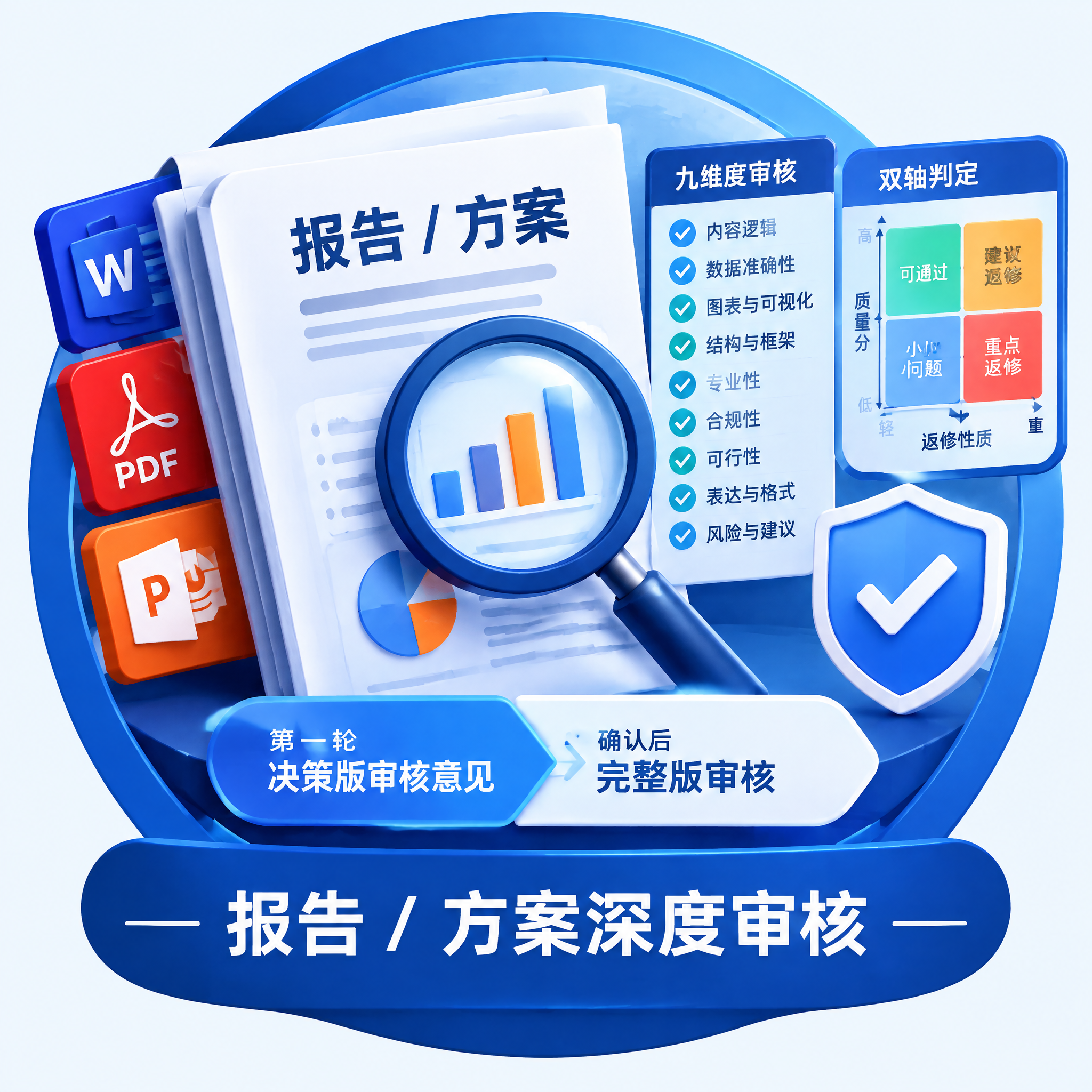
Report Deep Audit
Deep-check data, logic, and consistency
Report Deep Audit
Deep-check data, logic, and consistency
Showcase
Description
In-depth audit of reports and proposals. Use when a user uploads a report (Word, PDF, or PPT) and asks to “review it,” “audit it in depth,” “find the problems,” “tell me whether this report is good enough,” “can it be submitted,” “check the final draft,” or “evaluate and review the report.” Treat the report as a formal deliverable intended for a client or executive, and conduct a nine-dimension review with a two-axis determination (quality score × revision type). Systematically extract all data assets, including embedded charts. Provide a decision-oriented review in the first round, then expand it into the full version after confirmation.
Related Skills
View all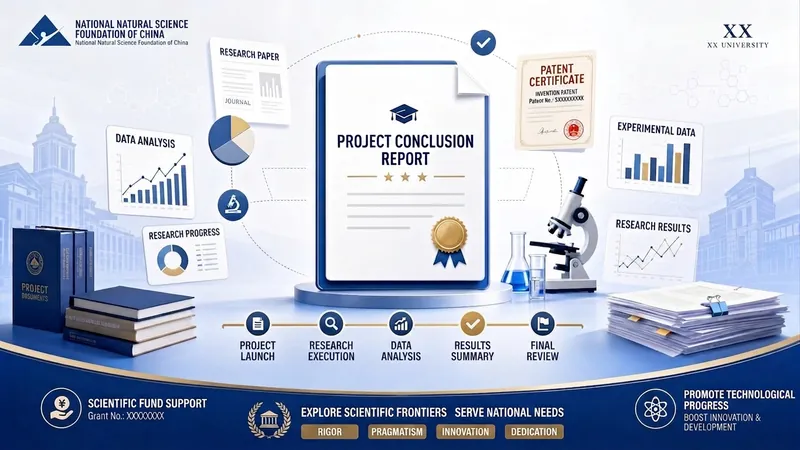
Project Closeout Report Pro
【Essential for closeout season】Create a high-quality final report in 3 hours—no more rejections! 🔥 Are you also facing these issues? → Closeout deadline approaching, not knowing where to start with years of research materials → After finishing, you realize you missed performance metrics and budget execution details → You want professional charts but don't know how to use complex tools → The generated report has an obvious 'AI smell' and you worry reviewers will notice ✅ This skill solves all these problems at once: 【Highlight 1】8-step structured workflow × Checkpoint mechanism From data collection to final draft, each step has clear guidance and confirmation. Problems are caught as they occur, not at the end. Covers all scenarios: NSFC, provincial/ministerial, and university-level projects. 【Highlight 2】One-click generation of 6 professional chart types Built-in sub-skill generators for word clouds, bar charts, line charts, and more (no extra cost). AI recommends the best chart type and generates in 30 seconds, so reviewers understand your results at a glance. 【Highlight 3】Exclusive 'de-AI-fication' optimization Four-dimensional AI trace detection + three optimization levels (conservative/moderate/aggressive). Replaces empty clichés with more specific, in-depth expressions. Optimized reports are more natural, denser, and more persuasive. 📩 Send feedback/suggestions to 1329806797@qq.com It's not about 'writing' the report, it's about 'getting the whole closeout process right.'
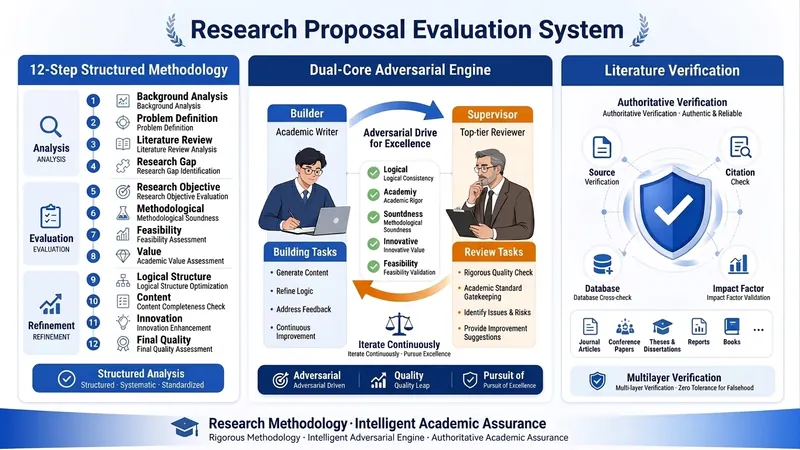
Grant Proposal Review PRO V2.0
🎯 Core Functionality Overview This is an intelligent review and optimization system specially designed for national social science, education ministry, and provincial grant applications. It simulates the thinking mode of a senior review expert with 15 years of experience, ensuring academic rigor and competitiveness through three core mechanisms. 🔧 Three Core Mechanisms 1️⃣ 12-Step Structured Methodology Covers the full lifecycle of grant proposal review: Phase 1-3: Basic Diagnosis - In-depth analysis of announcement (funding priorities, review criteria, application requirements) - Cross-disciplinary type judgment (precise identification of 8 types) - Research GAP five-dimension identification (theory/methodology/empirical/policy/technology) Phase 4-7: Core Element Review - Research question TMAQ model analysis (theory/methodology/approach/question four dimensions) - Research objective SMART principle test - Research content framework completeness assessment - Research approach type matching (6 types) Phase 8-10: Deep Quality Enhancement - Precise extraction of key difficulties (distinguish criteria + breakthrough paths) - Innovation point seven-dimension mining - Feasibility seven-dimension argumentation Phase 11-12: Overall Optimization - Nine-dimension quality check (academic rigor, innovativeness, feasibility, etc.) - Comprehensive optimization suggestions and final report 2️⃣ Dual-Core Adversarial Mechanism (Builder vs Supervisor) Working Principle: - Builder (academic writer): Generates optimization plans based on user materials - Supervisor (top journal reviewer): Challenges Builder's plans with the strictest standards - Adversarial iteration: 3 rounds of confrontation to ensure plans are robust Application Scenarios: - Innovation point mining: Builder proposes innovation points → Supervisor questions novelty → iterative optimization - Feasibility argumentation: Builder designs plan → Supervisor challenges feasibility → supplementary argumentation - Literature citation: Builder cites literature → Supervisor verifies authenticity → ensure academic standards 3️⃣ Literature Authenticity Verification Mechanism Two working modes: Mode A: Placeholder Mode (Default) - Use markers like [Literature Placeholder-001] in place of specific references - Output a Literature Requirement List specifying search requirements for each placeholder - User searches and fills in real references Mode B: Real-Time Verification Mode - Call Google Scholar to verify literature authenticity in real time - Generate Literature Verification Report (authenticity/relevance/authority scores) - Ensure every citation is traceable Preventing AI Hallucination: - Prohibits fabricating authors, journals, DOIs - All references must be verified or marked as placeholders - Guarantees academic integrity bottom line 💡 Core Value and Applicable Scenarios ✅ Key Pain Points Addressed 1. Academic sloppiness: AI-generated content often includes fake references, logical gaps 2. Insufficient innovation: Difficulty uncovering true academic innovation points 3. Weak feasibility: Research plans lack systematic argumentation 4. Cross-disciplinary difficulty: Interdisciplinary topics often fall between two stools 🎓 Target Users - University faculty (social sciences, education, humanities) - Researchers (applying for national and provincial grants) - Academic teams (needing systematic review processes) 📋 Typical Workflow 1. Input: Upload announcement + proposal draft 2. Review: System executes 12-step structured analysis 3. Adversarial: Dual-core mechanism iteratively optimizes key sections 4. Verification: Literature authenticity check 5. Output: Complete review report + optimization suggestions + literature list 🔍 Differences from Traditional Review | Dimension | Traditional Human Review | Expert Review System | |-----------|------------------------|----------------------| | Review depth | Depends on personal experience | 12-step structured + 9D QC | | Academic rigor | Hard to fully audit | Literature verification + dual-core adversarial | | Innovation mining | Subjective judgment | 7-dimension systematic analysis | | Feasibility argumentation | Experience-driven | 7-dimension item-by-item argumentation | | Consistency | Varies by individual | Standardized process | | Efficiency | Days to weeks | 1-2 hours for initial review | The core advantage of this system is: it makes the tacit knowledge of a 15-year senior review expert explicit, structured, and replicable, enabling every user to receive top-level expert review services.
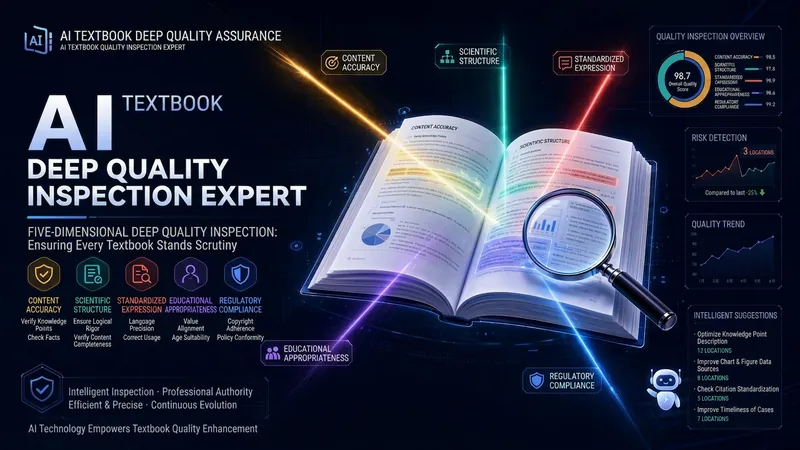
AI Textbook Quality Inspector
📚 AI Textbook Quality Inspector — Five-dimensional scan to make AI-written textbooks withstand review Textbooks written with AI assistance suffer from five common problems: hard-to-detect knowledge errors, instructional design lacking classroom feel, excessive 'correct but empty' statements, templated writing that feels robotic, and obscure language that makes students give up reading. This system performs a five-dimensional in-depth quality check chapter by chapter, examining each chapter from the perspectives of four roles: subject matter expert, instructional designer, fact-checker, and style reviewer. It outputs quantitative scores and directly replaceable modification suggestions. Five Dimensions: 📐 Knowledge Accuracy — Trace and correct concepts, models, and data one by one, with each error annotated with a source 🎯 Instructional Design — Review difficulty curve, prerequisite preparation, and chapter connections like a seasoned teacher 💎 Content Substantiveness — Expose 'correct but empty' statements, calculate real information gain per section 🤖 AI-Flavor Detection — Textbook-specific standards to distinguish normal writing from AI template patterns 📖 Readability — Paragraph rhythm, term density, assess whether students can read smoothly Highlight Features: 🔗 Cross-Chapter Consistency — Automatically generate knowledge profile, detect conceptual contradictions, inconsistent terminology, and duplicate definitions 🔄 Closed-Loop Iteration — After revision, resubmit and automatically track improvements, remaining issues, and new problems 📊 Layered Report — First see overview score + top 3 issues, then expand section-by-section analysis as needed 🎤 Sharp Commentary — No sugarcoating; if a definition is wrong, it says so bluntly, with each criticism accompanied by a revision reference Applicable to: AI-assisted undergraduate and graduate textbooks, academic monographs, and course handouts. Current version is optimized for undergraduate textbooks, but also works for graduate textbooks. Paste chapter → Get score → Make targeted revisions → Re-test until quality passes.
Information
- Version
- v4
- Last updated
- Runtime credits
- Usage-based
- Models
- Auto