
AFP Policy & CSSCI Topics
Decode policy; generate 3–5 CSSCI topics
AFP Policy & CSSCI Topics
Decode policy; generate 3–5 CSSCI topics
Showcase
Description
AFP prompt system for in-depth policy analysis—three-level source attribution, interpretation of hot topics, and academic mapping—and CSSCI topic generation (3–5 topics, each with policy basis, theoretical foundation, theoretical and practical significance, and publication potential assessment). Supports two entry points: A1 panoramic analysis and A2 targeted analysis, plus B reverse matching from ideas. Runs with Auto-Flow: strict step-by-step progression, silent background self-checks, a heartbeat HUD, and hard stops at each stage.
Recommended by
淡苍
Why we love this skill
Connects policy verification, structured interpretation, and academic problem formulation through traceable sources, theoretical mapping, and literature evidence to identify 3–5 CSSCI topics.
Related Skills
View all
H&SS Topic Selection AFP
Humanities and Social Sciences Topic Selection Engineering System 🎯 Adaptive Coverage System: | Topic Type | System Fit | Difficulty Level | |------------|------------|------------------| | National Social Science Fund | ✅ Core Application | ★★★★★ | | Ministry of Education Humanities and Social Sciences Project | ✅ Fully Compatible | ★★★★☆ | | National Education Science Planning Key Projects | ✅ Fully Compatible | ★★★★☆ | | Provincial Social Science Planning | ✅ Fully Compatible | ★★★☆☆ | | Vocational Education/Teaching Reform Projects | ✅ Fully Compatible | ★★★☆☆ | 📊 Six-Stage Delivery Process (P0-P5 Mandatory Steps): | Stage | Phase | Core Output | Key Action | |-------|-------|-------------|------------| | P0 | Anchor Your Base | Personal Resources & Position Assessment | Take stock of your academic accumulation, existing achievements, and team resources | | P1 | Policy Decoding & Real Problem Extraction | Policy Analysis Table + Problem List | Scan the latest policy documents to uncover issues that truly matter to the review committee | | P2 | Atomic-Level Object Decomposition | Minimum Granularity Object Table | Break down grand propositions into core research objects | | P3 | Nine-Grid Topic Explosion | 9 Topic Direction Matrix | One object, 9 angles, select the optimal direction | | P4 | Critical Review & Finalization | Revision Suggestions + Risk Checklist | Two-role confrontation: applicant vs. blind reviewer, iterative refinement | | P5 | Asset Packaging | Topic Core Asset Memorandum | Final topic + reasoning logic + ready for proposal writing | 🔧 Built-in Standard Tool Library: ✓ Two-Role Confrontation System — Topic Planner ↔ Blind Review Expert (self vs. self PK) ✓ Naming Red Line Check — No colons/dashes/subtitles allowed, must end with "research" ✓ Trinity Rule — Qualifier + Object + Problem (invisible scoring sheet) ✓ Real-Time Policy Update — Synchronized with latest guidelines from NSSF, MOE, and Education Science Planning ✓ Nine-Grid Topic Matrix — Systematically spread 9 angles, visualize innovation comparison ✓ Blind Review Risk Assessment — Predict topic weaknesses in review 📈 Expected Results: 📌 Grant Approval Rate — From average 20-30% to 60-70%+ (depending on prior accumulation) ⏱️ Topic Selection Cycle — From 3-6 months of polishing to 2-3 weeks of systematic finalization 🎯 Hit Accuracy — From "broadcasting" to precisely targeting the review logic of the target committee 📦 Continuity — The Topic Memorandum can directly interface with "Grant Proposal Writing AFP" for a complete closed loop
 Write
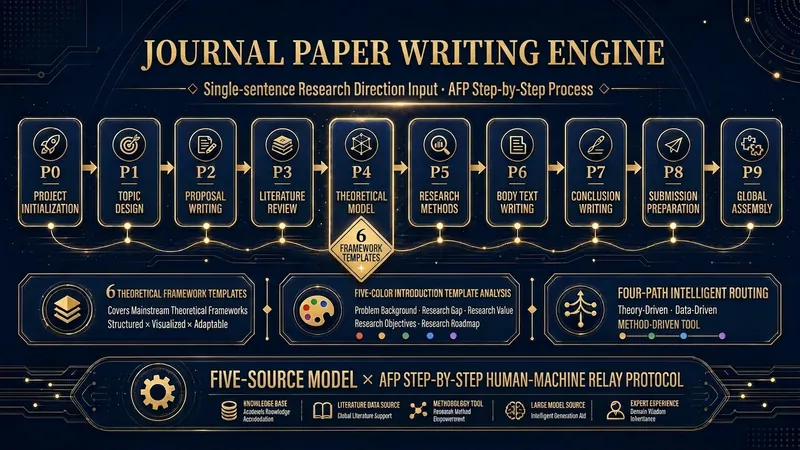
WriteJournal Paper Writing Engine
Input your research direction in one sentence, and the AFP step-by-step engine guides you through the entire process. P1 Topic Design — Davis Interesting Theory + Problematization’s Five-Level Topic Selection Method, extracting real problems from phenomena. P2 Introduction Writing — Five-Color Template Analysis Method, breaking down top journal model papers section by section: emotional appeal → knowledge gap → literature positioning → research space → value declaration, with embedded full deconstruction prompts. P3 Literature Review — Structured organization, distinguishing research threads and dialogue objects. P4 Theoretical Framework — Six theory integration templates embedded throughout (complementary, contrast, bridging, hierarchical, evolutionary, general), each containing six paragraphs: introduction → justification → sorting → premise → analysis → conclusion; plus a five-level deep-drill sentence skeleton for single-theory depth. P5 Research Methods — Automatically adapts strategies based on four paths: empirical quantitative, qualitative, speculative, and mixed. P6 Body Writing — 9-3-1 pyramid structure. P7 Conclusion Writing — Three-level conclusion processing (findings → dialogue → extension). P8 Submission Preparation — Eight methods to reduce AI detection rate. P9 Global Assembly — Compiles independent documents from each stage into a complete draft, supports cross-chapter bidirectional backfill, and allows interruption and iterative backtracking at any time. 🎯 Suitable for: Graduate students (master's and PhD) and early-career researchers aiming to submit to Chinese C-journals, core journals, or SSCI, especially those stuck on theoretical framework and introduction writing. ⚙️ Underlying Architecture: Five-Source Model × AFP Step-by-Step Human-Machine Relay Protocol, with heartbeat signals, mandatory stop points, and dual-core auditing.
 Research
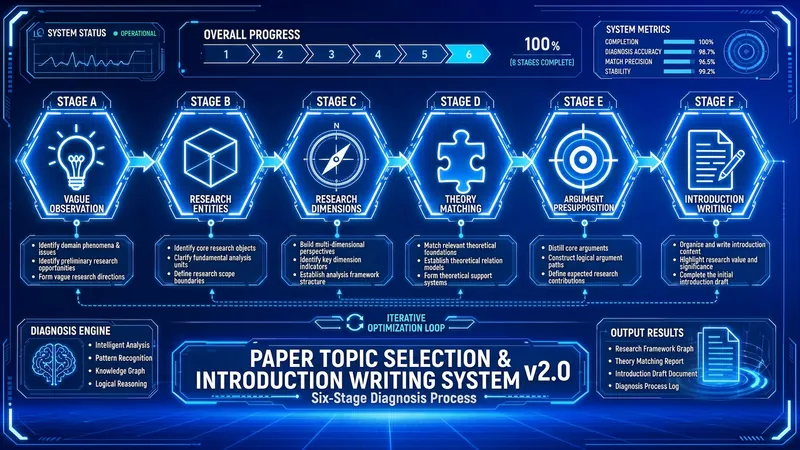
Thesis Topic & Intro v3.2
Read in 10 seconds: turn a vague observation into a defensible topic, then into an introduction that can pass review. Throughout, it uses only the real materials you provide — no fabricated references. Trigger words: thesis topic, topic selection, introduction, research gap, academic writing, thesis proposal, topic selection before literature review. Applies to: journal papers / dissertations / conference papers / course papers, across all disciplines — humanities and social sciences, STEM, agriculture, medicine, and life sciences. Up and running in 3 minutes: lock in your discipline and starting point → shape the topic layer by layer → strict evidence-chain gate → module-by-module introduction → ratchet finalization. [Division of labor with other skills] The health check comes first, writing comes after, and polishing comes last. This skill handles the middle stretch: topic shaping + introduction draft. It does not write the full paper (that's the Academic Paper Full-Process Writing System v4.x), and it does not polish language sentence by sentence (that's the Academic Paper Three-Track Polishing System v8.x). [Six gates] 1. Discipline placement: classify into one of four categories — 1A humanities/arts, 1B social sciences, 2A STEM, 2B agriculture/medicine/life sciences — and load the corresponding red-line norms; for category 2B, ethics review status is always checked. 2. Stage positioning: are you at a vague observation, have a unit but no angle, have an object but no theory, lack a method, lack a viewpoint, or only lack an introduction? Start from the corresponding gate instead of starting over from scratch. 3. Topic shaping: research unit → dimension compass → theoretical perspective → research method → research viewpoint, locked layer by layer; before locking each layer, first judge whether the previous layer holds. 4. Strict evidence-chain gate: before the introduction, your references are registered into an M1/M2… material library, each entry verified on four elements — author/year/title/locator; if fewer than 3 references are registered in the conversation, the system refuses to generate the research-gap statement — not a downgrade, a refusal. 5. Module-by-module generation: the introduction is produced in five inverted-pyramid modules, and each module must be annotated with citation numbers [Mn]; no source, no sentence. 6. Ratchet finalization: only versions that have passed receive credit; qualifying modules are locked and no longer changed; scores only go up, never down. [Deliverables] A '[Topic Keyword] · Topic & Introduction' document + a sentence-level traceable citation mapping table + a ⚠️ to-verify checklist + an AFP archive code. The archive code works across four systems — the proposal health-checker, the v4.x full-process system, and the three-track polishing system — so switching skills doesn't require re-stating your discipline, topic, journal, or material library. [Explicitly not done] It does not fabricate authors, years, volumes, issues, page numbers, or DOIs; any bibliographic records retrieved online are marked ⚠️ to-verify and can only be written into the reference list after you verify them; it makes no promises of acceptance or passing review. Authorship and responsibility are yours — please verify every citation and data point.
Information
- Version
- v6
- Last updated
- Runtime credits
- Usage-based
- Models
- Auto