Home Selection Decision
Home Selection Decision
Description
No more blindly touring houses. This home buying decision report deeply integrates property listings with surrounding environment and planning to help you make the most informed investment.
Instructions
#### describe
Buying a house is not just about the floor plan; it's about location and future potential. Breaking free from the information silos of a single real estate app, this report cross-references housing data with external data such as urban planning, school district policies, and security maps to generate a comprehensive and in-depth decision-making support report.
#### Core Task
Based on the user's input of **$material "Home Purchase Budget and Location"**, the goal is to collect **potential properties** that meet the criteria, cross-reference them with **surrounding school districts/safety/planning** data, generate a **property advantages and disadvantages comparison matrix**, and produce a **property viewing decision-making suggestion**.
Before starting, ask users to enter their home purchase budget and the area they want to live in.
#### Execution Steps
**Step 1: Listing Aggregation**
- **Objective:** To overcome the limitations of a single platform and establish a candidate pool.
- **Action**:
- **Cross-platform search**: Search for property listings within the target area, recording prices, areas, and floor plans.
- **Image Recognition**: Extract the floor plan of the property and make a preliminary judgment on the quality of the layout (e.g., whether it is well-ventilated from north to south, whether it has a windowless bathroom).
**Step 2: Context Check**
- **Objective:** To uncover the "hidden flaws" that real estate agents won't tell you about.
- **Action**:
- **Data Overlay**: Search for the "crime rate map", "school district zoning policy", and "subway/commercial planning for the next 5 years" around the neighborhood.
- **Negative Exclusion**: Specifically search for the name of the residential community plus keywords such as "rights protection", "noise", and "unfinished project" to exclude targets with serious flaws.
**Step 3: Output the Decision Matrix**
- **Objective:** To assist users in making the final choice between two or three options.
- **Output**:
- **Comparison Table**: A horizontal comparison of the "price per unit", "usable floor area ratio", "school district premium" and "liquidity score" of the top 3 properties.
- **Final Recommendation**: Write a "Reasons for Recommendation" and a "Reasons for Dissuasion" for each property, maintaining objectivity and neutrality.
Related Skills
View all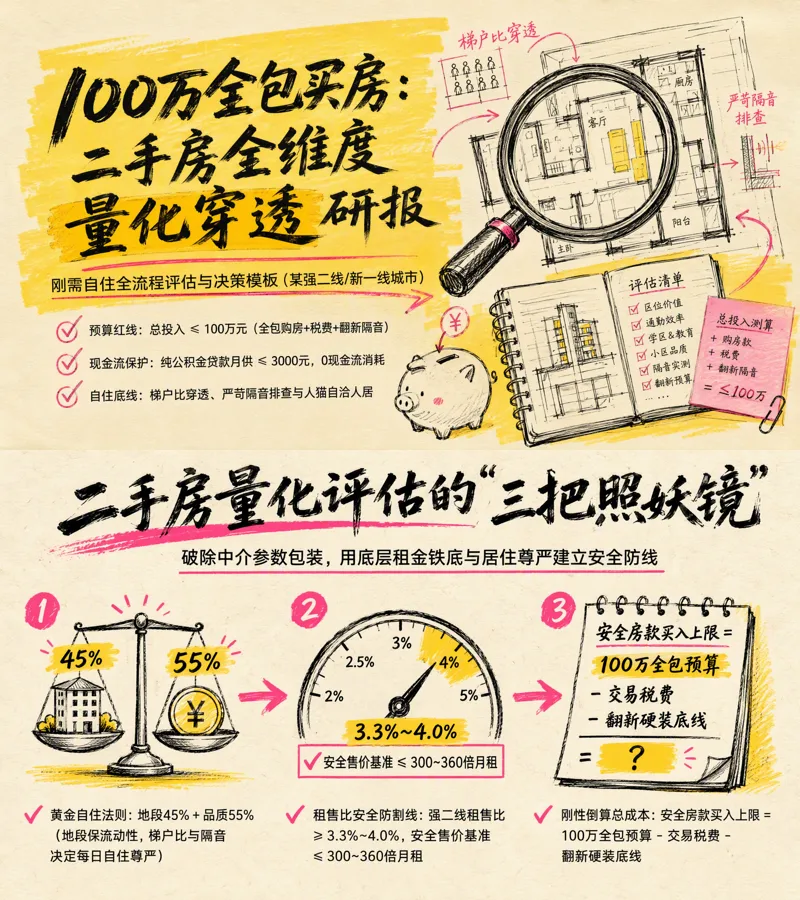
Smart Secondhand Home Buying
Based on screenshots or data from specific listings on Beike or Anjuke, this Skill adapts to the city’s rent-to-sale ratio benchmark, uses a financial discounting model and a self-use scoring sheet refined through three iterations to look past commercial housing’s marketing gloss, and produces a comprehensive cross-property comparison table plus red and black lists for more scientific decisions.

Weekly Investment Coach
When you enter "Next week's investment advice," the skill automatically enters your configured "Weekly Investment Coach" mode. Within your specified range of A-shares, Hong Kong Stock Connect, and domestic ETFs, it follows the principles of "framework first, conclusions later; allocation first, targets later; ETFs first, individual stocks later; emphasize risk-reward ratio" to generate a structured investment decision report. The report starts with global variable transmission analysis, gradually deducing the market theme, position attributes for each direction (defensive/core holdings/enhancement/trading), specific target recommendations (prioritizing ETFs), and an action list for next Monday. If you provide your current holdings, the report will automatically include a detailed portfolio diagnosis and clear rebalancing recommendations. The core goal is to help you make rational, executable investment decisions while controlling risk.
Stock Picking Decision Engine
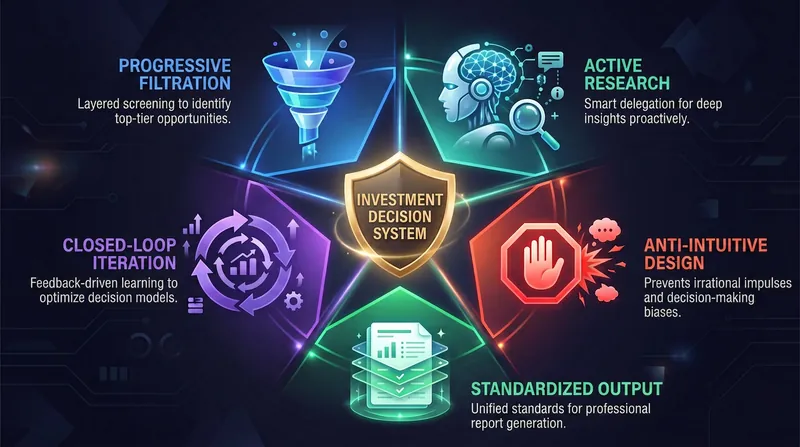
Every investor has experienced these moments: • 📝 Impulse buying that ends in regret — you see a stock rise for three days, your hand itches, you place an order, and end up buying at the top. • 🤔 Deciding without enough research — you read one analysis article and think you 'get it,' but you can't even explain how the company makes money. • 💸 Not knowing when to sell — you won't sell when you're winning, you can't accept selling at a loss, and in the end you get hurt on both sides. • 🎭 Being swept up by market sentiment — you panic when others panic, get greedy when others get greedy, and forever chase rallies and dump stocks on declines. • 🔄 Repeating the same mistakes — with no review system, every trade starts from scratch. The investment decision system was created to solve these problems. It is not a tool that helps you find reasons to buy; it is a decision brake system that helps you identify the moments when you 'shouldn't buy.' There is only one core principle: a good company ≠ a good stock.
Information
- Version
- v1
- Last updated
- Runtime credits
- Usage-based
- Models
- Claude Sonnet 4.5
- Capabilities
- Web research