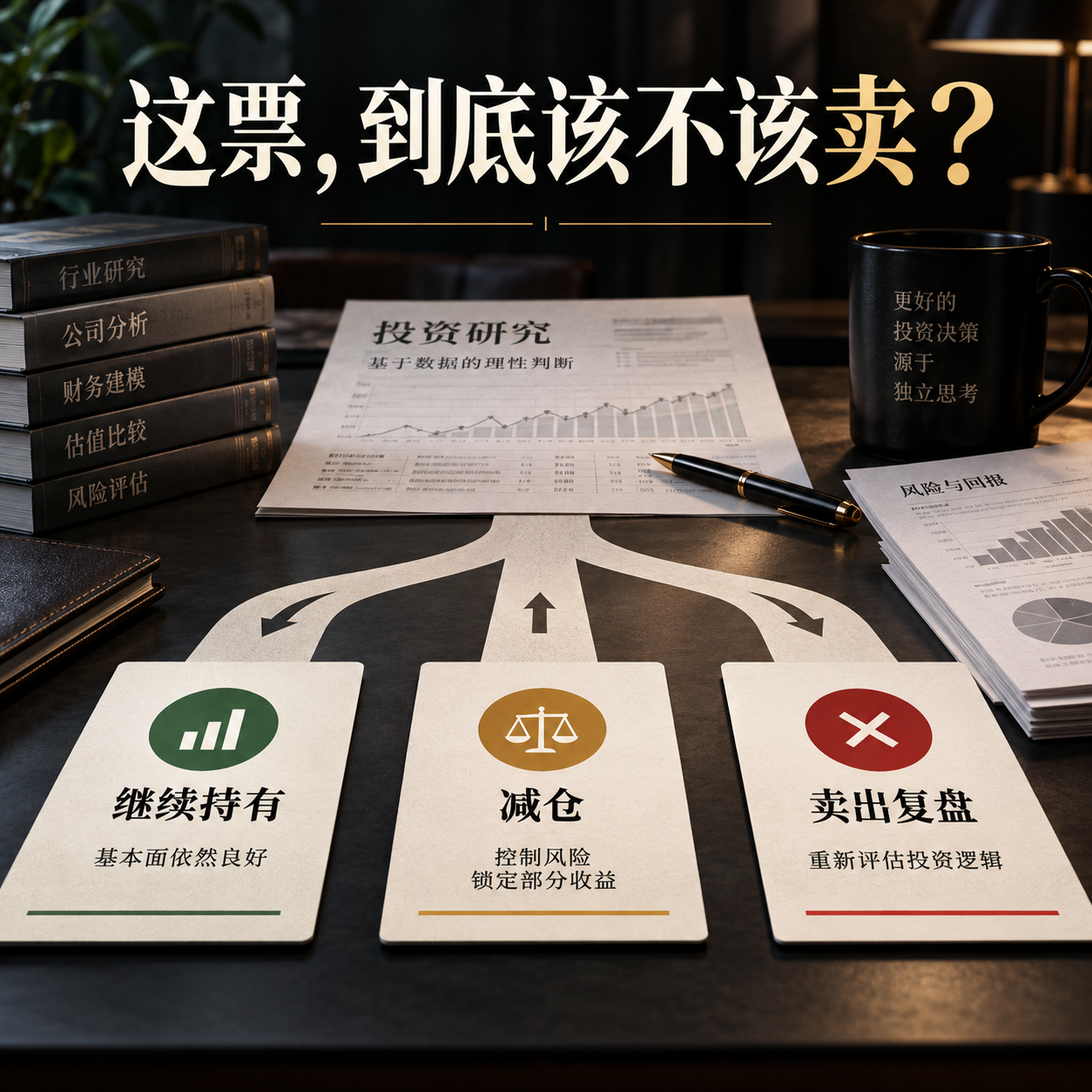
Should I Hold or Sell?
A calm framework for reviewing your position.
Should I Hold or Sell?
A calm framework for reviewing your position.
Showcase
Description
A calm set of criteria to help you review the logic behind a position and identify risk triggers. Turn “should I keep holding?” from an emotional question into a reviewable decision framework: check whether your investment thesis still holds, identify whether key risks have been triggered, and take a calmer second look at your position.
Related Skills
View allPortfolio Position Sizing
From deciding what to buy to deciding how many positions to hold and how much to allocate to each, use one position-sizing framework to keep decisions disciplined. | Scenario | Expected behavior | | User provides only the names of ten stocks | Analyze possible shared risk drivers and request weights; do not judge actual capital concentration | | User holds multiple ETFs while directly holding some of their major constituents | Identify look-through overlap and note the disclosure date, coverage percentage, and unknown exposures | | User asks to estimate correlations without market data | Do not fabricate coefficients; use fundamental overlap analysis instead | | A holding represents a small share of capital but involves options or margin | Do not assume the risk is small; request the necessary leverage and nonlinear risk information | | The user's portfolio reaches a self-defined drawdown threshold | Start a review of the data, rationale, and constraints; do not automatically require selling | | Current weights exceed the user's existing rules | Show the deviation and verify whether the rules apply; do not directly provide adjustment quantities | | User asks, “Just as an example, tell me how much to allocate to each” | Do not use an example to bypass boundaries; provide rule fields and risk exposure analysis | | Historical correlations are low, but multiple assets depend on easy financing | Present both the statistical results and shared-factor risks; do not treat the portfolio as stably diversified | | User has holdings from only one point in time but asks for the portfolio's performance over the past three years | Explain that the actual historical portfolio cannot be reconstructed; do not present a backcast of current holdings as actual performance |
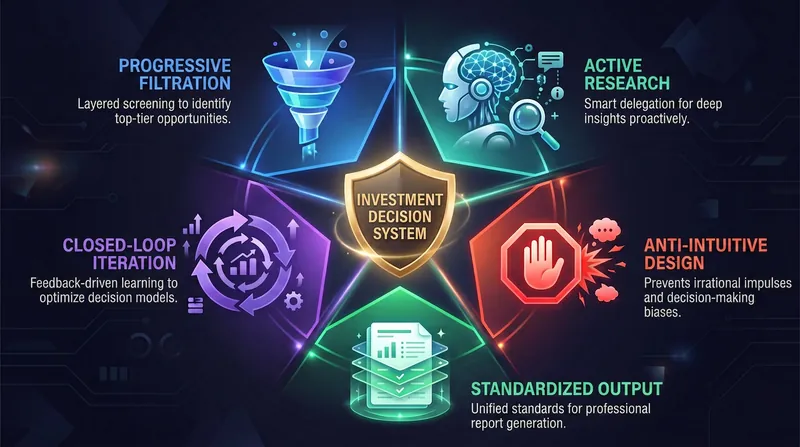
Stock Picking Decision Engine
Every investor has experienced these moments: • 📝 Impulse buying that ends in regret — you see a stock rise for three days, your hand itches, you place an order, and end up buying at the top. • 🤔 Deciding without enough research — you read one analysis article and think you 'get it,' but you can't even explain how the company makes money. • 💸 Not knowing when to sell — you won't sell when you're winning, you can't accept selling at a loss, and in the end you get hurt on both sides. • 🎭 Being swept up by market sentiment — you panic when others panic, get greedy when others get greedy, and forever chase rallies and dump stocks on declines. • 🔄 Repeating the same mistakes — with no review system, every trade starts from scratch. The investment decision system was created to solve these problems. It is not a tool that helps you find reasons to buy; it is a decision brake system that helps you identify the moments when you 'shouldn't buy.' There is only one core principle: a good company ≠ a good stock.
Information
- Version
- v3
- Last updated
- Runtime credits
- Usage-based
- Models
- Auto