Debate Preparation
Debate Preparation
Description
From examining the debate topic to mock debates, this skill helps you build solid arguments, gather data from across the web, and create an interactive webpage for practical drills. It ultimately produces competition-level opening statements, standardizing debate preparation into an industrial-grade pipeline, empowering you to face debates with confidence.
Instructions
#### describe
The debate preparation process is standardized into an industrial-grade assembly line of "divergence-convergence-simulation-output". Starting from understanding the topic and formulating the argument, through AI-assisted logical self-checking and red-blue team competition, a competition-level argument draft that is logically rigorous, data-rich, and has undergone practical simulation is finally generated.
#### Core Task
For the user-inputted "material" (e.g., whether remote work is beneficial to employees' long-term development), as the "material" (for/against), clearly define the "core argument." Objective: Develop 3-5 well-reasoned core arguments, generate a document, search the entire internet for supporting factual data for each argument as evidence, add it to the document, create an interactive webpage to help users conduct "blind box-style attack and defense exercises," and ultimately produce a "practical argument draft."
Before commencing any action, confirm the debate topic with the user. Proceed only after the user responds.
####
**Step 1: Question Analysis and Framework Construction (Structuring)**
- **Objective:** Establish the battlefield boundaries and logical framework.
- **Action**:
- **Positioning Stance**: Clearly define bottom lines and winning criteria.
- **Build the framework:** Create a document listing 3-5 core arguments (results/reasons/value aspects).
- **Logical Self-Check:** Use AI to generate **3 potential logical flaws** (such as "slippery slope fallacy" and "sample bias") for each argument, and write the remedial logic in advance in the document.
**Step 2: Evidence Filling**
- **Goal:** To ground logic in real data.
- **Action**:
- **Agent Sweep**: Launch Agent Research to crawl relevant papers, reports, and news from the entire web.
- **Snip Extraction**: Extract (snip) key data or expert opinions from the source material.
- **Embedded skeleton**: Drag the extracted **Snippet** under the corresponding argument title in the Step 1 document to form a closed-loop structure of "argument + irrefutable evidence + source link".
**Step 3: Blind Box Attack and Defense Simulation**
- **Goal:** Muscle memory training to break free from mental echo chambers.
- **Action**:
- **Build Battlefield**: Generate an offensive and defensive context based on existing arguments and create a webpage.
- **Random Card Draw**: The AI is tasked with playing the role of the "sharp opposing side," randomly selecting one of our arguments for challenging questions. No user input is required; it's simply a card draw, with a 60-second time limit for each answer. The card is automatically redrawn after 60 seconds. Users can also manually redraw the card.
**Step 4: Output the practical argument draft (Scripting)**
- **Objective:** To generate text suitable for on-site reading and quick response.
- **Output**:
- **Visualized Text**: Key quotes are **bold**, and detailed data is hidden using a **Toggle List** to ensure a clean visual experience while remaining readily accessible.
- **Defense Tips**: Attach the "defense golden rules" summarized in Step 3 next to the corresponding arguments.
- **Team-wide synchronization**: Generate a read-only link and share it with teammates to ensure consistency in communication. ››
Related Skills
View all
Proposal,Midterm,Defense PPT
An AI presentation generation system designed specifically for thesis defense/report defense scenarios—converts academic documents such as papers, research reports, and proposal reports into native editable PowerPoint. Strictly follows the 7x7 rule (≤7 lines per page, ≤7 words per line), adopts standard academic defense structure, outputs real DrawingML shapes instead of images, supports formula rendering, data charts, and animation transitions.
HTML Slides Generator
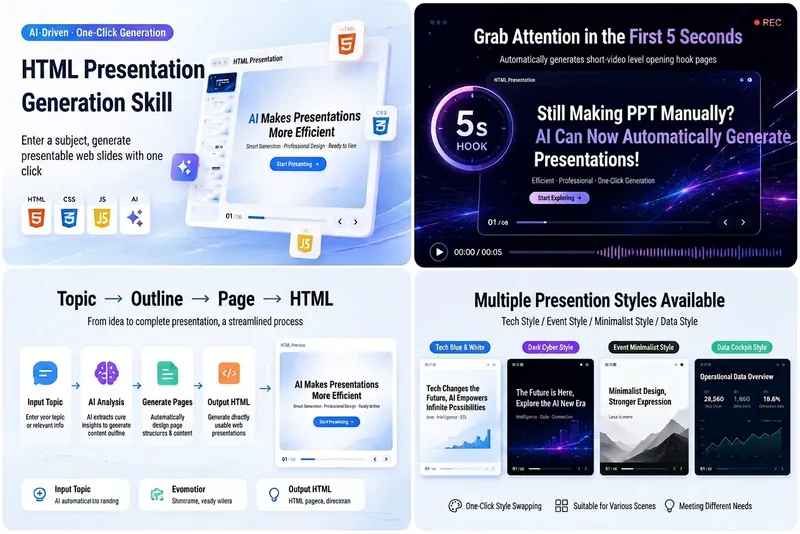
Easily turn your ideas, materials, or scripts into professional-grade HTML slides, designed for screen recording and pitch presentations. Whether you need AI tech sharing for platforms like Douyin, WeChat Video Channel, Xiaohongshu, or Bilibili, or product pitches, course demos, or business reports, this tool helps you quickly generate a visually refined, well-structured web slideshow. It automatically builds a complete slide structure, including an eye-catching opening hook in the first 5 seconds, titles and body text for each page, along with visual design suggestions. You'll get a standalone `index.html` file containing HTML, CSS, and JavaScript, supporting keyboard navigation, button navigation, progress bar, page numbers, and animations—perfectly optimized for 16:9 landscape screen recording. From AI tech blue-white to dark cyberpunk, to Apple keynote or Notion minimal style, you can choose or customize the visual theme to match your topic. Each slide is carefully designed to keep the content focused and easy to understand, with a reserved safe area in the lower right corner for video commentary, making your presentation more expressive and professional.
 Write
WriteFull-Process Academic Writing
"Full-Process Academic Writing" is an intelligent assistant tool designed for researchers, aimed at covering every stage of academic paper writing from initial conception to final submission. Whether you have just a vague research direction or have a draft that needs polishing, this tool provides systematic support to help you efficiently produce high-quality academic work. This tool guides you through four key stages. First is **Topic Planning**, which helps you refine preliminary ideas into concrete, feasible research topics and questions, and generates a comprehensive Topic Evaluation Report covering research framework, method matching, timeline planning, and resource bottleneck identification. Next is the **Literature Review** stage, assisting you in building search strategies, organizing core literature, and writing a logically rigorous literature review draft that identifies research gaps. The third stage is **Structured Writing**, where the tool designs a detailed paper outline based on your topic and literature review, and drafts the introduction, methods, body, and conclusions chapter by chapter, while also providing scientific chart code to ensure a complete structure and rigorous argumentation. Finally, the **Polishing and Revision** stage performs a comprehensive academic standard check, six-dimensional language polishing, and logical coherence review, and embeds an AI-assisted writing statement to ensure your final draft meets publishable professional standards. Throughout the writing process, this tool always adheres to academic ethics standards. All citations will be clearly flagged for verification and will never be fabricated. Output from each stage proceeds only after your confirmation, ensuring every step aligns with your research intent, allowing you to focus on expressing your ideas while leaving tedious formatting and standards to AI.
Information
- Version
- v1
- Last updated
- Runtime credits
- Usage-based
- Models
- Claude Sonnet 4.5Gemini 3 Pro
- Capabilities
- Web research