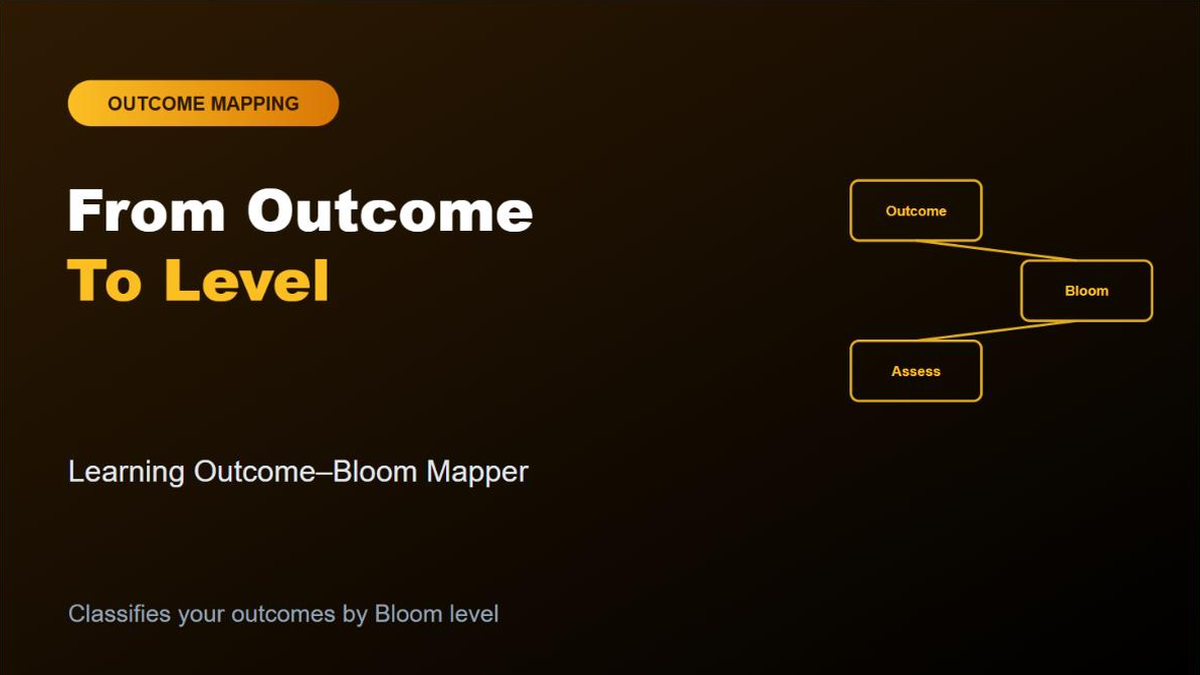
Learning Outcome–Bloom Mapper
Classifies your learning outcomes by Bloom level
Learning Outcome–Bloom Mapper
Classifies your learning outcomes by Bloom level
Showcase
Description
Classifies your learning outcomes by Bloom's taxonomy level, corrects unmeasurable verbs (like "know" or "understand"), and suggests an appropriate assessment method for each outcome. Classifies based on the outcome's actual cognitive demand, not the surface meaning of the verb. Who it's for: instructors doing curriculum/course design and program development committees.
Recommended by
Shuting@YouMind
Why we love this skill
An editor’s pick for turning vague learning outcomes into assessable targets. It looks beyond surface verbs to identify the cognitive work required, then aligns each outcome with a precise Bloom level, improved wording, and a fitting assessment method.
Best for
Instructors and curriculum teams designing measurable learning outcomes and aligned assessments.
How to use this Skill
Provide your input
Provide a course or module name, itemized learning outcomes, and an optional target cognitive level.
Run the Skill
The skill reviews each outcome’s cognitive demand, maps it to a Bloom level, checks whether the verb is measurable and consistent, and recommends a suitable assessment method.
Review your result
Receive a Bloom-level classification, verb feedback, revised wording where needed, and an assessment recommendation for each learning outcome.
Related Skills
View all Research
Weekly Lesson Plan Writer
Produces a structured weekly lesson plan from your lesson topic and duration, including measurable learning objectives written with Bloom's taxonomy verbs, a time-scheduled lesson flow, and a suggested assessment element. Always matches objectives to activities. Who it's for: university instructors and educators preparing courses or training programs.
 Research
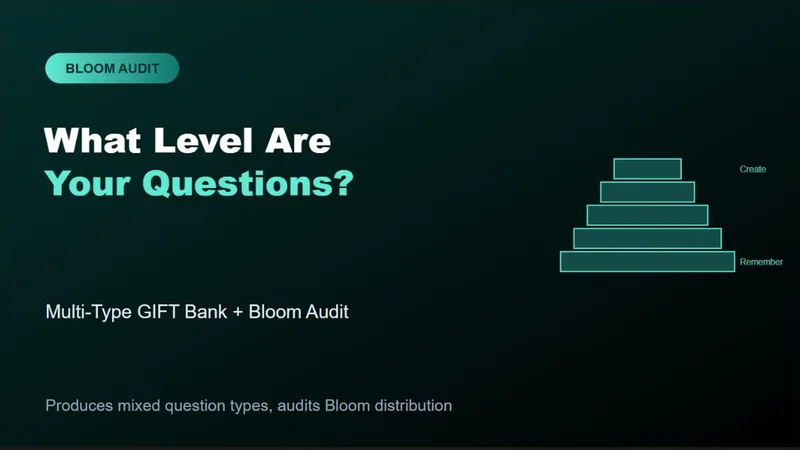
Multi-Type GIFT Bank + Bloom Audit
Produces a complete GIFT-format question bank from your topic and learning outcomes, including multiple choice, true/false, matching, short answer, and fill-in-the-blank question types. Tags each question's Bloom taxonomy level, and if questions are heavily concentrated at lower levels (Remember/Understand), explicitly reports it and suggests additional questions targeting higher-order thinking skills. Who it's for: assessment coordinators and department heads wanting to audit exam pool quality.
 Research
SCORM Content Structuring + Alignment
Designs the content skeleton (screens, interaction points, assessment items) of a SCORM-compliant e-learning package from your module topic and learning outcomes; then audits which screen addresses each learning outcome and how it's measured, explicitly reporting any misaligned outcome and suggesting content to close the gap. Who it's for: e-learning content developers and distance education coordinators.
Information
- Version
- v2
- Last updated
- Runtime credits
- Usage-based
- Models
- Auto
- Use cases
- Learning & education
- What you get
- Report