
Convertible Bond: Worth It?
Break down terms, value, and credit risk.
Convertible Bond: Worth It?
Break down terms, value, and credit risk.
Showcase
Description
Assess banks using bank-specific standards and build a framework for evaluating bad loans and capital adequacy.
Best for
Investors researching banks and financial stocks who want to understand operating quality and valuation through industry-specific metrics.
How to use this Skill
Provide your input
Provide financial statements, regulatory metrics, balance-sheet data, and net interest margin data for a bank or financial institution. You may also include peer comparisons and specific questions.
Run the Skill
After you submit the materials, systematically review capital adequacy, asset quality, net interest margins, earnings quality, valuation, and differences from peers.
Review your result
Receive a structured analysis report covering key risks, a framework for understanding valuation, and data requiring further verification. No buy or sell recommendations are provided.
Related Skills
View all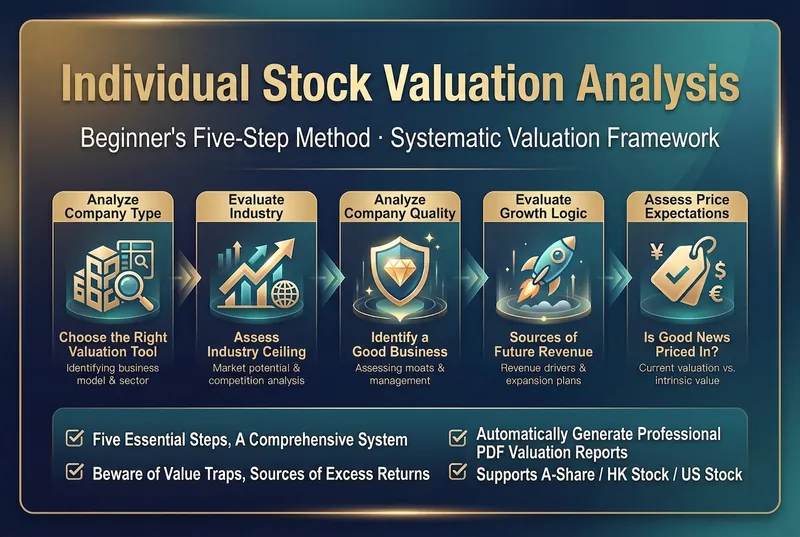
Stock Valuation Analysis
The two biggest fears in stock investing are buying a bad company and overpaying for a good one. Many investors, when they get a stock, first check its PE and PB ratios, compare them with peers, and draw conclusions—this is the biggest misconception in valuation. • 📝 Focusing only on numbers, not the company: Is a low PE always cheap? A low PE for a cyclical stock at the peak of its cycle can actually be a trap; for a growth stock, a high PE isn't necessarily expensive. With the wrong yardstick, you can't measure correctly. • 🤔 Discussing valuation without considering the industry: A contract manufacturer and a tech platform may both have a PE of 20, but their meanings are vastly different. Without first understanding the industry ceiling and business model, any valuation number is a castle in the air. • 📉 Ignoring value traps: A low valuation could be a sign of fundamental deterioration, not an investment opportunity. If the company quality is poor, no matter how 'cheap' it looks, it could still be a trap. • 🎯 Overlooking expectation gaps: Stock price movements don't depend on the absolute level of performance, but on the relative difference between performance and market expectations. If profits rise 30% but the market expected 50%, the stock can still fall. • 📊 Being too precise in valuation can itself be a mistake: Valuation is a range, not an exact number. Better to be roughly right than precisely wrong. This skill is designed to solve these problems. It is based on the 'Five-Step Valuation Method' framework and uses a systematic five-step process that cannot be skipped. It guides you from company type, industry ceiling, company quality, growth logic, and price expectations, progressing step by step to complete a full, professional individual stock valuation analysis. Finally, it outputs a structured valuation report and a downloadable PDF file. It applies to A-shares, Hong Kong stocks, and U.S. stocks.

Bank Due Diligence Report
Transform into a senior credit expert with precise insight into corporate risks. Generate bank-level due diligence reports with one click to help you make wise credit decisions and ensure asset safety.
Information
- Version
- v3
- Last updated
- Runtime credits
- Usage-based
- Models
- Auto
- Use cases
- Research & analysisInvestment & finance
- What you get
- Report